


Hello,
A goat rancher in Northern California needed to protect himself against this summer’s wage-rule changes. His entire operation depends on seasonal hired labour, and if the state raised minimum crew wages mid-season, his margins would disappear overnight. There is no insurance policy in the country that covers legislative risk for small livestock operations, and there has never been a futures contract listed for it on any exchange in the world. So Castle Tech, a firm that builds custom derivatives for exactly these kinds of uncovered risks, created a contract tied to whether California’s proposed wage legislation would pass by a specific date, settled the whole thing through Kalshi, and got Susquehanna, one of the largest quantitative trading firms on the planet, to take the other side for half a million dollars.
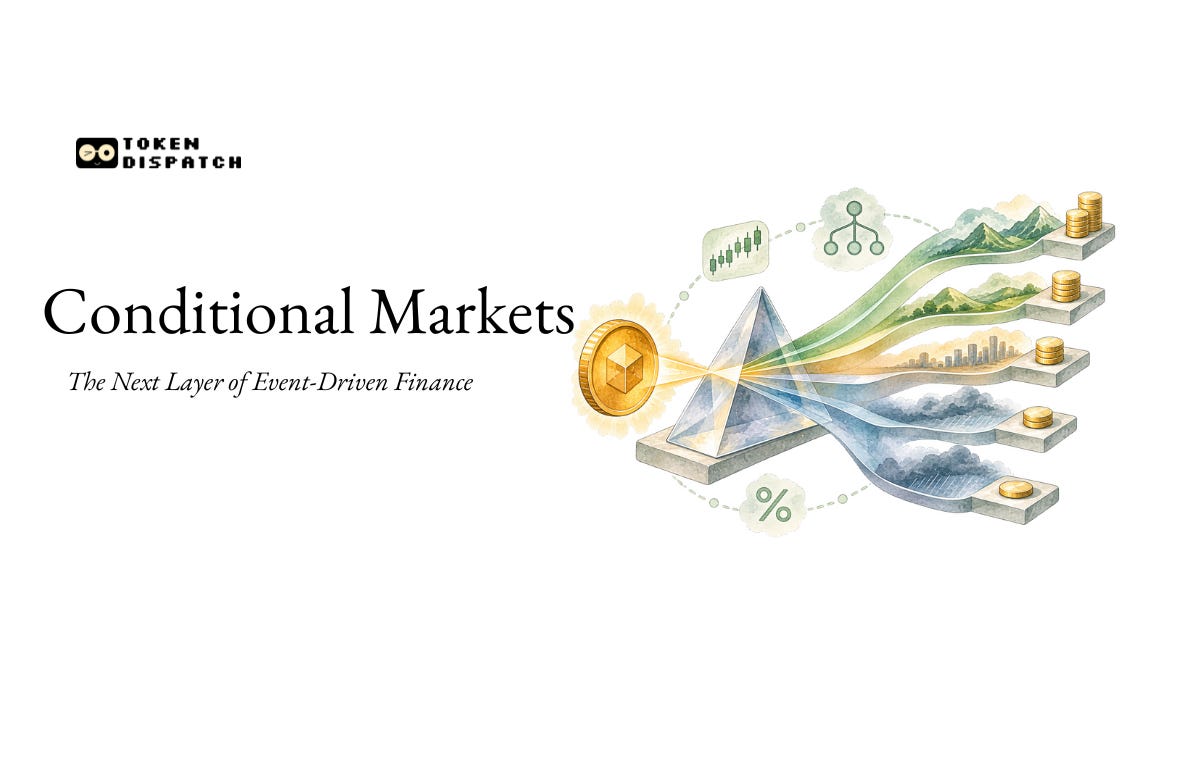
For nearly two years, conversations about prediction markets have focused on whether Polymarket and Kalshi can forecast elections better than polls. But prediction markets are becoming much more than forecasting tools, and the new financial products growing out of them are starting to touch governance, hedging, and speculation in ways I think nobody is paying nearly enough attention to.
Let’s dig in!

StablesReward: Your AI Agent Spends, You Earn
AI agents can surf the web, read reviews, and book hotels for you. All these tasks cost money. But what if these tasks could earn you back something?
StablesReward does just that. Once you connect your agent to an MCP endpoint, it gives your agent a menu of paid tools. Every call your agent pays for earns you miles or stocks. And this is in addition to the rewards you earn anyway on your own spending across 800+ merchants.
Every purchase pays you back. The best part is that you can choose how you’d like to be rewarded. Transfer miles to airlines and hotels, or let your stocks build a portfolio from the spend you were making anyway.
Launching soon. Free to join.
What Happens When Governance Becomes a Market
Every prediction market today, from a contract on Polymarket to a listing on Kalshi, produces only one kind of output, a probability. Which is nothing but a number that represents the market’s collective estimate of whether a specific event will actually happen.
Over the past two years, the infrastructure behind this has shown us that markets can aggregate dispersed knowledge about future events more accurately than any polls, expert panels, or any other forecasting mechanism humans have ever built.
But probability is a strangely incomplete piece of financial information. If you hold bitcoin and see a 65% chance the Fed will cut rates by 75 basis points next month, you might learn something tangible about the world and almost nothing useful about your own position. You know the event is likely, but you still have no idea what it would actually do to the price of the asset you’re holding. Would Bitcoin trade at $110,000 in that world, or $95,000, or $140,000? No prediction market can ever tell you that.
There are events, and then there are the impacts those events have on companies and assets, and the financial system has been collapsing those two entirely separate things into one for as long as markets have existed. That difference is exactly where the next generation of financial products is being built.
Two very different things are being built right now. One starts with a question prediction markets made inevitable: if markets aggregate information better than anything humans have ever built, why are we still using votes to run organisations? These are called decision markets. The other is something that has never existed before, a market that actually tells you what Bitcoin would be worth if the Fed cuts 75 basis points, not just the probability of the cut happening, but the dollar price of Bitcoin in that specific version of the future. These are called impact markets, and they’ll be far more important than anyone in the space is giving them credit for right now. I will get deep into impact markets in the next section, but the fastest way to understand why they matter so much is to see exactly where decision markets hit a bottleneck.
Decision markets were first implemented in governance because DAO governance and token voting have had a fundamental flaw for as long as they have existed. People with the most tokens rarely have the most information, and people with the most information rarely have enough tokens to matter. Decision markets invert this by letting anyone with capital express a view, regardless of token holdings. Ultimately, this lets people price information in real time.
Robin Hanson proposed a fix for this in 2000 called futarchy, and the core idea is beautifully simple. Say a protocol needs to decide whether to cut its staking rewards. Instead of a token vote, traders price the protocol’s token in two competing futures: one where rewards get cut and one where they stay, and whichever version of the future trades higher is the one that gets implemented. And if you ever trade that decision without understanding the protocol’s economics, you lose money to whoever did the work, and that loss directly shrinks your weight in every future governance call.
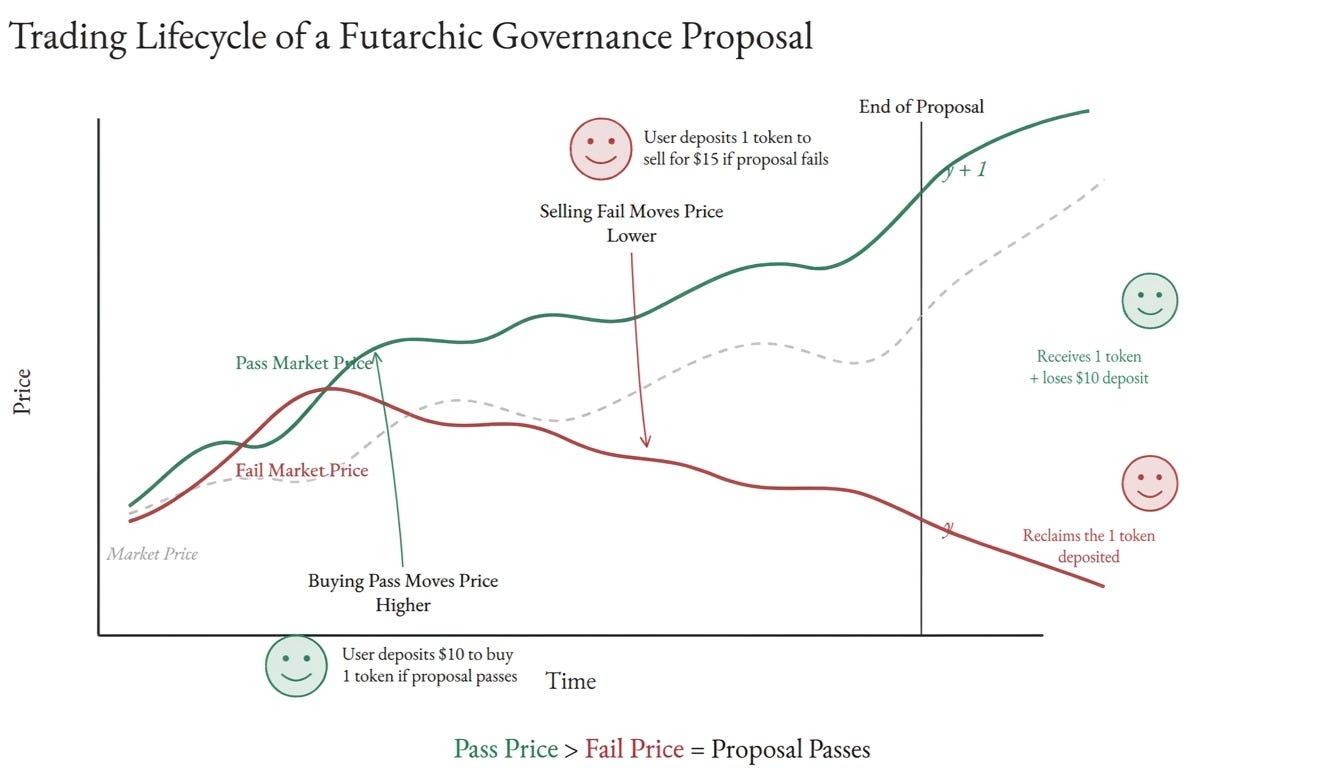
The system gets smarter over time because uninformed capital bleeds out and informed capital accumulates, the opposite of token voting, where you can make the worst possible decision on every proposal for a year and your governance power still stays the same. Futarchy makes ignorance expensive, something no governance system before it has ever managed.
MetaDAO was the first team to actually ship this. They launched on Solana in late 2023 with a binary model where every proposal is a straight pass or fail, and proposals go through conditional markets instead of token votes, and the market’s answer is the one binding.
But the binary design creates another kind of problem. Since the market can only answer yes or no, every parameter (Budget, timeline, technical changes) of the proposal must be negotiated in a forum before the market even opens. This defeats the whole purpose of decision markets because figuring out what the right version of the proposal looks like still happens through the same informal consensus process, where the biggest token holders dominate the conversation.
You have moved the final yes-or-no into a market, which is a real improvement, but you have left all of the design work in the broken system you were trying to replace.
In September, Umia launched a multi-outcome model for the MetaDAO version. So, instead of a single pass-fail question, multiple proposal configurations compete simultaneously, and the market filters out weaker parameter sets through trading. The discovery of what the right version of a proposal should be happens inside the market rather than outside it, which is where it always should have been if the whole point was to let price discovery do the work.
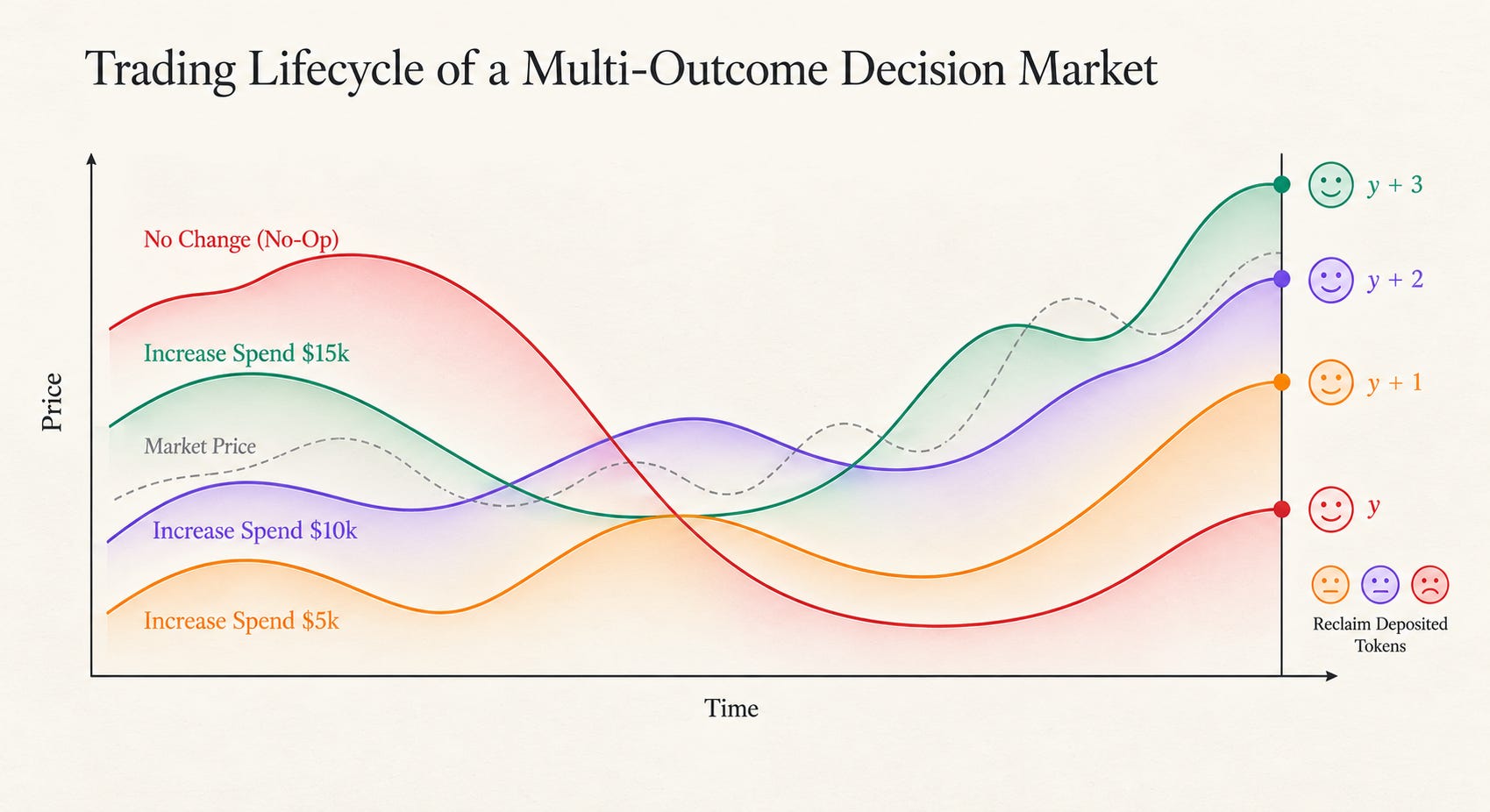
Across all 22 DAOs running this, 96 proposals have gone through market-based governance so far, and the total capital sitting inside market-governed treasuries is $50.5 million, with MetaDAO holding $39.3 million of that. So the trajectory toward real scale is there, but even if treasuries grow by a hundred times from here, decision markets have a ceiling, and it doesn’t even have anything to do with capital or adoption or how good the teams building them are.
A rule in economics called Goodhart’s Law says that when a measure becomes a target, it stops being a good measure. Credit ratings were designed to measure default risk, and when banks started using them to decide which mortgage products to buy, investment banks began engineering securities to meet rating criteria rather than select for actual loan quality, and the ratings kept printing AAA while the underlying mortgages rotted.
Decision markets have this vulnerability baked in. When a proposal passes, the token moves partly because the proposal itself might create value, and partly because passage signals team confidence. A strong project could propose burning treasury funds on a decorative bronze bull, and the token would still trade up on approval because traders react to confidence in governance, not the statue. Apple stock does the same thing every time it announces a buyback at absurd valuations.
The whole thing breaks because the market’s answer feeds back into the thing it is trying to measure, and you cannot fix that without destroying the reason traders show up in the first place. But strip the governance layer out entirely and point the same conditional mechanic at events happening outside the protocol, events that no trading outcome can influence, and that feedback loop disappears on its own. There is nothing left for the price to corrupt against. And that is what an impact market does.
Impact Markets
Hedging in crypto right now is impossibly blunt. If you hold Bitcoin and you’re worried about what a specific regulatory ruling would do to your position, you either sell and give up all the upside from every other scenario, or you buy volatility products priced against general market movement that have nothing to do with the specific event you’re actually worried about. There has never been a financial product that isolates one event and lets you trade its dollar impact on another, and that’s exactly what impact markets let you do.
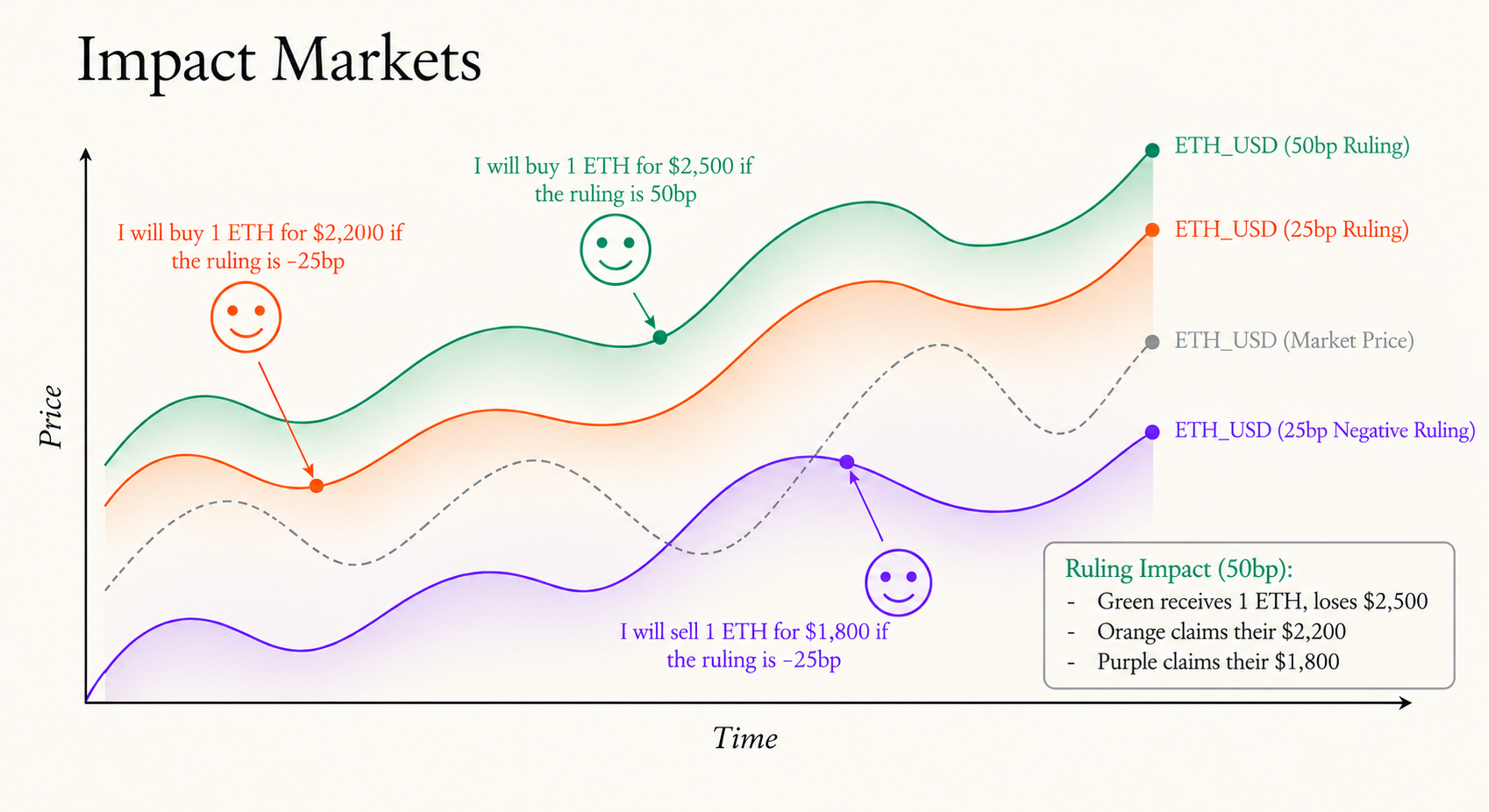
For example, let’s say the SEC is about to rule on whether a category of DeFi protocols qualifies as securities, and you hold a large ETH position. You believe a negative ruling would crush ETH to $1,800, but the impact market on ETH conditional on a negative ruling is trading at $2,300, which is the market’s collective estimate of where ETH would land if the ruling goes against DeFi.
You sell at $2,300, the ruling drops, ETH falls to $1,800, and you pocket $500 per token because your read on the severity was better than the crowd’s. If you’re wrong and ETH only dips to $2,200, you still pocket $100. A trade like this couldn’t have existed before impact markets, because no product has ever let you trade the magnitude of a specific event’s impact on a specific asset, with a live market pricing your estimate against everyone else’s.
It works because every asset price you have ever looked at is really just an average across all possible futures, compressed into one number, and impact markets are the first product that lets you trade beneath it.
Right now, if you want to protect yourself against a specific risk, you diversify across assets, which is really just a crude guess about which things might go up when others go down. Impact markets let you skip that entirely. You can hold a concentrated Bitcoin position and buy protection against the exact regulatory or macro event you’re worried about, without selling the position and without paying for volatility insurance that covers a thousand scenarios you don’t care about.
Instead of diversifying across assets and hoping correlations work out, you hedge specific scenarios directly, a completely different way to manage risk that only becomes possible when the underlying product gives you a conditional price rather than a probability.
I think impact markets will be far more consequential than prediction markets ever were. A prediction market closes and pays out a binary result, which is useful but, on its own, finite. You can’t build anything financial with that number because a probability isn’t a tradable object.
Impact markets produce a dollar-denominated price for where an asset would actually trade under a specific condition. You can hedge against it and write derivatives on top of it, instruments that literally could not exist before because there was no underlying conditional price to build on. The products that eventually get layered on reliable conditional prices will dwarf the conditional markets themselves, the same way the options and derivatives market is orders of magnitude larger than the equity market it’s written on.
The TAM for “how likely is this event?” is interesting but fundamentally capped, because there’s only so much you can do with it. But the TAM for “what would this event do to this asset?” has far more outcomes and runs as deep as finance itself.
The first implementations are already live and scaling faster than ever. Protocols like Branchpoint are even building something called Branchmap, a shared naming system for how conditional outcomes get defined across protocols, which matters because impact markets only become a real financial layer if “ETH conditional on a negative SEC ruling” means the exact same thing on every platform that trades it. Without that standardisation, liquidity stays fragmented and conditional prices on different platforms aren’t actually comparable.
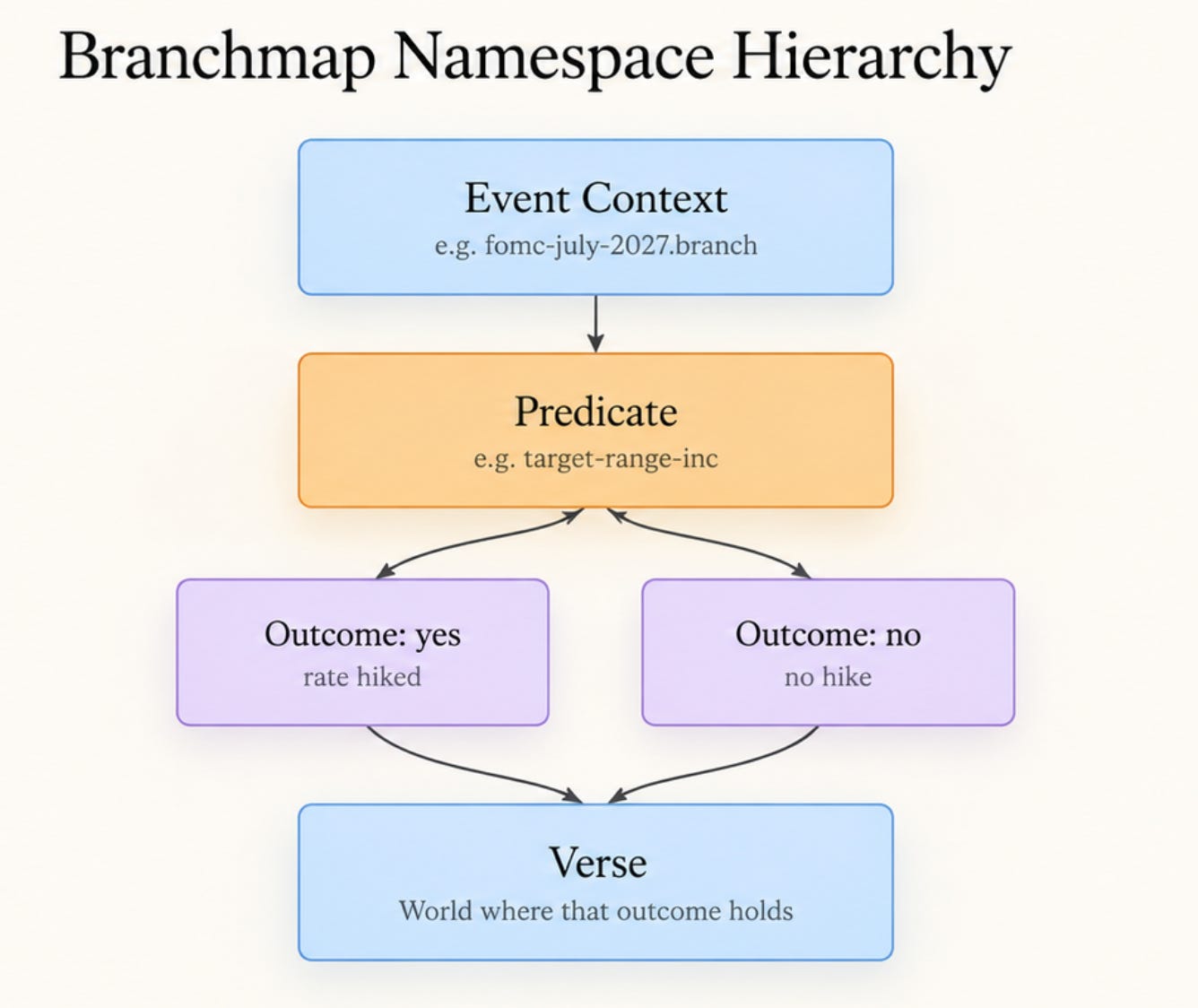
Branchpoint calls this “multiverse finance.” Every conditional market is a window into one version of the future, one branch of reality where a specific event did or didn’t happen. As impact markets mature and liquidity deepens, what emerges is not just a single conditional price for one event but a full spectrum of an asset’s value across parallel futures, each conditioned on a different scenario.
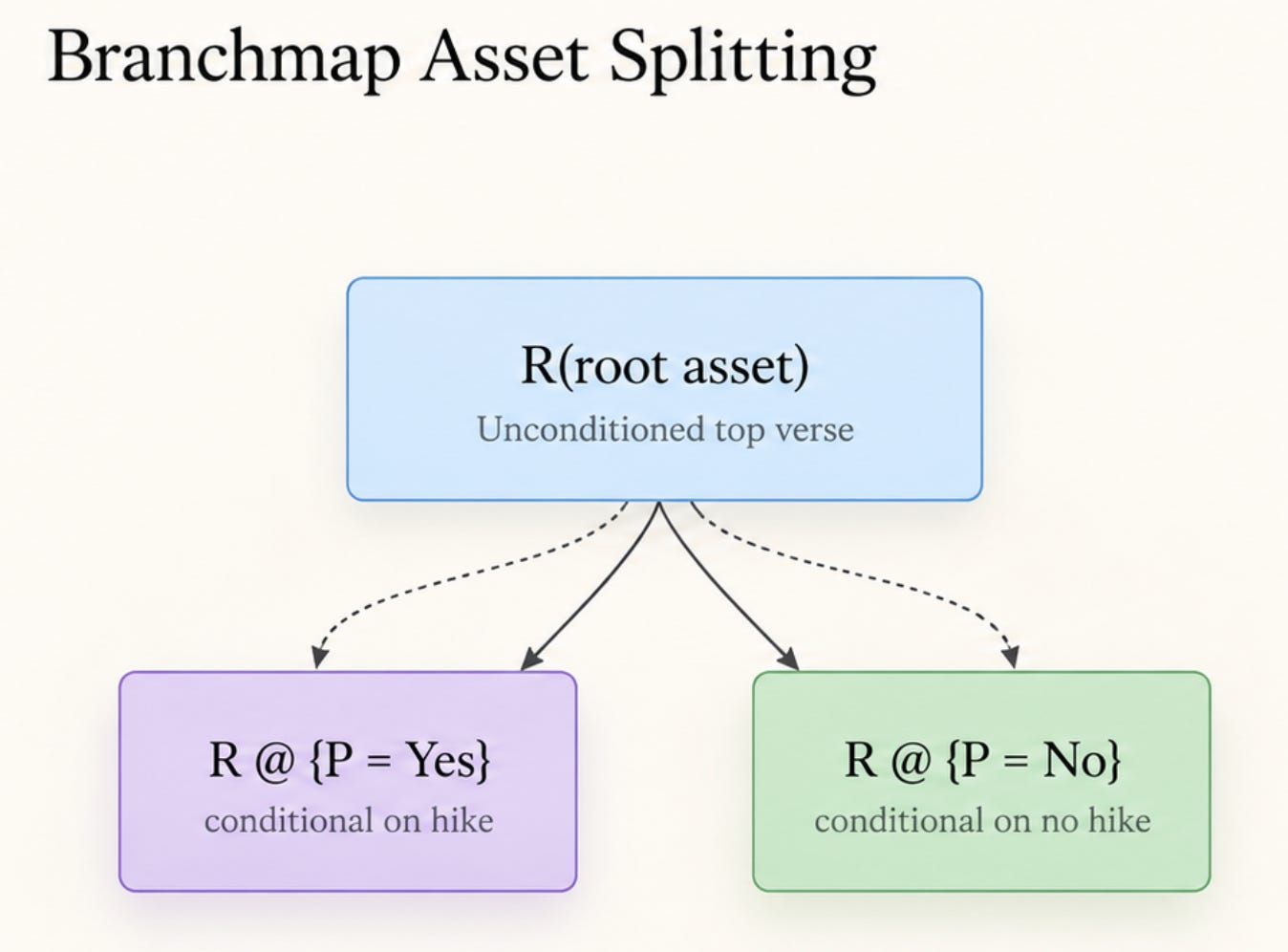
Finance has tried to decompose asset prices this way for decades. The entire discipline of event studies exists to work backwards through historical data and estimate how much of a price move was driven by one specific event versus background noise, and the best anyone has ever managed is a rough estimate after the fact.
Impact markets produce this decomposition forward-looking and in real time, and that information changes the foundations of how risk gets priced the moment it exists.
The next level is when conditional prices start plugging into risk models and portfolio engines that currently run entirely on spot prices and implied volatilities. Once that integration begins, the framework for capital hedging and exposure in crypto gets rebuilt from the ground up.
But there is no reason this stays just limited to crypto. The goat rancher couldn’t buy insurance because actuarial tables don’t cover goat pasture in a specific Northern California county. In every case, the missing piece has always been a liquid price for what would happen to X if Y occurs.
Once that price exists, capital allocation changes in compounding ways. Once an insurer can lay off risks too weird for its own book into a conditional market, it can underwrite policies it currently has to decline. A VC fund that can hedge sector risk separately from company risk can concentrate more on its best founders instead of diversifying across thirty bets as a substitute for conviction. A government considering a minimum wage increase can watch a conditional market price the employment impact in real time, with real money behind every position, instead of arbitrating between economic models that disagree with each other.
Options did that to equities in the 1970s; it rearranged the industries built on top of them in ways their inventors did not predict. Conditional markets are the same class of primitive. The difference is they decompose risk across events, not just across assets, and the number of events in the world is unbounded.
That’s all for today!
Vaidik
Token Dispatch is a daily crypto newsletter handpicked and crafted with love by human bots. If you want to reach out to 165,000 subscriber community of the Token Dispatch, you can explore the partnership opportunities with us 🙌
📩 Fill out this form to submit your details and book a meeting with us directly.
Disclaimer: This newsletter contains analysis and opinions of the author. Content is for informational purposes only, not financial advice. Trading crypto involves substantial risk - your capital is at risk. Do your own research.