


Hello,
Until the late 1970s, shampoo was sold mostly in bottles in India. Many couldn’t afford a whole bottle, so they didn’t buy it at all. Then a small company in Tamil Nadu started selling shampoo in a single-use sachet for under a rupee. That created a whole new economy for the underserved.
The unit cost of shampoo in a sachet was far more than that of a bottle. But people bought sachets nevertheless. India had crores of people who could not buy a month’s supply of shampoo at once. Although sections of people still bought bottles, the sachet turned shampoo into an everyday product.
Today, the AI compute industry has its ‘bottle buyers’. Frontier labs, like OpenAI and Anthropic, and big cloud companies can lock up GPUs in long private deals financed with enormous amounts of debt. For them, compute is a strategic asset. Here, compute won’t trade like a commodity, no matter how big the market gets.
The sachet buyers of compute are in open-source AI. There, the price of a token changes constantly. But there’s a problem here. The GPUs underneath are still sold in bottles, mostly on three-year contracts that only a handful of buyers can sign. Someone has to buy the bottle and sell it in sachets. This part needs a lender who is willing to back short contracts.
In today’s guest essay, Vishwa Naik, co-founder of Anera, a market maker in compute, explains how this splits the entire compute industry into two different ones.
On to Vishwa’s story…
Prathik

StablesReward: Your AI Agent Spends, You Earn
AI agents can surf the web, read reviews, and book hotels for you. All these tasks cost money. But what if these tasks could earn you back something?
StablesReward does just that. Once you connect your agent to an MCP endpoint, it gives your agent a menu of paid tools. Every call your agent pays for earns you miles or stocks. And this is in addition to the rewards you earn anyway on your own spending across 800+ merchants.

Every purchase pays you back. The best part is that you can choose how you’d like to be rewarded. Transfer miles to airlines and hotels, or let your stocks build a portfolio from the spend you were making anyway.
Launching soon. Free to join.
Over the last 18 months, I’ve been trying to answer one question: will compute trade as a commodity, like oil or electricity?
For all the venture activity in the space, the answer so far has been no. At Anera, we were one of the only market makers willing to price cash-settled compute derivatives. In March 2026, we did a pilot trade with FalconX on Polymarket Institutional. After that, very little. In particular, we saw almost no demand from the counterparties that matter: businesses with compute as a core input or output.
I know what real commercial demand looks like. Nine years ago, I traded oil futures and FX at the world’s most complex oil refinery, and saw firsthand how commodity finance and derivatives make the core business better. (For anyone who thinks compute has too many SKUs to standardise, it’s worth looking at the oil complex.) Commercial hedging takes hold when two things are true. The market is liquid, with enough counterparties that no small group can set the price. And the hedgers are exposed to a price that actually moves.
Compute passes the eye test: there are natural buyers and sellers. But it has two markets. In the first, compute is a strategic good, priced bilaterally and financed through credit, and it will likely never trade like a commodity. In the second, the open-source market, the characteristics of a real market are already showing up, and tokens are already discovering their price. A freely traded market for compute is coming, just not in the market everyone keeps looking at. To see why, start with where the risk lies in each.
Market One: Compute as a Strategic Good
Most of the infrastructure in this market was built to serve the tokens of two AI labs, by the hyperscalers and a handful of neoclouds purpose-built to serve those labs. Two labs, four hyperscalers, and a handful of neoclouds hardly form a market. There is no price discovery. OpenAI and Anthropic set their prices. The hyperscalers get privileged access to those weights and procure compute against very long-term agreements at fixed prices. For those familiar with the story of Marc Rich, this should sound eerily familiar to the seven sisters in oil. If you are not well-versed, I strongly recommend reading about it here.
The first market is built on hyperscaler credit and cash flows. Here, the counterparties are investment grade, financing runs through large bond issuances, and credit risk trades in the CDS market. Financial markets, particularly derivative contracts, are built as an instrument of risk transfer. For this market, Credit Default Swaps (CDS) are undoubtedly the correct instrument. In fact, CDS trading activity is hitting new highs every week as more data center and AI names race to the bond market to build the infrastructure needed to serve this market.
In this market, tokens have fixed prices, compute is procured on very long-term leases, and the stakes are now at a national-interest scale. There is no floating price for anyone to hedge. When I spoke to some of the neoclouds last year, most of them categorically didn’t need derivatives. This might change as the market matures. However, at the moment, serving the market for OpenAI, Anthropic, and the Hyperscalers is a gigawatt conversation and not a handful of megawatts. When scale is the product, the underlying infrastructure loses its commodity-like properties.
OpenAI and Anthropic are upstarts in a market dominated by the largest tech companies in the world. They have poured ever more capital into building the market for AI, and they sit inside partnerships that span the whole stack: model, application, chip, and cloud. Their partners bring decades of cash flow and public-market trust.
The rule of this game is simple: stay at the frontier. In the race to superintelligence, compute is not a commodity. Demand for it is price-inelastic, because falling behind the frontier costs more than any premium paid for compute. The model weights become the crown jewels, and they need ever more compute, data, and capital to stay ahead.
Anyone hoping the lab IPOs will ease pressure on liquidity should expect the opposite. They will draw on public-market capital at a scale we haven’t seen. When they do, they will put even more pressure on the bond market.
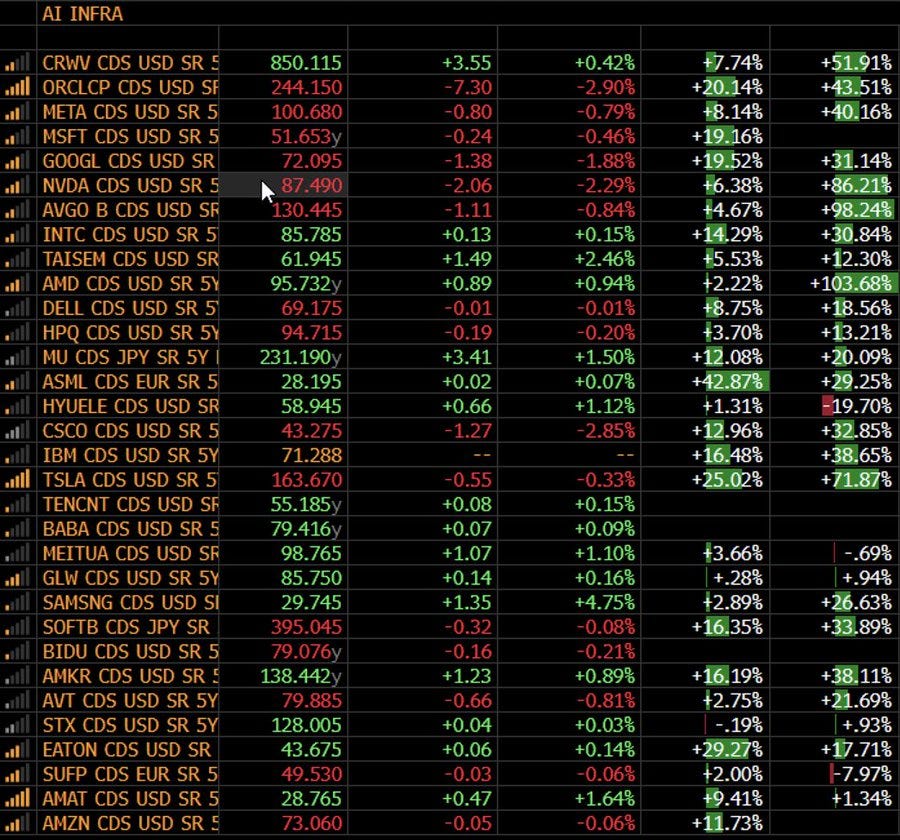
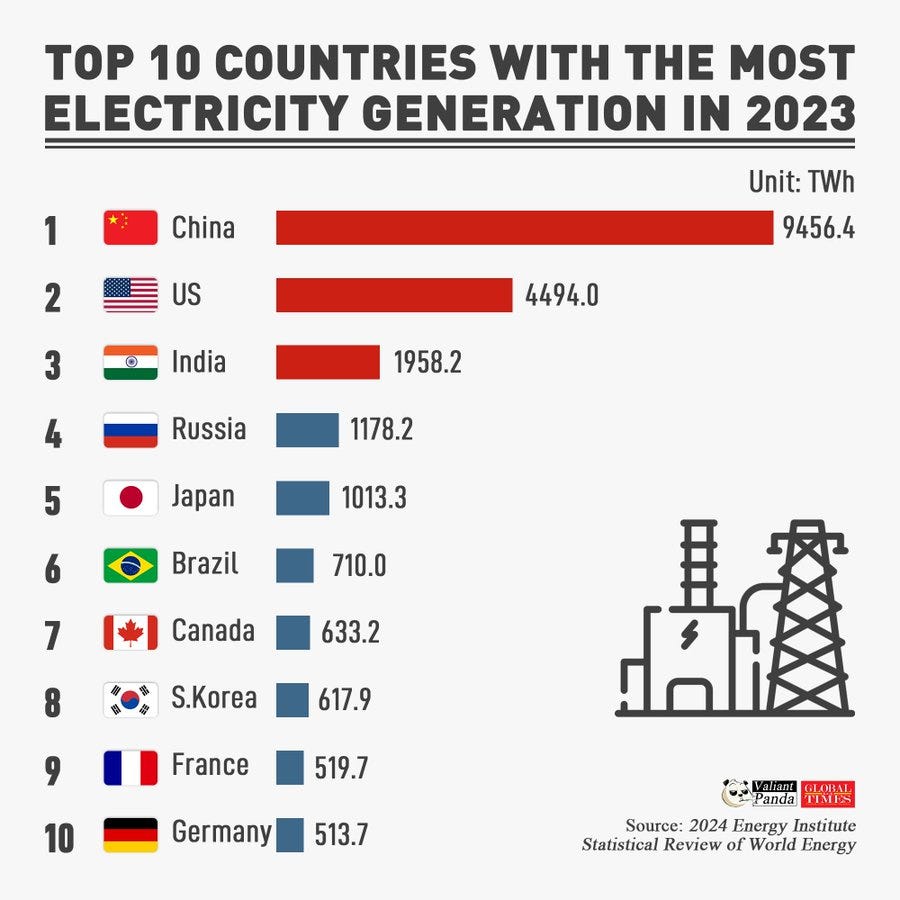
Bold prediction: the end state for this market is chips and nationalisation. The US government is already contemplating investing in AI companies, with OpenAI and Anthropic atop those lists. Staying at the frontier means relentless competition for compute and data, at multi-trillion-dollar valuations financed with unprecedented amounts of debt. Margins are thin, and getting thinner as open-weight models erode the value-add of proprietary ones. There is almost no margin for error. A market that large, levered, and strategically important doesn’t get to fail. When the room for error runs out, the state becomes the backstop of last resort. Increasingly, staying at the frontier has become a national security subject. Particularly with heavy Chinese state subsidisation and a multi-gigawatt headstart, America would not be able to afford to see these two labs fail. Upon listing, they will become structurally more important to the broader US economy and a bastion not just of the US capital markets, but also its intelligence apparatus.
In this market, compute is a strategic resource, unlikely to ever trade as a commodity like oil or electricity.
Market Two: Open-Source AI
Until about a year ago, it looked as if only the proprietary labs could push the frontier. Then, open-weight models closed most of the gap with far better unit economics. Add the ability to own your model and keep your data out of someone else’s training set, and open weights became a credible default from a just an alternative.
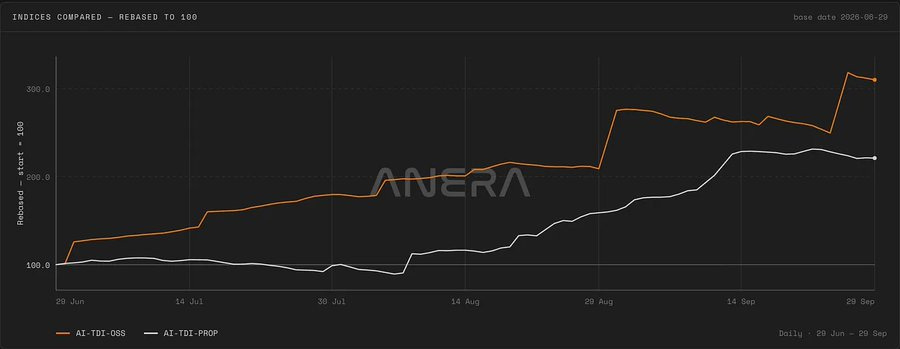
Anera’s token demand indices track consumption for proprietary and open-weight models separately. The baselines are very different, but the relative growth tells a clear story: the future is at least multi-model, and a growing share of tokens will run on open weights.
This isn’t an essay about open-source AI. It’s about where the market line falls. In the first market, compute is a strategic resource, where scale is the norm and commands a premium. In the second, compute is scarce and tokens are price-sensitive, so procuring compute becomes a strategic optimisation problem: every operator is trading off access, price, and tenor to protect margin on each token it serves. This blog from Vikram Singh at Galaxy does a great job explaining the business equation for many of the participants in the market for Open Source AI. There are also enough counterparties here for real price discovery. Tokens in this market continuously reprice. Compute, as we’ll see, is another story. The infrastructure providers for this market are hardly a few years old, far from investment grade, and completely underlevered.
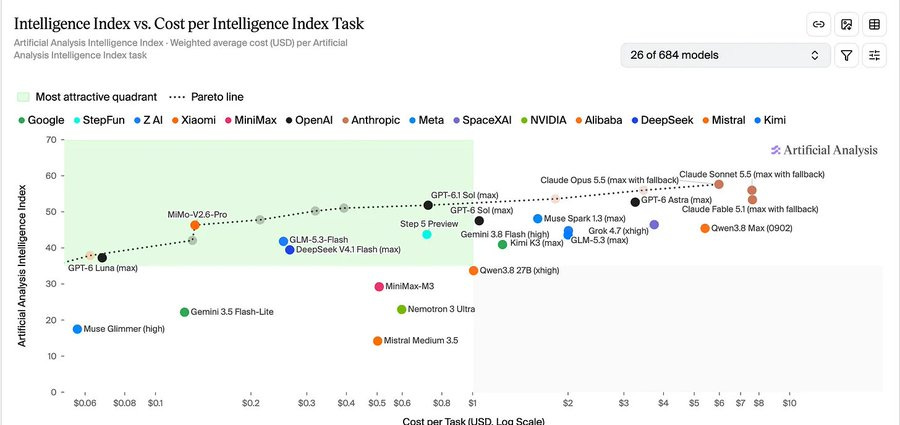
As open source models have closed the gap to the frontier and increasingly own the Pareto Frontier, there is a massive arms race to serve compute to this market.
The Bare-Metal Boom
The proprietary market runs on gigawatts of capacity across the hyperscalers and the large neoclouds. The open-weight market runs increasingly on a boom in bare-metal providers. Open-weight inference prefers bare metal, and all bare metal needs is colocation space and capital to procure GPUs. There are a ton of off-the-shelf cluster management software providers that have made the 0-to-1 of launching a bare metal neocloud easier than ever. As the established neocloud operators build out gigawatts for hyperscalers, they retain megawatts to compete in the market for open inference. CoreWeave, Nebius, Crusoe, and Nscale all have their own token factory businesses and have all but stopped serving other inference clouds. Therefore, there are more bare-metal providers today than ever, most of them formed to serve this demand that is growing exponentially.
The top inference clouds shape this market, often leasing at least 1000 GPUs + at a time on 3+ year leases. These major inference platforms are supplier-agnostic. They often work with 20+ suppliers (as Tuhin from Baseten mentioned in this interview) and have a procurement “guy” who is just continuously knocking on doors to find compute. I have been equal parts fortunate that I was one of those doors and unfortunate that I have had little to add other than introducing to another cloud or supplier.
These bare metal clouds offer a rather undifferentiated service. The top inference clouds know that they represent the most creditworthy counterparty in this segment of the market. Therefore, the only real lever these neoclouds have, if their goal is to only sell fixed 3Y take or pay leases, is their capital stack.
The Capital Stack
Cost of capital deserves its own piece. The capital behind open-weight compute looks nothing like the capital behind the proprietary market.
Bare-metal clusters are mostly financed by non-bank capital at a megawatt scale. Asset-backed lenders can fund up to 80% of a cluster’s bill of materials as long as an operator brings the other 20%. The condition for releasing that money is contracted cash flow from a creditworthy counterparty. No contract, no cluster. The more senior debt in the structure, the longer the contract the lender wants to see.
Operators in this market are considerably smaller in scale than the neocloud giants like CoreWeave, Nebius, Crusoe, and Nscale. These are increasingly new operators, who are entering the market with off-the-shelf software and some equity capital, hoping to capture a slice of this demand.
Typically, these operators look to fill their equity tranche of clusters BOM with a potential off-takers money. To understand this flow, I recommend visiting American Compute.
The standard practice today is for an offtaker to give up to 30% of the contract as a prepayment. This typically represents 1Y of service, and in many cases, that 1Y of service is back-loaded. This means that an offtaker gives an operator 30% up front, waits for 8-16 weeks until the cluster is ready for service (RFS), and upon getting delivery, they need to pay their monthlies up front too.
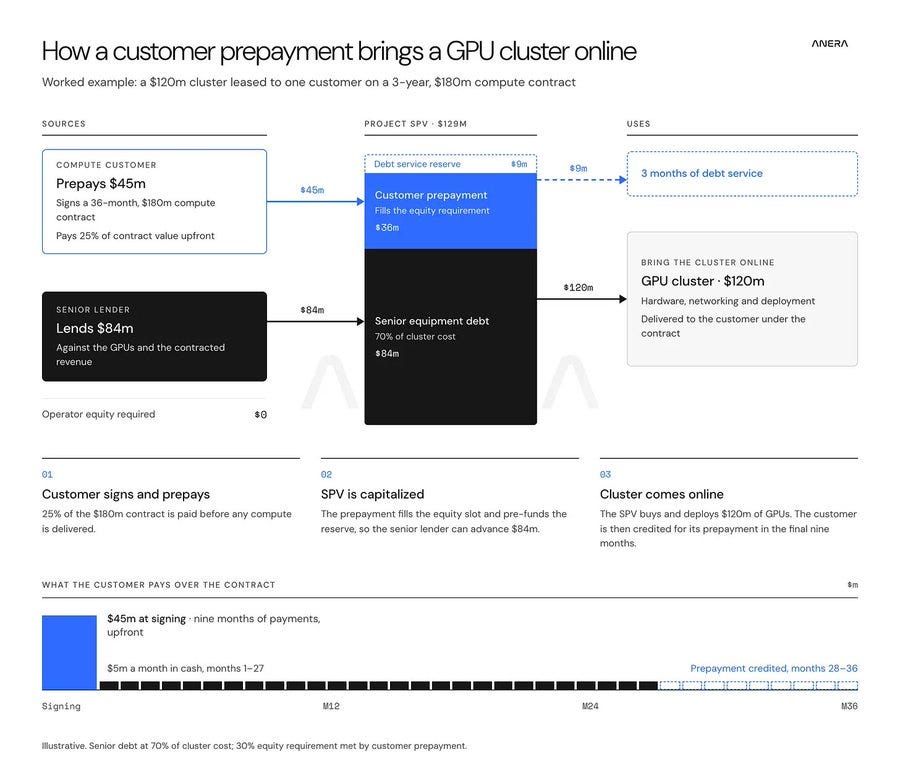
We are starting to see some cracks in prepayments, with bridge financing entering the mix. Bridge financing typically means that a financier can provide capital to the operator against a signed master service agreement (MSA) from a creditworthy counterparty. The caveat here is that their capital gets taken out upon delivery of the cluster. While this helps build trust, it does not solve the problem for the offtakers. Since there are barely 10-15 counterparties in this market who can be meaningful, creditworthy off-takers, they have begun to push back on these terms for the past three years. Some are reducing prepayments materially, while others are also starting to ask for pro rata credits every month instead of back-loading the contracts. All of this puts tremendous pressure on the capital stack of the bare metal operators.
Still, while tokens in this market reprice continuously, compute itself is sold in a 3Y credit box. This is where the promise of a liquid market is currently getting blocked.
The Tenor Mismatch
By definition, open-weight offtake could end up with the same concentration risk as the proprietary labs if the capital stack doesn’t evolve: a few large tenants absorbing almost all the financed capacity. One of my main takeaways from running a microlending business years ago was that banks and large credit asset managers have to deliver yield at scale. They are managing trillions of dollars of capital with hurdle rates in the tens of billions of dollars. To make their economics work, you need to deliver scale. As a consequence of this need for scale, you will continuously see systemic risk in the system. Blowups happen at the top, never at the bottom. This is a feature of large-scale capital markets.
We find ourselves in a similar place with compute. If compute can only be sold on fixed 3Y-5Y take-or-pay contracts, it can only be accessed by a few. Just like with credit, there is a massive, underserved market begging for compute. This market is fundamentally not creditworthy as duration increases, and equally creditworthy as duration shrinks. A startup’s credit horizon is roughly its cash runway: a company that just raised with 18 months of cash can credibly commit to a year of compute, not three. Most startups are good for a month. Anyone is good for a day.
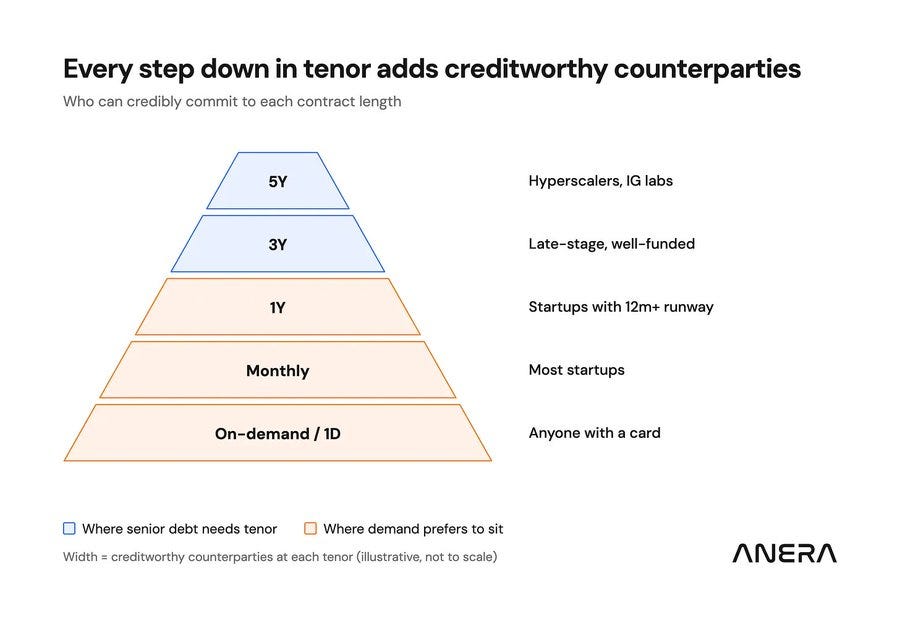
The base of the pyramid is where most of the underserved demand sits, and it’s exactly the part today’s capital stack can’t reach. Access to compute is rationed by tenor, and the limited evidence so far shows that shorter tenor is commanding a significant premium.
The Evidence: A Tenor Premium
Though the data is thin, it’s clear that shorter-term contracts command a premium. The first thought that comes to mind is that the premium just pays for the operator’s idle capacity and remarketing risk. However, the demand we see says otherwise: short-tenor capacity isn’t sitting idle. It’s oversubscribed. The premium is what buyers pay for flexibility that the financing structure keeps in short supply. In fact, operators with the capital stack that allow it to serve the shorter duration market have considerably more demand and potential cash flow than operators who cannot.
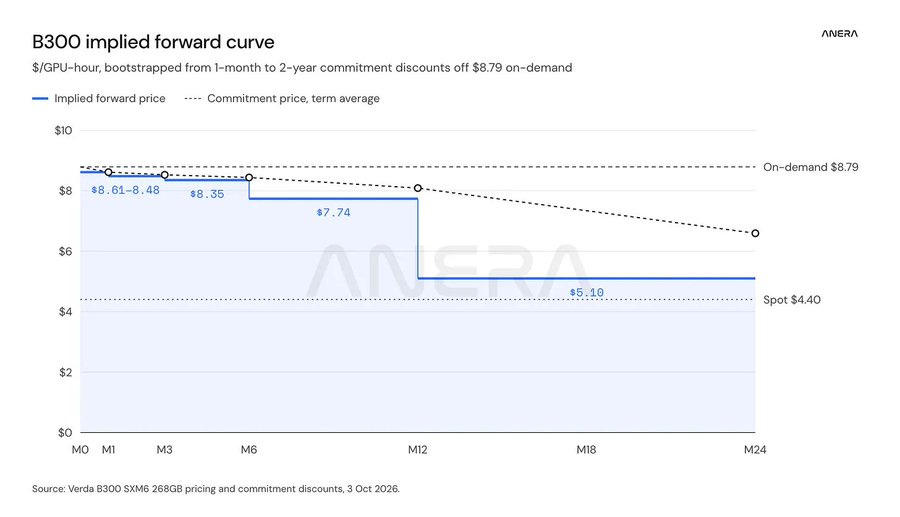
As is clear, the data shows that shorter duration commands a considerable premium. On demand, B300s are clearing almost $9.00, with prices falling off a cliff as the duration goes from 1Y to 2Y.
Compute price indices already exist, and they are the first attempts at price discovery in this market. But the current capacity flowing through short-duration contracts is a tiny sliver of the actual traded market. Long-tenor deals are few, large, and bilateral, so they never print publicly. Short-tenor activity has the most counterparties but is spread across hundreds of providers with no common reference.
So the curve today’s prints describe should be read with a grain of salt. The indices have real issues, but they are a start. The data is thin; the logic is not.
Short Tenor Is the Easy Sale
The standard objection is remarketing risk. If the loan amortises over three years and the contracts run six months, someone holds the gap, and lenders assume the operator will struggle to re-lease the cluster.
That risk is overstated. Short-duration compute is far easier to sell than long-duration compute. At Anera, we turn away requests for one-, three-, and six-month compute every day.
Those requests don’t only come from startups and independent developers. Many come from existing inference operators who want to scale their fleets up and down with demand. In fact, the largest inference platforms in the world still run almost 50% of their fleet on spot/short-term compute across tens, if not hundreds of venues. Today, when an operator wins an enterprise contract, it often has to pull GPUs off its serverless inference, on OpenRouter for example, to serve that customer. It can’t add capacity for the length of the deal, so it takes supply out of the open market instead.
The outcome lenders fear, a cluster nobody wants when the contract ends, is the least likely one. The queue for short-tenor compute is longer than the queue for long-tenor compute. What’s missing isn’t demand.
Access Flows through Credit
The data on cash flows from realising the tenor premium is emerging. A new crop of resellers is setting out to serve short-tenor demand, among them SFC, Runpod, Hyperbolic, AMP, Andromeda, Ornn, Compute Desk, and Liquid Compute. Their model is to take down long-term capacity and sell it in strips: one-year, three-month, one-month, and on-demand. Some of them sell bare metal access, others with custom VMs on top. Some take on principal risk, while others take none. The essence of their work, though, is to realise the tenor premium and open up the market for compute.
They are raising equity to do it. But equity alone can’t scale to meet the demand, and without leverage, they will stay small. Leverage won’t come until a specialist underwriter emerges: one that understands the demand for compute, can prove that short-tenor compute is creditworthy, and can scale the amount of compute allocated to shorter tenors. Once that leverage arrives, these resellers will depend on price as well as utilisation, and they will need price protection on margin, and high utilisation to realise superior economics. This is how a freely trading compute market gets created.
Until then, access stays gate-kept. Compute goes to whoever can sign a three-year take-or-pay contract, and that is a handful of buyers. Compute is too essential a commodity to concentrate in the hands of a few. The path to mass democratisation of access to compute and liquid markets runs through credit.
That’s it for today.
P.S.: This story was first published here.
P.P.S.: We will be featuring good writing and writers we love from time to time. If you have recommendations, send them our way.
Token Dispatch is a daily crypto newsletter handpicked and crafted with love by human bots. If you want to reach out to 165,000 subscriber community of the Token Dispatch, you can explore the partnership opportunities with us 🙌
📩 Fill out this form to submit your details and book a meeting with us directly.
Disclaimer: This newsletter contains analysis and opinions of the author. Content is for informational purposes only, not financial advice. Trading crypto involves substantial risk - your capital is at risk. Do your own research.
