


Hello,
I hear a loose thought floating around me, used so often at this point: AI will take away our jobs and make us redundant. The bigger irony is that people across domains use this without really questioning exactly what these AI models are replacing in their line of work.
As writers, my team often discusses this idea in our internal calls. Although there are a lot of ideas about how AI will evolve from here, there’s one thought we all seem to agree on. When everyone has access to the same data, similar models and common building blocks, data no longer remains the moat. The content creation game flattens out at the level of data aggregation and research. But there’s something else that AI also does.
Every door closed shut, more often than not opens another one. Once these AI models and the software built on top of them make building things easier, they force humans to differentiate based on our ability to imagine and express diverse tastes.
What I find under-appreciated about AI-enabled software is that they strip away the excuse that building something is difficult or costly. What hurts humans more about AI is not that it takes away our jobs or makes us redundant. But it’s that they act as beautiful filters and ask a difficult question: “Do you actually have a vision that separates you from the rest? Can you build something different when the playground is levelled for everyone to build?
Today’s piece by Kinjal Shah, General Partner at Blockchain Capital and Co-founder of Komorebi DAO, takes that instinct and grounds it in what’s actually happening. It’s about the explosion of personal social software and why open protocol infrastructure like the AT Protocol ensures that small, specific, human experiences don’t have to start from scratch. She explains why the bottleneck isn’t code anymore but imagination.
Give it a read.
Onto Kinjal’s story…

Do you remember when your friendships translated for the first time? I was thirteen, ranking my “top eight” shelf on MySpace, only to realise I didn’t have eight friends I’d include. Ranking them made my stomach sink.
Fast forward to 2026, and numbers are still the fastest way for a stranger to determine your status. The platform on which you’ve gained them adds context. Your name, profession, and appearance are all scrutinised in the flick of a scroll, quickly adding up to a first impression.
What’s real or not is an afterthought. Perception is reality.
The early internet was a companion to many users, whether it was through Tumblr communities or the early blogging world. It allows anyone to expand their network beyond geographies and gain access previously held by gatekeepers.
When the algorithm became the discovery tool for default social experiences, it forced everyone into the same doomscroll. In doing so, it fundamentally changed how humans form connections online, creating parasocial relationships that are optimised for the wrong metrics.
What if it wasn’t the desire for human connection that broke — but the game itself?
The barrier just collapsed. With today’s agent functionality, the cost of creating software has collapsed to nearly zero.
But a more interesting consequence of this is the friction AI removed.
Before, if you had an idea for an app specific to your community or context, you had two options: find an existing platform that approximated it, or hire someone to build it and hope they understood what you meant. Either way, building yourself was for a technical user. It involved real friction for an app that most people might not even want.
That friction is effectively gone. Intent can now translate directly to action.
My brother-in-law recently built an app for his friends where they share weekly sports parlays. He vibe-coded it in a week, and now they use it every week. That wasn’t possible 12 months ago.
We’ve moved from personal computers to personal software.
The parlay app will never have a million users, but it doesn’t need to. It is working perfectly on the one metric that matters the most: deepening specific relationships.
The numbers confirm this.
Apple app store submission grew 30% in 2025, followed by an 84% year-over-year jump in Q1 2026, the largest surge in a decade.
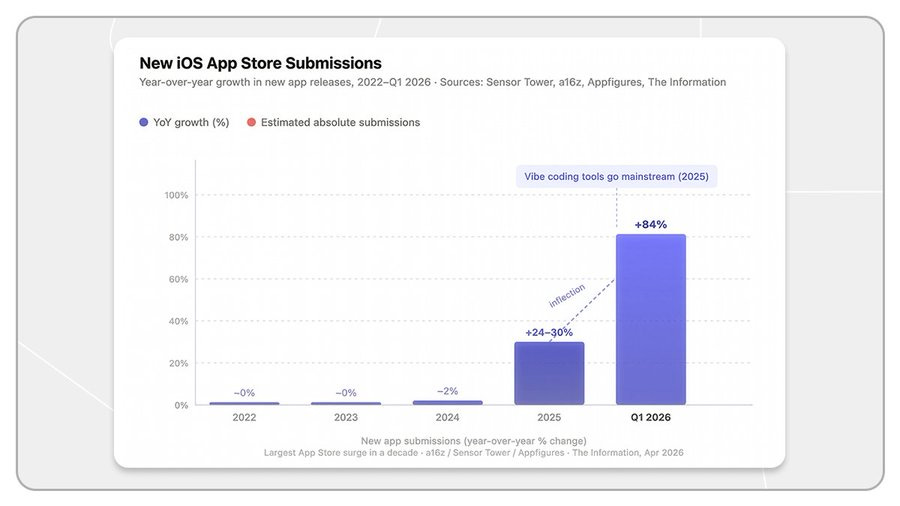
This is after declining 48% from 2016 to 2024. The inflexion point correlates precisely with the release of more accessible agentic coding tools.
What’s even crazier is 63% of the vibe-coding users today classify themselves as “non-developers,” many of whom have never written a line of code.
Personal Social Software is the Future
When I think of the early web, I remember the cosy corners where lifestyle blogs, independent journalism, and the personal website proliferated. One of the biggest enablers of websites was an open-source content management system called WordPress.
As of 2026, WordPress powers nearly 44% of all websites published on the internet.
WordPress didn’t succeed because a single blog had millions of readers. Most WordPress sites have relatively low traffic.
It succeeded because it enabled millions of distinct, self-publishing experiences on shared infrastructure.
The metric that mattered was the number of websites deployed. That’s the same frame for what’s coming.
What would a world of thousands of social experiences, many of which are pop-ups, look like? Each is built for a specific group, ritual, context or use case.
A weekly parlay app for eight friends. A darkroom photography community for a neighbourhood. A shared reading log for a family. A group planning tool for a climbing crew.
None of these needs to win the internet. All of them deepen specific relationships in ways that no generalised platform can, because none of those generalised platforms was designed with those specific people in mind.
When software doesn’t need to scale, it allows for personalisation and community formation.
When the cost of building a social experience approaches zero, the bottleneck shifts from infrastructure to imagination.
Why AT Protocol Matters as Infrastructure
The problem with building your own social experience from scratch is that you start from zero. Your social graph lives somewhere else. Your identity lives somewhere else. You’re effectively building on sand, where the ground can shift quickly under your feet.
This is what killed most of the ‘build your own community’ tools of the last decade. The only audience you’ve been able to own is your email list. Every new network asks users to start over - new account identity, new followers, new context. AT Protocol breaks this constraint.
When you build on AT Protocol, you’re not building on a platform. You’re building into a network that users already belong to. Their identity travels with them. Their followers travel with them. Their context travels with them. The parlay app isn’t a closed garden but a node in an existing social graph.
This means a builder who creates something for eight friends doesn’t have to solve the cold start problem. The network is already there. When someone discovers the parlay app and joins with their existing AT Protocol identity, their connections see that they joined and the context compounds across deployments rather than within each one.
Why Should You Build on AT Protocol?
Shared identity on the AT protocol. Social graph portability lets you bring your users with you. Moderation primitives let you focus on the product rather than on trust- and-safety tools. A whole suite of à la carte building blocks is coming to you.
The things that take months to build from scratch, AT Protocol gives you right away, out of the box.
Attie, the feed-building tool the Bluesky team recently launched, is a live demonstration of what this infrastructure unlocks. It’s a portal into creating your own feed experience on top of the underlying network. What you find there is a vibrant set of users already organising events around science and academia, sports, news, analogue hobbies, and niche interests that you rarely see spaces made for. The like-minded users are already in the network. The tools to build for them are already available.
There are some really unique examples being built today.
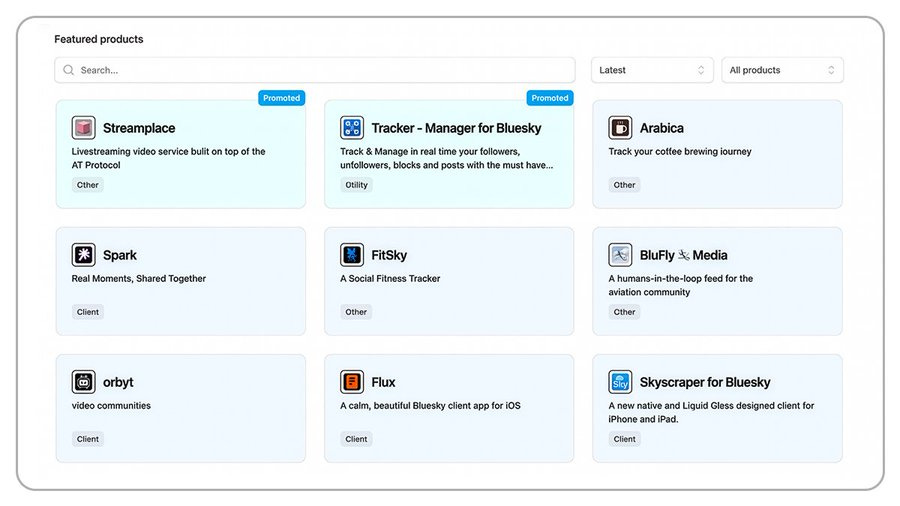
One of my personal favourites, Anisota, created a gamified social interface where each post becomes a collectable trading card with rarity ratings and stamina limits to discourage compulsive scrolling. It makes social feel like play. It’s built on AT Protocol, which means it inherits the network rather than having to recruit it.
Tangled is another example, building a social coding platform where coding is a social, owned experience rather than a solitary professional one.
These aren’t competitors to Bluesky. They’re what a healthy protocol ecosystem looks like: multiple distinct experiences, all running on a shared identity and data layer, each finding the specific community it was built for.
The Open Question
The thing I keep coming back to is if AI makes creation cheap for everyone, doesn’t everything converge toward the same AI-generated aesthetic? If the tools are the same, don’t the outputs homogenise?
I don’t think so, and here’s why. The inputs to a 1-of-1 social experience are human taste, specific relationships, and local context. Those don’t homogenise. The medium becomes generative, but the intent stays personal. My brother’s parlay app is shaped by the specific way his friend group talks about sports, the running jokes, and the particular format of their picks. No amount of AI tooling makes someone else’s version of that app feel like his.
The broader ‘human-only’ framing emerging across new social apps is responding to this desire to prioritise human connection. When synthetic content saturates the feed, genuine human context becomes a scarce resource. We are seeing this permeate our everyday interactions. Recently, the World launched a “humans only” concert to address the challenge of bots sniping tickets online.
We’ve also seen this in our digital spaces, on apps like Retro or Subtext, which emphasise private social for humans only.
1-of-1 social is, among other things, a structural defence against that. It’s a social space designed for specific people, making it legible to them in ways that generic content can never be.
Build Something
Cosy corners of the internet are coming back. Not as a nostalgic throwback but as a return to the fundamentals that made the internet a meaningful place for connection. This is the structural consequence of tools that enable personal software.
The social graph can be open. The identity layer can be portable. The moderation primitives are available. The barrier isn’t technical anymore. It’s imagination.
Think about the ritual your group already has that no app serves perfectly. The shared behaviour that happens in spite of the tools you’re using, not because of them. The group chat that’s doing work it was never designed for.
That’s the brief. Build the thing that makes it better — and build it on infrastructure that doesn’t make you start bringing together your users from square one.
That’s it for today,
Kinjal Shah
Disclaimer: This piece was originally published as an X article.
We will be featuring good writing and writers we love from time to time. If you have recommendations, send them our way.
Token Dispatch is a daily crypto newsletter handpicked and crafted with love by human bots. If you want to reach out to 170,000+ subscriber community of the Token Dispatch, you can explore the partnership opportunities with us 🙌
📩 Fill out this form to submit your details and book a meeting with us directly.
Disclaimer: This newsletter contains analysis and opinions of the author. Content is for informational purposes only, not financial advice. Trading crypto involves substantial risk - your capital is at risk. Do your own research.
