


Rye and the fight between marketplaces, merchants and AI assistants
I have a strange amount of faith in strangers when I shop online.
If I am buying something, I usually check three or four marketplaces first. Then I read every review, especially the ones with photos, because those tend to make or break the decision for me. If I still like it, I might look for a YouTube review, check Reddit, compare the price elsewhere, and eventually go wherever I have a coupon. Or Amazon, because I already have Prime.
A lot of the time, I still don’t order anything.
By then, I have spent so much time comparing prices, reviews, delivery dates and tiny differences between products that the decision somehow feels less rewarding than when I started. Shopping online gives us almost unlimited choice, but also gives the job of sorting through all of it. AI shopping assistants are offering to take over that work.
The agent can search different stores, read the reviews, compare features, check delivery dates, and eventually show me the two options it thinks I might like. So, as with everything these days, shopping gets easier too.
Today Amazon gets enormous power from being the place where many shopping trips begin. A merchant wants to be there because customers are already searching there. The merchant can then pay Amazon a marketplace fee, pay for fulfilment and often pay again for advertising so its product actually appears where people are looking.
With an AI assistant, the customer may no longer begin the search inside a marketplace at all. The merchant may still manufacture the table, hold the inventory, process the order and deliver it. Amazon or another marketplace may still appear somewhere along the way. But the decision about what the customer should buy happens outside of these platforms.
Although it’s too early to see the behaviour broadly, it is becoming measurable. Shopify said AI-driven traffic to its merchants grew eightfold year over year in the first quarter of 2026, while orders coming from AI-powered searches grew nearly thirteenfold.
So this is a good week to look at Rye, a small company that lets almost any AI agent buy from almost any online store for five cents an order, including stores that never agreed to it. It shows fairly clearly where the money and the customer go when an agent does the shopping.

Frontrun: Early Bird Holds the Edge
Most people hear about a promising startup the day it announces its funding. By then, the investors who backed it have known about it for months. How did they get there first?
Hours of digging, who started the company, what they’ve built before, how to reach them, and understanding what to write to them so that you can join them early in their journey.
Frontrun does this digging for you. When top investors start following a young company on X, Frontrun flags it, finds the founder, and writes your opening message. You can read the draft, tweak it, and hit send without leaving the platform.
Frontrun gives you a ready brief on every company it flags.
You can also automate a daily morning report with the list of startups to track based on what your favourite accounts are following. Served hot, along with your breakfast.
Why this week?
Meta released Muse on September 8. Very cute, looks like a penguin dressed up as labubu for halloween.
It is a personal AI agent that can reply to your emails, book you a table and, if you let it, do your shopping. Twelve days later, anyone who asked Muse to buy something on Amazon got a pop-up saying that continued access by “an unauthorised AI agent violates Amazon’s Conditions of Use.” Amazon had asked Meta to keep Muse off its site, Meta said no, and Amazon locked the door.
Shopify took about a day to do the opposite thing. It opened every store on its platform to Muse, and its shares closed 7.3% higher. It also let browser agents finish checkout on its merchants’ sites and signed a similar deal with Instinct, a personal agent startup that raised $1 billion at a $10 billion valuation the same day.
It makes sense once you think about how you buy something. Say your phone charger dies. You open Amazon, type “USB-C charger,” scroll past a few results marked Sponsored, compare three that look identical, pick the one with the most reviews and just order it and forget. Along the way the seller paid Amazon a cut of the sale, usually 15% in most categories, paid again to have Amazon store and ship the charger, and quite possibly paid for one of those sponsored slots too.
If you hand the same errand to an agent, say Muse or Instinct. You tell it you need a charger that works with your phone and costs under $20, and it checks a dozen stores, reads the reviews and asks you to approve the payment. Since you never see a results page, nobody gets to sell you the top of it, and you might not notice which store sold you the charger until the box comes to you.
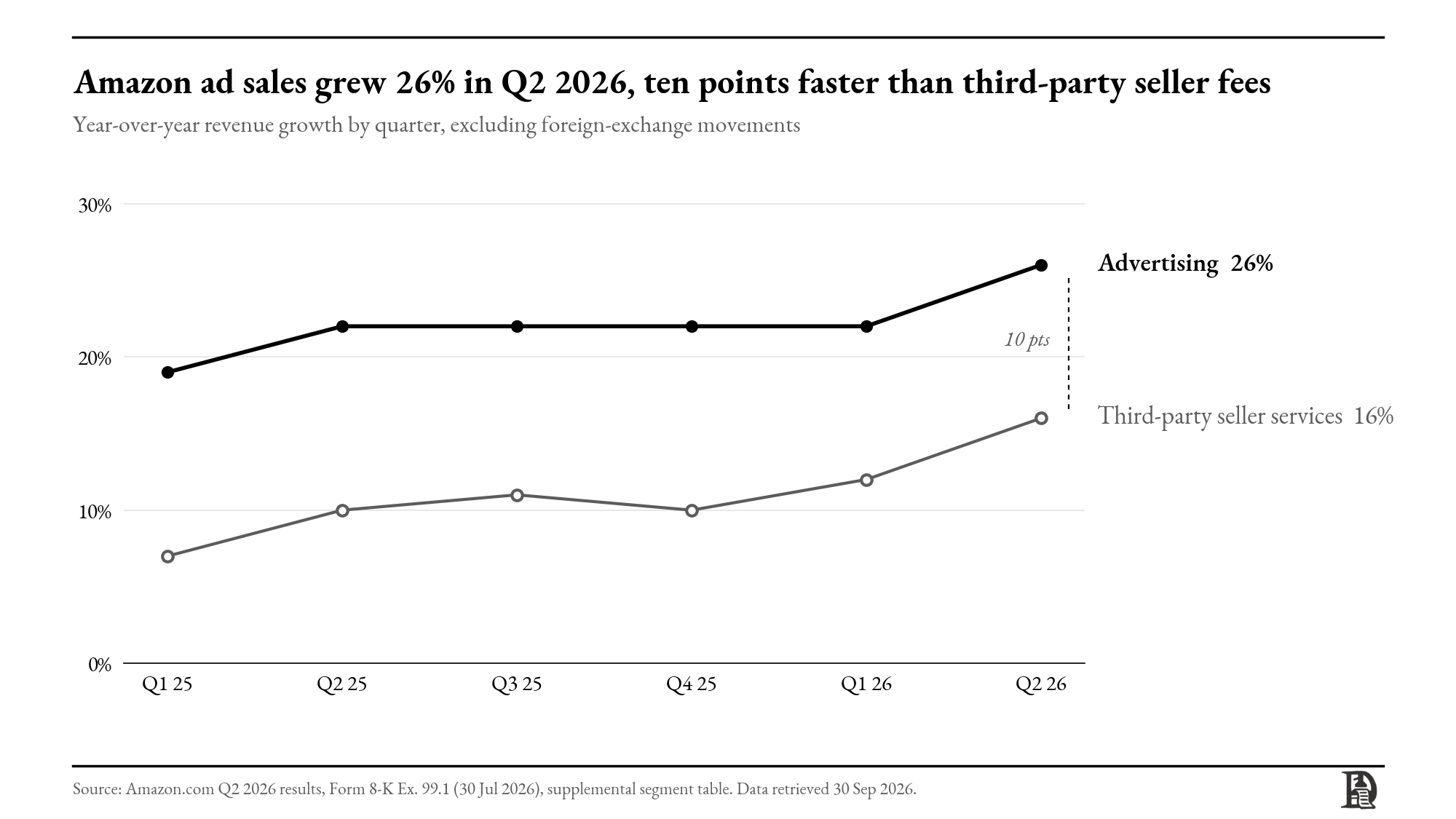
But Amazon’s ad business is enormous and depends on you doing the scrolling yourself, while Shopify makes money when its merchants sell, wherever the shopper started. Amazon reports advertising as its own line, and it has become very large.Amazon advertising was 9.6% of total net sales in 2025 at $68.6B out of $716.9B. In Q2 2026, it was 9.9% at $19.8B out of $200.6B. It made $46.8 billion from third-party seller services, the commissions and fulfilment fees it collects from merchants, and that line grew 16%.
Amazon is perfectly comfortable with agents in general, since its own Buy for Me buys from other retailers’ websites without asking them first. It would simply prefer that the agent holding your wallet belongs to Amazon.
The shift is still small, which is one reason Amazon can afford to fight it now. Adobe, which tracks more than a trillion visits to US retail sites, says traffic from AI tools grew 393% in the first quarter of 2026 compared with a year earlier, though Flagship Advisory Partners points out it is still under 1% of all retail visits. At the same time, in March 2025 shoppers arriving from AI tools converted 38% worse than shoppers from paid search and email, and by March 2026 they converted 42% better. Adobe sells tools that help retailers show up in AI answers, so it has reasons to like that number, but a swing that size in one year is hard to ignore.
OpenAI made the first serious attempt to put the whole purchase inside a chat window. It launched Instant Checkout in ChatGPT with Stripe in September 2025, so you could buy without leaving the conversation while the merchant stayed the seller of record. More than a million Shopify stores were meant to be eligible, and roughly 30 ever went live.
Walmart put about 200,000 products in and later said sales completed inside ChatGPT converted at a third of the rate of links that sent shoppers to Walmart.com. The feature handled one item at a time, and had no proper cart and no loyalty points, which is obviously not how anyone buys groceries.
OpenAI shut it down in March 2026 to focus on discovery, and Walmart now runs its own app inside ChatGPT where you pay on a Walmart screen.
The lesson merchants took from this was to let the chatbot find the customer and then bring the customer home to pay. That works for Walmart, but small shops still need someone to carry an order from an agent to its checkout page, which is the job Rye has taken on.
OpenAI has ACP, its Agentic Commerce Protocol that is still live. Google and Shopify have UCP, or Universal Commerce Protocol. Visa is working on agent payments. Shopify, PayPal and Adyen are also making it easier for AI systems to interact with merchant catalogues and checkout.
Rye launched in 2022 as a crypto commerce project and raised $14 million in a round led by a16z crypto, with Twitch co-founder Justin Kan among its founders and a planned RYE token that was meant to lower merchant fees. CEO Arjun Bhargava, a former Reddit engineer, has since rebuilt it around a narrower idea, which is letting software buy things for people.
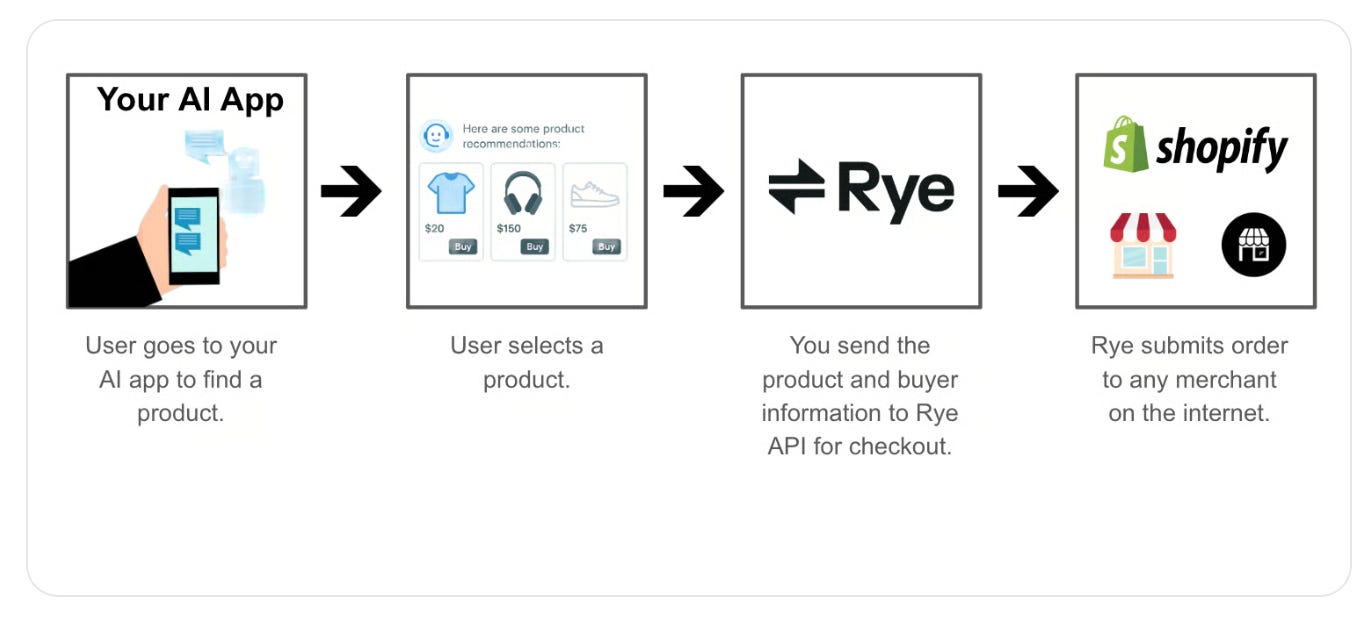
Rye’s product is easy to describe. A developer sends it a link to a product page along with the buyer’s name, email, phone number and shipping address.
Rye reads the live price, tax and shipping from the store, places the order and sends back tracking. It says checkout takes under five seconds on Amazon and Shopify, where it has direct integrations, and under ten seconds elsewhere, where an AI-driven browser fills in the form. Rye is basically the transaction layer between an AI agent and thousands of stores. It does not need to own the marketplace or the customer-facing app itself.
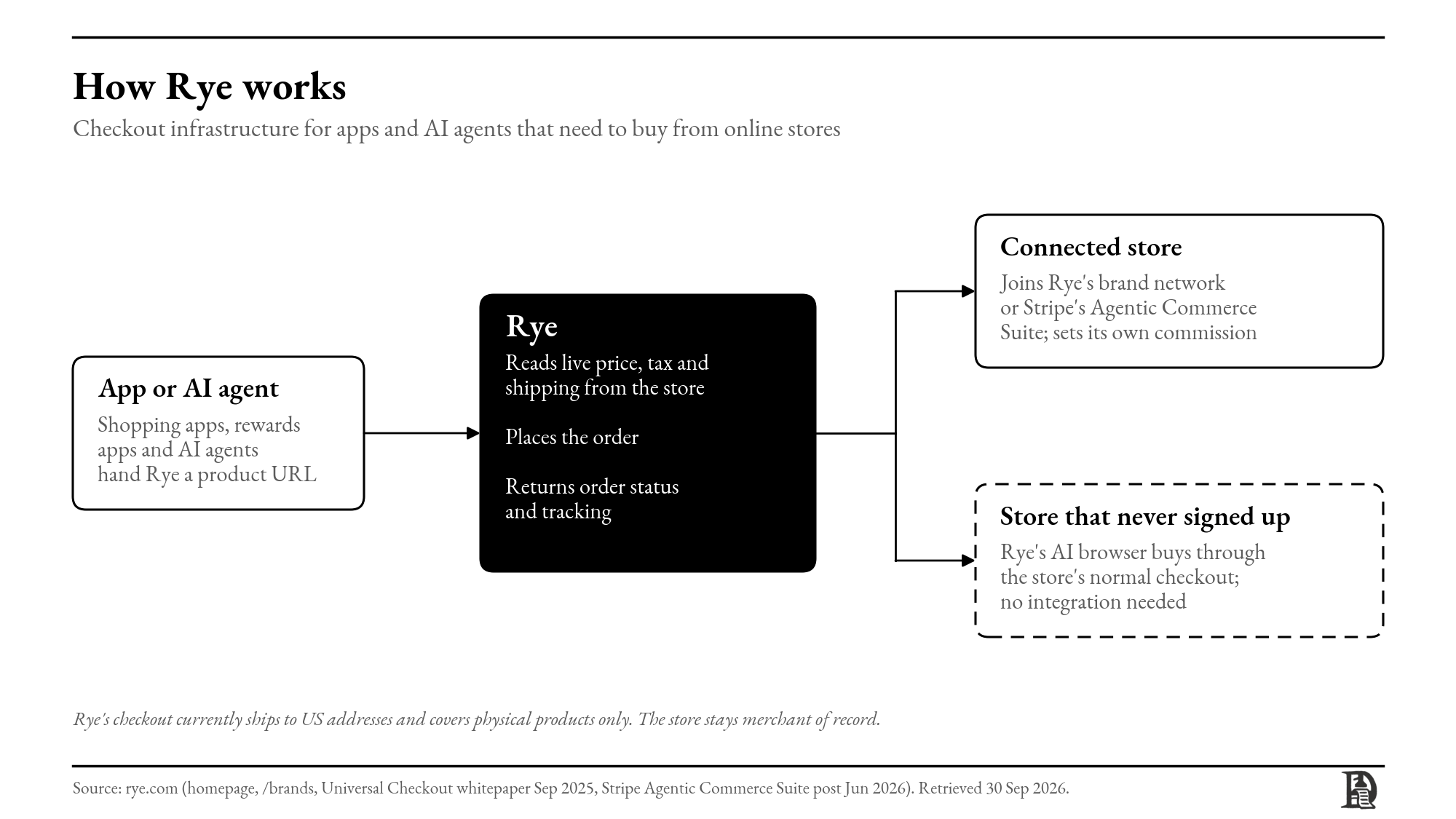
It claims more than 15,000 merchants and lists “no merchant opt-in” as a feature. Developers pay $149 a month with $50 of credit included, then five cents per order and two cents per product lookup. An agent with a crypto wallet can skip the account and pay per call in USDC through x402 and AgentCash, at two cents to open a checkout and three cents plus the item’s price to place it.
To get past the bot filters most big stores run, Rye sends checkouts through a proxy network with residential IP addresses, which it says keeps orders from being blocked. Its ChatGPT connector, still in beta, is pitched as the only way to shop Amazon from inside ChatGPT.
Amazon bars other companies from sending automated tools to shop its site, and nothing on Rye doesn’t explain how its Amazon orders fit with that rule, which, after this month, I would very much like to know.
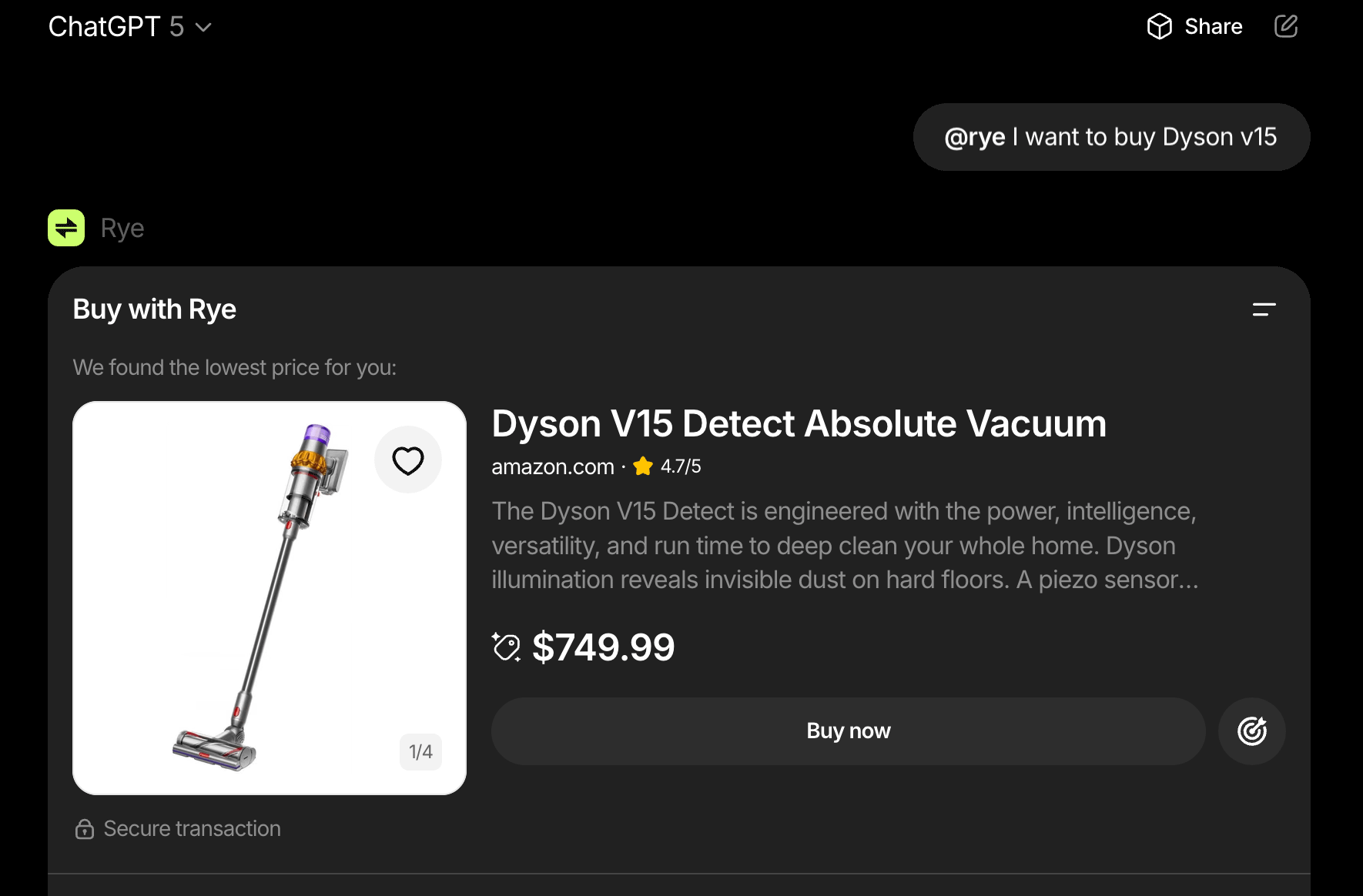
Look at the small merchants, suppose an AI assistant recommends a pair of running shoes from a small independent store. The shopper rarely searches for the store or browses its homepage and may never see its normal checkout page. Rye can still place the order against the merchant’s existing system. The merchant sets the price and remains responsible for sending the shoes.
Some merchants connect directly to Rye. In those cases, Rye can send the order straight into the merchant’s system instead of navigating the website, and the app that brought the customer can earn a commission. A normal marketplace earns its position by gathering buyers and sellers in the same place. Rye does not have to gather shoppers at all. The shopper can belong to Muse, ChatGPT, Instinct or some future agent that has nothing to do with Rye. Rye only needs to be there when that agent decides what it wants to buy.
That changes where the valuable part of the marketplace goes. Amazon showed you the product and then sold it to you. Google sent you somewhere else, so it monetised the search instead. Meta showed you an ad and hoped the merchant could finish the job.
There are already early signs that people who shop the agent way and how they behave differently. L.E.K. surveyed 2,650 US consumers in April and found that about 30% had used AI to help make a purchase decision. Among the people who already use AI for shopping, 46% now begin their research with a standalone AI product such as ChatGPT or Gemini. Traditional search starts 24% of those journeys.
Two years ago those numbers were almost reversed, with 43% beginning on search and only 25% with AI.
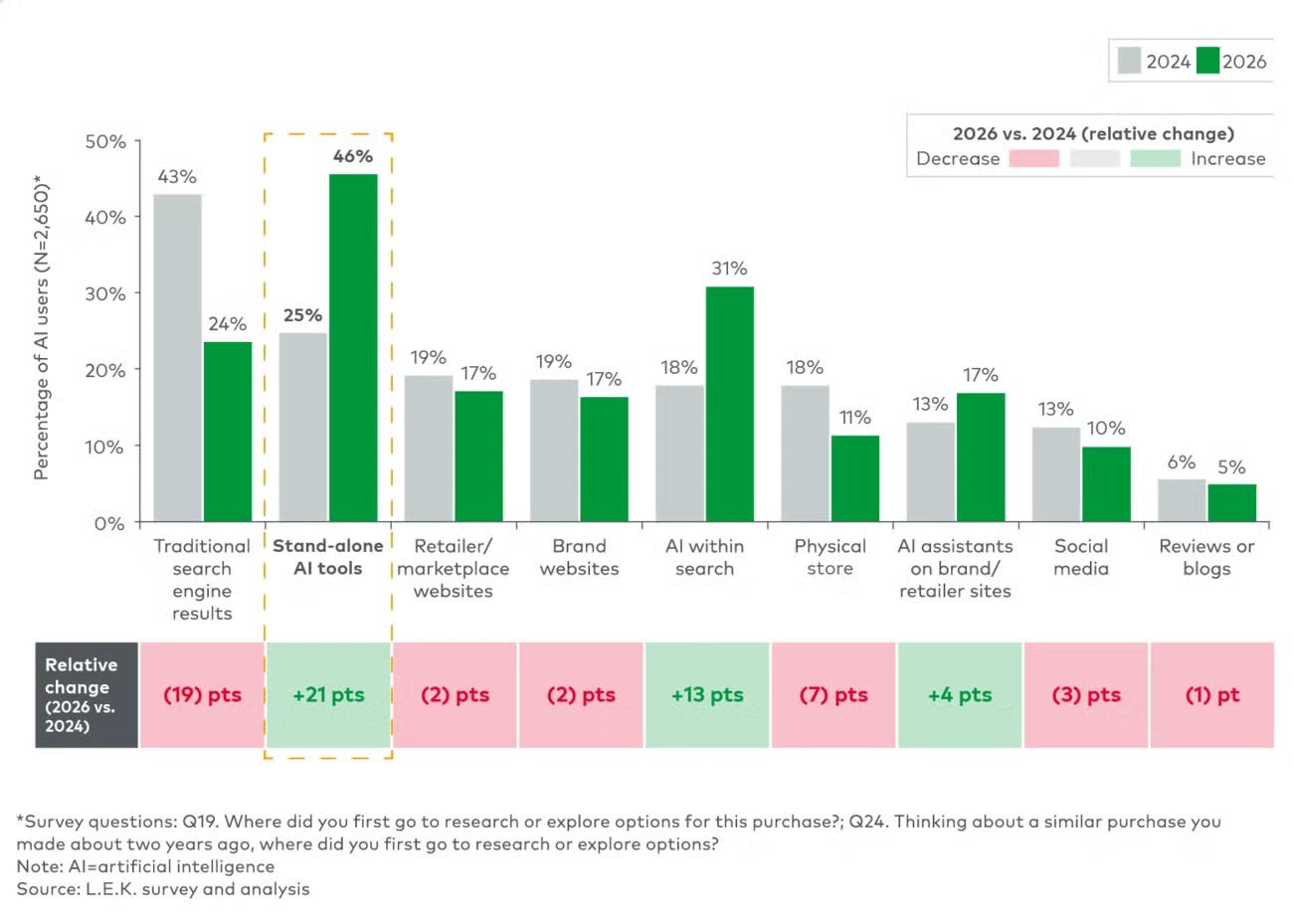
That is still a subset of shoppers, but it helps explain why the traffic arriving from AI behaves differently once it reaches a store.
Shopify says visitors from AI-referred orders grew nearly thirteen times year over year in the first quarter of 2026. Visitors arriving on product pages from AI search also converted almost 50% better than organic search traffic and spent 14% more per order. The easiest explanation is that some of the shopping has already happened before the customer arrives.
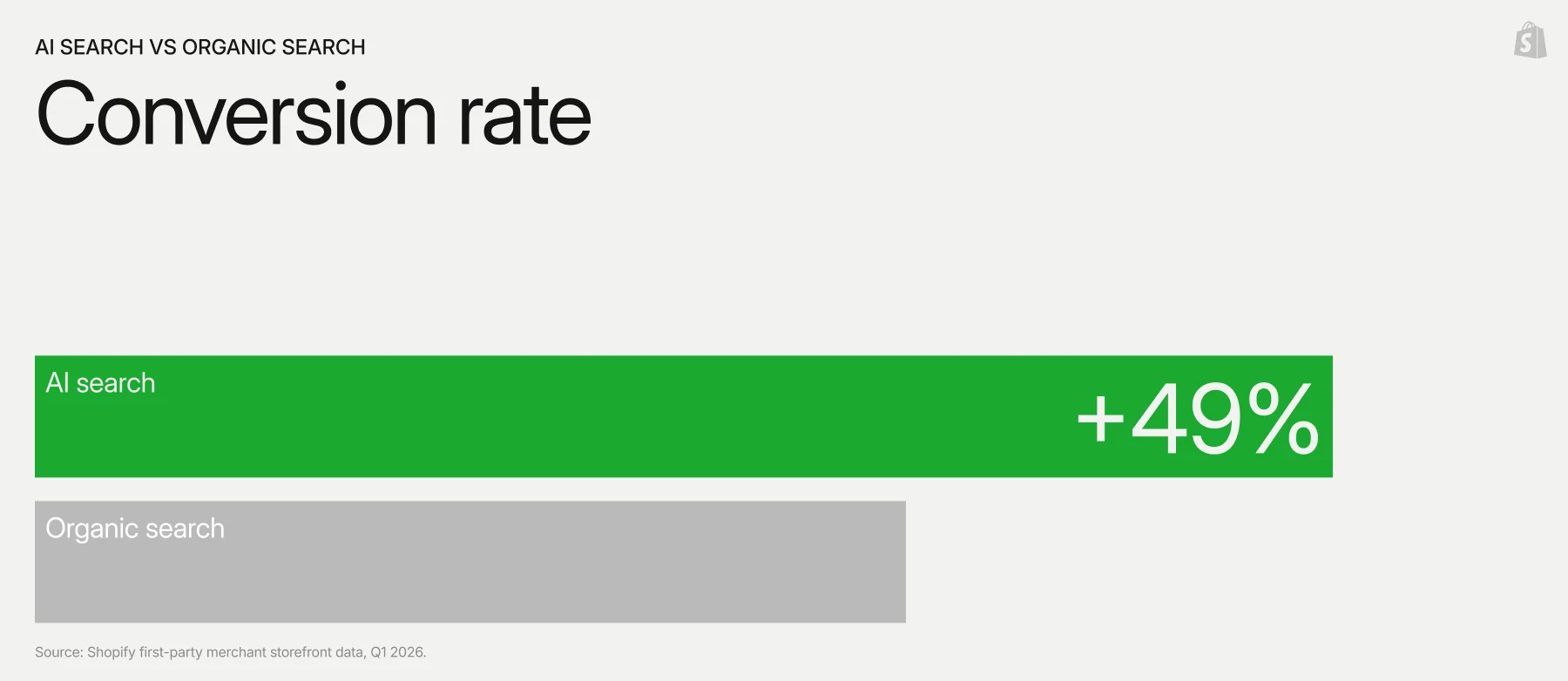
If I search Google for the table, I may still be at the stage of figuring out whether I want one. If I spend ten minutes telling an assistant that I am 160 centimetres tall, work from home, have a small room and refuse to spend more than $100, whatever store I eventually reach gets a much more decided version of me. The merchant gets better traffic without necessarily owning the conversation that produced it.
Who decides which merchant receives that traffic?
Amazon search gives sellers several chances to be seen. A shopper may scroll through twenty products before choosing, so even a merchant that does not rank first can still appear through organic results, ads or recommendations. An AI assistant may reduce all of that to three suggestions. Once thousands of stores are reachable through infrastructure like Rye, simply being available matters very less and instead getting chosen becomes the scarce part.
That puts a lot more power in the system making the recommendation. Rye can make a product purchasable, Shopify can make the catalogue readable to an agent, and standards like ACP or UCP can help the systems talk to each other.
The agent decides whether your table is one of the three shown to the customer. Merchants may get access to customers without relying on a traditional marketplace, but they become more dependent on a recommendation system they do not fully control. The money around placement will probably follow. But the incentive to pay for visibility does not disappear. Merchants may eventually pay for promoted recommendations, affiliate placement or better product data that helps agents surface them. Companies like Wildcard are already building around that problem. The auction may simply move from the page into the recommendation layer.
At 5 cents an order, Rye would need about 20 million orders a year to make $1 million from checkout fees alone, before its monthly subscriptions are included. So the more interesting part of the business may be its directly connected merchant network.
Those merchants can offer a commission whenever Rye sends them a sale. The merchant only pays when someone actually buys. Rye says developers typically earn 14% to 17.5% on sales from its directly connected merchants. What we still don’t know publicly is Rye’s own economics on those transactions, including how much of the merchant-funded commission it retains.
Amazon’s 15% referral fee applies to every sale, including sales to shoppers who would have found the product anyway, and the ads on top pay for attention that may never turn into an order. When an agent does the scrolling, there is no person to catch, so the ad budget drifts toward whoever delivers a finished order, which works like an affiliate commission if you think about it.
Rye is not the only company trying to sit between agents and merchants, although others attack different parts of the transaction.
Firmly works from the retailer’s side. It lets companies such as Best Buy and Backcountry sell through AI agents while the retailer remains the actual seller responsible for the order. Firmly already powers checkout inside Perplexity. Channel3, which raised $6 million led by Matrix, has built a catalogue of more than 50 million products for agents and passes a 5% commission to the developers whose apps send buyers. Shopify, meanwhile, offers its Agentic plan to brands that don’t use Shopify for their store at all, which puts the biggest name in independent commerce in the same line of work. If a Shopify store gets an order from Google, Instagram, ChatGPT or Muse, Shopify can still participate in the transaction underneath.
So opening stores to agents can increase the number of places where Shopify merchants are able to sell without necessarily weakening Shopify’s relationship with those merchants.
The platforms want their cut as well. Shopify charges merchants nothing beyond normal payment processing for sales through Meta’s checkout, though its terms say those orders are credited to Meta. Muse passed 2.8 million downloads in its first 12 days, and investors have just valued Instinct at $10 billion. At Meta Connect on September 23, Mark Zuckerberg said Meta expects to take a small fee on these transactions over time, without giving a rate or saying who would pay it. Whatever number he picks will be the first public price for an agent’s recommendation, and every merchant will hold it up against the 15% it already pays Amazon.
Being the merchant of record still counts legally, though it increasingly describes the part of the sale with the thinnest margin, the part made of warehouses, returns and customer service emails.
The agent may also remember why you chose that product and what you rejected along the way. That makes the next purchase easier to influence, which is where the longer-term customer relationship starts to count.
Marketplaces have fought middlemen before. In 1997, Bidder’s Edge pulled listings from eBay and other auction sites into one search engine. Its software hit eBay up to 100,000 times a day to keep those listings fresh. eBay sued, and in 2000 a federal judge stopped Bidder’s Edge from accessing the site without permission.
Bidder’s Edge stood between eBay and the shopper, letting someone else decide where the customer went next.
An AI agent can do the same thing, except it can also compare products, remember what you like and handle payment.
The law has moved since then. In August 2026, the Ninth Circuit overturned an injunction Amazon had won against Perplexity’s Comet browser, partly because the user, not Perplexity’s servers, was accessing Amazon. The ruling was narrow, and Amazon can still use its terms and other restrictions to control access.
Still, the fight is basically the same one. The valuable position may belong to whoever hears “charger died” first.
Token Dispatch is a daily crypto newsletter handpicked and crafted with love by human bots. If you want to reach out to 170,000+ subscriber community of the Token Dispatch, you can explore the partnership opportunities with us 🙌
📩 Fill out this form to submit your details and book a meeting with us directly.
Disclaimer: This newsletter contains analysis and opinions of the author. Content is for informational purposes only, not financial advice. Trading crypto involves substantial risk - your capital is at risk. Do your own research.