


Hello,
Perps, or perpetual futures, processed over $90 trillion in trading volume last year. For scale, that’s more than the combined GDP of the top 10 countries in the world. Today, perps account for about three-quarters of all crypto derivative trading and have been growing faster than almost any other financial product in history.
And even with all that happening, no American institution could legally trade them, at least until last Friday. On May 29, the CFTC approved Kalshi to list the first regulated Bitcoin perpetual futures contract in U.S. history. And on the same day, it also gave Coinbase a green light to route its customers to global perps and options through Deribit.

HYPE, Hyperliquid’s token, jumped 30% after that news. For context, Hyperliquid is currently the largest on-chain perpetual exchange, and it does not serve American users. CFTC Chairman Michael Selig wrote an op-ed in Coindesk, calling perps “a foundational risk management and price discovery tool in the global crypto asset markets.” If you have been in crypto for a while, seeing all this happening in real time is a bit wild. Let me explain why it matters.

How Did Perps Get to $90T
It started in 1993, when Nobel-winning economist Robert Shiller published a paper proposing a futures contract that could never expire. His idea was that homeowners could use this to hedge against falling property prices without ever having to sell their house.

The concept was interesting, but it had no practical use at the time because the entire derivatives market operated on expiry, with clearing houses and margin models all settled on a fixed date. For example, agricultural contracts would settle on a fixed date each month, while bond futures would have coupon dates. There simply wasn’t the infrastructure for it, so it remained an idea in academic journals for decades.
Then, in May 2016, three founders in a Hong Kong office decided to experiment with it. Arthur Hayes, Ben Delo, and Sam Reed launched BitMEX with a modified version of Shiller’s original concept. They built a futures contract on Bitcoin with no expiration date and added a mechanism to keep its price tethered to the underlying market, allowing people to trade it with up to 100x leverage. Within 18 months, BitMEX became the largest derivative crypto exchange.
So, what actually is a perp, and how does it work?
In a regular futures contract, you bet on where the price of something will be on a specific date. For example, a Bitcoin June 2026 futures contract will settle when June arrives, at whatever the price is, and if you want to keep your position open, you will have to buy the next contract. The problem is that every time the rollover occurs, it costs you money and leaves gaps in your exposure.
A perp, on the other hand, removes the expiration entirely. You can open a position, and it stays open until you close it. It could be as small as five minutes or as long as five months. The catch here is that a regular futures contract naturally snaps to the real price when it expires. But a perp never does, so it needs something else to keep it honest about pricing. For that, it uses the funding rate.
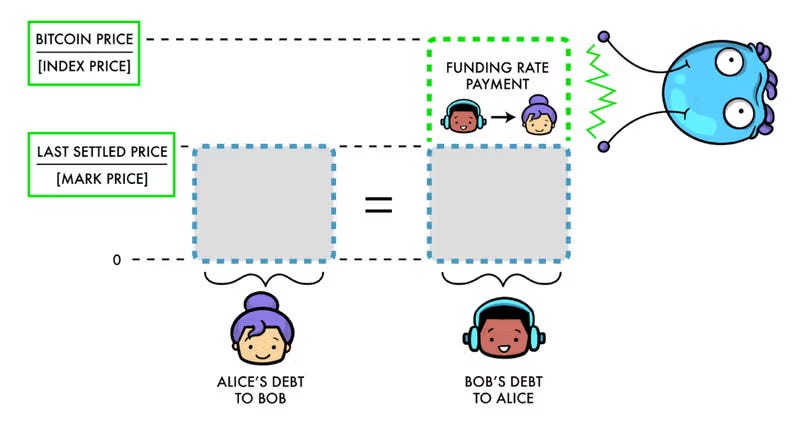
One reason perpetual exchanges became so popular is that, compared to traditional exchanges, which split liquidity across quarterly contracts (March, June, September, December), perps put everything in one place. There is a single order book. This made them among the most efficient venues for trading, and in financial markets, efficiency compounds. The more traders show up, the tighter the spreads get, leading to even more traders showing up.
Offshore perps grew from $28 trillion in annual volume in 2023 to over $90 trillion in 2025. On-chain perps on decentralised exchanges grew even faster, up 346% in 2025 alone to $6.7 trillion. And on any given day, perp volumes run roughly 10 to 15 times larger than spot volume. That means the price discovery of an asset has now moved from spot to derivatives. When Bitcoin moves 5% on a Tuesday afternoon, the move almost always starts in perps. A cascade of leveraged positions triggers liquidations that force buying and selling, which spot follows.
The tail wags the dog, and this entire market, the part of crypto that actually sets the price, was completely off-limits to American institutions until now.
What Does This Mean for the U.S.?
America finally has access to perps, but just not to the same product that the rest of the world trades. Even Coinbase’s own operations will route through a subsidiary in Bermuda to Deribit in Dubai, because liquidity was built offshore over years of regulatory hostility and is not coming back overnight.
U.S. perps are capped at around 10x leverage with full CFTC segregation protections; by comparison, offshore traders use 50x to 100x leverage. At 100x, one dollar controls a hundred dollars of exposure. A 10% price move returns 10x your capital. An options contract on the same move pays far less because the premium you pay upfront already prices in some of that expected move, and time decay chips away at the position every day you hold it. A typical one-month Bitcoin call nets you around 3x on that same 10% move. The leverage is the product here, and the American version is still the tame one.
This is why HYPE went up the day the CFTC legalised perps in America. The immediate take from many people was that volume would now migrate from Hyperliquid to Kalshi and Coinbase, and that regulated venues with institutional capital would eat into what Hyperliquid had built.
Hyperliquid made $907 million in revenue last year without a single American user. Think about who actually trades on these platforms. The person opening a 50x short on a memecoin at 3 am will never open a Kalshi account for 10x on bitcoin. The institutional allocator who needs regulated access with proper segregation was never going to use Hyperliquid anyway. These are different products for completely different sets of people. What it did was, the CFTC just confirmed that the product category Hyperliquid dominates is legitimate. And for Hyperliquid, that’s pure validation.
And while American exchanges are still limited to Bitcoin perps under regulatory guardrails, Hyperliquid has already surpassed crypto entirely. Through HIP-3, anyone can launch a perp on any asset, and many are already live. Silver perps had hit $4 billion in daily volume during the February spike, and oil perps briefly surpassed Bitcoin’s perp volume in April.
Jeffrey Sprecher, CEO of Intercontinental Exchange, the company behind the New York Stock Exchange, said this at a Bernstein conference two days before the CFTC approval: “This Hyperliquid that we’re talking about, if you haven’t heard about it, it’s bigger than NASDAQ, okay?” Today, ICE is talking to Hyperliquid, learning about their model, and asking regulators why traditional venues cannot offer the same products. The direction of learning has shifted: Wall Street is studying a two-year-old decentralised exchange with zero VC funding because it has built a trading infrastructure that the world’s largest exchanges now want to replicate.
Perps Are Going to Eat Everything
The reason I think this moment is bigger than anything is that perps are no longer staying just in crypto.
They started as a tool for trading on Bitcoin and then expanded to every altcoin. And from there to now into commodities like gold, silver, oil, and natural gas. Then to equities like NVIDIA, Tesla, etc., to then pre-IPO companies like SpaceX, OpenAI, and now also including prediction markets through HIP-4.
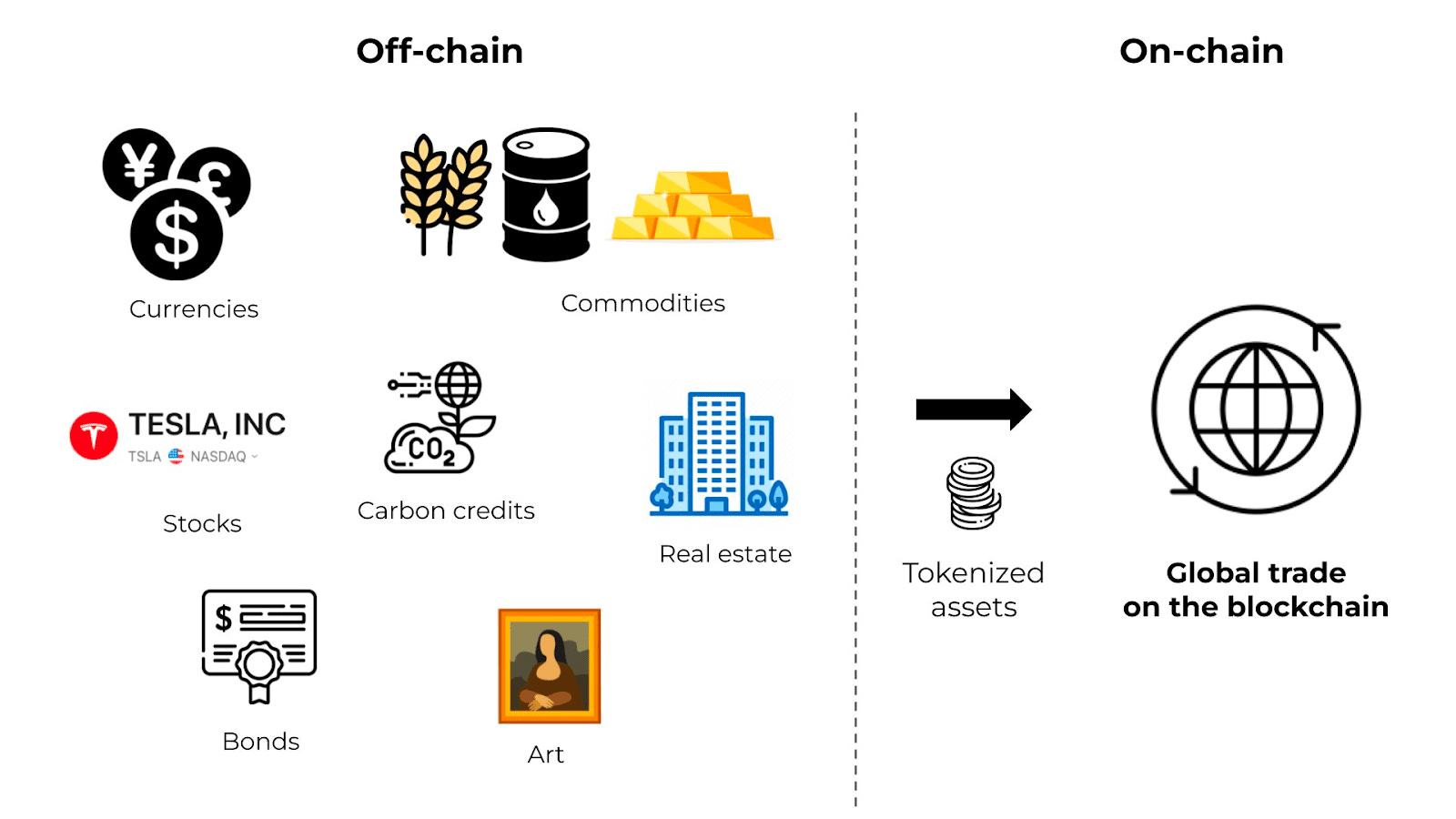
In two years, perps have gone from a crypto-native hack to a financial instrument that can reference any asset in the world, trade 24/7, and have no expiration or clearing intermediary. Traditional derivatives were built for when markets closed at night, and they made sense for as long as trading happened on physical exchange floors and settlement required paperwork.
But in today’s global digital infrastructure, when assets move around the clock, session-based markets can leave gaps. An oil trader who wants to position around a weekend geopolitical event has no option on any regulated exchange. On Hyperliquid, that trade is already happening. And the CFTC just acknowledged this. The agency’s staff advisory on 24/7 trading explicitly said: “Derivatives referencing crypto assets may be well-suited for 24/7 trading due to digital infrastructure and global reach.”
The real race now is whether American-regulated venues can move fast enough to matter. For instance, the average centralised exchange charges around 4 basis points on futures, whereas Hyperliquid charges just 2 basis points. On spot, the difference is wider: 15 basis points versus 5. When switching platforms takes only minutes, traders will go only where fees are lower.
Compass Point’s analyst assigned a sell rating to Coinbase the week of the CFTC’s approval, arguing that a wave of competition in derivatives will erode pricing power and squeeze margins. Coinbase earned $50 million in perps revenue in Q1 2026, while retail trading revenue fell to its lowest level since Q3 2024. Perps are growing, but they are also cannibalising higher-margin spot trading.
In fact, the compression shows up in many areas. If you can achieve leveraged directional exposure on any asset, at any time, without an expiration date, then traditional derivative products feel insignificant. For instance, why roll a quarterly futures contract when a perpetual contract provides continuous exposure? Yes, funding rates in a crowded trade can run higher than the cost of a roll, sometimes 2% every eight hours. And exchanges have every incentive to keep quarterlies alive because rolling means two extra trades and two extra rounds of fees. But most retail traders hold positions for hours or days. For them, no expiry is just simpler.
Why buy a short-dated option when a perp gives similar directional leverage? Yes, with options, your downside is capped at the premium. But look at where the volume actually sits. 0DTE SPX options averaged 2.3 million contracts a day in 2025, and most of that is pure directional betting. For that use case, perps are simpler.
I am not saying perps will fully replace options or traditional futures because options give defined risk and convex payoffs that perps cannot replicate. However, for the vast majority of trading activity focused purely on directional leverage, perps are a far better and cheaper alternative. And ultimately, the product has proved to be successful, at least $90 trillion a year says so.
That’s all for today.
Token Dispatch is a daily crypto newsletter handpicked and crafted with love by human bots. If you want to reach out to 170,000+ subscriber community of the Token Dispatch, you can explore the partnership opportunities with us 🙌
📩 Fill out this form to submit your details and book a meeting with us directly.
Disclaimer: This newsletter contains analysis and opinions of the author. Content is for informational purposes only, not financial advice. Trading crypto involves substantial risk - your capital is at risk. Do your own research.