


Hello,
AI, much like a religion, remains privately financed and valued, within closed doors. A select few firms raise huge sums, hire the best researchers, rent the biggest clusters and let the rest of the market infer value from funding rounds announced months apart. ‘Valuation’ has often been a number agreed upon in a room and not a price discovered in a free-flowing market. By the time ordinary investors see the price, most of the upside has already been absorbed by the early players.
Bittensor’s wager is that AI should not be financed like that, and I am fascinated by what it’s building. Not because it builds any better models than the OpenAIs, Anthropics and Googles of the world. At least not yet. But it’s found a decentralised way to judge, fund, and price AI projects in public before they become conventional companies.
This approach is notably different from many decentralised attempts we have seen in the previous AI waves.
Bittensor’s subnets are backing teams, rewarding execution, cutting off laggards and repricing the whole AI in real time. This is unlike any previous attempt to price AI. I know it’s a brutal way to build AI, but it’s also a more honest one.
In today’s deep dive, I will walk you through how Bittensor’s model works and why it could outperform any previous attempts at AI pricing.
Shall we?
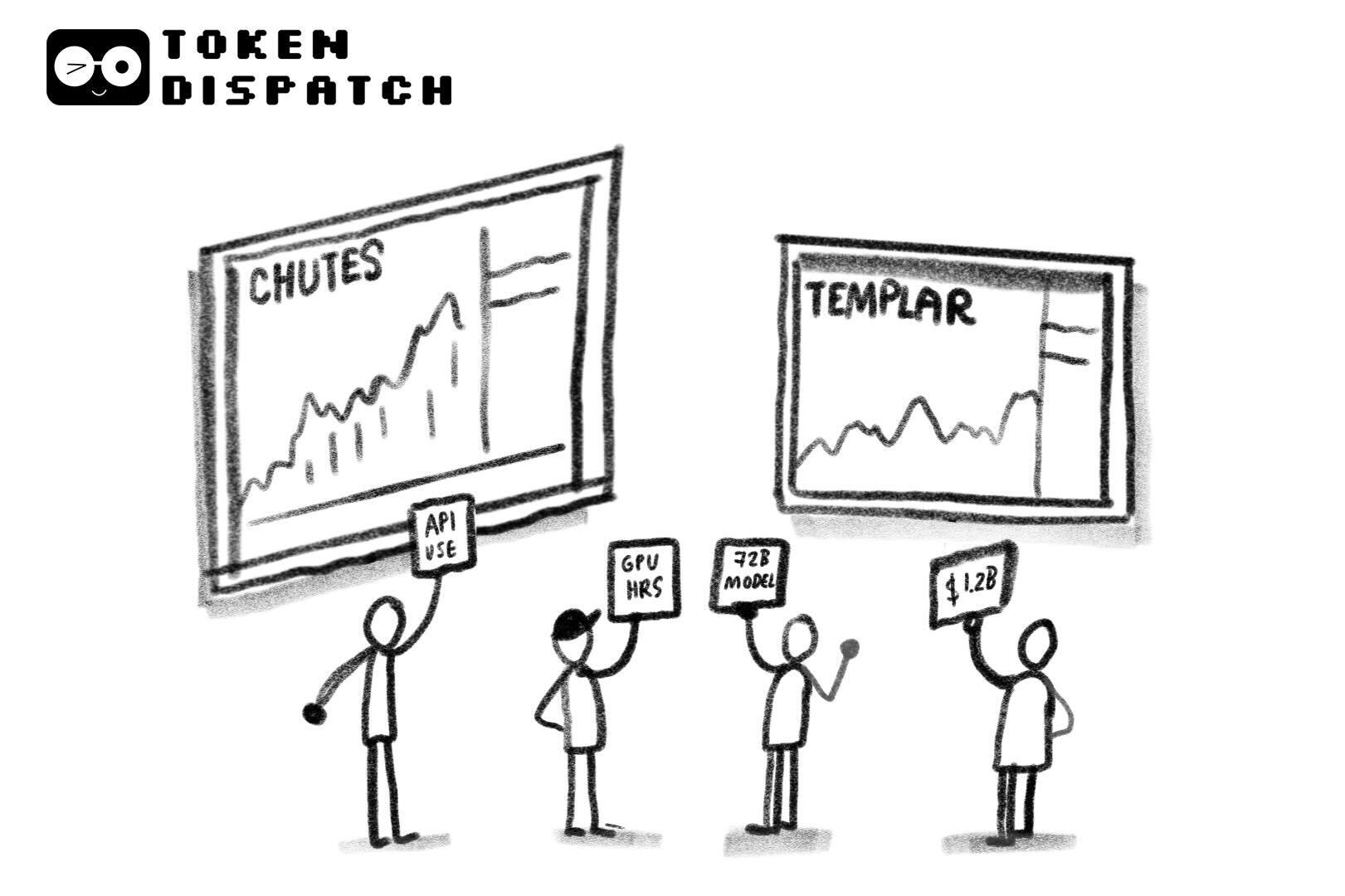
The Room Where AI Gets Priced
In Q1 2025 alone, AI start-ups secured $73.1 billion, or 58% of all global venture funding, despite warnings from investors like GIC and TPG that some market segments were being valued at exorbitant multiples, with little operating history to back up these valuations.
This model works for founders, insiders and late-stage investors, but not for others. It leaves out those who provide the crucial compute resources, developers who build on open models, and early consumer supporters. Even open-source AI doesn’t change this. The money still pools among cloud contracts, deployment layers, enterprise wrappers, support, security, and distribution.
Throughout the journey, while the general public contributes to creating value, it’s the select few who bear the fruit. Although this has been the status quo for a long time, what’s changed is the rise of the open model AI economy.
Enterprises are increasingly adopting open-source AI models for on-premise, sovereign, and specialised workloads, especially in highly regulated sectors such as telecommunications and banking, Red Hat Developer noted in its report. It serves enterprises looking to deploy AI to monitor, automate, and scale AI workloads, rather than just reference an AI model.
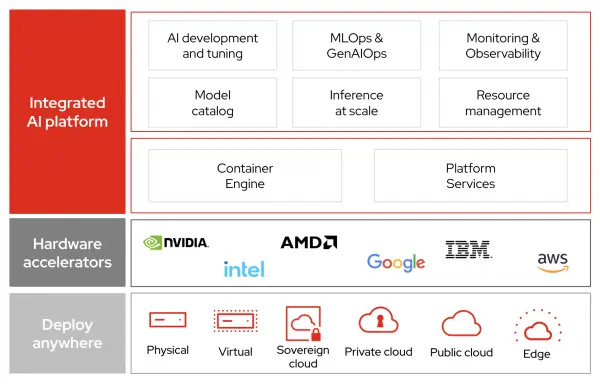
Larger firms like McKinsey have also endorsed this idea. The firm’s survey found that more than half of the respondents were already using open-source AI across their technology stack. The survey included more than 700 technology leaders and senior developers across 41 countries.
Bittensor’s model takes cognisance of all these changes and challenges the current model of pricing an AI project.
The crypto natives are losing their minds over Bittensor’s native $TAO token, which has doubled in price over the past month. Some others are busy talking about decentralised versus centralised AI. But what’s more important to me is to probe what a more accurate way of pricing AI is. Bittensor feels it’s one where the people financing, building, validating and using the AI meet in one market and price it based on open metrics.
Taking AI to Public Markets
Bittensor is easier to understand when you think of it as a network of mini AI economies rather than as a single token.
Each subnet is a specialised market for a specific task in the AI stack. It could focus on interference, distributed training, prediction signals or computation. Subnet owners set the incentive structure and tasks they want to accomplish; miners carry them out, while validators judge and score them. Stakers can support specific validators by staking TAO with them.
The incentive structure became more interesting after Bittensor announced the Dynamic TAO upgrade in February last year. With this, each subnet got its own token and liquidity pool. Bittensor stopped being a single, broad AI trade and became a system with many smaller AI ventures living within it.
Later in 2025, Bittensor made rewards depend more on net TAO inflows than on stale token prices. The icing on the cake came in December with the first halving of TAO issuance, reducing the daily issuance to 3,600 TAO. This forces the financiers to choose where to place their capital. It turned the AI marketplace into a survival of the fittest.
Web3 researcher and writer Jeff aptly terms this “the dynamics of Darwinian AI” and summarises it beautifully in the newsletter 0xJeff.
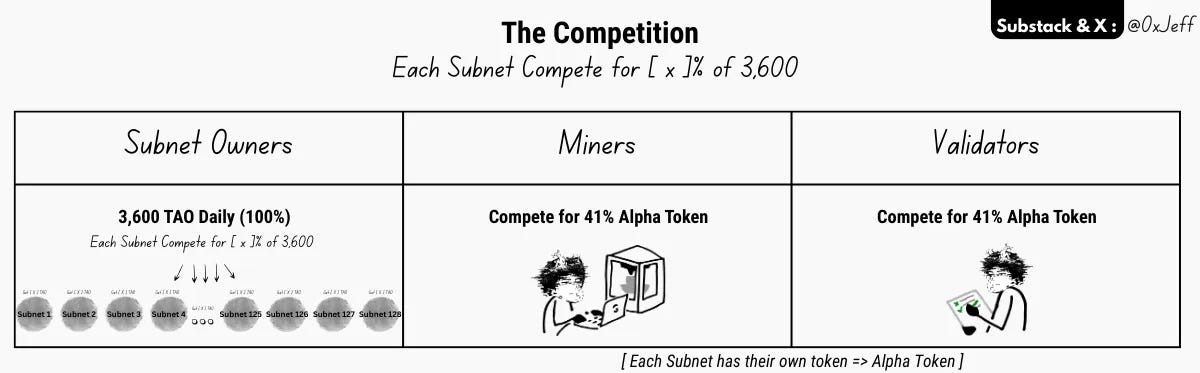
Darwinism = evolution through natural selection. Human competes and all the good traits that help with survival keep on getting passed on to the next generation.
Similar concept is being applied within Bittensor across a couple of layers:
Subnet Competition: Subnets compete for a share of 3,600 TAO incentives. Top subnets ensure they can survive longer with the incentives.
Miner Competition: Miners compete to deliver the best work. Depending on the subnet, people across the world compete to deliver work that meets subnet KPIs. Top performers receive highest share of the 41% of the alpha token incentives.
Validator & Investor Competition: Validators also compete to validate miners task while investors compete in investing in the right subnet(s) that perform
What happens if you don’t compete OR you don’t perform?
Death.
Subnets get delisted (Yeah.. that’s a thing, you get deleted).
This is where the comparison with traditional AI becomes useful.
In the conventional model, a founder pitches a company, raises equity, hires a team, builds in private and hopes the market agrees with the valuation.
Bittensor flips this by publicising the bet much earlier in the market. Here, entrepreneurs start by launching a subnet, followed by GPU operators contributing compute. The developers and researchers then contribute work, after which investors buy exposure through TAO or specific subnet tokens. Customers follow by paying for the underlying service. The market collectively prices the project by considering everything at the end.
What I like most about it is that it reimagines the capital market for every stakeholder.
Investors get to continuously discover price, unlike in private startups, where they have to wait for the next funding round. In fact, Bittensor lets them take either a broad view of the overall ecosystem through TAO or make a narrower, focused wager on a single subnet they believe in most.
For builders, the appeal is in not being restricted to Anthropic, OpenAI or other elite hyperscalers to participate in the upside of the AI narrative.
It offers entrepreneurs a capital market around their idea even before it has matured into a full-fledged company, something we never see in the venture industry. You can see this playing out in how capital has clustered within the network. A small set of subnets now attracts a disproportionate share of TAO inflows and emissions, while others lag. The top five subnets by market cap account for almost a third of the cumulative market cap of 128 subnets.
For customers, the system can provide cheaper, more flexible access to open-model infrastructure.
Beyond all this, the Bittensor model appeals to all stakeholders more because it not only sounds fairer but is also commercially viable.
When the Market Grew Legs
This is evident in how institutions are seeing Bittensor as more investable.
In December 2025, Grayscale Bittensor Trust began trading on OTCQX, a top marketplace for over-the-counter stocks. The wrapper gives traditional investors a familiar route to an unfamiliar but highly demanded product.
This is how any new market grows legs: by finding a wrapper, a ticker, a price on a screen and a way into one’s brokerage account. We all saw this with Bitcoin and Ethereum ETFs and Digital Asset Treasuries (DATs). Bittensor might not command the same mindspace in the crypto market as Bitcoin and Ethereum, but Grayscale’s trust is a sign that the institution’s curiosity in it has matured from theory to product.
Bittensor’s work has attracted acknowledgement even from the top echelons of the elite industry that it promises to disrupt.
When Chamath Palihapitiya, a renowned venture capitalist and entrepreneur, brought up Bittensor’s distributed training run to Jensen Huang, the Nvidia CEO did not downplay it as an inferior crypto achievement. He called it a “modern version of Folding@home”, a term for a decentralised, distributed project that uses excess computing from volunteer computers to simulate protein folding or solve other complicated problems.
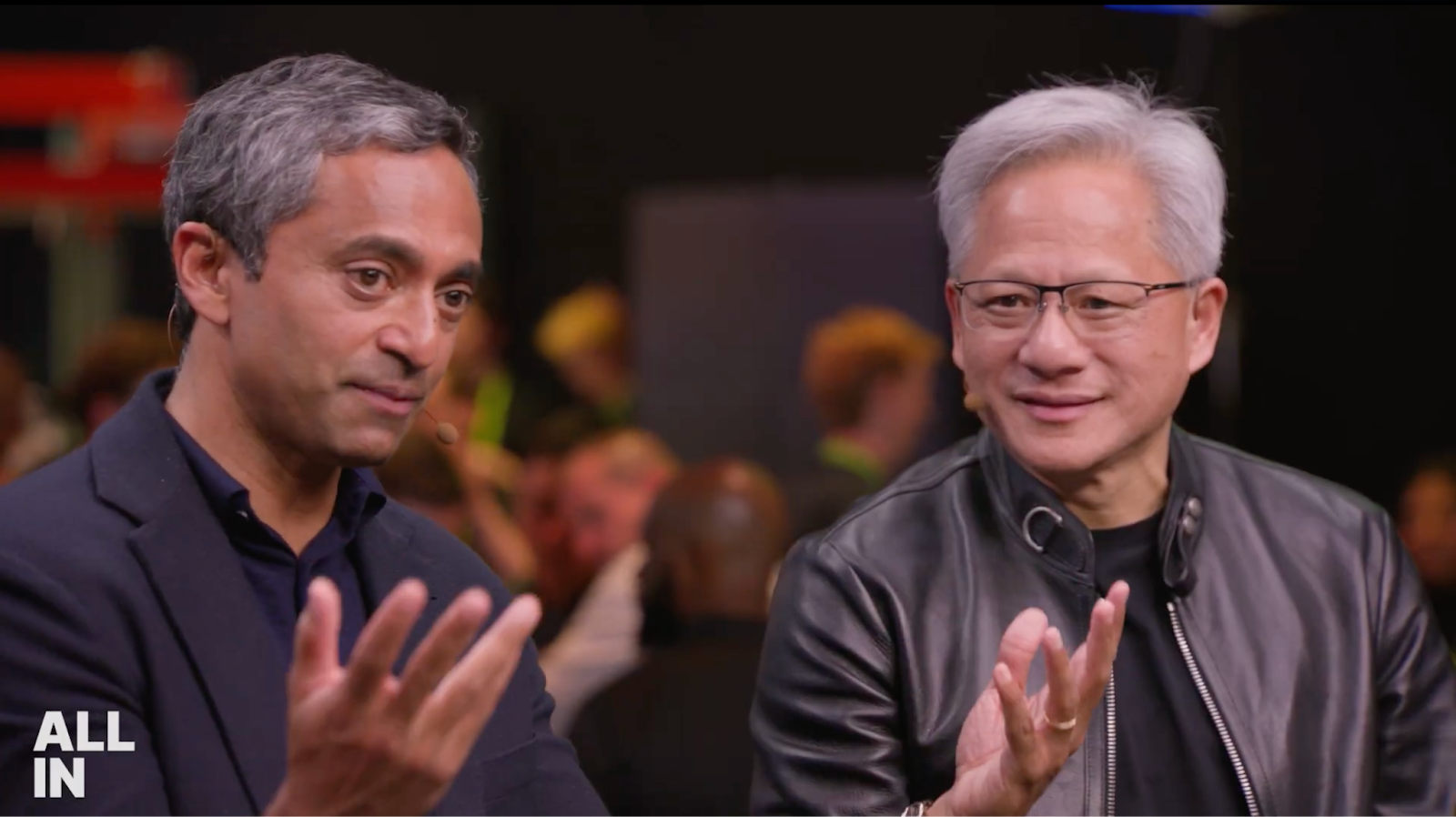
This acknowledgement positions Bittensor within a longer history of distributed computing rather than within the usual token-cycle narratives.
The recent accomplishment by Templar, one of Bittensor’s top subnets, adds more technical weight to what Bittensor can achieve.
Its Covenant-72B model describes a 72-billion-parameter model trained from scratch on 1.1 trillion tokens by 20+ globally distributed participants coordinated through Bittensor. On the published benchmark table, Covenant-72B posts an MMLU score of 67.11, versus 65.63 for LLaMA-2-70B.
In plain English, that’s still not enough to beat OpenAI or Anthropic. Yet, it does enough to prove that decentralised coordination can produce commercially relevant AI infrastructure.
Subnets such as Chutes are explicitly positioned as decentralised serverless AI compute platforms, while Bittensor’s own documentation describes subnets as separate competition markets for digital commodities such as inference, training and related AI work. It shows that the market is not pricing AI as a vague narrative, but is pricing specific pieces of the stack independently.
The Demand-Side Dilemma
Bittensor’s supply side is more transparent than any other AI marketplace. You can see emissions, staking flows, which subnets attract the most capital and which don’t. The concern arises on the clarity, or the lack of it, on the demand side.
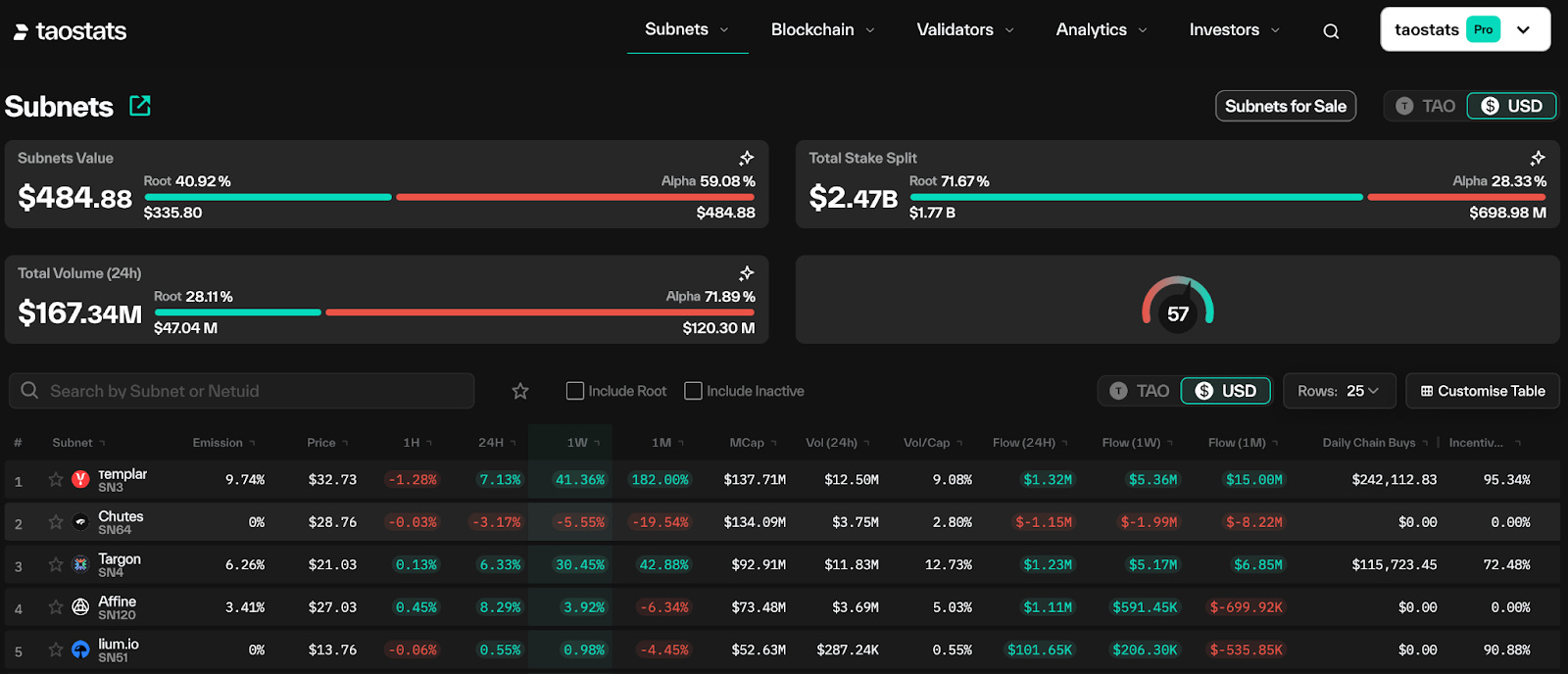
The blockchain records token movements but doesn’t collect data on customer retention, API usage quality, margins, or audited revenue. So, even when a subnet appears commercially thriving, you are often still inferring business quality from market structure rather than from financial statements.
Pine Analytics makes a sharp and pointed criticism in its sections on “Supply Transparency vs. Demand Opacity” and “Chutes (SN64): The Subsidy Behind the Savings” here.
They point out that some of Bittensor’s strongest commercial claims may still be subsidy-led. In this case, these subsidies accrue internally to subnets as TAO emissions. Pine estimates that the entire network’s identifiable external revenue is still tiny relative to the value implied by TAO.
This is evident in the fact that Bittensor’s largest subnet, Chutes, receives $52 million in TAO emissions annually, while generating $2.4 million in external revenue. Without the subsidy, it could cost Chutes a fortune to carry out its operations.
All this doesn’t take anything away from the Bittensor’s model. It merely acknowledges that the market may be pricing AI ambition better than it is pricing AI cash flow today.
This is all the more reason why I am interested in Bittensor’s journey.
It has all the signs of a maturing ecosystem. It hasn’t put to rest the ‘decentralised AI’ debate. It is still perfecting the most accurate way to value AI projects. Yet, it has taken strides towards exposing what the private market has chosen to ignore all this time. And it does so by letting the belief trade prices and valuations in the open.
While private AI players ask the world to trust a room to decide valuations in the trillions of dollars, Bittensor asks to trust the public market.
I know for sure that the latter is not perfect, but I also know and appreciate transparency when I see it.
That’s it for today. I will be back with another deep dive.
Until then, stay curious!
Prathik

Token Dispatch is a daily crypto newsletter handpicked and crafted with love by human bots. If you want to reach out to 170,000+ subscriber community of the Token Dispatch, you can explore the partnership opportunities with us 🙌
📩 Fill out this form to submit your details and book a meeting with us directly.
Disclaimer: This newsletter contains analysis and opinions of the author. Content is for informational purposes only, not financial advice. Trading crypto involves substantial risk - your capital is at risk. Do your own research.