


Hello,
On July 1, Robinhood launched its own Ethereum Layer 2. It built an L2 at a time when doing so is becoming increasingly trivial and cheaper because anyone can just rent one. What stands out for Robinhood is its 28 million funded accounts, most of whom have never used a blockchain. Even now, many will probably never know they are using one.
While Robinhood’s chain will face stiff competition from other L2s in generating considerable economic value, its traditional finance audience will paradoxically become its biggest moat in helping it stand apart from the competitors.
In today’s piece, I will explore what makes Robinhood the best-placed TradFi consumer app to make crypto rails invisible and turn a barely crypto-aware retail base into users of a full financial supermarket.
On to the story…

Chain Is No Longer a Business
Thanks to Rollup-as-a-Service (RaaS) platforms and modular frameworks, building an L2 scaling solution in 2026 is a weekend project. One could rent the Arbitrum Orbit or OP stack and settle in Ethereum.
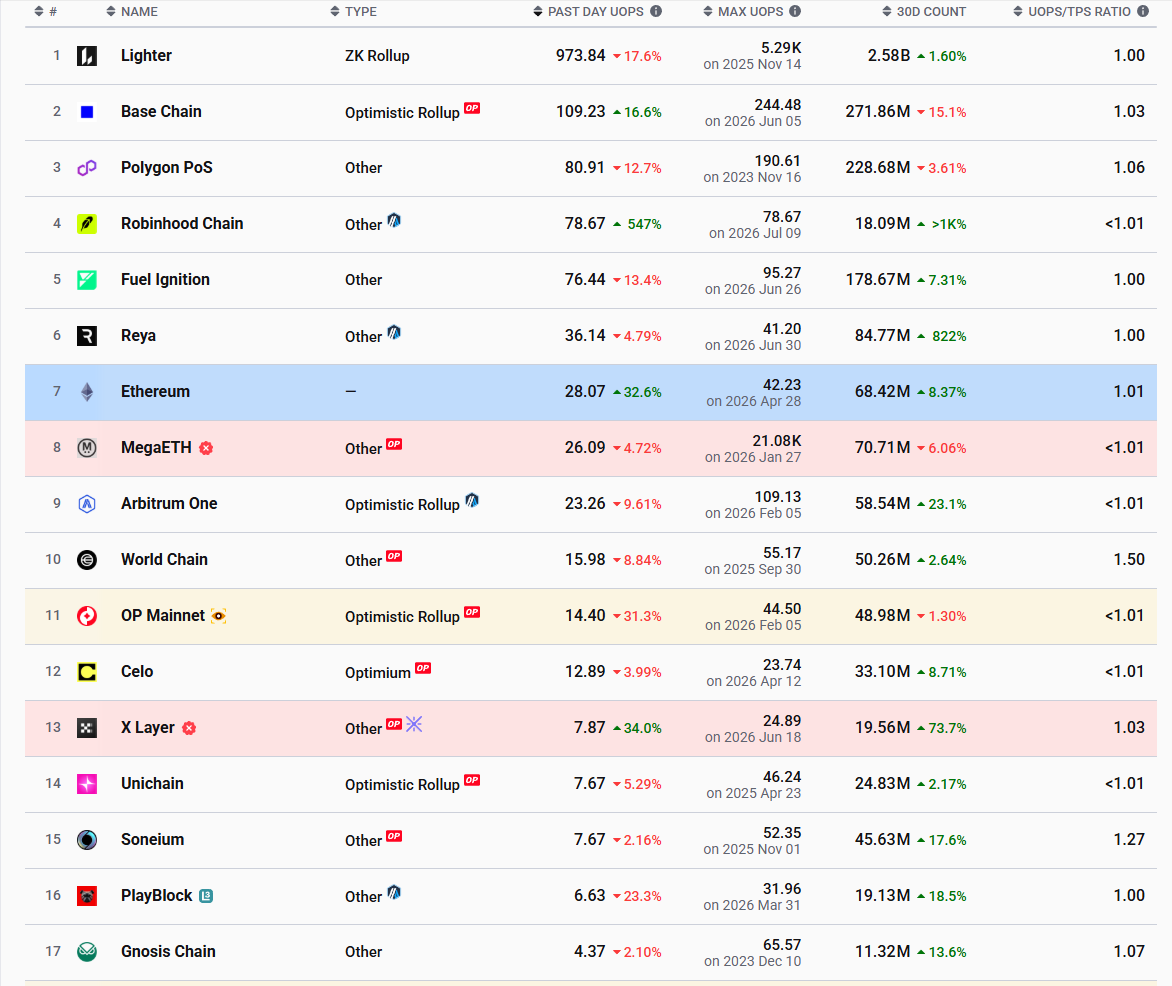
Every other large company that thought owning the rails rather than paying rent on someone else’s ended up in the same graveyard of chains. Only two L2s recorded three-digit user operations per second (UOPS) in the last 24 hours. When you look beyond the top 12, none of the 100+ chains crossed single digits in the last 24 hours.
This shows that running a chain itself is no longer a business. The chains that managed to stay economically relevant did so not through their superior technology but by riding on the ecosystem environment in which they operated.
Base rode a crypto-native moment that Coinbase could tap because its users were already on-chain curious. It further piqued the interest of its onchain-curious users through Onchain Summer, its annual festival and promotional campaign featuring collaborations with major brands and artists for NFT drops, gaming events, hackathons, and developer grants. It helped create an environment conducive to Coinbase’s goals for Base.
But blockchains never had to be the product that made money. Every major infrastructure eventually got commoditised, shifting value to the adjacent layer. The internet is the best example. It was the centre of all talks in the last two decades of the 20th century. In the 21st century, nobody consciously cares much about what it does, even when the entire world runs on it.
For crypto maximalists, a blockchain could mean many things. Maybe a tool of resistance against the centralised world of traditional finance, or a decentralised infrastructure that enables a parallel financial system. But when you zoom out, blockchains just become a useful infrastructure that enables capital to move more efficiently than existing tooling.
The product is then moving capital, not the blockchain itself.
So long as you can use a chain to move capital as efficiently as possible, it no longer matters who has the superior chain. Robinhood has 28 million funded accounts. This makes it one of the best-placed platforms to benefit from its chain.
Why Robinhood, But Not a Crypto Exchange?
Robinhood’s audience is the opposite of Base’s. The TradFi-first, retail-first people initially arrived for commission-free stocks and were then cross-sold adjacent products like options, retirement accounts, margin lending, stock lending, and so on. Robinhood only later eased its audience into crypto products as a nice-to-have asset class for those seeking exposure to emerging asset classes. None of the users ever had to think about the rails underneath. Most never cared about the crypto culture. They just wanted access to multiple asset classes in an app that they already trusted, and that is exactly what they got.
Making the blockchain almost invisible is the only strategy that would work for Robinhood’s audience. Blocks, blobs, gas fee and seed phrase will never be the vocabulary that amuses their users. Yet they will buy event contracts on Robinhood’s prediction markets, sign up for tokenised versions of stocks and lend money via Robinhood’s Earn product even without having to understand that it is being routed through a stablecoin (USDG, issued by Paxos) that is being lent into a DeFi vault powered by Morpho (a crypto protocol).
As long as the interface still looks like the brokerage app they have been using for over a decade, they won’t care about the underlying technology powering the assets they want to own or transfer. This is clearly reflected in how Robinhood CEO Vlad Tenev positioned the company’s image during their keynote speech on July 1 at the Old Royal Naval College in London.
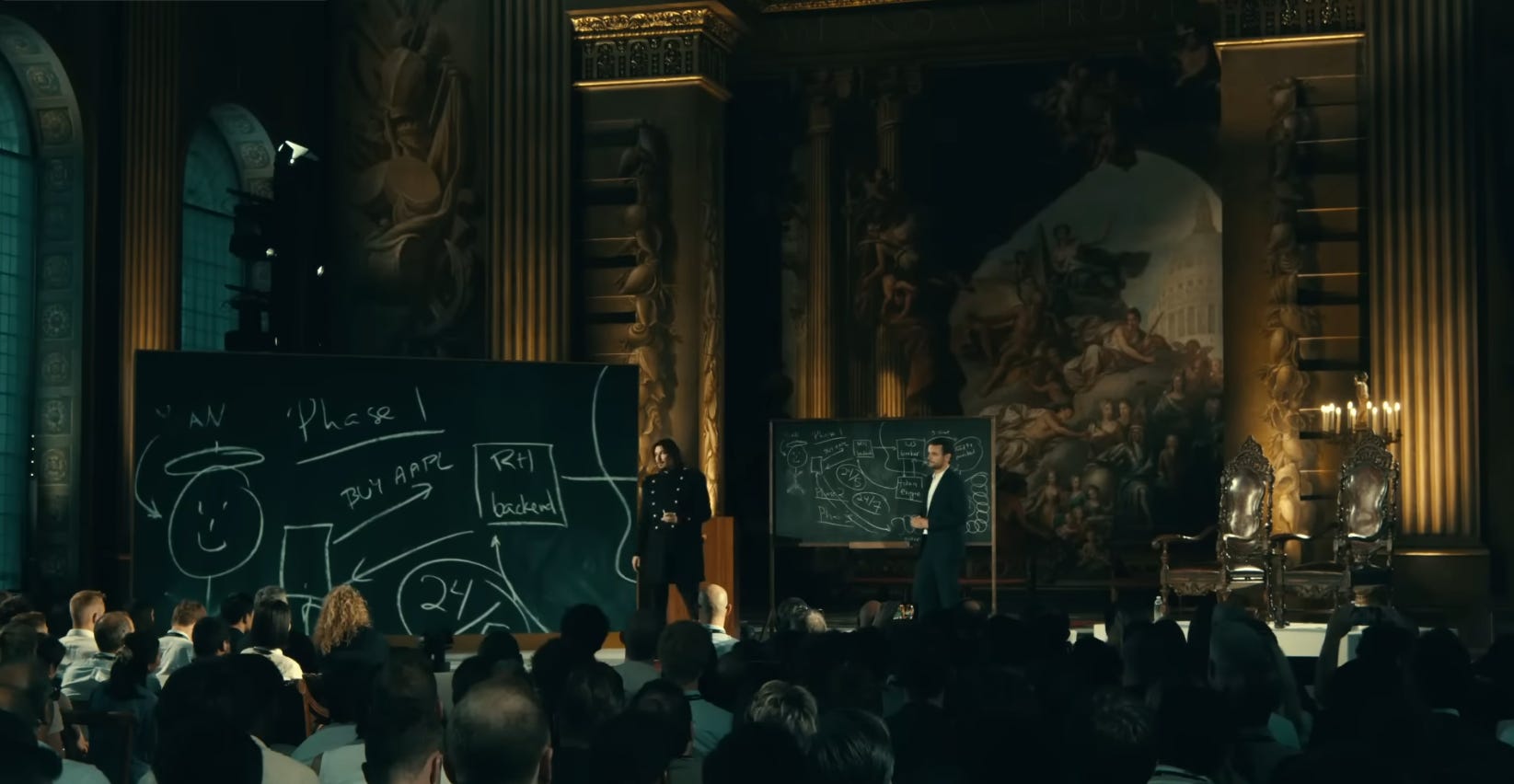
The hour-long speech titled ‘The World is Flat’ that involved half a dozen speakers, including Vlad, focused strictly on “ownership” and spared the technological jargon. Even though the company announced the launch of its chain, it never mentioned decentralisation, blobs, TPS, or developers.
This is why a comparison of Robinhood versus Kraken or Coinbase isn’t apt. While Coinbase built Base, Kraken has the Ink protocol as its L2 solution. But the difference is that both are crypto-native exchanges building chains for crypto-native users. That is convergence within crypto. While Coinbase’s edge with Base was its cultural proximity to on-chain–curious users, Robinhood’s edge with its chain is to use it to distribute a suite of crypto-adjacent products to an increasingly aspirational audience that does not care about the underlying commoditised layer of blockchain.
The Financial Supermarket
Robinhood’s chain enables it to offer its customers a full financial supermarket under one roof. They can buy Stock Tokens for equity exposure, Robinhood Earn for a ~7% yield on their USDG stablecoin through a Morpho-powered vault, leveraged exposure via perpetual futures through Robinhood’s integration with Lighter and use agentic accounts for automation.
Even beyond the DeFi product suite, they can get pricing probability through prediction markets, which is already Robinhood’s fastest-growing business.
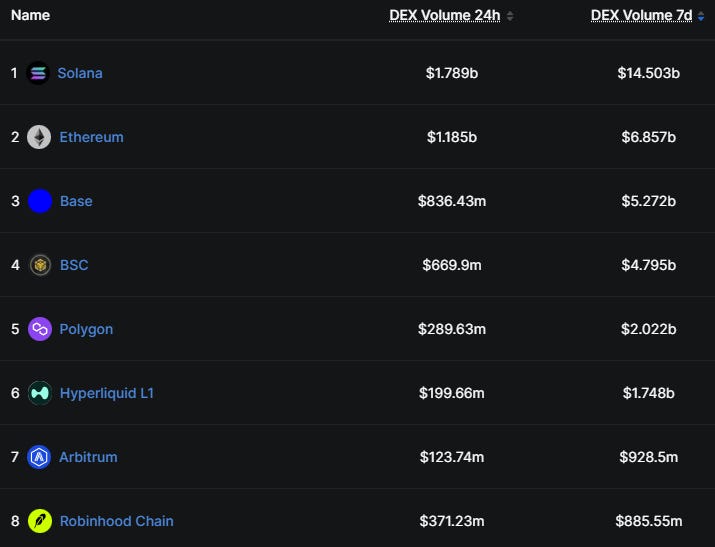
Robinhood’s chain already inspires confidence for a newly launched L2. Its TVL is a touch away from $100 million, less than two weeks after launch. The 24-hour DEX volume on the chain has made Robinhood Uniswap’s largest non-Ethereum venue. In terms of 7-day DEX volume, the chain ranks 8th.
The chain barely makes any money, though. Gas fees are subsidised for 90 days. But the interesting part is that Robinhood doesn’t need the chain to make any money.
Most other chains that need to justify their existence by charging transaction fees would be under pressure to juice activity. But Robinhood doesn’t need to. For Robinhood, the chain just needs to become an efficient layer that can bring the dozen business lines, from equity-to-event contracts, closer and hold the customer inside that circle. It can then use the chain to more efficiently cross-sell different products to them.
The appeal of the chain is in the convenience and access it offers for a user profile that matches Robinhood’s audience. For instance, a user in Europe with no simple path to a US brokerage account, or to earn dollar yield, or to access leveraged exposure via perps, now gets all of it in an app they trust, without having to worry about the technical jargon surrounding blockchains.
The chain serves as the horizontal connective layer that helps Robinhood offer a suite of asset exposures, earn product, and pricing tools across its user base. It is also what makes Robinhood dangerous in the industry. In its 2025 Q4 call, Vlad said the company now runs 11 business lines, each generating over $100 million in annualised revenue. The blockchain can allow Robinhood to let its users move capital between businesses across the whole stack without ever leaving the app.
Many argue about the money the Robinhood chain can generate on its own as the 12th business line, but for Robinhood, the chain could simply be the common layer that makes the other 11 businesses stickier.
The biggest advantage of Robinhood’s chain over Base is that nobody expects anything from it. Robinhood’s users have no opinion on decentralisation. They will not care if the sequencer is centralised or whether the validators are whitelisted. The ranking of Robinhood’s chain on the L2BEAT dashboard will be of little relevance. A crypto-native audience could punish a chain for failing the neutrality test. But a typical Robinhood user has never heard of the test. So, Robinhood can run the most centralised chain across the board, turn it invisible and monetise it on its own schedule.
Robinhood enjoys the freedom of low expectations.
But that’s not to say the chain cannot generate any income on its own. Robinhood has chosen USDG, issued by Paxos, as its settlement dollar stablecoin. Like any other stablecoin issuer, Paxos shares its reserve income with the partners that drive usage. Paxos needs Robinhood’s 28-million-user funnel more than any other issuer right now.
Robinhood could also get a cut of the fee that Lighter charges on perp contracts sold on the former’s app.
All of this is incremental income that Robinhood might not be desperate to earn, but it will happily pocket it if there’s a way to do that. And I won’t be surprised if the company’s next step is to replace the USDG with USDR (its own stablecoin) and capture the full float on the dollar that runs on its chain.
While the crypto industry focused on decentralisation and built the distribution around it, Robinhood is solving it backwards. It has a distribution of 28 million accounts and an audience that wants the financial world brought closer. Robinhood is in a position to do just that by letting them access and price every asset and instrument using blockchain or otherwise. As long as its users don’t care about the underlying technology, Robinhood won’t either.
That’s it for today. I will be back with the next one.
Until next time, stay curious,
Prathik
Token Dispatch is a daily crypto newsletter handpicked and crafted with love by human bots. If you want to reach out to 170,000+ subscriber community of the Token Dispatch, you can explore the partnership opportunities with us 🙌
📩 Fill out this form to submit your details and book a meeting with us directly.
Disclaimer: This newsletter contains analysis and opinions of the author. Content is for informational purposes only, not financial advice. Trading crypto involves substantial risk - your capital is at risk. Do your own research.