


Hello,
Can a business generate more revenue on an unchanged or much lower trading volume base? Economics 101 suggests that when you raise the price, you lose customers. But Polymarket just raised the price, lost a customer, yet made more revenue.
Until earlier this year, the world’s largest prediction market by trading volume operated on a zero-revenue model. Users could trade, deposit, or withdraw without paying the prediction market a dime for most of its existence.
All that changed in less than a quarter.
Polymarket first announced fees on some of its market categories early this January. Three months later, on March 30, the prediction market went full throttle, announcing fees for all categories, barring geopolitical markets, and even increasing rates on categories that already attract fees.
The platform has now collected more fees in the 8 days since its announcement than it did in the entire month before it.
In today’s analysis, I will show you how Polymarket’s new fee structure reshapes how it builds liquidity on its platform amid market uncertainties.
The Volume-Fee Inversion
When Polymarket increased its fee rates across categories, the inevitable happened. The higher cost of making a prediction reduced trading volume. Did they expect that? Most likely. That’s Economics 101. But there was little cause for concern.
Although a higher fee reduced demand for Polymarket trades, the decline was not proportional to the price increase. Again, that’s Economics 101. As a result, Polymarket’s total fee collections increased.
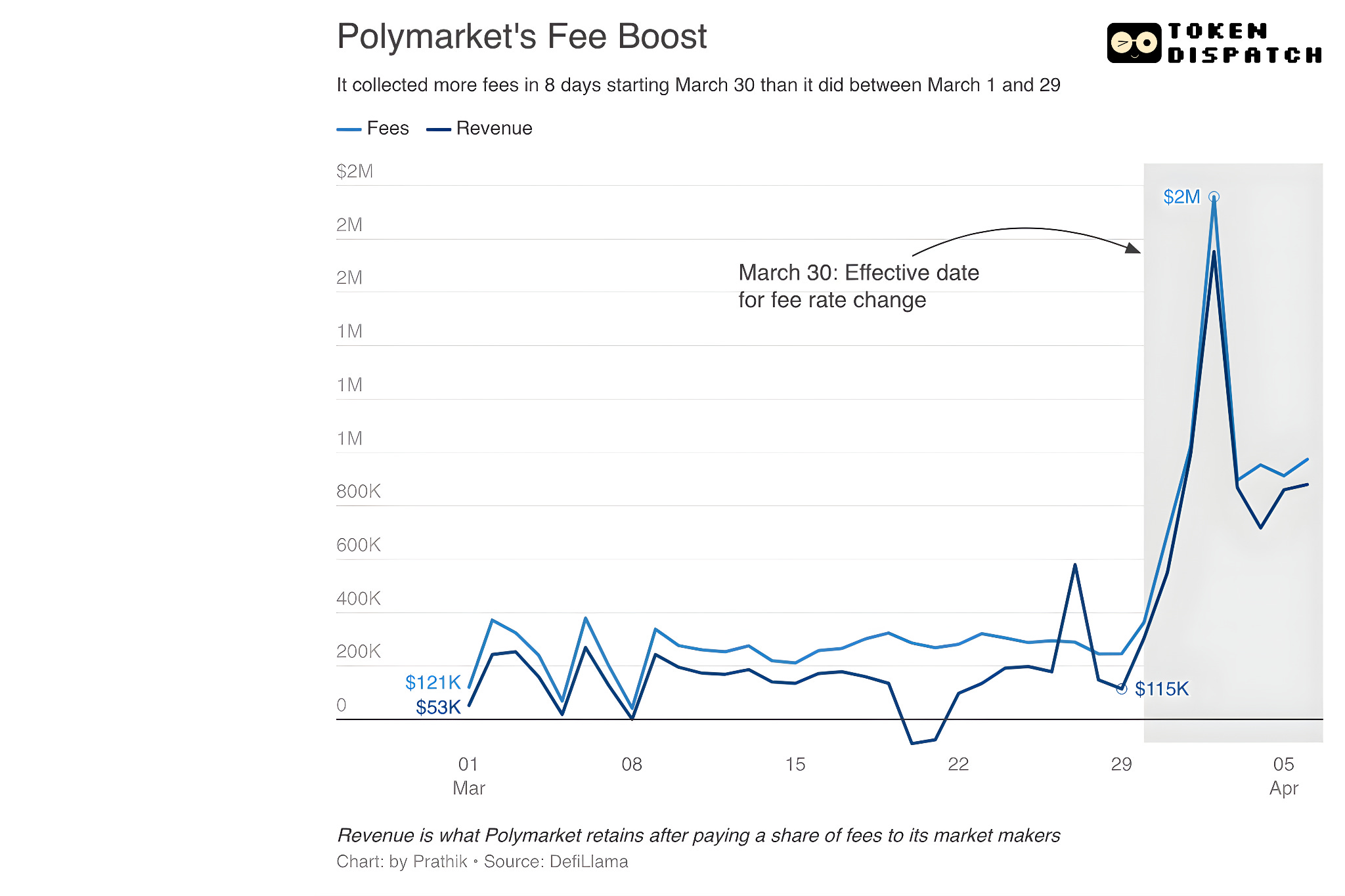
Despite a
0 wasn’t the first time Polymarket moved away from the “more volume equals business growth” view. It first announced fees on some of its market categories in January this year.
This shift is evident in Polymarket’s daily take rate — fees as a percentage of total volume, which has been consistently rising.
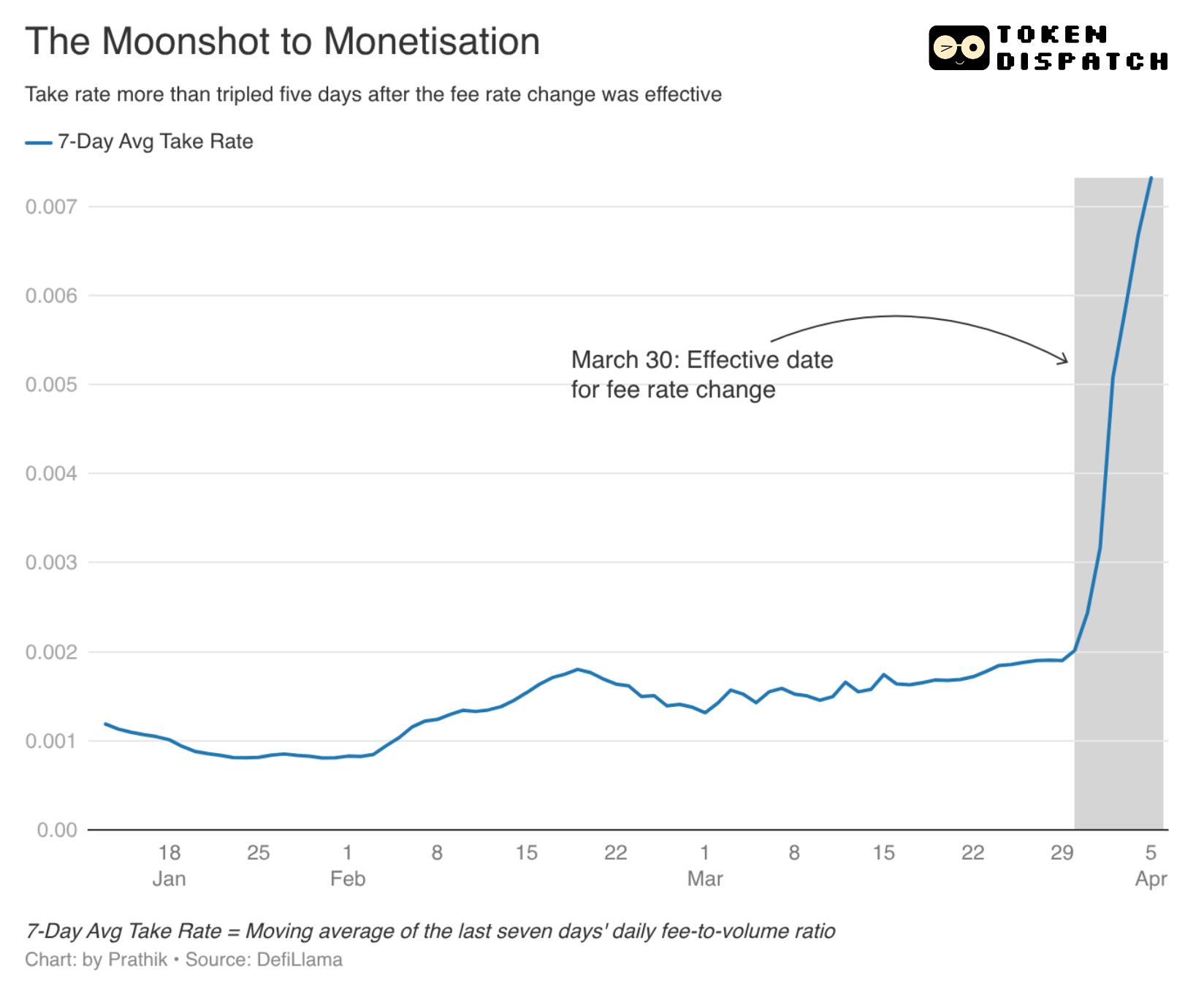
From January through late March, this ratio crept upward, doubling from roughly 0.001 to 0.002. After March 30, that rate tripled and shot past 0.007. That’s about 70 cents of earnings on a sale of $100.
But how does a business generate more revenue on the same (or in fact lower) trading volume base? That’s what happens when a business targets users willing to pay a premium for access to better markets.
The fun part is in the formula it uses to calculate the fees.
Pricing Uncertainty
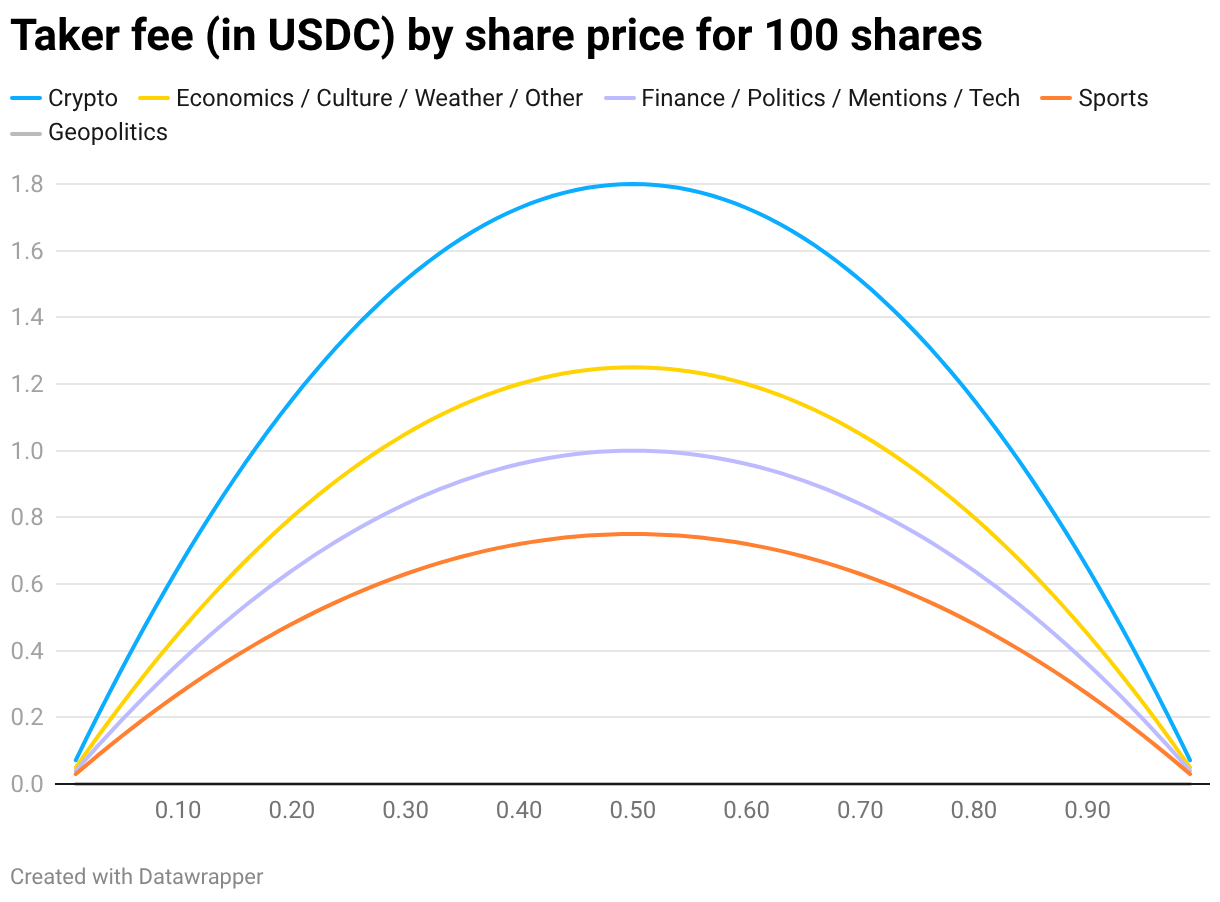
Polymarket doesn’t charge a flat fee, unlike conventional commission mechanisms. Instead, its fee varies depending on the likelihood of the outcome. The fee changes with probability: Fee = Shares × feeRate × Price × (1 − Price).
Every market on Polymarket is structured as a yes/no share. These shares trade between $0 and $1, reflecting traders’ estimates of the likelihood of the underlying event occurring. For example, a $0.90 price means traders collectively believe there is a 90% chance of the event occurring. Polymarket’s fee is designed to be the highest when the likelihood approaches 50% probability and to minimise toward zero as the outcome approaches certainty in either direction, 0 or 1.
This model ensures that Polymarket earns the most when traders trade in markets where the outcome is most contested. That’s because it makes economic sense (Economics 101, again). Think about it. A trade on an outcome with a 90% or 10% probability of occurring will yield a minimal payout. Why would such a trader trade anyway if the high cost of such a trade, via fees, further squeezes out their winnings? That would stifle trading activity at the margins.
Let’s understand this using a sample market: ‘Will Bitcoin hit $100K by June 30?’ Say the “Yes” share is trading at 90 cents. This means the traders are 90% certain that the BTC price will hit $100,000 by June 30. If you buy 100 shares at that price, you spend $90 and stand to win $100 if you’re right, giving you a profit of $10.
A flat fee of 1.5% on the $90 trade would cost you $1.35, reducing your maximum potential winnings of $10. Polymarket’s probability-scaled fee fixes this problem. When you buy the same trade of 100 shares on Polymarket, it charges you a fee depending on the likelihood of the occurrence of the event.
If the likelihood stands at $0.90 per share, then Polymarket’s fee comes up to $0.65. [100 shares x 0.072 (fee rate) x $0.90 (price) x $0.10 (1-Price)].
However, at 50-50 probability, the fee is maximum at $1.80 [100 shares x 0.072 (fee rate) x $0.50 (price) x $0.50 (1-Price)].
This ensures that fee collection is concentrated at that point on the probability curve where the stakes are the highest.
The Rebate Flywheel
There’s an interesting part about this bell-shaped fee model.
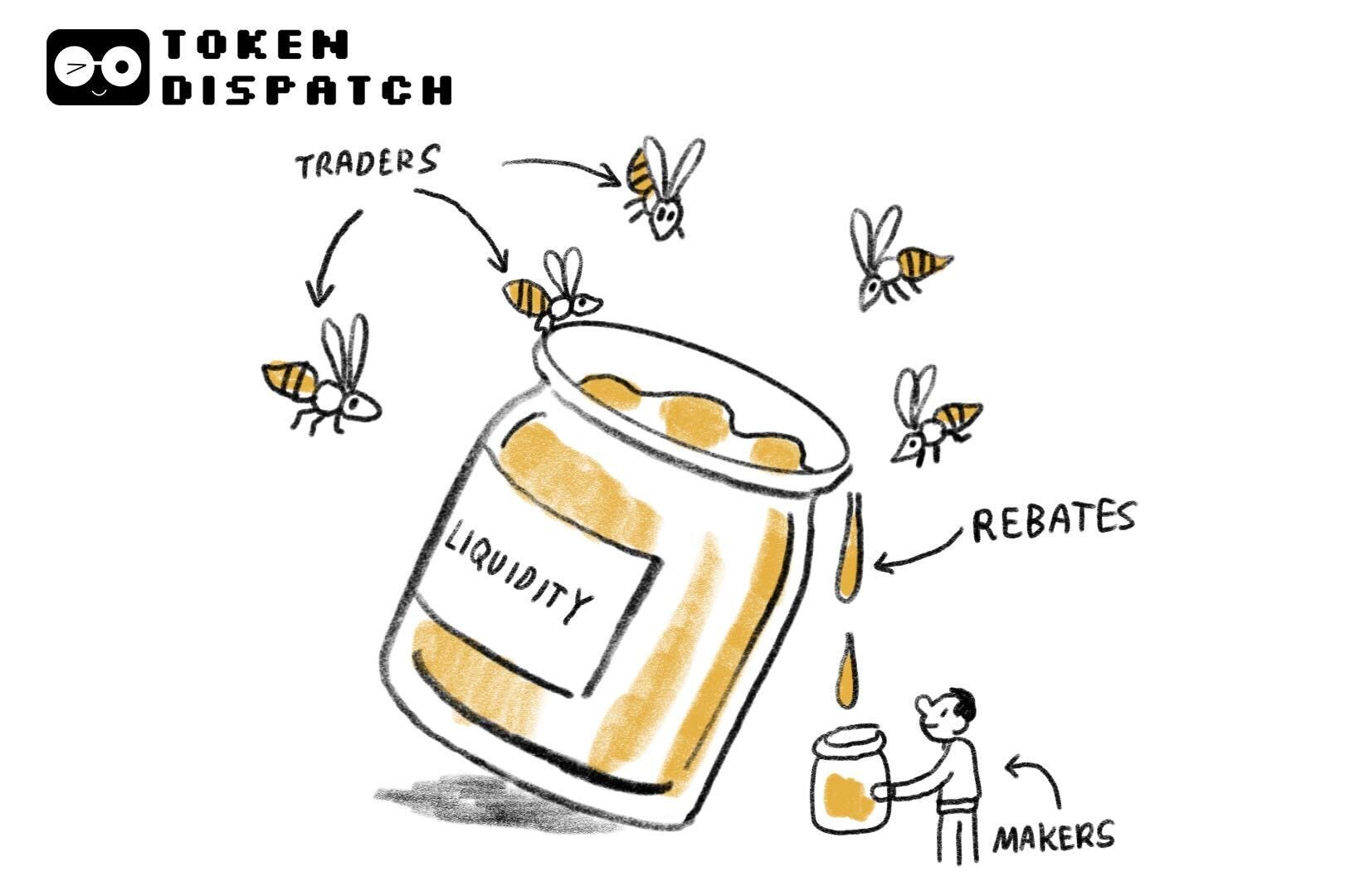
Polymarket doesn’t stop at charging takers a premium for offering tighter bid-ask spreads and good liquidity. Takers are those who want to make a trade by simply clicking on “Buy”/”Sell” at the market price. Polymarket allocates a share of the fee income to market makers as a rebate. Market makers help improve liquidity by placing deeper order books at limit prices.
These rebates attract more market makers, which in turn improve liquidity and attract more takers. The rebate share varies across categories 20% for crypto, 25% for politics and sports, and 25% for finance. Only geopolitical markets charge no taker fees and offer zero maker rebates.
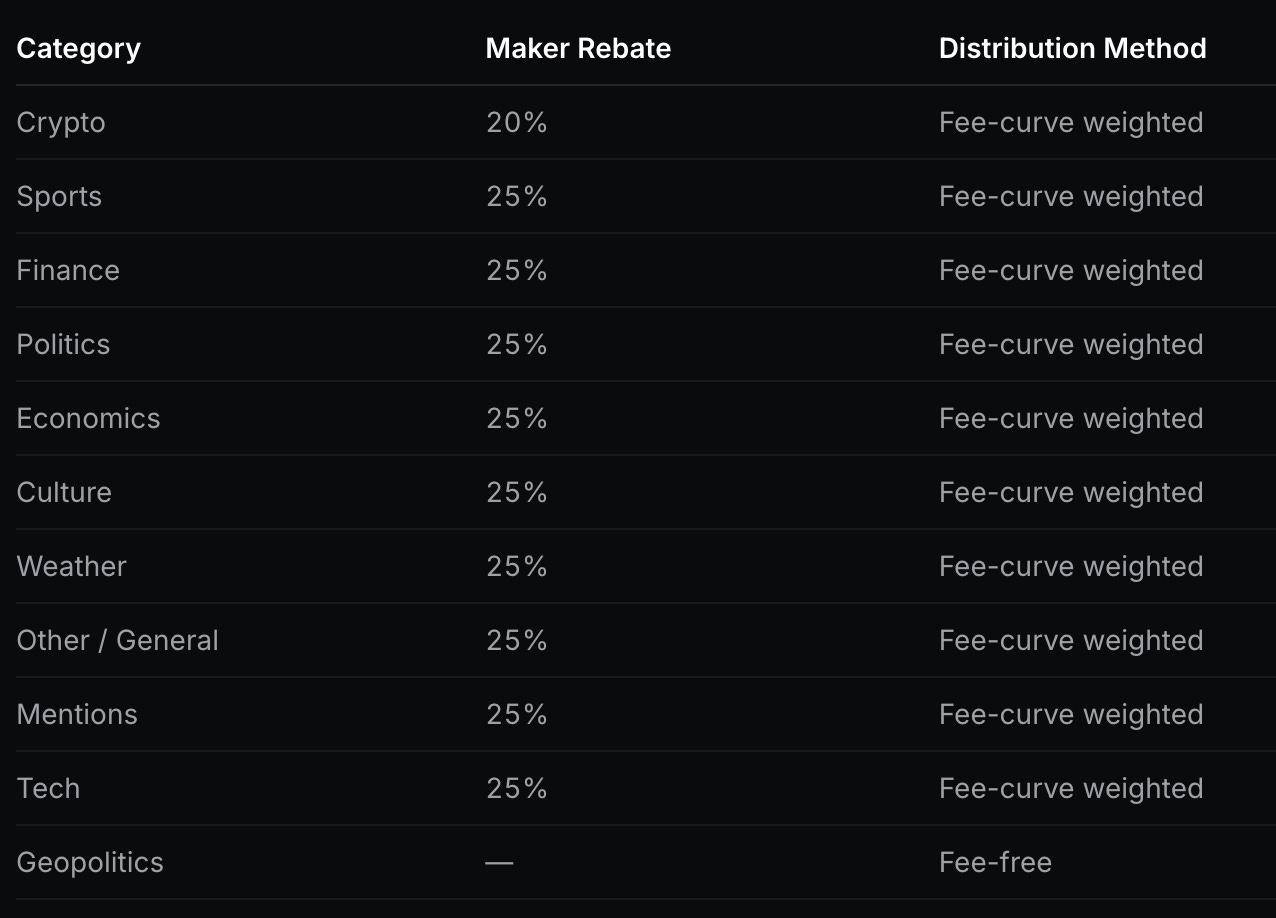
Polymarket’s zero-rebate and zero-fee policy for markets related to geopolitics and world events reveals its approach to the category. It expects these markets to draw traffic by offering low friction, zero cost, and maximum visibility. Once it has captured the trader on its platform, Polymarket expects the trader to cross-trade across categories and pay fees across other categories.
The Liquidity Bet
Polymarket has been around for more than half a decade. Yet, it kept struggling to achieve its product-market fit for almost four years. Few knew about it or used it until the 2024 U.S. Presidential Elections gave it its aha moment.
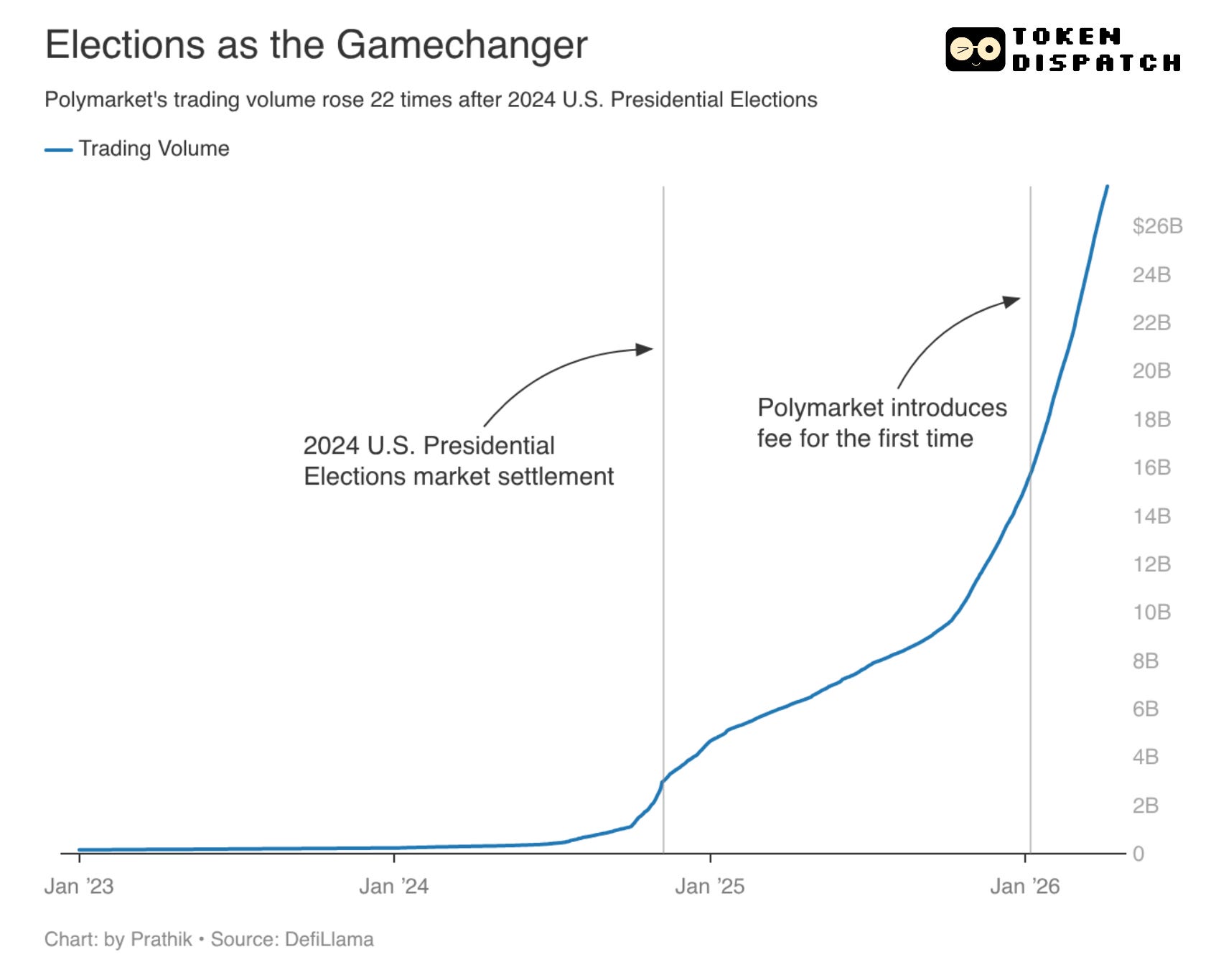
After the election euphoria died down, people doubted whether the prediction markets would stay. Sports and crypto categories filled that gap.
Its fee announcement has boosted Polymarket’s revenue for now. But can it retain its users from leaving for its competitors?
History has some answers.
When Uber launched in 2012, it took 20% of every ride before giving the rest to the drivers. Over the years, the fee kept creeping up. By 2025, it even exceeded 40% in some instances. Drivers protested. Some quit. Yet, it didn’t matter. New drivers kept joining, and riders stuck to their favourite app.
The lesson was that if a platform raised fees gradually, users would absorb them as long as the alternatives were worse. Is it the most ethical thing for Uber to do? I may have my reservations about that.
But Polymarket is doing something more than just raising fees.
A flat fee hike extracts value from users who have nowhere better to go. But Polymarket’s bell curve charges the most where traders have the highest stakes and uses a share of that fee to reward the market makers who make the platform worth staying on.
Better rebates attract more market makers. More market makers create tighter bid-ask spreads and deeper order books. And that matters, because Polymarket runs a central limit order book where every trade pays a spread and large orders walk the book, incurring slippage. These costs don’t show up on a fee schedule, but they come out of the trader’s pocket.
A taker paying zero fee on a low-liquidity platform still loses to wider spreads and greater slippage on every trade. A taker paying a small fee on Polymarket gets tighter execution funded by the very rebate that fee pays for. If this flywheel is well-managed, the all-in cost of trading on Polymarket, with deep liquidity, will feel lower than on a platform with shallow liquidity. In this case, the fee becomes a small price to pay for better pricing.
That’s it for this week. I will be back with another one.
Until next time, stay curious,
Prathik

Token Dispatch is a daily crypto newsletter handpicked and crafted with love by human bots. If you want to reach out to 170,000+ subscriber community of the Token Dispatch, you can explore the partnership opportunities with us 🙌
📩 Fill out this form to submit your details and book a meeting with us directly.
Disclaimer: This newsletter contains analysis and opinions of the author. Content is for informational purposes only, not financial advice. Trading crypto involves substantial risk - your capital is at risk. Do your own research.