


Hello,
For the first time in modern history, central banks around the world hold more gold than US Treasuries. Long-dated Treasuries have lost over 40% of their value since 2020, and the countries that used to absorb new issuance ( China, Japan, Europe) are now net sellers. The US government needs someone to keep buying its paper, and over the past couple of years it has gone from trying to shut down stablecoin issuers to writing laws that turn them into Treasury buyers.

A direct line runs from America’s debt problem to stablecoin regulation and the growth of perps, prediction markets, and on-chain stocks. I want to trace that line today, because at the end of it, the US government is funding its borrowing through a global crypto roadhouse.
Let’s dig in!

TOKEN2049: The Largest Crypto State
Over 25,000 attendees, 300 speakers, 500 exhibitors and 1,000 side events will come together at TOKEN2049 to rewrite the future of finance. And you are invited!
TOKEN2049 Singapore is just over three weeks away. The global crypto industry meets at Marina Bay Sands, 7-8 October, for the world’s largest crypto event.
Book by Wednesday, September 23, to lock in the current rate of $539 ($599) and get the exclusive 10% discount before the price goes up Today!

Patient Money Out, Hot Money In
If you hold USDC right now, your dollar is sitting in a Treasury bill. Under the GENIUS Act, every stablecoin issuer in the US has to back its tokens with short-term government debt. Circle and Tether together hold about $149 billion of Treasuries, and we holders don’t earn anything on that because GENIUS specifically bans issuers from paying interest on stablecoins. So you have a $149 billion pool of money that federal law requires to sit in T-bills and has no legal way to chase a better rate.
The $149 billion might feel like pennies compared to the entire $32 trillion debt market, but that’s not what matters here. For example, Money market funds already hold trillions of dollars in T-bills. And the difference is they can sell those bills whenever they want. If rates shift or spreads open up elsewhere, the fund can move its money because it is a buyer by choice, and it stays a buyer only as long as bills are the best option available. But a GENIUS-regulated stablecoin issuer cannot do that. It must hold reserves against every token in circulation, no matter the yield, for as long as anyone holds the token. And that’s why it gets locked in by the federal statute.
Washington used to have locked-in buyers on the long end of the curve too. Countries that sold goods to the US got paid in dollars, and those dollars needed somewhere to go. The only market deep and liquid enough to absorb that volume was US Treasuries, so Japan, China, and every other export economy ended up buying American bonds as a side effect of selling Americans cars, electronics, and clothing.
But not anymore, because foreign official holdings have dropped to 12.8% of outstanding Treasuries, the lowest since 1993.
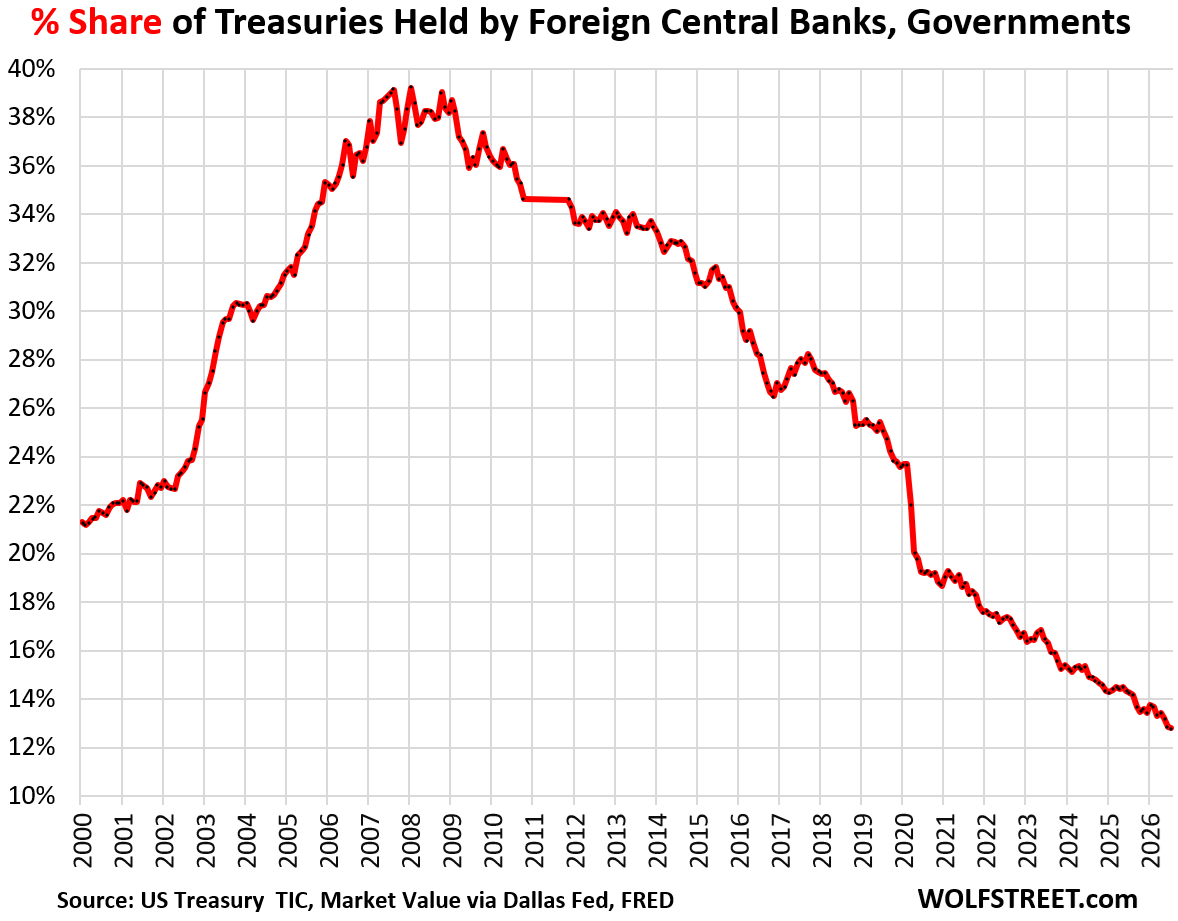
What took their place is mostly hedge funds running leveraged bets out of the Cayman Islands. They buy a Treasury bond, sell the matching futures contract, and capture the tiny spread between the two prices. The spread is usually only a few basis points, so they lever it 50 to 100 times to make real money.
Close to $2 trillion of this trade is sitting in the market right now. And we already know how these buyers behave under stress: in March 2020, due to the COVID crash, every fund running this trade tried to exit at the same time, which led to the Treasury market freezing, and the Fed had to spend $1.6 trillion in three weeks buying Treasuries because nobody else would. Sellers couldn’t find buyers at any price, so the central bank became the buyer of last resort for its own government’s debt.
So Treasury Secretary Scott Bessent has a problem. The buyers who held American debt for decades are gone, and the buyers who replaced them are the kind that panic and run all at once. So he changed the strategy to shift more of the government’s borrowing away from long-term bonds, where nobody reliable wants to lend anymore, and toward short-term bills.
He doubled the Treasury’s buyback program on the long end to $4 billion per operation, and is paying for those buybacks by issuing new short-term bills. In 2024, before he got the job, Bessent co-wrote a paper accusing Janet Yellen of doing this exact same thing and called it stealth monetary easing that hid how bad the borrowing situation really was. Now he is running the same play at twice the scale, which tells you the situation got worse since he wrote that paper.
But the strategy only works if someone keeps buying those bills reliably. And that is where GENIUS comes in, because the stablecoin issuers regulated under that law are now required to buy exactly those bills that Bessent is flooding the market with.
And quite frankly, stablecoin holders are a much better buyer for Washington than the central banks ever were. Because China or any other country can call one meeting and decide to dump its Treasury holdings. But millions of stablecoin holders scattered across different blockchains have no way to coordinate a sale, even if every single one of them wanted out at the same time. That makes stablecoin holders the new captive buyer, and a more locked-in one than any central bank ever.
Another thing is, not all demand is equal for T-bills, since it splits into domestic and foreign money. When an American moves money from a bank account into a stablecoin, it doesn’t really create new demand for T-bills, because the bank was probably already holding bills with that money anyway. The demand just shifts from one holder to another.
But when a trader in Istanbul swaps lira into USDT to trade perps on Hyperliquid, that is net new money flowing into American government debt from outside the country, and no existing T-bill demand is being displaced by that transaction. About 60% of stablecoin demand comes from abroad, which is why the Treasury’s own borrowing committee projects the stablecoin market at $2 trillion by 2028 and counts on roughly $900 billion of new bill demand from it.
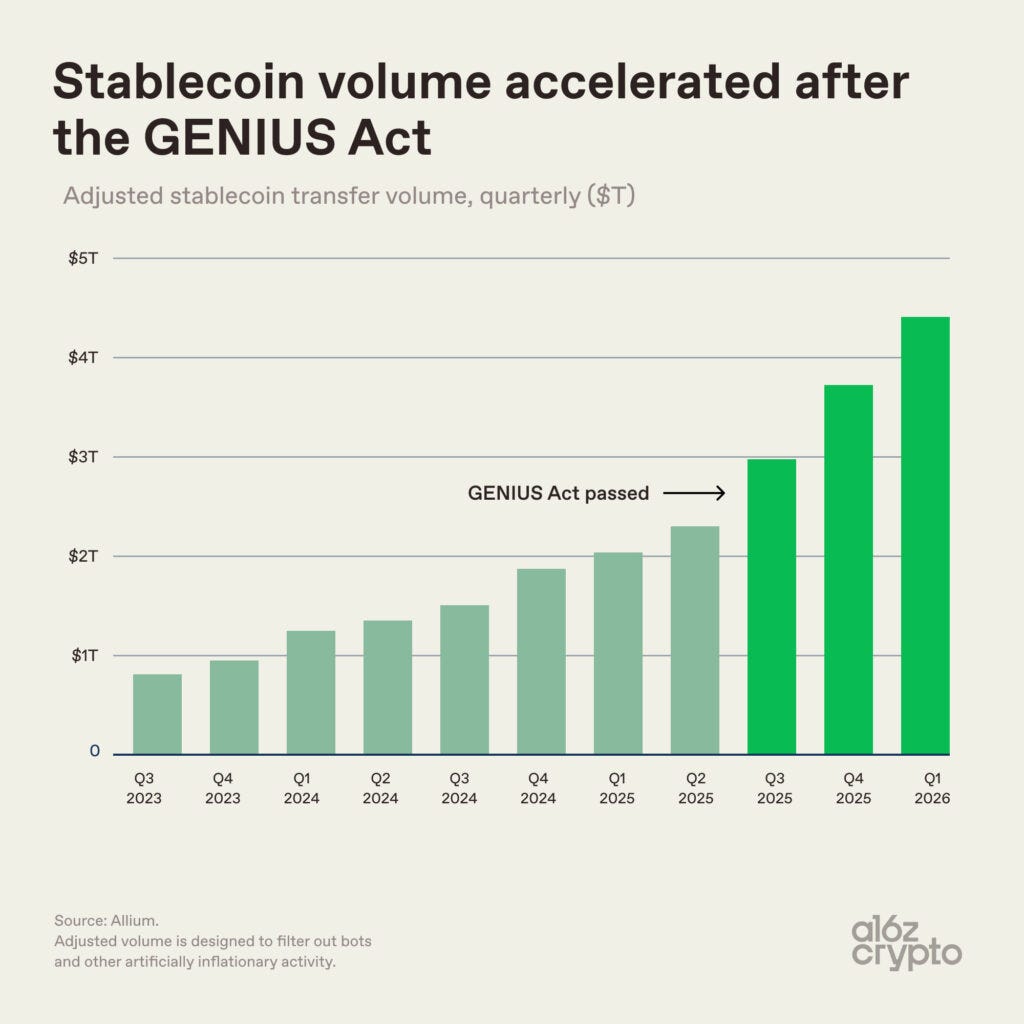
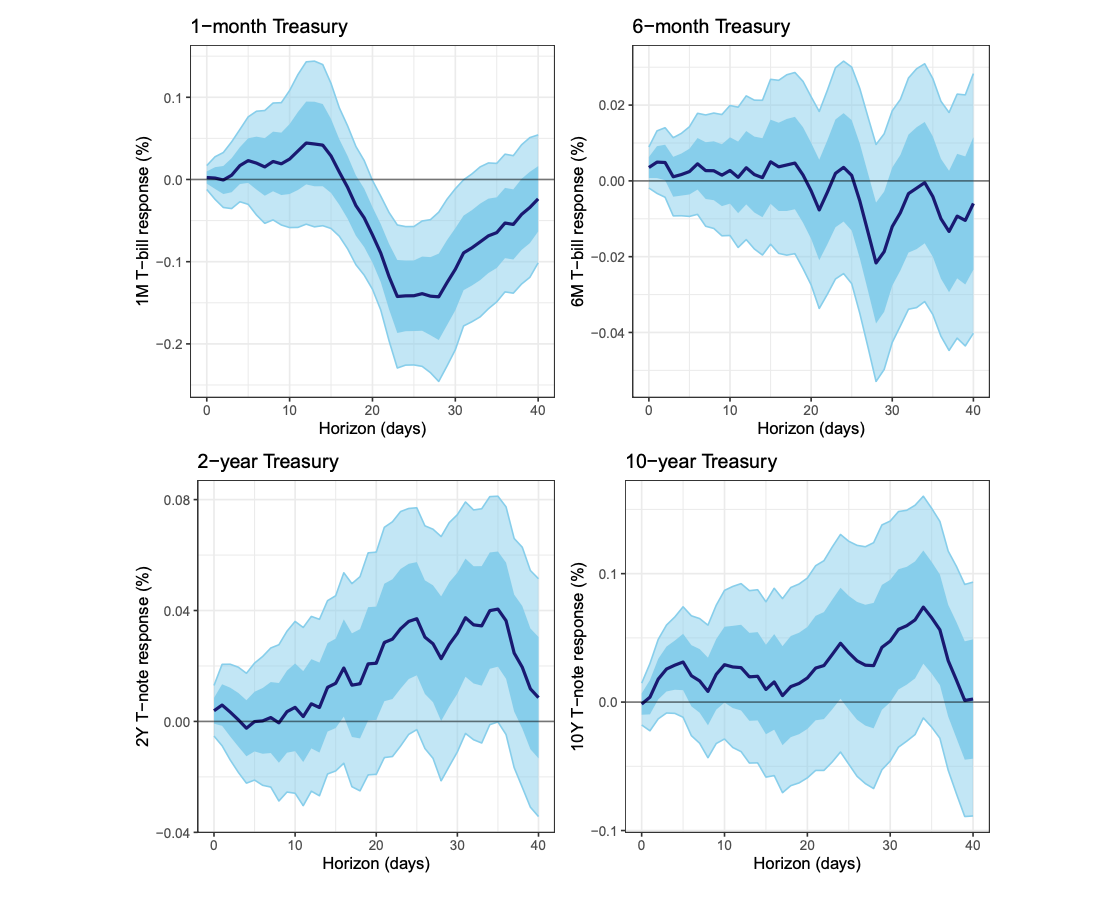
And we can already see the effect in the data. Every time $3.5 billion of new money flows into stablecoins, it immediately pushes 3-month T-bill yields down about 0.71 basis points, and that drops further to around 4 basis points over the next 10 days. The more stablecoins in circulation, the bigger that effect gets.
But then the catch is that GENIUS bans yield on stablecoins. Every other way of holding dollars pays you something for it. A savings account pays interest. A money market fund pays interest. The T-bill sitting underneath your stablecoin pays interest too, just not to you, because the issuer keeps that yield. So why would anyone still choose to hold a dollar token?
Because the token gets you into the trading venues. You hold USDC because Hyperliquid lets you trade 100x-leveraged crude oil perps with it at 2 AM on a Sunday. The trade-off for the yield is access to the venue. But all that T-bill demand exists only because people want to trade. If the trading dries up, people redeem their stablecoins, and the issuers have to sell the T-bills backing them. We already know that is exactly what happens, because when crypto trading collapsed after the October 2025 crash, USDC supply dropped by nearly $6 billion.
Crypto is Washington’s Las Vegas
Two years ago, the US government was actively trying to destroy the stablecoin industry. Under the Biden administration, federal regulators ran what the crypto industry now calls Operation Choke Point 2.0, where the FDIC and the OCC pressured banks to close accounts belonging to crypto companies without passing any new law or holding any public hearing; they just called the banks and told them crypto clients were too risky. Signature Bank, Silvergate, and Silicon Valley Bank all failed in 2023, and each had been a major on-ramp for stablecoin issuers. The federal government spent two years trying to cut stablecoins off from the banking system entirely.
Then Trump won, hired David Sacks as his crypto czar, and the entire posture reversed in weeks. Sacks went on TV and said the GENIUS Act “could create trillions of dollars of demand for our Treasuries practically overnight.” You don’t go from prosecuting an industry to writing it into your borrowing strategy unless the borrowing situation got bad enough to force your hand. And the fact that Sacks could say that on camera without a single person in Washington pushing back means the entire political establishment had already agreed that stablecoins were going to be the next source of Treasury demand.
And then the CFTC pushed it further. In May 2026, Chairman Michael Selig approved the first regulated perpetual futures contracts in US history, saying that “perpetual trading activity has predictably occurred offshore” and that American firms were “competitively disadvantaged.” The regulator, whose entire job is to protect markets from excessive speculation, approved 100x-leveraged offshore perps and decided the problem was that American firms were losing fees and deposits to foreign venues.
As funny as it may sound, it proves that the US derivatives regulator is now actively trying to grow speculative trading volume because growing that volume is how you grow the government’s newest source of debt financing.
And the speculation has already outgrown crypto. trade.xyz runs on Hyperliquid and was responsible for 55% of all Hyperliquid volume in August 2026. Its top markets were crude oil, silver, Brent crude, a Nasdaq-100 proxy, the S&P 500, and AI chip stocks like SK Hynix and Micron.
Every dollar deposited to trade crude oil or SK Hynix perps on Hyperliquid is a dollar that Circle has to back with a Treasury bill, which means the crypto derivatives market has turned into a funnel that takes money from people in Istanbul, Lagos or São Paulo who want to bet on oil and semiconductors and pushes it directly into American government debt.
But someone has to lose for this machine to keep running. When a trader loses a leveraged position, stablecoins don’t leave the system. They move from the loser to the winner and stay on-chain. T-bill demand only falls when someone actually redeems their stablecoins and takes dollars out. So the system does not actually need trading volume in the abstract; it needs a constant flow of new depositors willing to put fresh money in and lose it.
That’s very similar to how a casino works, because the house does not care about total bets placed; it cares about new players walking through the door.
Out of about $35 trillion in total stablecoin transaction volume in 2025, only about $390 billion were actual payments for goods and services. That’s roughly 1%. Circle’s own real-world payments network did $5.7 billion in Q4 2025, against trillions in on-chain USDC volume. So when someone tells you stablecoins are a payments innovation, they are technically correct in the same way that Las Vegas is technically a city with restaurants, but the restaurants are not why anyone goes to Las Vegas.
So the US government is funding its debt by keeping a roadhouse open. And the weirdest part is that both parties agree. Republicans want it because they see deregulation and dollar dominance. Democrats went along because 15 of them voted for cloture on GENIUS, and nobody wants to be the one who voted against something that kept Treasury yields down.
The crypto lobby spent over $130 million on the 2024 election cycle, and that money bought bipartisan agreement to keep the stablecoin-to-T-bill pipeline running, because both parties need the debt to keep getting funded and neither wants to explain to voters why yields spiked.
Maybe this works for decades. Maybe stablecoin supply hits $2 trillion by 2028, as the Treasury’s own committee projects, and $900 billion of new bill demand shows up right when Washington needs it most. Or maybe crypto has another October 2025 where the trading collapses, USDC sheds another $6 billion, and Washington discovers that its strategy is nothing but an empty suit.
Until Next time!
Vaidik
Token Dispatch is a daily crypto newsletter handpicked and crafted with love by human bots. If you want to reach out to 165,000+ subscriber community of the Token Dispatch, you can explore the partnership opportunities with us 🙌
📩 Fill out this form to submit your details and book a meeting with us directly.
Disclaimer: This newsletter contains analysis and opinions of the author. Content is for informational purposes only, not financial advice. Trading crypto involves substantial risk - your capital is at risk. Do your own research.