


Hello,
Berkshire Hathaway was sitting on a record cash pile for 14 straight quarters, and then, in June 2026, anchored Alphabet’s new $84 billion equity raise. What’s interesting is that Alphabet generates $174 billion in operating cash flow annually. A company that prints that kind of money would not go to public markets to raise more unless the amount it needs to spend has outrun what it can earn, and that is exactly what is happening across the entire AI industry right now.
In the three previous parts of this series, I covered how GPUs became collateral and how the lending structures beneath them work, but I held back on exactly where the money is coming from. Over roughly two years, the AI industry has worked through its own cash flow, moved through the debt markets, reached for equity, and is now getting the biggest asset managers on earth to pull more money from pension funds and insurance float.
Today I want to explore how long it will take for this difference between spending on compute and earning from it to catch up, since money committed today does not become working capacity anytime soon. At least until 2029!

Altitude Card: Earn Cashback on What Runs Your Business
Corporate card points sound great until you try to use them. Then you’re stuck navigating rewards portals, calculating conversion rates, and keeping track of expiration dates.
Altitude skips the points game and puts real cashback directly into your Altitude account. Earn 2% on travel, 1.5% on AI tools and SaaS, and 1% on everything else, paid monthly in USDC. No points to convert, rewards to redeem, or expiry to worry about.
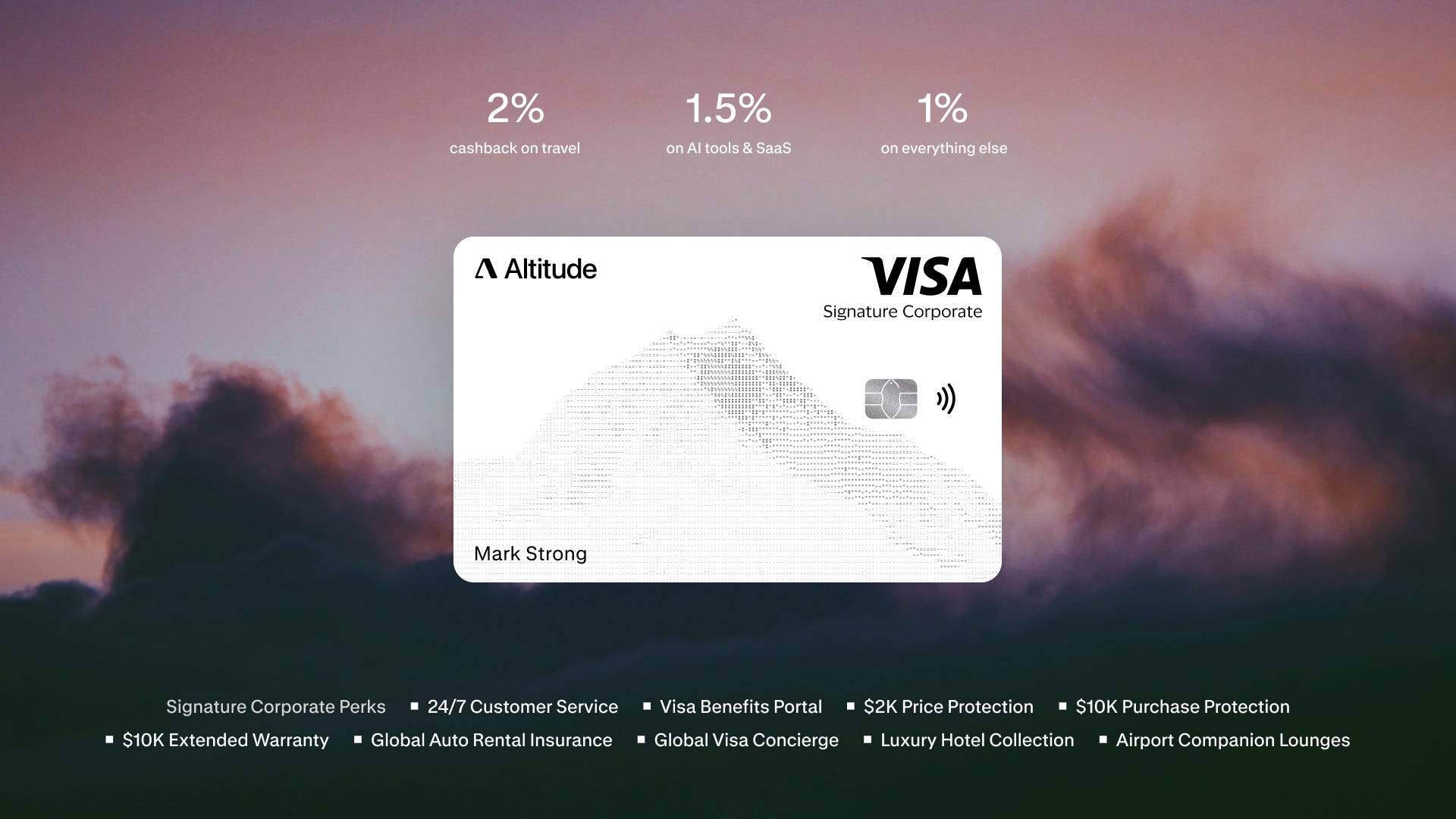
Issue unlimited cards to your team, set custom spend controls, and manage every purchase from one operating balance. There’s no credit line to apply for and no separate card account to fund.
Altitude is available to businesses in 150+ countries, with no US entity or traditional bank account required.
Book a demo and get your team onboarded!
The Production Gap
The reason there is not enough compute in 2026 is that there was not enough investment in manufacturing in 2023 and 2024. To understand this, let me walk you through exactly how it’s done.
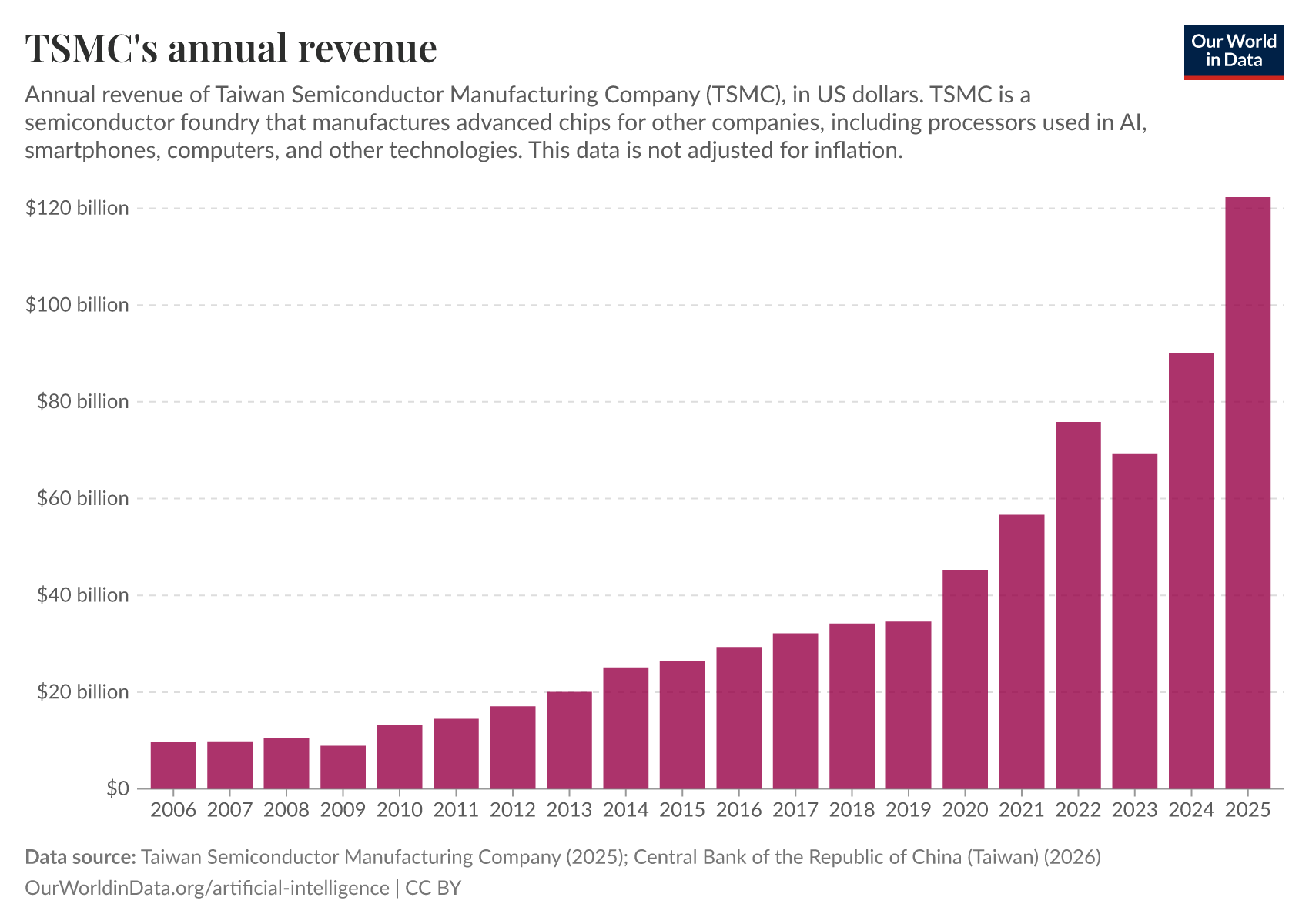
As of today, almost every advanced AI chip in the world is made by one company. TSMC, the Taiwan Semiconductor Manufacturing Company, produces roughly 90% of the world’s most advanced chips. Every frontier AI chip company, including Nvidia, AMD, Intel, and Qualcomm, first designs its chips in-house and then sends the blueprints to TSMC, which manufactures them in facilities called fabs (fabrication plants).
The machines inside a fab each cost hundreds of millions of dollars, and even the air inside them has to be filtered to be thousands of times cleaner than a hospital operating room, because a single speck of dust can ruin a chip that has features smaller than a virus.
The whole facility typically costs over $20 billion in capex before it produces a single working chip. And from the day you start production to the day wafers start coming off the line at scale, the entire process takes at least 3 years. What you should also note is that no amount of money can make this process any faster, because everything from equipment installation to tool calibration runs on a timeline restricted by physics and urgency cannot change physics.
This three-year timeline is the reason for the current chip shortage. The chips coming out of fabs right now in 2026 were funded in 2023 and 2024, which were also the years when TSMC and other chip manufacturers reduced their capex to tackle the cyclical downturn in the global electronics market. So when people say there is not enough compute, they are really describing a spending decision made three years ago, and there is nothing anyone can really do in 2026 to undo it.
And when you read that the AI industry is doing everything it can to build new supply, what they really mean is that capital is being committed today, but it will take another two to three years to turn it into working chips available on the market.
On top of that, each new dollar of spending buys less capacity than the last. Because every new generation of chips has more, smaller (Moore’s Law) features than the last and requires more layers of patterning on each wafer, the cost of the fabrication plant needed to make them also doubles roughly every four years, a pattern known as Rock’s Law. For example, TSMC’s newest 2nm process costs significantly more than the same capacity at 3nm. So even the large spending increase in 2025 and 2026 does not produce proportionally more chips.
The industry is spending almost twice as much as it spent three years ago, but the output is still the same. But chips are only half of the problem. A data centre full of GPUs is useless without electricity to power them. And getting electricity turns out to be even harder than getting the chips.
In America, if you want to connect a new power source to the grid, whether it is a solar farm, a gas plant, or a nuclear reactor, you have to go through something called the interconnection queue. In which you have to file a request, wait for studies, undergo an environmental review, negotiate agreements with the grid operator, and then get approval to begin construction.
And the median time from filing that initial request to actually having power flowing is now over five years. This is only increasing because roughly 8,200 projects are currently sitting in the queue, and only about 13% of the projects that enter the queue ever actually get built. The rest just die somewhere in the process.
So any new data centre project has two separate timelines working against it simultaneously. The chips take two to three years from investment to production, and the power takes over five years from the interconnection request to the electricity becoming operational. You need both to be ready before the data centre does anything useful, which means the slower one sets the pace. For anything starting today, the grid is the slower clock.
What makes this even more interesting is that active natural gas capacity in the queue rose by 86%, while solar, wind, and storage have all fallen by 20%. Companies building data centres are choosing gas over renewables simply because gas plants can be operational faster. They know a gas turbine committed today will still be burning fuel in the 2040s, but they are signing up for it anyway because it is the only option that will give them power by 2029.
This story is so similar to what happened with the shipping industry a few years back. Container shipping is a very simple business. Companies pay to move goods in standard metal boxes from one port to another, and the price of moving each box is set by supply and demand like any other commodity.
But during the pandemic, there were not enough ships to carry all the goods that needed to move, so rates went from around $3,000 to $4,000 per container to over $17,000. The shipping companies made enormous profits in a very short window, and they also ordered more ships.
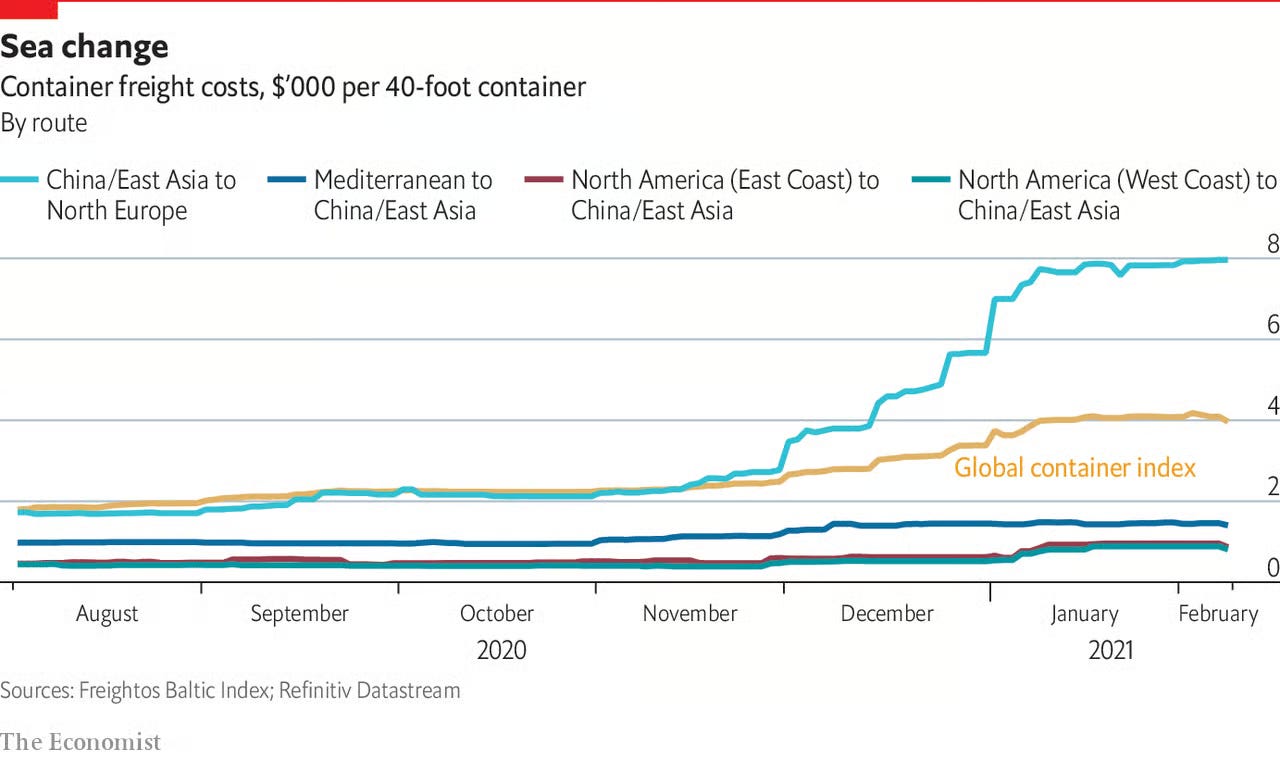
Now, A new container ship takes about two years to build, and because every shipping company was looking at the same sky-high rates and the same demand forecasts, they all ordered at the same time. Then all the new ships showed up at once, from 2024 to 2026. The orderbook currently stands at roughly 27% of the active fleet, the highest since 2010, and spot rates on the Shanghai-to-Rotterdam route are more than 60% below the 2022 peak.
So when all those new ships arrived, and prices collapsed, the carriers did not park them. They kept running every single ship because they had already invested so much money in acquiring them. And it’s better to run the ships at whatever price the market will pay for a container, because the alternative is to let them sit at anchor, earning nothing.
That’s exactly how commodity markets always work once the capital is sunk. The price drops to whatever it costs the marginal operator to keep the lights on, and they all keep operating because running at a loss is still better than earning zero on an asset you already paid for.
The financial models behind the AI infrastructure are very similar. Every dollar committed to building data centres right now is justified by the current price of compute. GPU rental rates have been climbing, with H100 hourly rates rising from $1.96 to $2.71 over the past year, and operators are signing leases for hardware released five years ago.
When Does the Money Catch Up?
The financial stress of the current over-extension in power and compute will start to be reflected the moment it becomes clear that enough supply is on the way, and that’s when the pricing power that justifies today’s investment starts to erode.
You do not need the ships to arrive in port for freight rates to drop; you just need the market to know they are coming, and right now everyone in this industry knows they are coming because they are the ones paying for them. The way some of these frontier model companies calculate their revenue also shows how hazy the industry’s operations are.
Anthropic went from roughly $10 billion for all of 2025 to an annualised run rate of about $65 billion by July 2026, and OpenAI hit $40 billion annualised in August. That kind of growth has very few precedents in the history of technology. The two companies do not even measure their revenue the same way. Anthropic reports on a gross basis, counting the full amount end customers spend through cloud partners like AWS, while OpenAI reports closer to net.
The AI labs are growing faster than almost any technology in mankind, and they are still losing money on every dollar of revenue they bring in. The combined run rate of the frontier labs sits at roughly $105 billion. But the industry is spending roughly $800 billion a year building capacity to serve them.
And the speed at which this industry has chewed through its funding sources can tell you how far we have come skating on thin ice. The industry went through every source of capital above pension money in roughly two years. And pension funds are a very different kind of money because they operate against actuarial return targets that stretch over decades, and they are used to investing in infrastructure where the asset lasts as long as the financing does.
A toll road, for instance, runs for fifty years, or a power plant operates for thirty. And the revenue assumptions underneath those investments do not change much from one year to the next. But a data centre financed with a ten- to fifteen-year horizon has chips inside it that will be two or three generations behind within four years.
The electricity contract might run twenty years. But the assumption through which institutions are financing it might not survive two years, because it was set during a shortage, and when that shortage ends the economics of the deal will completely change.
The railroads had the same problem. It took a decade or more to build a network and start generating revenue from it, but the bonds that financed the construction needed to be serviced immediately. In 1873, Jay Cooke’s bank collapsed because it could not sell Northern Pacific Railroad bonds enough to cover the construction costs it had already incurred. The railroad itself was fine, but Cooke had borrowed against future revenue to build present infrastructure, and that revenue did not arrive fast enough to cover present obligations. It led to 25% unemployment in New York and a depression for six years.
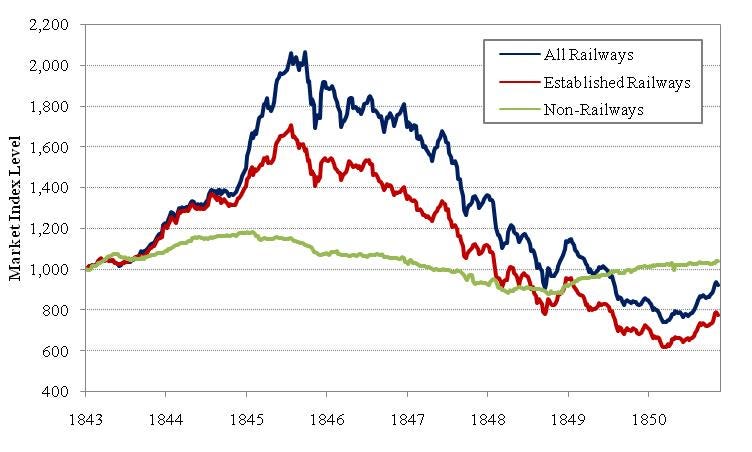
The railroads eventually transformed the American economy; they opened the entire western half of the continent to commerce, but many of the people who financed their construction were bankrupt by the time they arrived.
I think with AI we are in the same position. Revenue will come, and probably faster than railroad revenue did, because software adoption curves are measured in months. But the question is, will the current bridge hold until the revenue catches up? The compute will arrive, but between here and there, a lot of money is sitting on financing structures that assume the shortage is permanent, which it is not. Which means we might run out of money before we run out of compute.
That’s all for today!
Token Dispatch is a daily crypto newsletter handpicked and crafted with love by human bots. If you want to reach out to 165,000+ subscriber community of the Token Dispatch, you can explore the partnership opportunities with us 🙌
📩 Fill out this form to submit your details and book a meeting with us directly.
Disclaimer: This newsletter contains analysis and opinions of the author. Content is for informational purposes only, not financial advice. Trading crypto involves substantial risk - your capital is at risk. Do your own research.