


Hello,
Imagine running a 40-person startup and deciding to pay your team in stablecoins. Faster settlements, no banking middlemen, and lower fees across borders. Sounds like a win, right?
But then, reality sets in. The moment you process your first payroll, every single salary becomes visible on-chain. Your lead engineer can see what the new hire earns. Your competitors can access your total burn rate. A random blockchain explorer can piece together your entire treasury activity just by watching one wallet.
This is not hypothetical. Researchers analyzed 22.7 million stablecoin transactions and extracted customer spending habits, peak sales times, and average order values from businesses that accept crypto straight off the public ledger. They could identify transaction timing patterns that reveal peak sales periods. They could conduct a geographic analysis to determine where a company was expanding. All of it sitting there, in public, forever.
Your bank doesn’t publish your account balance on the internet. But on Ethereum, Solana, or any major Layer 1 (L1) blockchain today, that’s exactly what happens by default.
Stablecoins processed over $33 trillion in volume in 2025. That’s a 72% jump from the previous year. The market cap went from $205 billion in January to over $306 billion by November. The GENIUS Act was signed into law in July, providing a stable regulatory framework for stablecoins for the first time. Stablecoin issuers are now the 7th largest purchasers of U.S. government debt. By every metric, this market is exploding.
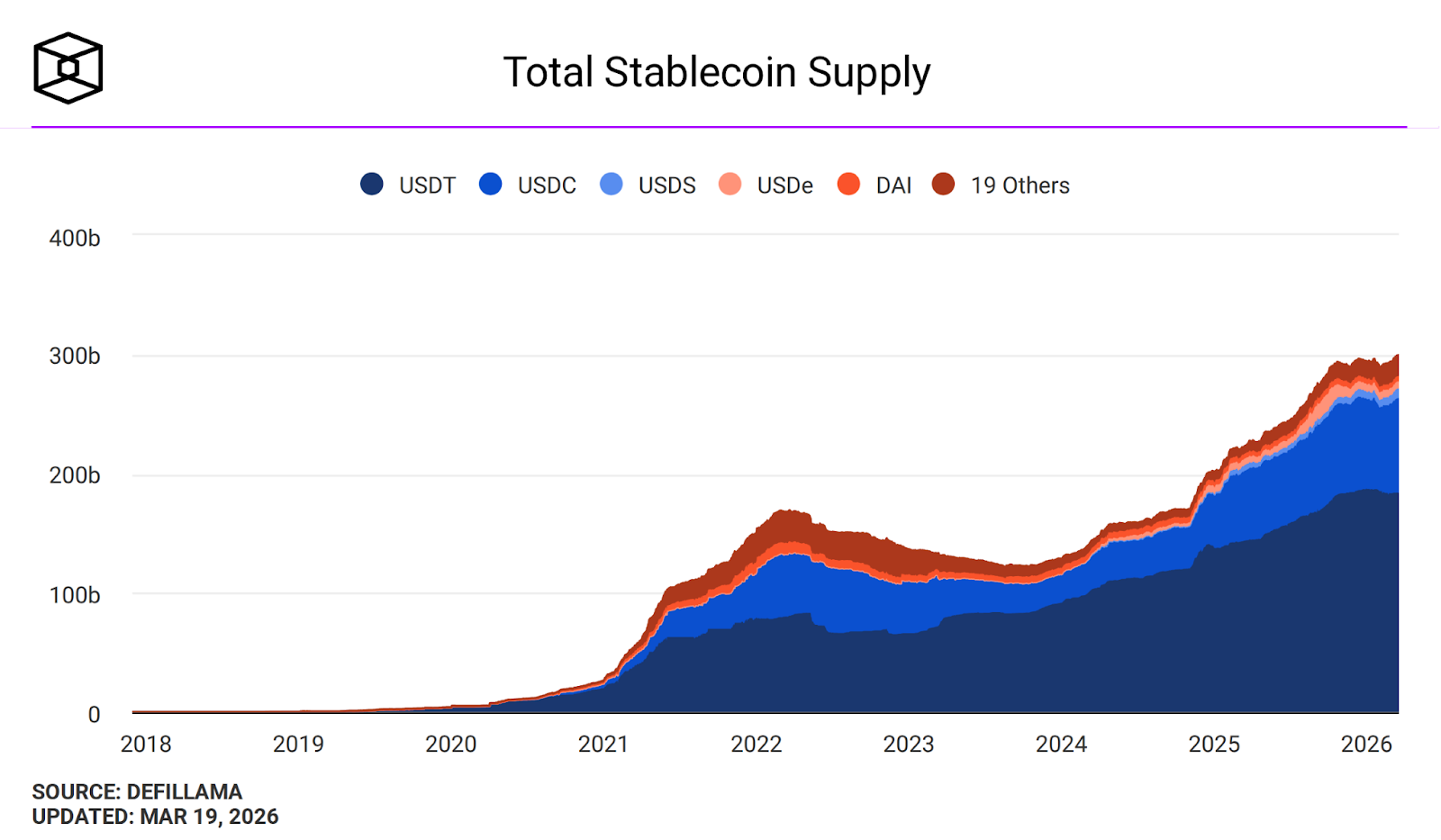
Yet, despite these numbers, almost no businesses use crypto for payroll. Stablecoin-based B2B payments only grew past $6 billion monthly by mid-2025, which is still a tiny fraction of the $55 trillion global payroll market. Privacy, the most basic expectation in finance, is still missing from almost every blockchain.
This is what Aleo was built to close.
The Chain That Encrypts Everything
Most privacy solutions in crypto operate as bolt-ons. You take an existing transparent blockchain and add a privacy layer on top. But the base ledger is still public.
Aleo works differently. It’s a Layer 1 blockchain where privacy is the default, and not an option you toggle on. Every transaction on Aleo is encrypted. Wallet balances are private, transfer amounts are hidden, and the entire chain runs on zero-knowledge cryptography, which means the network can verify that a transaction is valid without ever seeing the actual data inside it.
To understand why that matters, think about how blockchains normally process transactions. On Ethereum, when you send 100 USDC to someone, the network needs to verify a few things. Does your wallet actually have 100 USDC? Is the transaction properly signed? Is everything following the rules? To do those checks, every validator on the network looks at your balance, the amount, and the recipient. All of that gets stored permanently on a public ledger.
Aleo uses a record model, a variation of Bitcoin’s UTXO system. Instead of keeping a global balance sheet that everyone can read, each transaction creates encrypted “records” that only the owner can decrypt. The network validates everything using zero-knowledge proofs, mathematical guarantees that the transaction is legitimate without revealing what’s inside.
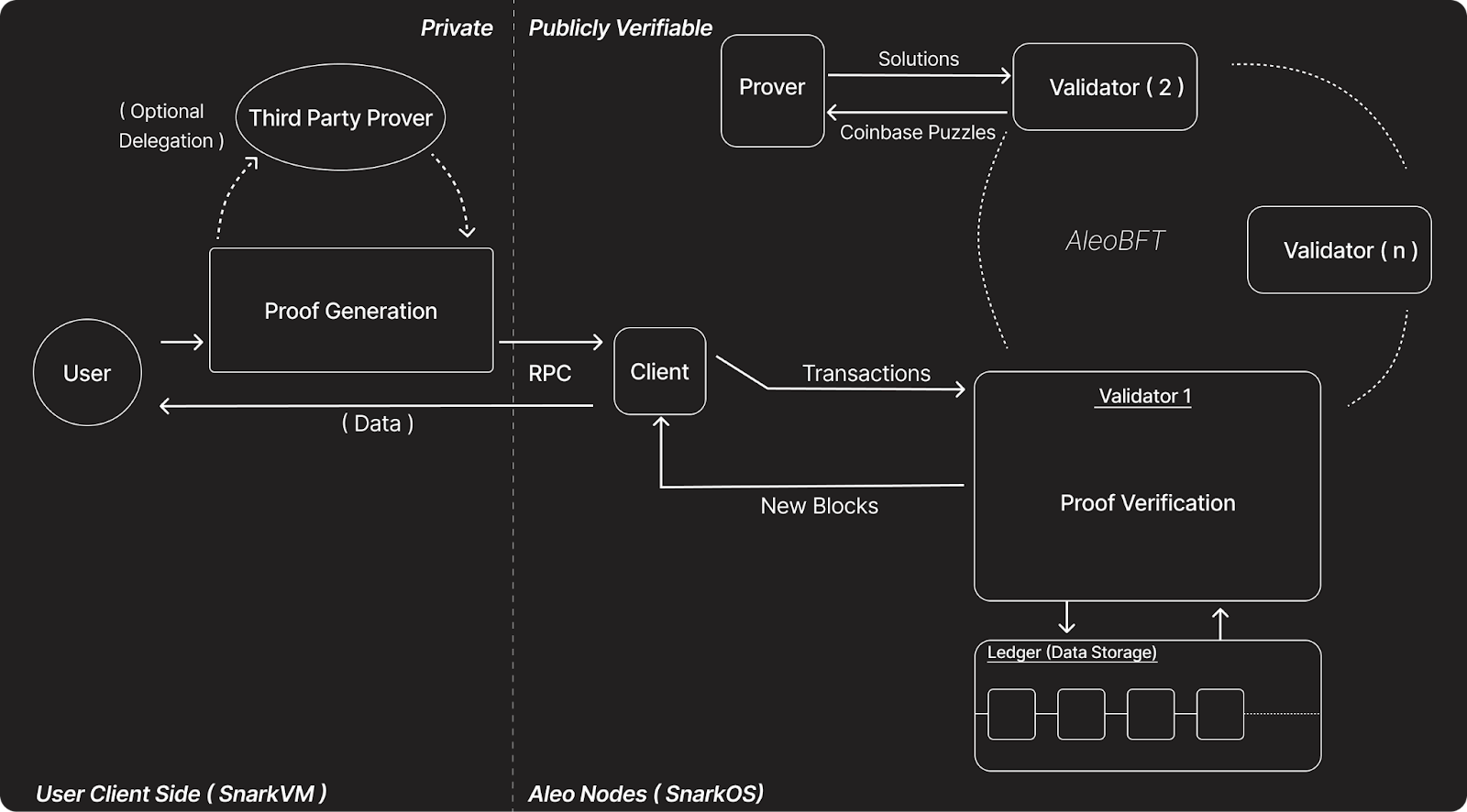
The result is a blockchain that provides the same security and trustlessness you expect from a public chain, but without the public visibility. Your transactions are verified. They’re final, they’re on-chain, they’re just not visible to everyone.
This is different from what projects like Tornado Cash tried to do on Ethereum, where funds were mixed in a privacy pool. That approach got sanctioned by OFAC in 2022 precisely because it was a privacy tool layered on top of a transparent system, making it impossible for regulators to distinguish legitimate privacy from illicit activity. Aleo’s design starts from privacy and builds compliance tools into the protocol itself. That matters a lot when you’re trying to work with the financial system instead of around it.
One of Aleo’s understated engineering feats is how it handles fees. Running zero-knowledge proofs is computationally heavy. On many privacy systems, that cost is passed onto the user, making private transactions expensive enough to defeat the purpose. Aleo’s design routes a chunk of the computation off-chain: instead of broadcasting all transaction data to every node, the chain only needs to see a short cryptographic proof that everything checks out. The actual data stays with the parties involved. For users, this means lower transaction fees, even as privacy guarantees run in the background of every single transaction.
Aleo launched its mainnet in 2024, and since then, the pace of what’s been shipping is worth paying attention to. In July 2025, the team released snarkOS 4.0.0, the largest protocol upgrade since launch, delivering 500% faster confirmation times. In August 2025, Aleo became the first privacy-preserving blockchain listed on Revolut. If you’re not familiar with Revolut, it’s the largest crypto-friendly fintech in Europe, with 60 million users, operating across the UK and EEA, giving users across Europe direct access to buy, stake, and hold ALEO tokens with staking yields of up to 19% APY.
The same month, Aleo joined the Global Dollar Network, a stablecoin consortium founded by Paxos, whose members include Robinhood, Kraken, Standard Chartered, and Worldpay. This is the network that major financial institutions use to settle in dollar-backed stablecoins. Banks and payment processors in that network need privacy too, and now, Aleo is the chain that can offer it.
Making Stablecoins Usable
Cross-border payments are already broken before you add any blockchain to them. A company paying contractors across different countries today typically goes through SWIFT, which chains together multiple correspondent banks, each taking a cut. The World Bank’s 2025 data puts the average global remittance cost at 6.49% per transfer. For a $5,000 contractor payment, that’s $325 gone before the person even receives it. Settlement takes anywhere from 2 to 5 business days. And none of this cost includes the FX markup that banks add on top, typically 2-3.5% above the mid-market rate, which, as a standard practice, most businesses don’t track separately.
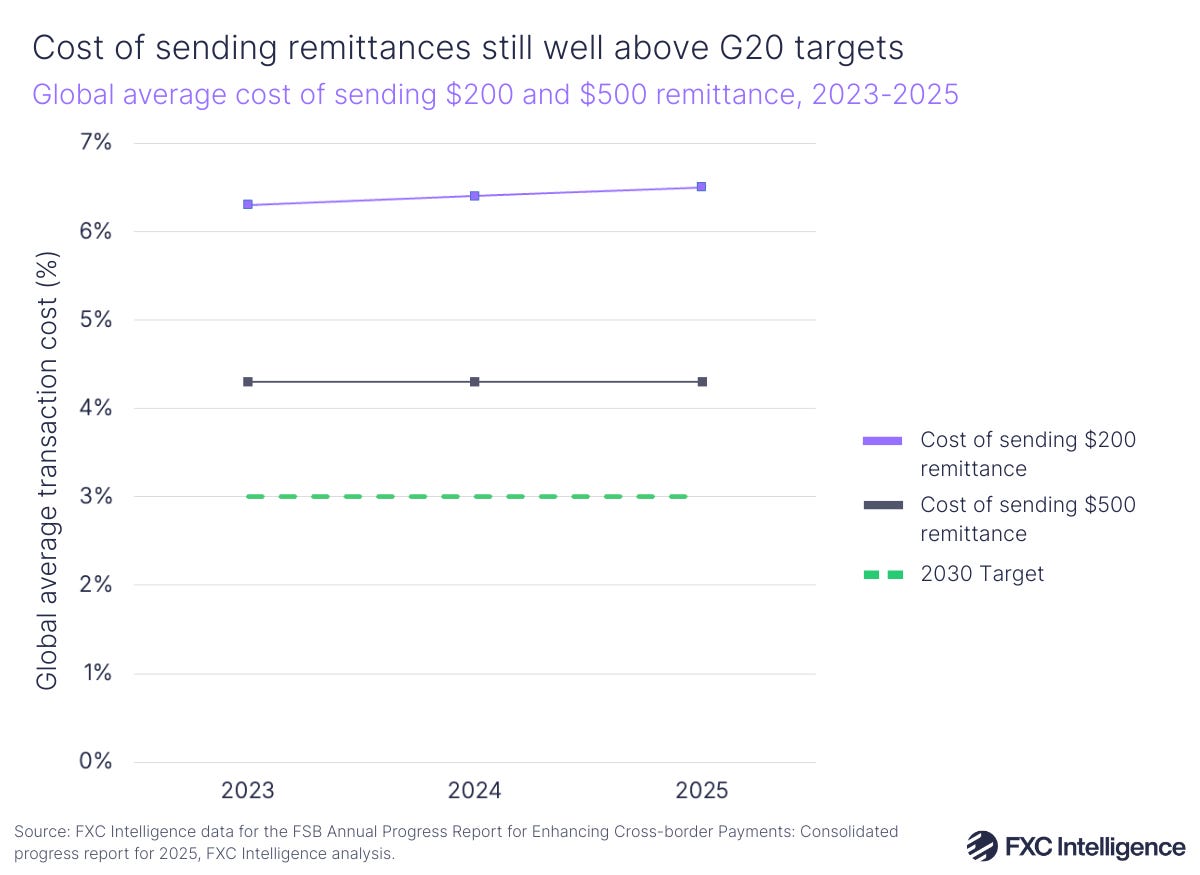
Stablecoins solve most of these issues. They provide same-day settlement, eliminate the correspondent bank chain, and offer fractional fees. The payment infrastructure problem has been genuinely solved. The privacy problem wasn’t, until now. So, what does private stablecoin infrastructure actually unlock for these real financial workflows?
The most concrete answer is Toku. Toku is an Employer of Record (EOR) platform built specifically for companies paying distributed teams. They handle tax withholding in each jurisdiction, local employment contracts, labor law compliance, and real-time FMV calculations for token-based compensation. On January 29, 2026, Toku integrated Aleo’s infrastructure and added USAD as a payroll settlement currency. A company using Toku can now run payroll across 100+ countries in stablecoins with full compliance in each jurisdiction and without any of that payroll data going onto a public ledger. Toku handles the compliance layer, USAD handles the settlement, and Aleo handles the privacy. The company’s existing payroll software doesn’t change.
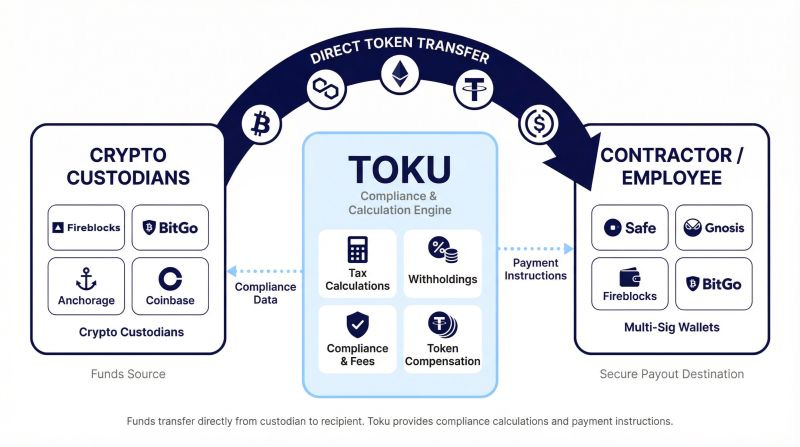
This changes the economics for a business entirely. For example, International wire transfers average around $50 each. If a midsize company pays 80 contractors monthly, that’s $4,000 a month, $48,000 a year, just in transfer fees, before the FX markup. Private stablecoins bring that cost down to cents per transaction. When you also remove the 6-7% in fees that SWIFT-based payments typically carry, a company paying $5 million in annual international payroll saves somewhere between $250,000 and $350,000 in friction costs alone.
Then there’s USDCx. It runs on Circle’s xReserve infrastructure, which means it stays 1:1 backed by USDC held in a smart contract. When a company wants to move USDCx back into regular USDC on Ethereum for liquidity purposes, xReserve issues a cryptographic attestation that settles the transfer without a third-party bridge. Private settlement on Aleo, public liquidity on Ethereum, connected natively. For a treasury team, when you need to access DeFi liquidity or convert to fiat on an exchange, you move back to USDC without paying bridge fees or trusting a third-party protocol. The private rails and the public rails interoperate.
Paxos introduced another option with USAD, backed 1:1 by USDG and regulated across Singapore, the EU, and the U.S., giving institutions in those jurisdictions a fully compliant private stablecoin option with cross-border bridge support on Ethereum and Solana.
One often overlooked use case in this context is humanitarian aid. NGOs operating in conflict zones or under hostile governments face a specific problem with transparent financial rails. If aid distribution transactions are on a public ledger, the recipients can be identified. In environments where receiving foreign aid can make someone a target, that’s a genuine security risk. Private stablecoins on Aleo are one of the first financial infrastructure solutions that can move regulated, compliant dollar payments to recipients in sensitive environments without creating a permanent public record of who received what. This is not speculation; Aleo has explicitly identified aid relief as a core use case in its documentation, and the infrastructure is already live.
Regulator-Friendly Privacy
There’s a common assumption in crypto that privacy and compliance are opposites. That if you build for privacy, you’re building against regulators. Aleo’s approach is built specifically to break that assumption.
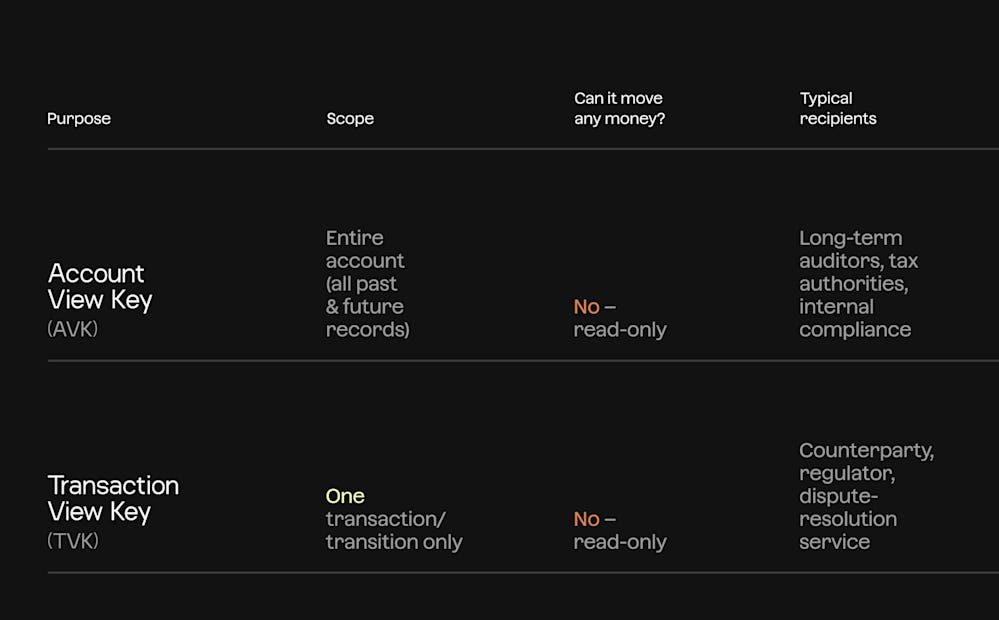
The protocol includes something called view keys, which are baked directly into the account model. Think of them as cryptographic windows that stay sealed unless the account owner decides to open them for someone specific.
There are two types. An Account View Key gives read-only access to an entire account’s history, past, and future. You can hand this to an auditor, a tax authority, or an internal compliance officer at the start of the year, and that authority can verify everything they need throughout the year without the company having to produce records on demand. They can see everything they need, but cannot move any funds or modify anything. And the key is derived from the user’s private key in a way that makes it mathematically impossible to reverse-engineer access to the actual funds.
Then there’s the Transaction View Key, which is automatically generated for every single transaction on the network. It decrypts only the inputs and outputs of that one action. Its hash gets recorded on-chain as part of the transaction, so its authenticity is verifiable by anyone. A company settling an invoice can share the transaction view key with the counterparty to prove payment without exposing anything else about their treasury.
For banks and compliance teams, the comparison point here is traditional correspondent banking, where AML checks happen through a patchwork of monitoring systems that generate false positives constantly. JPMorgan estimated that financial institutions spend over $31 billion annually on AML compliance in the U.S. alone, and still miss an estimated $800 billion to $2 trillion in illicit flows globally each year. The compliance infrastructure is expensive, and it still doesn’t work well. View keys with on-chain verifiable attestations give compliance officers a cleaner audit trail than the systems most banks are currently running.
Standard Chartered predicted the stablecoin market will hit $2 trillion by 2028. B2B cross-border payments alone represent over $10 trillion annually, with the market expected to grow at 7.1% CAGR through 2030. The question isn’t whether enterprises will eventually move payments onto stablecoin rails. The economics are too clear. The question is whether blockchains can offer the confidentiality that every serious business finance team already takes for granted.
That’s what Aleo is solving. Not with privacy as a feature bolt-on, but as a chain where privacy is the starting point, selective disclosure is the compliance tool, and the products built on top, USDCx, USAD, Toku’s payroll infrastructure, are already in production. As the $33 trillion stablecoin market grows, the need for financial privacy is just getting started.
That’s it for today! See you next week!
Until then, stay curious!
Vaidik

Token Dispatch is a daily crypto newsletter handpicked and crafted with love by human bots. If you want to reach out to 200,000+ subscriber community of the Token Dispatch, you can explore the partnership opportunities with us 🙌
📩 Fill out this form to submit your details and book a meeting with us directly.
Disclaimer: This newsletter contains analysis and opinions of the author. Content is for informational purposes only, not financial advice. Trading crypto involves substantial risk - your capital is at risk. Do your own research.