


Hello,
Do you know trading floors used to be one of the most innate monopolies in financial markets? Brokers used to gather at one coffeehouse or under one particular tree every day because that’s where all the other brokers were. You could start a rival exchange across the street, but nobody would care unless everybody else is there.
And that’s the thing: the whole point of a venue is that other people were already in there. Credit markets in crypto somewhat follow the same logic. Borrowers always go where the deposits already are, and depositors always go where borrowers already pay interest. Once this network effect is set in place, it’s very hard to replicate it from scratch.

Last week, Aave announced it would shut down its lending markets on six blockchains. Each of these six chains generates less than $5000 a quarter in revenue. For Aave’s usual 13-cent take rate on every dollar of interest, its revenue on Mentis and Aptos is worth roughly the price of a dinner. At the same time, Aave’s Ethereum deployment made $142 million last year; it expanded to new chains like Linea and crossed $300 million in V4 deposits.
In this piece, I will dig into what exactly happens to these chains as Aave leaves them and whether anybody is going to replace it. Otherwise, these chains might lose access to credit permanently.

The wreckage
So what exactly happens to a chain when its primary lenders leave? To understand this, I will start with some past cases.
The first one is Harmony Protocol; in June 2022, one of its biggest bridges, Horizon, was hacked and exploited for about $100 million. And Aave, being the largest lending protocol on the chain, froze every reserve on the chain. Later in the year, a recovery proposal was also pushed, but it got downvoted by 99% of Aave token holders. Today, the chain is extinct because it lost all of its lender liquidity.
Now you might wonder why nobody could just fork Aave on Harmony and relaunch. After all, the code was always open source, and deploying a lending protocol takes less than a day. True, but what you are missing is that a lending market also needs actively maintained, sponsored oracles to price collateral. It needs enough DEX liquidity that when a borrower gets liquidated, the collateral can be auto-sold without moving the price 40%.
It also needs stablecoin issuers who actually consider the chain worthy enough to support the native redemptions, meaning stablecoin issuers like Circle or Tether can natively issue their tokens on that chain, so you can redeem your USDC for an actual dollar directly without having to bridge it somewhere else first. On Harmony, when the bridge went down, all the stablecoins got depegged, which broke the oracle feeds and made liquidations impossible. All the main components that support a lending market on a chain failed at the same time, and after that, no individual actor had a business case to rebuild it because they all function together. Who would want to sponsor an oracle feed on a chain where nobody borrows anymore?
Another case like this was Fantom. It too experienced a multichain bridge hack in 2023, and before that, 78% of its market cap depended on that single bridge. When the hack happened, the bridged USDC on Fantom dropped to about 22 cents, and that led to all the collateral being drained underwater because its value was worth a fraction of the debt.
The most interesting part here is that, at one point, Fantom was the third-largest DeFi chain in crypto with real users and demand. And even with all that, it couldn’t rebuild its credit marketplace, because the cost of reconstructing the entire stack of oracles and stablecoin backing on a depleting chain is always higher than the revenue you can expect from operating on that chain since the power users would have already left.
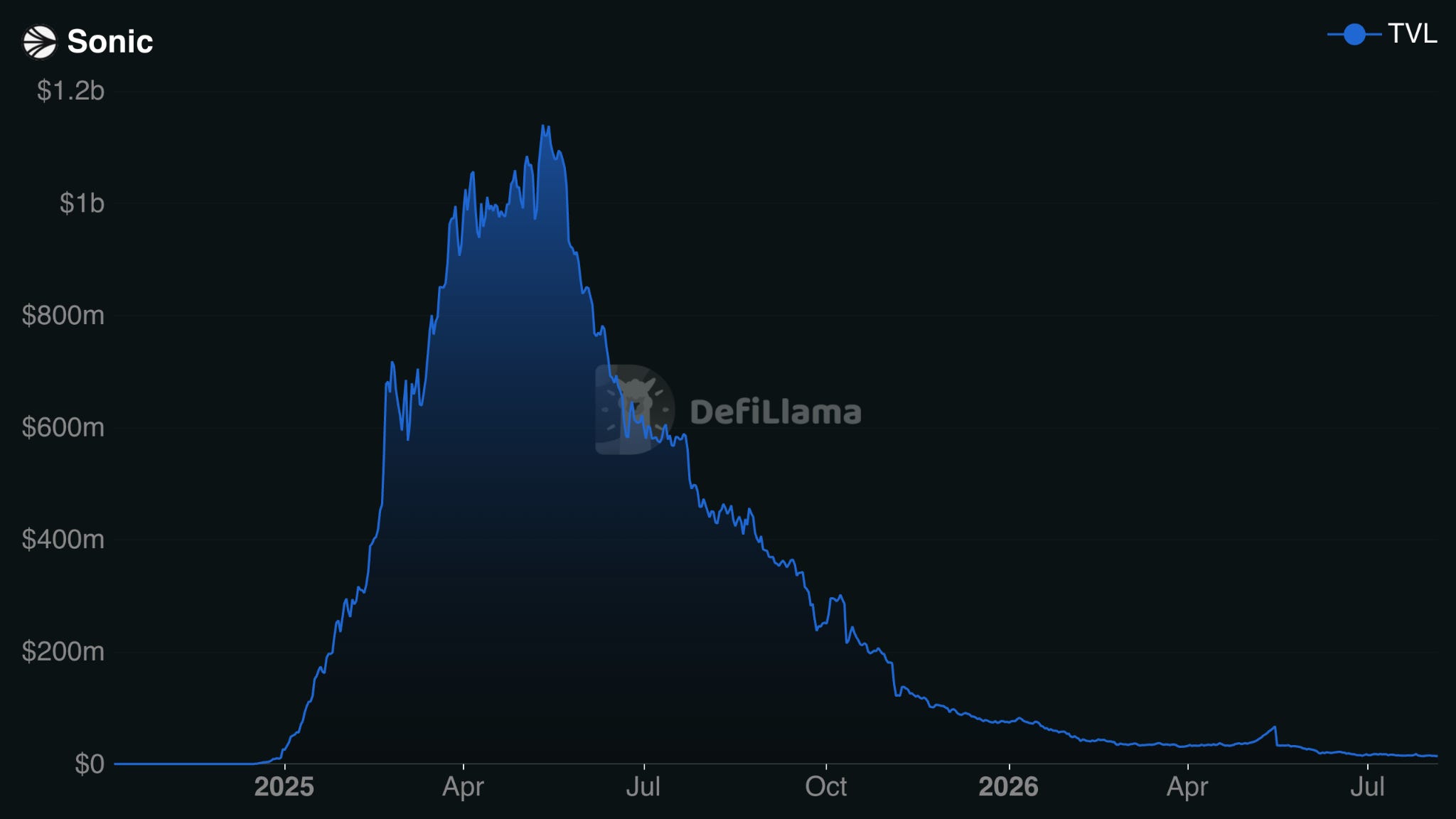
Fantom later also tried to relaunch with a new name and was branded as Sonic to test whether raw capital could work. They did a $190 million token airdrop and got Aave, Silo, and Euler deployed on day one with market-making supported by Wintermute. But it had the opposite effect, where it got sybiled. Depositors and borrowers were largely the same people. They were depositing to farm airdrop points and borrowing against the same deposit to maximise points exposure, and the TVL was rigged because it counted the same capital multiple times through leveraged loops.
Borrower demand was a derivative of the airdrop, not of some actual economic activity on the chain that needed working capital or leverage. For example, on Ethereum, people borrow because they want to loop stETH, or maybe they just need capital for trading strategies, and the demand exists regardless of whether a protocol is running a rewards program. But on Sonic, if you remove the incentives, there was literally no demand either. Which is exactly why, when the Wintermute term ended, its TVL collapsed 98%, the token went to less than a cent, and both its founders resigned from the board. You might game a credit market with subsidies and market maker deals, but you cannot sustain one with it.
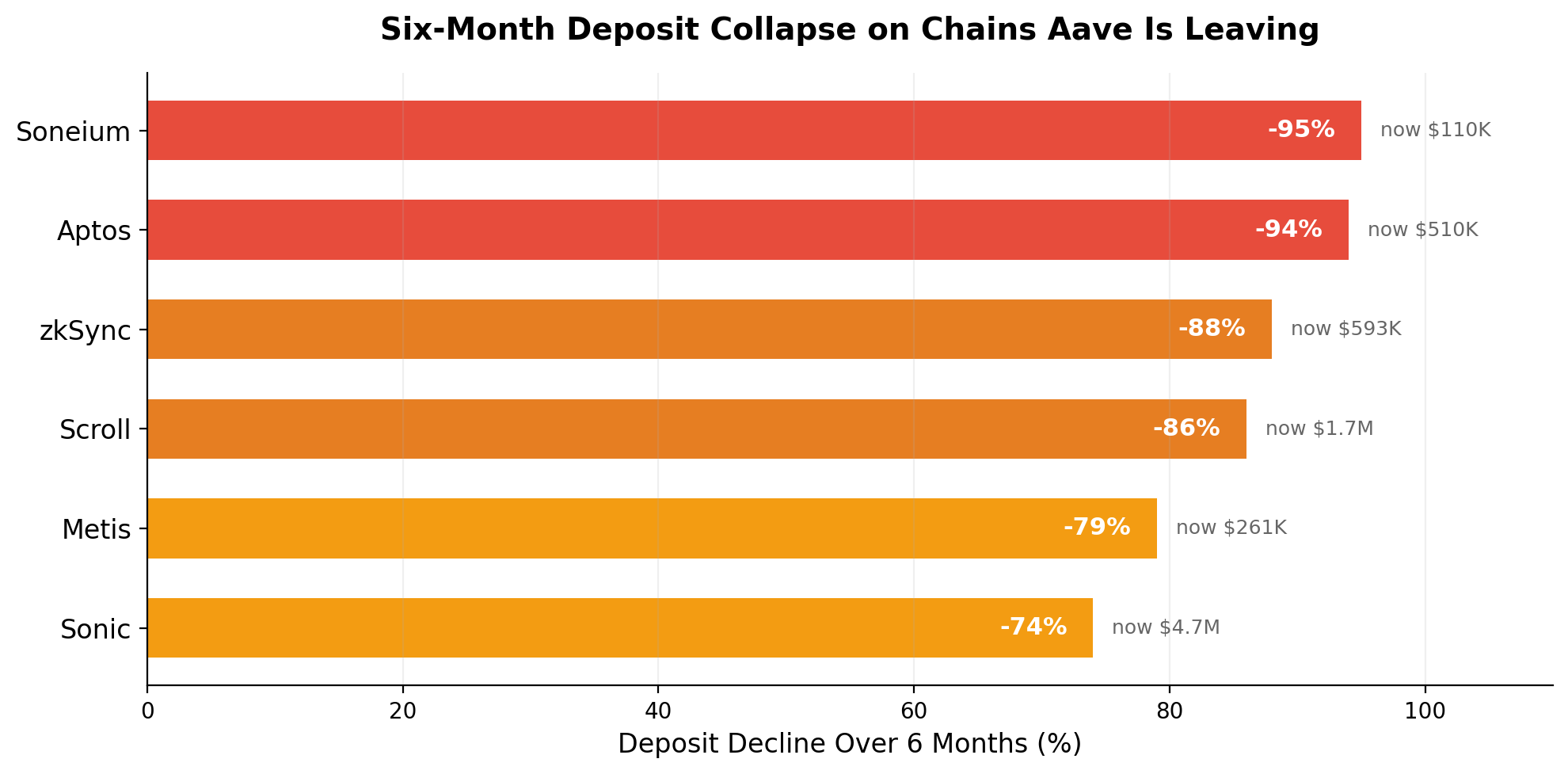
Next, if you look at the Soneium, Aptos, Zksync, and Scroll that Aave is leaving, they have, in fact, a worse trajectory than Harmony or Fantom. Their deposits have collapsed by 95%, and they generate less than $5,000 a quarter in lending revenue.
Harmony or Fantom at least had organic users with real borrowing demand before the bridge hacks wiped them. But these six chains never had any organic demand in the first place. They had raised an average of $250 million each in funding and had launched lending markets with the most cost-efficient protocols in DeFi operating on them, but still couldn’t materialise any demand.
And Aave’s exit is only going to have downstream triggers. You would be surprised, but Aave was the anchor tenant of Financial infrastructure on these chains. Almost all Chainlink oracle price feeds on these chains were being maintained by Aave, because it was the largest consumer of them. This will lead every oracle provider to question whether they should maintain a feed on a chain with no liquid lending market. The maker markets will stop allocating capital on the DEXs of these chains for the same reason. Even stablecoin issuers can’t support native issuance on a chain generating less than a thousand dollars a month. Each exit will make the next one more certain because each provider’s business case depends on the other being present.
The wind-down mechanics also accelerate into the chains that do work, where liquidity is deeper, and lending markets can function properly. Each exit from a small chain reinforces the concentration on the large ones, which in turn makes the next small chain’s case for sustaining its own lending infrastructure even weaker.
The consolidation feeds itself because Lending is the base layer of the entire financial stack on a chain. Without it, you can’t run yield strategies because most of them involve borrowing one asset against another, and you also can’t do Capital-Efficient LP because concentrated liquidity positions regularly use borrowed capital. If lending leaves, every financial application that sat on top of it loses its foundation. Which leads to developers leaving, which means less activity on the chain, and that means there’s even less reason for any infrastructure provider to come, or rather stay.
This is why, going forward, Aave has set a minimum requirement of $2 million in annual revenue for any new deployment, which is effectively what it costs to maintain the oracle feeds, risk monitoring, and liquidation infrastructure a lending market needs per chain. I feel it’s also important because it shows that the previous model of raising hundreds of millions to fast-launch a chain and subsidise early liquidity to stay just doesn’t work anymore. It’s not sustainable now.
Not Common to Crypto
This whole thing about chains losing their credit infrastructure is not limited just to crypto. It happens all around the world where fixed-cost infrastructure serves a thin market.
After 2008, global banks had also started cutting their correspondent banking relationships with small countries. The reason was very similar to Aave’s, as compliance costs for anti-money-laundering monitoring and regulatory reporting were fixed per relationship, and revenues from small corridors were not enough to cover them. Between 2011 and 2022, active banking relationships have dropped by 30% globally. Specifically, Pacific Island countries have lost over 60% of their USD clearing corridors. Some of them only have a single correspondent bank. It got so bad that the World Bank had to provide $69 million in subsidies to keep the single providers running for the eight Pacific nations.
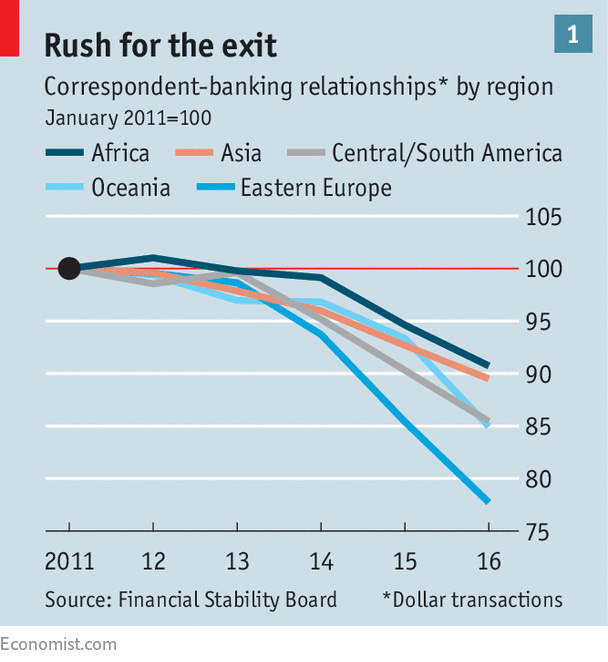
And this is the difference between crypto and all these traditional cases. In correspondent banking, we had the World Bank stepping in, and the floor becomes whatever a central bank or a development institution is willing to subsidise. But in crypto, the floor is close to zero, and that’s what we’re seeing happen with most of these chains. A mid-size bank spends $15 to $40 million a year on compliance alone, and the World Bank still had to put up $68 million just to stop eight countries from losing their last dollar clearing relationship. Aave’s risk monitoring contract was $5 to $8 million for all chains combined, and six of them couldn’t even cover their share of that.
All of this could be a shrinking-market story if DeFi lending was actually declining, but it’s the opposite. It’s growing rapidly and concentrating hard. Protocols like Morpho went from $105 million to over $8 billion in TVL in a year; Euler grew from just $6 million to over $300 million in less than a couple of months. We are seeing Aave’s own V4 surpass $300 million in deposits in months of launch, with Société Générale becoming the first bank to integrate with a DeFi lending protocol. The credit market is alive more than ever, but it’s concentrating on bigger chains like Ethereum or maybe two or three L2s like Base and Arbitrum and not spreading to thirty chains.
The assumption behind launching all these chains was that, since infrastructure is so cheap to deploy, every chain could host its own financial system. The assumption was half right: launching a chain is cheap, but operating a credit infrastructure on it certainly is not, as we have seen. If we look at most of the L2 today, ETH and the other top three account for 90% of all the TVL. Others are just fighting over scraps that can’t even cover the cost of a Chainlink price feed. These chains might get an Aave fork with a broken oracle, or they might not get anything at all.
That’s all for today!
Token Dispatch is a daily crypto newsletter handpicked and crafted with love by human bots. If you want to reach out to 170,000+ subscriber community of the Token Dispatch, you can explore the partnership opportunities with us 🙌
📩 Fill out this form to submit your details and book a meeting with us directly.
Disclaimer: This newsletter contains analysis and opinions of the author. Content is for informational purposes only, not financial advice. Trading crypto involves substantial risk - your capital is at risk. Do your own research.
Banks' most critical duty isn't moving money; it's safeguarding the sanctity of the financial system.
A lack of enforcement or design weaknesses in AML controls or KYC procedures permits dirty money into the clean system. This allows criminals' money laundering rings, sanctions evasion, corruption, and myriad other financial crimes. Regulators worldwide have long since stepped in to punish many an institution for egregious AML breaches.
The answer is continuous financial intelligence-not tick-box compliance. Banks need to implement AI-powered transaction monitoring, robust customer due diligence, better verification of beneficial ownership, sharing of threat intelligence where permissible by law, and stand-alone compliance departments with clear board control. Effective risk management, not transaction throughput, must become the incentivized factor.
Compliance is not a drag on development. It is a necessary prerequisite to a system built on trust that will protect clients, facilitate legitimate commerce, and buttress economic stability.
The institutions that lead the way forward will perceive trust, openness and responsibility not as the problems regulatory compliance poses but as valuable assets-as a competitive advantage.
What measures can banks take to enhance AML effectiveness while protecting customer privacy and maintaining operational efficiency?