


Hello,
Between 2020 and 2022, some of the sharpest crypto investors backed a wave of protocols building on-chain fixed-rate lending, letting you lock in returns like government bonds. Element Finance took $32 million from a16z and Polychain, Notional raised $10 million in a round led by Pantera Capital, and at least five others followed right behind them.
Today, every single one of them is dead, and the yield they were trying to package into these products was completely made up—mainly because DeFi in 2021 ran on token rewards that protocols printed out of thin air and leveraged loops that collapsed the moment anyone tried to exit.

The only protocol that survived this wipeout was Pendle. And the reason was that tokenised US Treasuries started showing up on-chain, giving actual income to build yield products around. I think that same shift is about to tear through every major primitive we have. Let’s dig in!

Frontrun: Early Bird Holds the Edge
Most people hear about a promising startup the day it announces its funding. By then, the investors who backed it have known about it for months. How did they get there first?
Hours of digging, who started the company, what they’ve built before, how to reach them, and understanding what to write to them so that you can join them early in their journey.
Frontrun does this digging for you. When top investors start following a young company on X, Frontrun flags it, finds the founder, and writes your opening message. You can read the draft, tweak it, and hit send without leaving the platform.

Frontrun gives you a ready brief on every company it flags.
You can also automate a daily morning report with the list of startups to track based on what your favourite accounts are following. Served hot, along with your breakfast.
The Workarounds
To see what that shift looks like, we need to start with the conditions DeFi was born into.
Consider what onchain financial markets looked like in 2018 and 2019. The assets available for trading were native crypto tokens with no cash flows, no legal entity behind them, and price swings so violent they could wipe out 90% of their value in an afternoon.
These markets were also used by pseudonymous wallet addresses with no credit histories, legal identities, or mechanism for accountability if they defaulted. Ethereum processed roughly 7–8 transactions per second in 13–15-second blocks. The capital base consisted largely of retail speculators and a small number of crypto-native funds willing to take enormous risk for the chance at enormous returns.
A functioning financial market normally runs on inputs that none of these conditions could provide. You need market makers willing to sit on both sides of a trade, quoting bid and ask prices on assets that behave predictably enough to hedge against. You need lenders who can assess whether a borrower will repay, which means knowing who the borrower actually is.
DeFi was far from this model. The assets were too volatile for any professional market maker to touch. Borrowers, meanwhile, were anonymous wallets. And the user base had zero interest in fixed expiry dates.
So builders at the time started designing the missing pieces. For example, Uniswap didn’t invent the AMM because it was a better way to trade. It invented the AMM because nobody would make markets in tokens that could lose 90% of their value in minutes. The solution was to embed the pricing function directly into a smart contract and let anyone deposit capital into a liquidity pool, so that the constant product formula could handle price discovery on autopilot, adjusting the exchange rate with every trade based on the ratio of tokens in the pool.
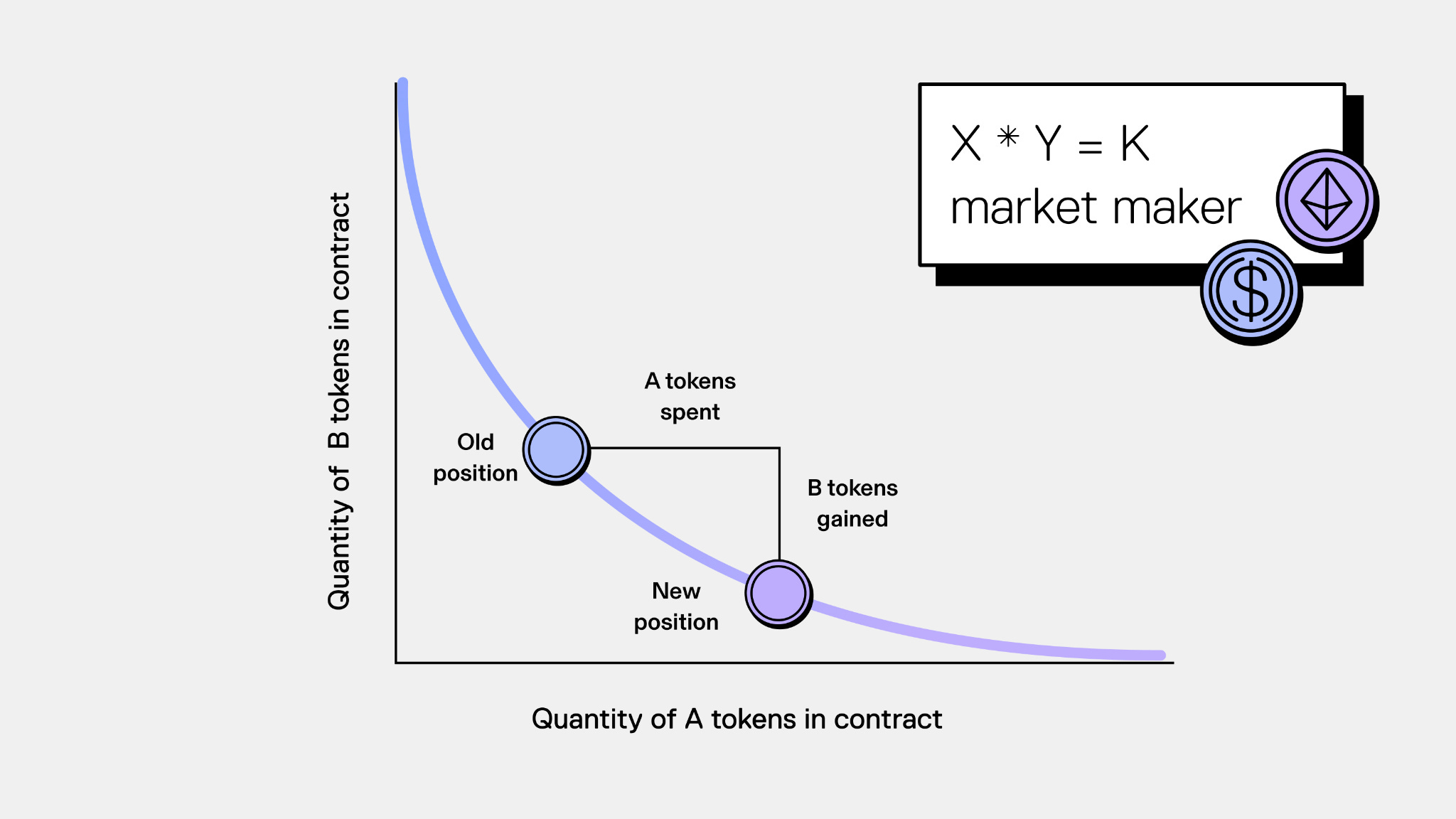
What many DeFi-native users still do not fully grasp about this design is how different it actually is from market making.
A traditional market maker earns the bid-ask spread. But an AMM liquidity provider is doing something else entirely. Every time an arbitrageur spots a price discrepancy between the pool and the broader market and trades to correct it, the LP on the other side effectively pays the arbitrageur to rebalance the LP’s portfolio.
Here is how it works: let’s say you deposit an equal value of ETH and USDC into a Uniswap pool, and ETH pumps 20% on Binance, but the pool doesn’t know that yet. Then an arbitrageur sees the cheap ETH in the pool, buys it, and sells it on Binance for a profit. Your pool now holds more USDC and less ETH, and you just sold ETH on the way up.
When ETH drops, the reverse happens: arbitrageurs dump ETH into your pool and pull USDC out. Trade after trade, your portfolio gets automatically rebalanced toward a 50/50 split, and the arbitrageurs pocket the difference as arbitrage profit.
And the mathematics behind this is crazy. Even if you assume the absolute worst case—that every single trade in the pool is pure arbitrage and zero retail volume ever touches it— the small fee charged on each trade still compounds into positive returns for the LP.
Aave and Compound followed the same constraint logic in lending. A normal bank usually decides whether to lend you money by looking at your credit score and your income history. But you can’t do that for pseudonymous wallets on-chain. So these protocols adopted a model of over-collateralised lending.
Similarly, perpetual swaps replaced traditional dated futures for the same reason. Rolling a quarterly futures contract requires counterparties to commit to showing up on a fixed settlement date, but with crypto’s user base, with anonymous capital rotating between protocols to chase the highest yield, those commitments are impossible.
And don’t get me wrong, every one of these workarounds created a functional product. But if you zoom out and look at what kind of financial system they collectively produced, the picture gets really uncomfortable. The reality is none of the collateral backing any of these products generates any income.
A simple way to stress-test any financial arrangement is to check whether the borrower’s income from whatever they posted as collateral actually covers what they owe. You can sort these arrangements into three buckets.
First, hedge finance is the safest: your income covers both your interest payments and your principal. For example, a salaried worker paying off a mortgage from their paycheck is a clear example. Next is speculative finance, the middle ground: your income covers the interest, but when the principal comes due, you need to refinance. Think of a company rolling over its corporate bonds. And at the very bottom is Ponzi finance: your income covers neither. The only thing keeping you solvent is the hope that whatever you bought keeps going up in price. And the moment it stops, you are done.
Now think about the moment someone takes a loan on Aave today. A borrower deposits $10,000 worth of ETH, borrows $6,000 in USDC against it, and goes off to do whatever they want with that USDC. But the ETH in that Aave vault is generating absolutely no income to service the loan. The only thing keeping the loan alive is the market price of ETH staying above the liquidation threshold, and the moment it drops far enough, the protocol sells the collateral and closes the position.
The entire arrangement depends on the asset’s market value holding up long enough for the borrower to exit on their own terms. And that describes almost every overcollateralized DeFi loan ever written against a native crypto token.
What Changes
Now replace the collateral in that scenario with tokenised US Treasuries. The lending protocol and the borrower remain the same, but instead of ETH, they now post $10,000 in tokenised US Treasuries earning 4.5% and borrow stablecoins at 3%. The collateral is producing $450 a year in income, while the loan costs $300.
The collateral income covers the cost of the debt. That income has nothing to do with crypto market cycles because it comes from actual US government coupons, so it keeps flowing whether Bitcoin is at $100,000 or $30,000. And every day that loan stays open, the borrower’s position gets slightly stronger. Think about how different that is from the ETH loan, where every market dip edges the borrower closer to liquidation because the collateral produces absolutely nothing.
When every piece of collateral in DeFi produces zero income and depends entirely on price appreciation, every position faces the same directional risk. When one asset drops, it triggers liquidations, and the forced selling pushes prices lower, which triggers even more liquidations, and the whole thing cascades.
We have watched this sequence play out in almost every crypto downturn since 2020 and treated it like a black-swan event, as if the outcome were surprising when the collateral was never producing anything at all. But when a meaningful share of the collateral base is earning income from US Treasuries, those positions hold firm during a crypto crash because their cash flows have nothing to do with crypto.
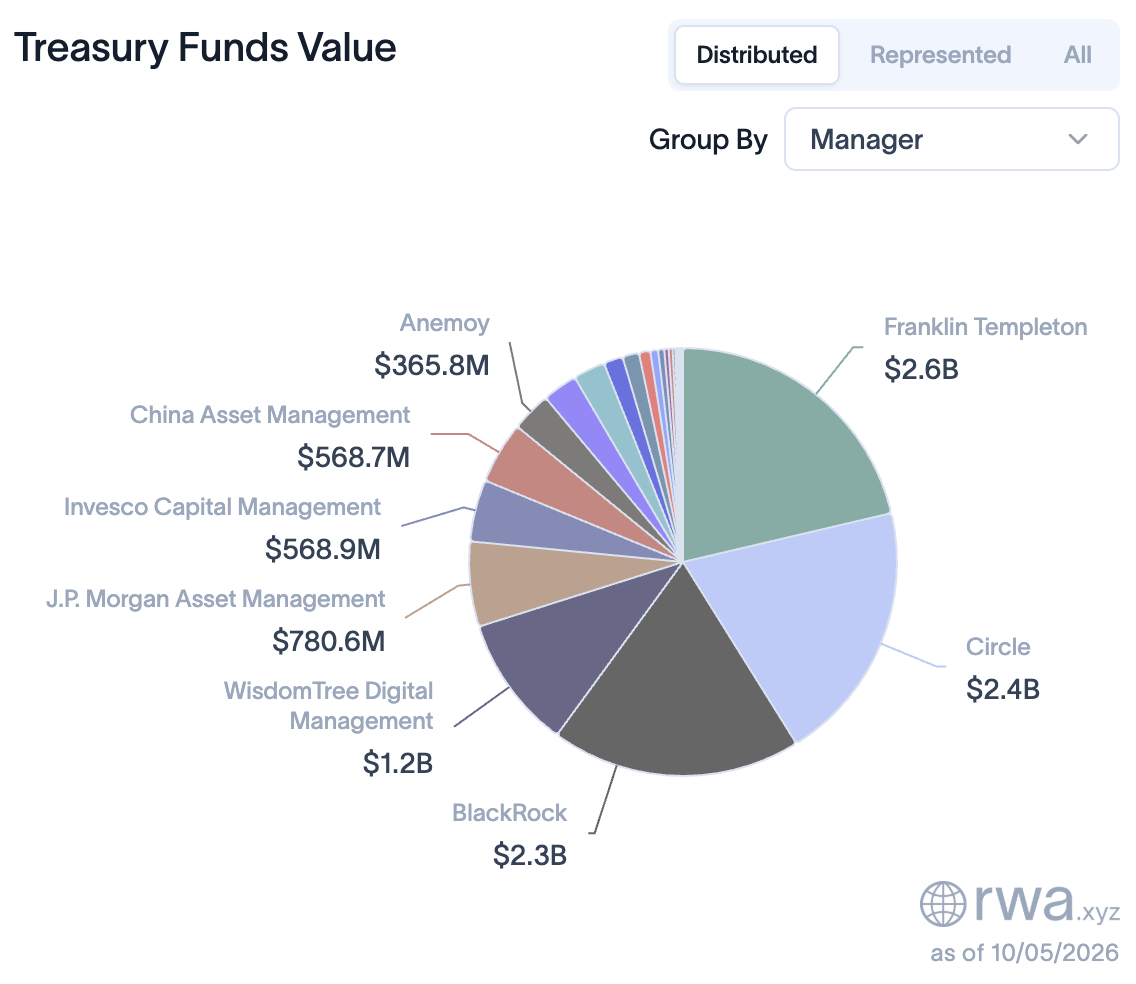
For the first time, the lending system has a floor that does not depend on the market going up. Tokenised money market fund shares went from $770 million at the end of 2023 to $14.82 billion as of 5 October 2026—roughly nineteenfold in under three years.
This pattern also has a historical precedent. In 1955, Midland Bank in London started accepting US dollar deposits because Regulation Q capped the rates American banks could pay and British banks had no such cap. So dollars flowed offshore to chase better yields, and a parallel dollar system grew from nothing to an estimated $4.7 trillion by the early 1980s.

But the Federal Reserve did not crush the Eurodollar market; instead, it adapted to it. A parallel system that grows out of a limitation in the incumbent will keep expanding until that limitation gets fixed. So Regulation Q was phased out, and money market funds emerged as the domestic competitive response, and the parallel dollar system got folded back into the original.
Stablecoins are this generation’s Eurodollars, and tokenised Treasuries are this generation’s money market funds.
The dead protocols all tried to build a rate market even before real rates existed onchain, using token emissions and leverage loops as stand-ins for actual income. But you cannot build a rate curve on yields that a protocol governance vote can turn off whenever sentiment shifts.
Pendle survived because it was still alive when tokenised Treasuries and yield-bearing stablecoins finally gave the market actual government-backed income to build products around. Pendle’s Boros is now the first functioning onchain interest-rate-swap analogue, pointing to a traditional finance interest-rate-derivatives market that runs over $600 trillion in notional outstanding.
The same logic applies to trading. The 11% annual cost that AMM liquidity providers bleed to arbitrageurs on liquid pairs, and for tokens with no centralised listing, paying that tax was the only option. But for Treasuries, equities, and bonds that already trade with deep liquidity globally, routing through an AMM is absurd.
These assets need an onchain order book fast enough to match centralised exchange performance, and every major L1 team spent years claiming that was technically impossible, but then Hyperliquid proved them wrong. At points in early 2025, it handled roughly 60% of onchain perpetual-swap volume.
All of this suggests that the infrastructure being built for tokenised Treasuries and equities looks far more like traditional electronic markets than you might want to admit, because these are the same assets those markets were designed to serve.
DeFi’s first generation of primitives was shaped largely by the constraints of volatile, income-free tokens held by anonymous wallets. But now that the assets are changing, the workarounds are giving way, and what replaces them is converging toward the same infrastructure that has processed trillions in volume every day for decades.
That’s all for today!
Vaidik
Token Dispatch is a daily crypto newsletter handpicked and crafted with love by human bots. If you want to reach out to 165,000 subscriber community of the Token Dispatch, you can explore the partnership opportunities with us 🙌
📩 Fill out this form to submit your details and book a meeting with us directly.
Disclaimer: This newsletter contains analysis and opinions of the author. Content is for informational purposes only, not financial advice. Trading crypto involves substantial risk - your capital is at risk. Do your own research.