


The SEC was born because America discovered that a market could be extremely active without being trustworthy.
Before the 1929 crash, companies could sell shares with limited disclosure, traders could organise pools to manipulate prices, and stock exchanges were largely expected to police themselves. The crash made the cost of this arrangement impossible to ignore. Congress first passed the Securities Act of 1933, which required companies selling securities to give investors meaningful information.
The Securities Exchange Act followed in 1934 and created the SEC to oversee exchanges, brokers and the secondary market. The government was establishing a bargain that the claim had to be real, and the market moving that claim between people had to follow rules.
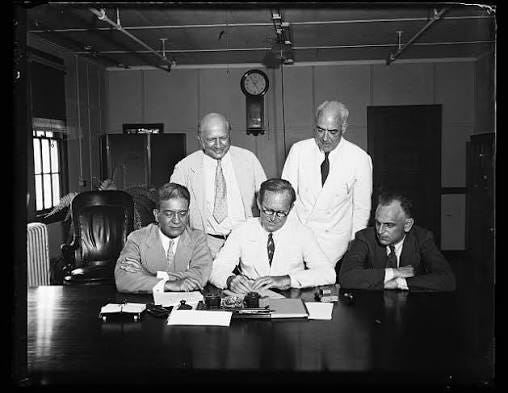
Nothing fundamental changed when certificates went digital, and floors became server rooms. Issuers still made the shares, transfer agents recorded who held them, exchanges matched trades, and market makers still supplied the other side so prices kept moving.
A blockchain can bring these jobs much closer together. The share, the ownership record, the payment and the trading pool can all operate through connected smart contracts.
The SEC’s obsession for much of the past decade has been asking when a crypto token should be treated as a security. The Clarity Act did not make it through Congress —RIP — but the SEC has now created a smaller, temporary route through its Innovation Exemption. This one gives companies five years to find out. A qualifying Tokenised Securities Venue (TSV) can facilitate onchain trading of tokenised US stocks through permissioned automated market makers and liquidity pools.
So if a token is already a genuine stock, can it trade through a crypto-style pool that only approved investors are allowed to use?
The SEC’s answer is yes, but the old protections must remain.
The token must carry normal shareholder rights.
The company behind the stock must be informed and can object.
Only approved wallets can trade.
If the stock stops trading on Nasdaq or the NYSE, its tokenised version must also stop.
The smart contracts must be public so regulators and investors can inspect what happened.
Creating a real stock and approving the pool only gets the market started. Someone must still provide the shares and cash, keep the price accurate and carry the risk. That is where we are going today.

TOKEN2049: The Largest Crypto Stage
Over 25,000 attendees, 300 speakers, 500 exhibitors and 1,000 side events will come together at TOKEN2049 to rewrite the future of finance. And you are invited!
TOKEN2049 Singapore is just over three weeks away. The global crypto industry meets at Marina Bay Sands, 7-8 October, for the world’s largest crypto event.
Book by Wednesday, September 23, to lock in the current rate of $539 ($599) and get the exclusive 10% discount before the price goes up next week.
A normal stock exchange tries to match someone who wants to sell with someone willing to buy. An automated market maker, or AMM, gives both of them a pool to trade against.
The seller needs the pool to contain enough cash. The buyer needs enough shares. Whoever supplied those assets earns part of the trading fees.
This sounds fairly easy, but suppose Apple trades at $200 on Nasdaq while its tokenised share costs $198 in the pool. A trader can buy the cheaper token, hedge it against the traditional market and keep the difference. This pulls the prices closer, but the liquidity provider’s pool sold the stock too cheaply.
Crypto calls one part of this impermanent loss. When a stock falls sharply, the pool can end up holding more of the falling stock and less cash. When it rises quickly, the pool may sell the stock too early.
Traditional market makers handle this by widening the difference between their buying and selling prices, trading less, hedging elsewhere or withdrawing. A simple AMM follows its programmed rules. This is uncomfortable with listed stocks, which can jump after earnings, a lawsuit or a post from a CEO who should perhaps have gone to sleep. A 24-hour pool remains awake.
The Innovation Exemption creates room for these pools to operate, and it offers conditional relief to certain firms supplying their own capital. It cannot guarantee that the trading fees will be greater than the losses from stale prices, adverse trades and badly balanced inventory.
Once we see the market this way, tokenised-stock liquidity separates into three problems.
The venue must check who is allowed to trade. A wallet address alone cannot show who owns it, whether that person has passed identity checks or whether they are legally allowed to hold the stock.
The pool needs enough shares and cash. If a pool holds only a few shares, even a small trade can empty it and push its price away from Nasdaq.
The liquidity provider needs enough capital to keep the pool running. It must fund the shares and cash, protect itself when prices move and earn enough from fees or spreads to make the risk worthwhile.
I tracked who gets to fix these layers.
Uniswap can decide who enters the pool
Uniswap v4’s Permissioned Pools deal directly with the first problem.
Uniswap v4 is normally permissionless. Anyone can create a pool, swap through it or provide liquidity. A regulated security cannot behave that way because its token contract may be required to reject transfers to wallets that have not passed the issuer’s checks.
Uniswap v4 keeps balances inside one PoolManager contract and updates virtual balances as people trade. If a restricted stock only checks wallets when a real token transfer occurs, it cannot see everything happening inside the pool. An unapproved person could receive exposure without triggering the stock token’s ordinary transfer check.
Permissioned Pools solve this by checking the wallet before the trade itself is allowed.
The real stock is held inside a separate smart contract called the Permissions Adapter, which the issuer has approved. Uniswap then uses a virtual version of the stock to track trades within the pool. Before anyone can buy, sell or add shares and cash, the adapter asks the issuer’s compliance system whether that wallet has permission.
It does not matter whether the issuer uses Securitize’s DS Protocol, Tokeny’s ERC-3643 or its own investor registry. Uniswap only needs a yes-or-no answer from that system.
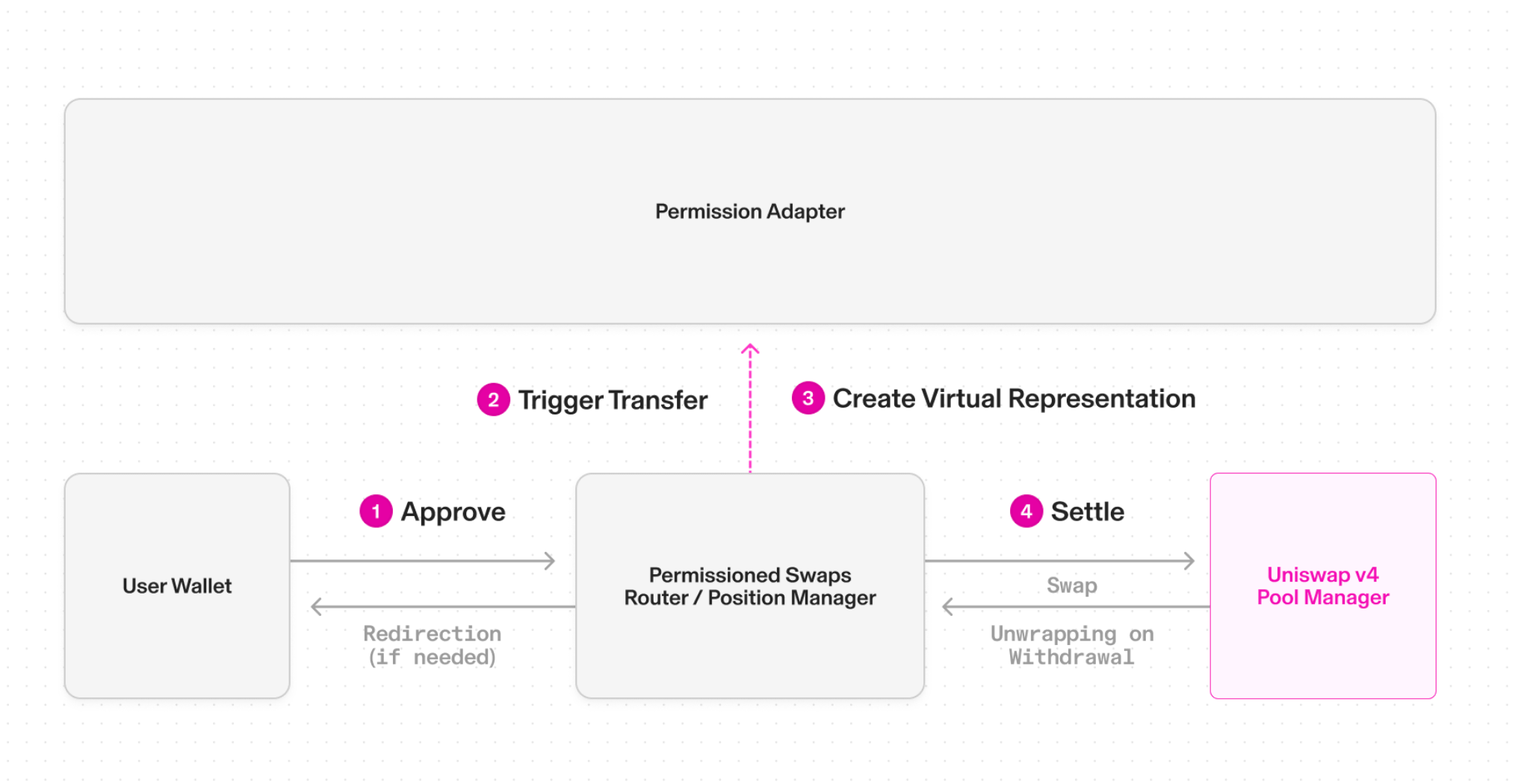
The permission to trade is also different from the permission to provide liquidity. Someone may be allowed to buy a tokenised stock without being allowed to supply shares and cash as a market maker. Uniswap checks the trader before every swap and checks the liquidity provider before accepting their assets. Permission can also be withdrawn later. If a liquidity provider is no longer eligible, the issuer can close the position. The LP receives the unrestricted asset, such as USDC, while the tokenised stock is moved to an address chosen by the issuer. The stock does not forget that it is regulated merely because it entered DeFi.


The system is already live and Uniswap says Superstate, Securitize and Dowgo are building with it. None has thereby been approved as a TSV. The SEC published no list of winners. Uniswap has built technology resembling the permissioned AMM the order now makes possible.
The stock still has to come from somewhere
A token can carry Apple’s name and follow Apple’s price without making its holder an Apple shareholder.
Robinhood’s Stock Tokens, for example, are debt securities issued in Jersey. They provide economic exposure to the underlying stocks, but Robinhood states that holders receive no legal or beneficial ownership of those shares. The SEC’s new exemption requires the token to carry the same rights as the traditional stock. For the moment, we will step around Robinhood’s awkwardness and see who owns that layer currently.
Superstate’s Opening Bell helps public companies make their actual shares available on Ethereum and Solana. Galaxy Digital became its first major example in September 2025, when it allowed shareholders to move its Class A common stock onto Solana. These tokens were Galaxy’s SEC-registered shares, carrying the same rights as the traditional stock. When tokens moved between verified investors, Superstate updated Galaxy’s official shareholder list in real time.

As an SEC-registered transfer agent, Superstate maintains the shareholder registry across traditional book-entry shares, tokenised holdings and supported DeFi applications. When a company already has a transfer agent, Superstate works alongside it and builds a bridge between the existing record and the blockchain. Superstate also offers a Direct Issuance Program. This allows a listed company to sell newly issued shares directly to eligible investors using real-time market prices. The investor pays in stablecoins and receives the actual shares as tokens in an approved wallet.
Securitize covers similar ground. It issues and administers regulated digital securities, maintains investor records and enforces the rules governing who can hold or transfer them. Uniswap’s pools can query Securitize’s DS Protocol when deciding whether a wallet may trade or provide liquidity.
It is also the tokenisation and transfer-agent platform behind BlackRock’s BUIDL fund. BUIDL became available for onchain trading through UniswapX in February 2026, although this was not an AMM pool. It used a request-for-quote system in which approved investors could receive prices from whitelisted firms, including Flowdesk, Tokka Labs and Wintermute. Securitize Markets facilitated the transactions, and every participant had to be approved by Securitize. But look at how the two layers could work together.
Securitize controlled who could legally hold and trade the security. UniswapX supplied the technology for finding a quote and settling the transaction onchain. These companies are not necessarily Uniswap competitors. A transfer agent records who owns the share and whether a transfer is valid. Uniswap handles the exchange between approved participants.
SEC requires a Tokenised Securities Venue to verify that each token carries the same rights as the equivalent traditional share. If an unaffiliated third party tokenises a company’s stock, the venue must notify the original issuer and give it an opportunity to object. If the stock stops trading on its primary exchange, its tokenised version must stop too.
The SEC order also limits the number of symbols and trading volume available to each venue during the exemption. Somebody must still supply enough shares and cash to make those permitted markets useful.
How do you keep the price from becoming ridiculous?
A passive AMM, such as a standard Uniswap pool, is always open for trading. Its price depends on how many shares and how much cash are sitting in the pool.
Concentrated liquidity allows the liquidity provider to place most of that money close to the stock’s current price. This helps the pool offer better prices without requiring as much capital.
The bigger problem is the clock. A simple AMM sets its price from its own pool, while arbitrage traders keep it close to the outside market by buying wherever the asset is cheaper and selling wherever it is more expensive. Let’s say Nvidia finishes Friday at $200. On Saturday, the company announces something terrible. People now expect the stock to fall, but there is no fresh Nasdaq price to tell the pool how far. If the pool is still buying near Friday’s price, someone who sees the news can sell into it before the price adjusts. The people who put money into the pool are left holding shares that may be worth less.
RedStone’s COO, Marcin Kaźmierczak, pointed out that regular NYSE and Nasdaq trading takes up only 32.5 hours of a normal 168-hour week. Trading before and after those sessions gives us more prices to work with, but weekends still leave a gap.
Oracles, which bring outside data into blockchain applications, help narrow that issue. Chainlink’s 24/5 US equity streams cover regular, pre-market, post-market and overnight sessions. They report buying and selling prices, market status and information about how old the price is. When the traditional market closes for weekends or holidays, however, those feeds carry stale values. An application can use prices from tokenised markets instead, but those are no longer a live reference to the underlying stock market.
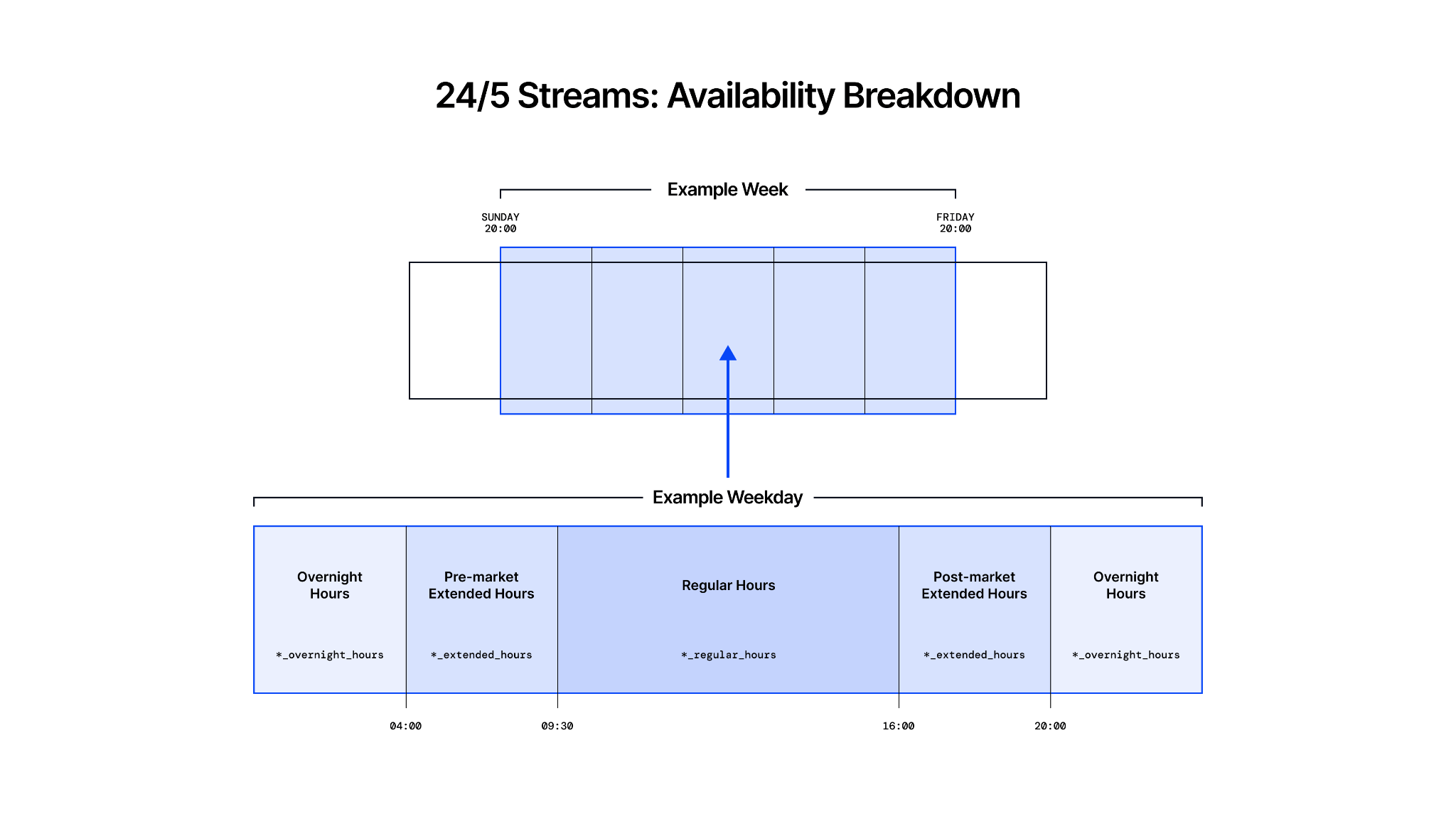
This leaves another decision for the trading system. Knowing the latest available price is useful, but how much inventory should we offer at that price, and how cautious should we be when the information gets old?
Byreal, a Solana exchange incubated by Bybit, approaches this by offering several possible routes for each trade. It compares concentrated liquidity pools with quotes from professional market makers through a request for quote, or RFQ. Or, let’s just say it asks a trading firm what price it will offer for the requested amount.
A professional firm may offer a better quote after considering its own inventory and prices elsewhere. Byreal can draw on its own pools, external AMMs including Raydium, Orca and Meteora, and market-maker quotes. The useful innovation is the ability to compare these sources rather than expect one pool to handle every order equally well.
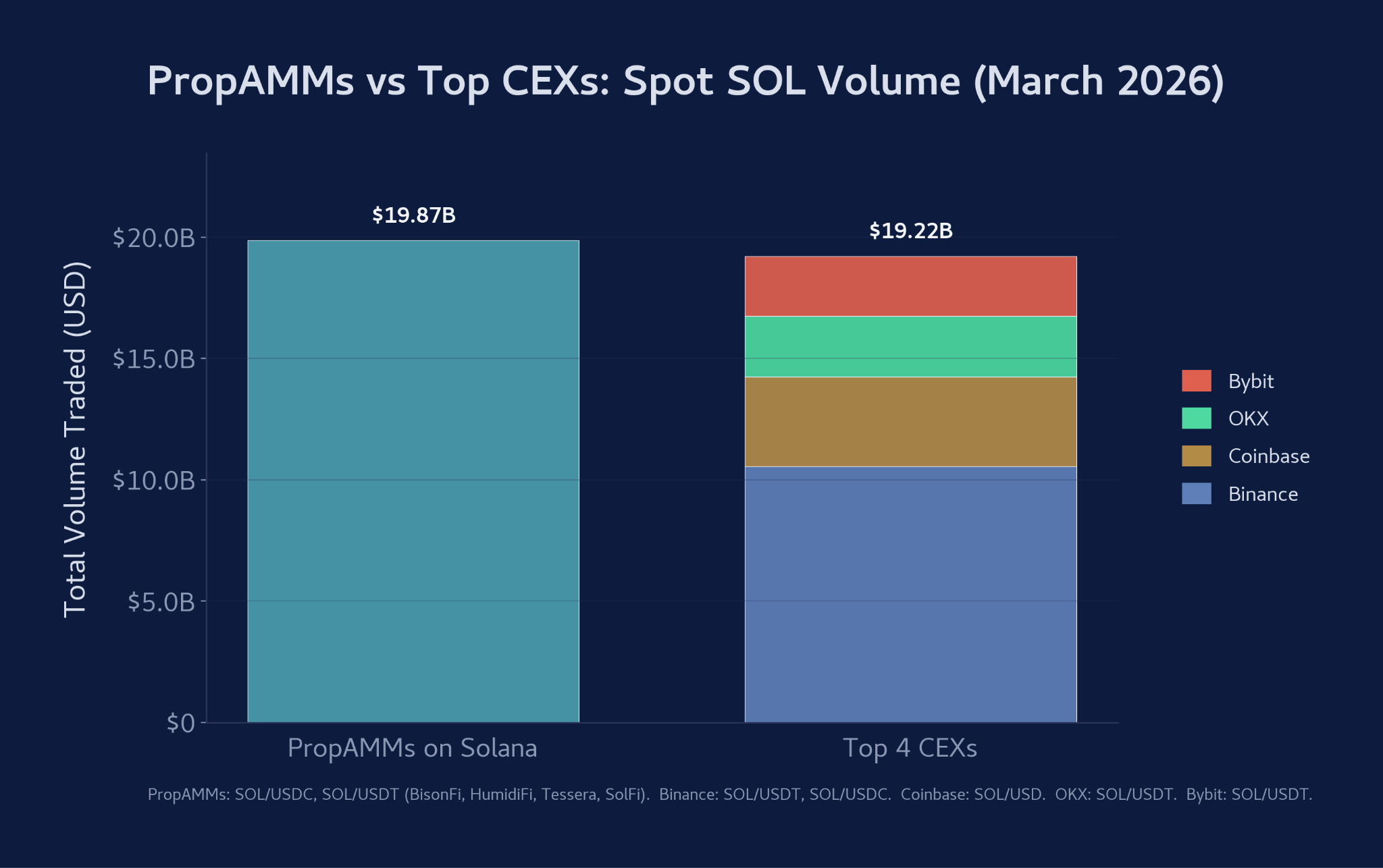
BisonFi, from Jump Crypto, is a proprietary AMM, or PropAMM, with an offchain pricing engine that watches other markets and sends updated prices to an onchain trading program. The assets and settlement remain onchain, but the price can change before someone trades against an outdated quote.
Its program also responds to inventory and the freshness of its information. If it holds too much of one asset, it can adjust prices to encourage trades that restore the balance. If its price update is old, it can widen the gap between its buying and selling prices or offer less inventory. These are ways of continuing to make a market while limiting how much risk the firm accepts.
UniswapX addresses the same broader pricing problem through competition. Firms compete to fill a trader’s order using different liquidity sources. Separate from Uniswap’s permissioned pools, you can see how execution can improve when a trader is not confined to a single pool’s quote.
What all of these offer is a better way to trade under that uncertainty. For builders working on genuine tokenised stocks, the opportunity is to combine reliable market data, competitive quotes and controls that respond when information becomes scarce. Existing crypto-market capabilities provide a useful foundation, although applying them under the SEC exemption remains a separate task.
Suppose everything else is ready. The token represents a real share, the pool checks who can trade, and a market maker knows how to keep its prices competitive. That firm still needs enough shares to sell and enough cash to buy from everyone else.
A firm making markets in ten tokenised stocks may need shares and stablecoins across ten pools. Without financing, every dollar supporting those quotes comes from its own balance sheet. Traditional finance already has businesses called prime brokers that lend to trading firms. When deciding how much security to require for a loan, they can consider several investments together. For example, a firm might own shares while also holding a separate trade designed to gain value if those shares fall. Looking at both gives the lender a better picture of the risk than examining either alone.
Arkis brings this very portfolio margin into digital markets. Lenders supply money, while Arkis assesses a borrowing firm’s supported investments together and monitors the assets backing its debt. If those assets lose too much value, the system can sell positions to help repay the loan.
Arkis is adjacent to tokenised-stock liquidity, not a stock AMM. But it could help finance the firms putting shares and cash into trading pools. A market maker that can borrow against its combined investments may be able to support more trading with the money it already has.
There is still a large jump between that possibility and the exemption. Arkis has not established that these US stocks will be accepted as collateral, that TSV positions can enter its margin system or that its lending structure meets the relevant securities requirements.
The SEC has also offered a temporary conditional dealer exemption to liquidity providers that use proprietary capital in TSV pools, quote prices or commit capital. That removes one regulatory obstacle.
A single stock trade can support several businesses. One keeps the ownership records, another runs the trading pool, and others supply the shares, set prices or lend the money.
They can earn administration fees, trading income or interest, so they are not all competing for the same payment. Who earns the most will depend partly on where people choose to trade. Buyers and sellers want good prices and enough shares and cash available to complete their orders. But the firms supplying those assets need enough customers to make the effort worthwhile. Each side is waiting for the other.
When prices move sharply, and someone wants to sell a large holding, can the pool complete that sale at a reasonable price, while leaving the firms supplying its shares and cash willing to keep doing so? That is when we will know whether tokenisation has created a market people can rely on.
We never know. Robinhood is probably naming a feature as we speak.
Token Dispatch is a daily crypto newsletter handpicked and crafted with love by human bots. If you want to reach out to 170,000+ subscriber community of the Token Dispatch, you can explore the partnership opportunities with us 🙌
📩 Fill out this form to submit your details and book a meeting with us directly.
Disclaimer: This newsletter contains analysis and opinions of the author. Content is for informational purposes only, not financial advice. Trading crypto involves substantial risk - your capital is at risk. Do your own research.