


Hello,
South Korea opened single-stock leveraged ETFs in May 2026, and within weeks, an entire generation of twentysomethings turned them into the world’s biggest collective bet on AI. These are kids who can’t afford a Seoul apartment on fifteen years of their graduate salary, so when someone handed them a way to go 2x leveraged into Samsung and SK Hynix, they went all in.
But then the AI trade snapped, and the country margin-called roughly 3% of its own adult population in a single month. Sixty-two per cent of those liquidated accounts belonged to people under 30.
Korea looked like a one-off until I started pulling the numbers for every other market underneath. Two-thirds of all S&P 500 options now expire the same day they’re created, 90% of crypto trading volume runs through perpetual futures that never settle, and prediction markets have started running contracts that resolve in five minutes. The average holding period for a stock went from eight years in the 1950s to about five and a half months, and it keeps shrinking. Nobody wants to own anything past tomorrow.
So I went deep into what’s actually driving this, and the story turned out to be quite strange. Let’s Dig in!

StablesReward: Your AI Agent Spends, You Earn
AI agents can surf the web, read reviews, and book hotels for you. All these tasks cost money. But what if these tasks could earn you back something?
StablesReward does just that. Once you connect your agent to an MCP endpoint, it gives your agent a menu of paid tools. Every call your agent pays for earns you miles or stocks. And this is in addition to the rewards you earn anyway on your own spending across 800+ merchants.
Every purchase pays you back. The best part is that you can choose how you’d like to be rewarded. Transfer miles to airlines and hotels, or let your stocks build a portfolio from the spend you were making anyway.
Launching soon. Free to join.
The Unpriceable Future
The easiest explanation for all the financial nihilism that we are experiencing is smartphones. Trading apps have removed all friction from access, our attention spans are now shorter than a goldfish’s, and a whole generation raised on TikTok is bringing its dopamine habits into financial markets.
But something about that story never added up for me. If phone apps and retail traders were the whole reason, you’d see it in retail accounts and nowhere else. But Institutional options desks running money for pension funds and hedge funds have moved to the same ultra-short timeframes on their own. Crypto derivatives markets built by a dozen quants in a Singapore WeWork have done the same.
Not only that, but Prediction markets operating under completely different rulebooks are racing to compress contracts down to five minutes. These groups barely overlap, and neither do their regulations, yet they all independently decided within a few years to stop pricing anything past the next few hours.
So why did every part of finance, at roughly the same time, lose the ability to think past tomorrow?
I think it’s pretty similar to what Frank Knight figured out in 1921. He split “not knowing what comes next” into two completely different problems. He called the first problem risk. That is, you don’t know exactly what may happen, but you know the menu of possibilities and can attach rough odds to each one. For example, A company might miss earnings by five per cent or beat by three, or an interest rate decision might go one way or the other.
In all of these cases, you can draw boundaries around what could happen, assign probabilities to each outcome, and build a strategy around it. You can model that exposure, hedge it, sell it to somebody running a different model, and let the market figure out who was closer. That’s what Black-Scholes, or value-at-risk, does.
The financial engineering revolution of the last fifty years was built to take messy, noisy, complicated reality and turn it into probability distributions traders could optimise against. It always worked perfectly, until now, because real-world outcomes stayed clustered tightly enough that even rough models gave you something to steer by. Your model didn’t need to be right. It just needed to be roughly in the neighbourhood, and the law of large numbers would do the rest.
The second problem Knight identified is when you can’t even write down the list of outcomes you’d assign probabilities to. Basically, you can’t even price the risk. For example, Will AI eliminate 80% of white-collar jobs within ten years, or will it plateau next year into fancier autocomplete? Both futures have serious people with real credentials backing them, and neither side has data. You can’t build a probability distribution here because nobody can agree on what the possible states of the world even are.
For most of economic history, this second problem of not-knowing stayed in containable pockets. A pharmaceutical company runs a drug trial and has no idea whether the molecule works. Nobody can assign a probability because the biology is too complex and every compound is different. That’s true uncertainty in the Knightian sense.
But it sits inside one company’s balance sheet. If the trial fails, Pfizer’s stock may drop a few per cent, and the rest of the market won’t even blink. Similarly, A startup building a new kind of battery has no idea if the chemistry will scale, and neither does anyone funding it. The founders can’t model success because the thing they’re building has never existed before.
That’s what venture capital was invented for. VC works precisely because it absorbs these concentrated pockets of real uncertainty and walls them off from the rest of the financial system. A venture fund makes fifty bets knowing that forty will fail completely, and the model still works because each bet is independent and the failures don’t cascade into anything else.
Meanwhile, the broader economy also moved slowly enough that you could model around it. A company selling toothpaste in 1985 could project ten-year cash flows with reasonable confidence because the forces that shaped its business, like population growth, consumer spending patterns, and retail distribution, used to change on timescales of decades, and not months.
Pension funds committed capital for thirty and forty years because the range of plausible futures was narrow enough to build a portfolio around. The world in 2025 would look recognisably like the world in 1995, give or take a recession or two. You could fight about the numbers and still agree on the shape of the future. The models weren’t perfect, but they didn’t need to be. They just needed to be roughly right, and roughly right was good enough to run a pension fund or price a thirty-year bond.
But AI wrecked that, and not on its own. Several forces hit the world at once, each of which, on its own, would have been manageable the old way. A handful of fabs in Taiwan and South Korea produce half the world’s advanced chips. One policy decision or one military escalation could sever those supply chains overnight and reshape the global economy in ways nobody has a model for.
Climate tipping points sit somewhere inside a thirty-year window that the best atmospheric scientists on the planet cannot narrow, and each one triggers feedback loops that make the next one harder to predict. These are big problems on their own. But they’re the kind of big problems that institutions had slowly started to develop frameworks around.
And then, on top of all that, a technology landed whose impact ranges from “bigger than electricity” to “overpriced autocomplete”, depending on which equally credentialed expert you ask. AI didn’t just add one more hard-to-model variable. It also made every other variable harder to model because AI’s trajectory determines how fast supply chains restructure, how quickly climate adaptation happens, how many jobs exist in five years, and how much any given company’s revenue is worth.
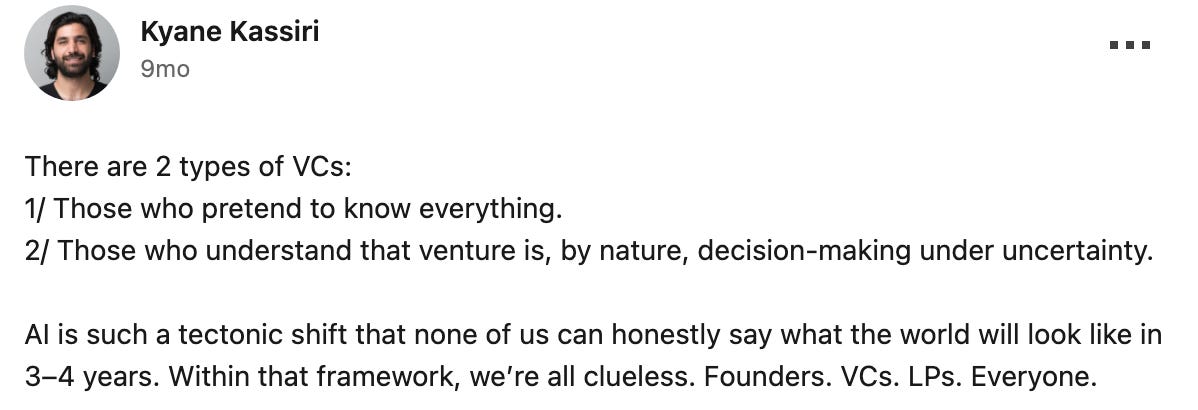
It’s an uncertainty about uncertainty, what decision theorists call deep uncertainty, the point where you can’t even define the set of outcomes you’d try to assign probabilities to. You’re not arguing about which future is most likely. You’re arguing about what futures are even possible.
This showed up outside of finance first: Homeowner insurers in Florida and California have started pulling out of those states. These are not impulsive companies. Insurance is the most mathematically conservative industry on the planet. Actuaries built the entire modern framework for pricing future risk. They’ve done it for centuries, through world wars, pandemics, and every kind of natural disaster. When they looked at climate models and loss distributions, they decided they couldn’t price a policy anymore. The historical data they’d always relied on to predict future claims had stopped being predictive. Because now a hundred-year flood was showing up every decade. Wildfire seasons that used to follow recognisable patterns were burning through neighbourhoods that had never been considered high-risk.
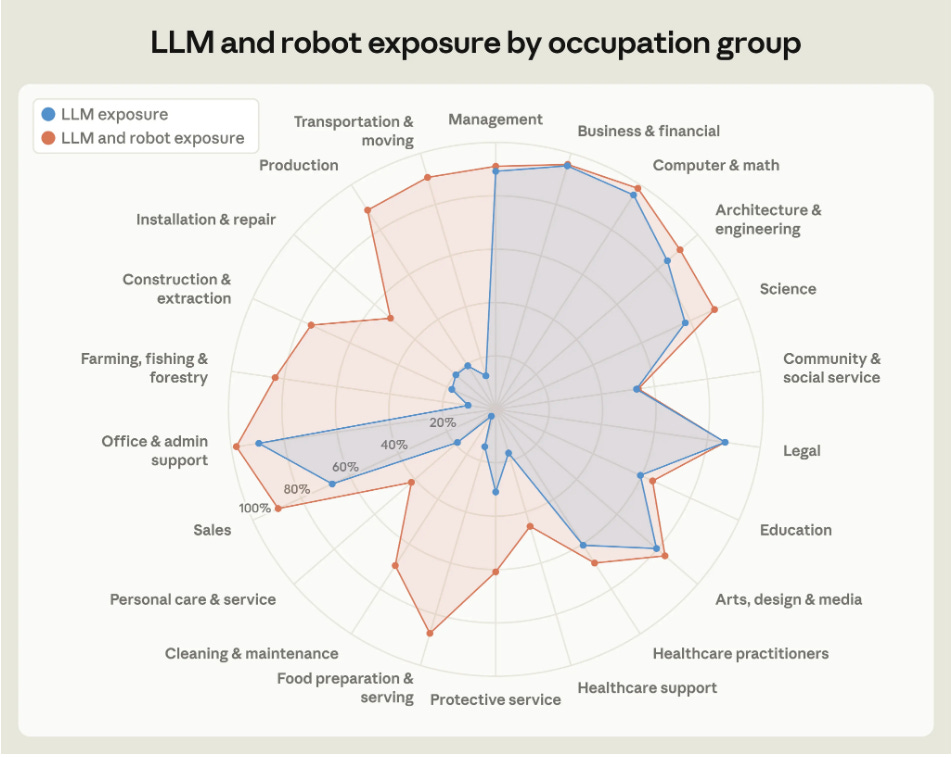
AI is doing the same thing to the financial markets. Right now, AI uncertainty lives mostly in the tech sector. If you’re worried about Nvidia’s valuation or Microsoft’s AI spending, you can hedge by owning healthcare, industrials or consumer staples, sectors that AI hasn’t disrupted yet. Thats Portfolio construction’s core idea, you blend assets that don’t move together, and you can get better returns for less risk.
But as AI spreads, uncertainty spreads with it. Once AI touches healthcare, you can’t hedge your tech exposure with healthcare anymore because healthcare now carries the same unknowable AI future. Once it reaches manufacturing, logistics or finance, every sector carries it. Diversification, the thing that made the whole portfolio work, fails. You can’t hedge sector A with sector B when both face the same unknowable future. And when investors can no longer diversify away that risk, they need compensation for bearing it. That means the equity risk premium across the whole market has to rise. For the premium to rise, prices have to fall.
A fund manager in 2000 could look at Pets.com and know with reasonable confidence that a company burning cash to ship dog food at a loss wasn’t going to be worth anything in five years. The dot-com bubble had a built-in resolution mechanism for its own absurdity.
AI doesn’t have that. We may be sitting inside a bubble while the thing being bet on keeps producing real results every quarter. A robotics company just hit a $39 billion valuation with barely any revenue. From 2026, that valuation looks insane. From 2040, if humanoid robots are doing warehouse logistics and elderly care and construction, it probably looks cheap. Both can be true at the same time.
A decade ago, when people imagined monetary collapse, they mostly imagined hyperbitcoinization. Bitcoin wins, becomes the global currency, and fiat turns into toilet paper; a bright-orange monetary system replaces the old one.
I think that’s still possible. What’s changed is that it feels almost quaintly linear. Maybe we don’t replace dollars with Bitcoin. Maybe money itself becomes utterly meaningless. Maybe you buy your eggs with government-allotted compute credits cryptographically signed by your DNA. The range of plausible futures has grown so wide that even people who’ve spent years thinking about the end of money can’t narrow it to a single scenario anymore.
The promise capitalism made to the middle class always rested on two things at once. Wages had to grow fast enough relative to asset prices that ordinary people could accumulate capital over a working lifetime. And the future had to stay predictable enough for long-term compounding to work. Both of those have fallen apart at the same time today. Wages flattened against asset prices starting in the 1980s, and the crack has widened every decade since. Which makes the future impossible to price.
Financial nihilism gets framed as a generational attitude problem, as if millions of young people across dozens of countries just independently decided to be reckless for fun, and that’s a very biased way to think about it.
When patient accumulation can’t produce wealth on any timeline that matters to your actual life, you compress the timeline and swing hard. A 5% chance of making it beats a 0% chance through the approved channels.
That’s all for today!
Vaidik
Token Dispatch is a daily crypto newsletter handpicked and crafted with love by human bots. If you want to reach out to 165,000 subscriber community of the Token Dispatch, you can explore the partnership opportunities with us 🙌
📩 Fill out this form to submit your details and book a meeting with us directly.
Disclaimer: This newsletter contains analysis and opinions of the author. Content is for informational purposes only, not financial advice. Trading crypto involves substantial risk - your capital is at risk. Do your own research.