


Hello,
There’s a bar in New York called The Jeffrey that ran a promotion during the Knicks playoffs last season. If the Knicks advance, drinks are on the house for a night. The owner did the math and realised a Knicks win would cost him about $5,000 in free drinks. So he went on Kalshi and bought a position that pays out if the Knicks win, and hedged the whole thing.
Later, when the Knicks won, he honoured the promotion and collected all the money from Kalshi, costing the bar literally nothing.
A bar in Manhattan just used a prediction market the way a Fortune 500 company uses a derivatives desk. And I think this tells us a lot about what’s happening with prediction markets. For the past two years, the conversation has focused almost entirely on how accurate these markets are. Whether they can actually forecast elections and price risk better than the polls and analysts that have been doing it for years.
But while they debate that, prediction markets are creating a whole new financial surface that goes beyond forming a view, with value living well past the predictions themselves. Let’s dig in!

Meet the Future of Crypto @TOKEN2049
For years, crypto and traditional finance have eyed each other from across the room. That era is over.
This October, you’ll find Nasdaq’s Adena Friedman, Morgan Stanley’s Amy Oldenburg, and Franklin Templeton’s Jenny Johnson sharing the stage with Polymarket’s Shayne Coplan, Hyperliquid Labs’ Jeff Yan and The Network State’s Balaji.
The best from the boardrooms of VCs, exchanges, regulatory bodies, banks and fund houses - all under one roof - TOKEN2049. Collectively rooting for one industry, but from myriad perspectives.
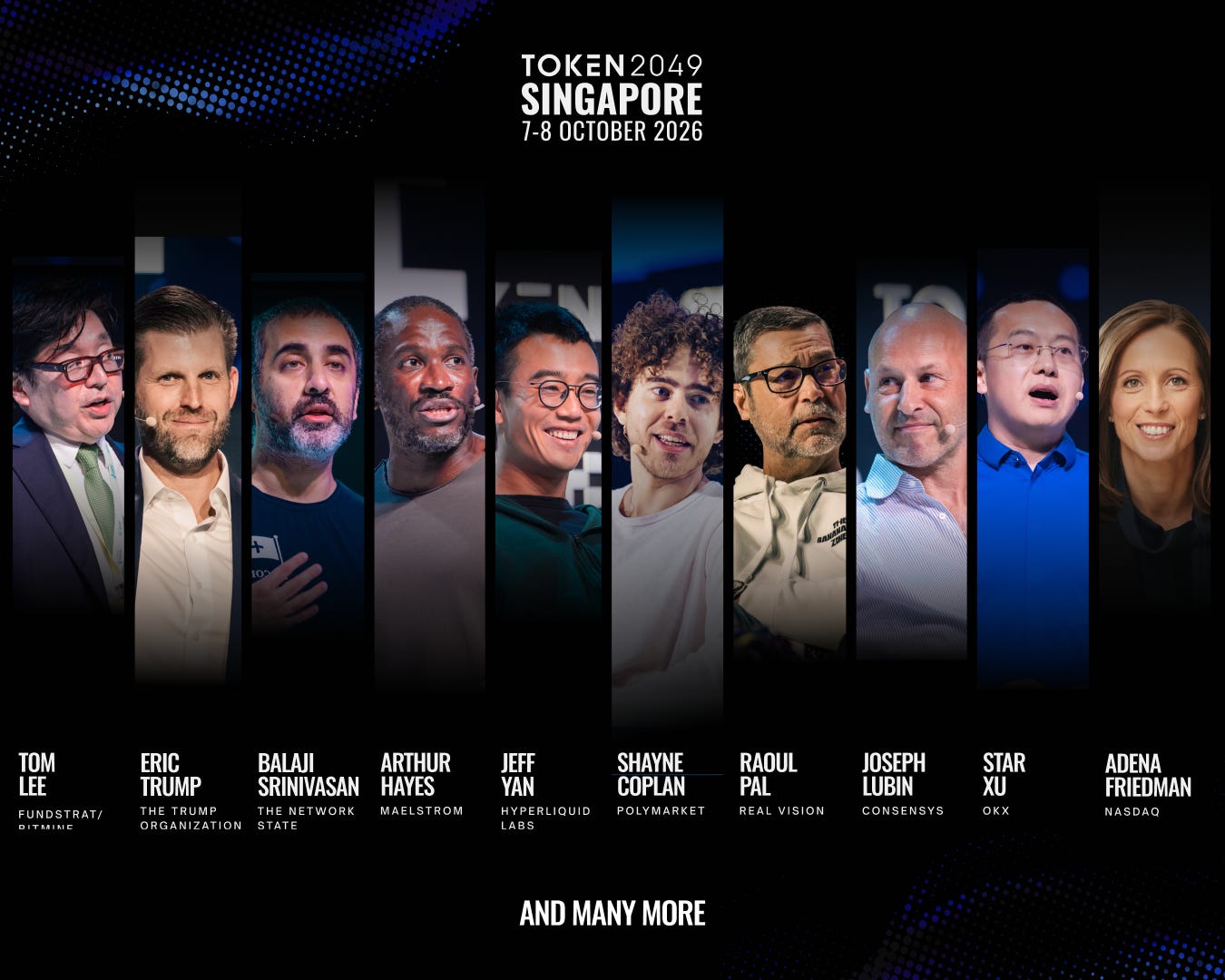
You cannot afford to miss the chance to witness the best of the financial world in action on crypto’s largest stage. It cannot get bigger than this!
You have been among our most loyal readers, so here’s an exclusive 10% off coupon to spoil you!
Beyond the Prediction
The last time I remember a financial instrument jumping from gambling to legitimate infrastructure was in 1973, and the instrument was options. It had existed for decades before that, but the regulators treated it the same way your uncle treats you when you say you work in crypto. SEC was suspicious, Courts were hostile, and the CBOE had to fight for years just to get permission to list them. Then, one day, Fischer Black and Myron Scholes published a pricing formula that led to something exceedingly wild over the next five years.
Traders started using the formula to spot mispricings between different options contracts. As more traders used it, their collective buying and selling pushed actual market prices toward what the formula predicted. By the late 1970s, the formula fit the market almost perfectly. That formula wasn’t some divine truth about how options should be priced; it was the result of enough people using it to trade that the market reshaped itself around its math.
And that’s how a model built for an instrument the mainstream called gambling ended up creating one of the largest markets in modern finance, which is now worth trillions of dollars. And I am pretty much convinced that Prediction markets are at this exact inflexion point right now.
ICE, the company that owns the New York Stock Exchange, recently paid $2 billion for Polymarket and immediately started distributing its probability data through the same consolidated feeds that already carry NYSE stock prices to every institutional terminal on the planet. The feed ICE runs is the backbone of how institutional money accesses financial data, and is now being delivered alongside Apple’s share price and Treasury yields.
Once fund managers start using these probabilities as a real input to their positioning, it will directly add more volume and depth to the polymarket contracts underneath. This will produce a more reliable probability, and that in turn will attract more institutional capital. ICE has seen this loop play out once before with options after Black-Scholes, and so they wanted to make sure they own the infrastructure this time when it plays out again.
But there is a problem sitting at the core of all this, which is that the most useful prediction markets, the ones pricing narrow geopolitical and regulatory events, are the ones that can’t get liquid enough to produce reliable probabilities. In simple English, the word for this is ‘adverse selection’.
Prediction markets, like all financial markets, depend on market makers to function. These market makers sit on both sides of a trade, offering to buy and sell at slightly different prices and pocketing the spread. And for them to do this profitably, they need a healthy share of uninformed traders on the other side, people whose bets carry no special insight into the outcome.
Election markets are the poster child for this. For example, when a partisan drops $10,000 on their preferred presidential candidate because they watched too much cable news and truly believe their guy will win, that bet is pure emotion with zero information edge. Market makers love this kind of flow because they can comfortably take the other side, knowing the bettor has no special knowledge.
Now compare them with contracts like “Will there be a ceasefire between the US and Iran by Oct?” or “Will tariffs hit semiconductors in Q4?” Nobody bets on these markets out of patriotism or tribal loyalty. The only people showing up to trade narrow geopolitical contracts are people who probably know something; maybe they work in the semiconductor supply chain, maybe they have connections in government, or maybe they simply read intelligence cables. And market makers can smell this miles away.
When every counterparty on a contract likely has real information, market makers widen their spreads to protect themselves or just refuse to participate entirely. So the contracts the financial system most desperately wants priced- the forward-looking probabilities on specific events, which you literally can’t get from any other instrument end up too thin to be useful here, too!
This has been a problem with all kinds of financial instruments in the past, and the solution they came up with for this was hedging. If we go back to 1870s Chicago, when grain futures were just getting started. Those markets became the deepest commodity pits in the world, because farmers and grain elevator operators started using futures contracts to protect themselves against price swings on crops they had already planted or purchased.
A farmer selling corn futures has no special insight into where grain prices are headed next quarter. He is simply locking in a price for next season’s harvest so he can sleep at night. But to the speculators on the other side of his trade, his orders look random, indistinguishable from noise. And that noise gave market makers the confidence to participate, which brought in more speculators and deepened the market, turning what started as a basic hedging tool for Midwestern farmers into the foundation of global commodity finance.
The owner of The Jeffrey, that bar in Manhattan, did the same thing on Kalshi. To the market makers and speculators on the other side, his bet looks indistinguishable from someone gambling on basketball. And that is precisely what makes hedgers valuable.
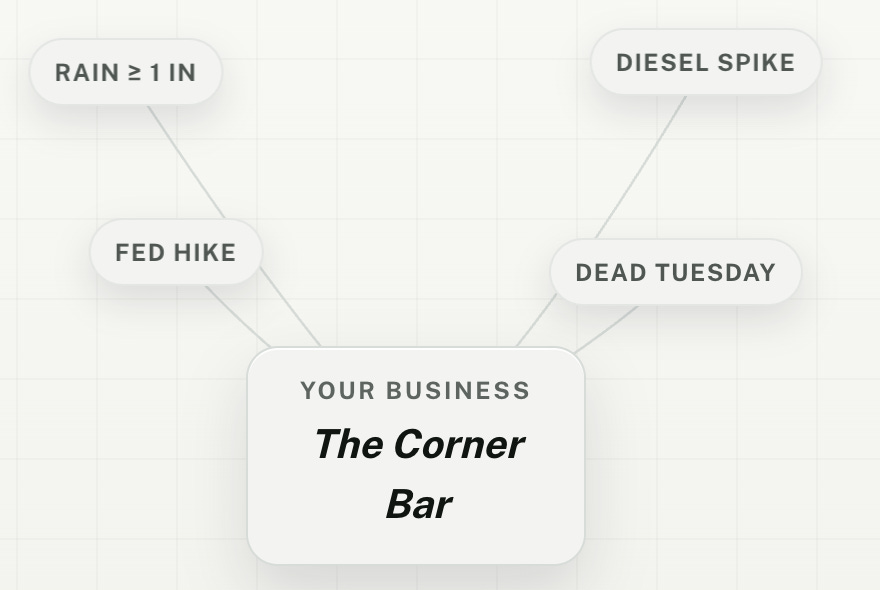
And Prediction markets need an army of them: bar owners, fleet managers worried about diesel prices, event planners exposed to weather risk, small businesses with real money riding on outcomes they cannot control. But you cannot expect a bar owner or a fleet manager to open Kalshi, scroll through hundreds of contracts, figure out which one maps to their specific business risk, and size it properly relative to their actual exposure.
Goldman Sachs has an entire derivatives desk that does this translation for Fortune 500 companies. But your local coffee shop owner does not.
The Translation Layer
I came across two startups that saw the Goldman Sachs problem and are building products to close it.
Blanket started from the hedging side. It is an independent product built on top of Kalshi that works as a recommendation engine for small businesses. You can describe what your business does and what you are worried about, and its models figure out which Kalshi contracts map to your specific exposure and how to size the position against the risk you are actually carrying.
It does not execute trades or hold funds, and no money moves through the application. Kalshi handles all execution and custody, and it is CFTC-regulated. Blanket sits entirely upstream as a recommendation layer. The owner of The Jeffrey did not need Blanket because his hedge was simple.
But a fleet manager worried about diesel costs is exposed to a web of overlapping probabilities: whether OPEC cuts production, whether Middle East tensions disrupt shipping lanes, whether fuel tax policy changes, and how each interacts with the others in ways that are genuinely hard to reason about without a financial background.
The only businesses that have traditionally navigated this kind of multi-variable risk were the ones wealthy enough to hire a derivatives desk. Blanket is trying to compress that entire function into something a coffee shop owner can use.
What I find interesting about this is how clearly it maps onto how every financial market that has ever matured. Nasdaq, for instance, once made just $77 million from US stock trading in a single quarter while Goldman Sachs pulled $1.74 billion intermediating those same stocks. Even Virtu, a market-making firm most people have never heard of, earned $373 million, nearly five times what the exchange itself made processing every single one of those trades.
The matching venue, where buyers meet sellers, consistently ends up being the lowest-margin part of the system because matching is a commodity that anyone with capital and a license can replicate. The value always migrates toward whoever controls the friction point where someone with a view, or an exposure, gets connected to the specific instrument that expresses it.
Blanket is betting that, in prediction markets, that friction point is when a business owner’s real-world anxiety becomes a financial position, and by choosing to own only the intelligence layer and let Kalshi handle everything downstream, they are betting the recommendation is worth more than the execution.
But to a certain extent, it would be interesting to see how this pays out because it also gives rise to a lot of unthinkable anomalies. In agricultural finance, there is a well-studied problem called basis risk. When a farmer buys weather-index insurance to protect against drought, the insurance pays out based on a regional rainfall index, not based on what actually happened on that specific farmer’s field. So even if the index says it rained enough but the crops dried out, the insurance pays nothing.
Even with government subsidies covering more than 60% of the premium, only about 20 to 30% of eligible farmers actually buy in, because the difference in what the index tracks and what they actually experience is pretty unreliable.
Similarly, a fleet manager hedging diesel costs with a Kalshi contract on OPEC production can face the same uncertainty. OPEC could cut production, and diesel prices in her region might barely move because local refining capacity and seasonal demand patterns create a wedge between the macro event they hedged against and the actual price they pay.
So, Blanket’s AI can recommend the right contract, but prediction market contracts are, by design, binary bets on specific events, and the delta between a specific event resolving one way vs the business actually feeling the financial impact can be completely opposite. It will be interesting to see how that pays out, though.
Another one, approaching the problem a bit differently, is ZEIT Finance. ZEIT built what they call Perpetual Prediction Vaults, and the simplest way to think about them is as prediction market ETFs. You can just type a thesis in plain English into their Worldview generator, something like “AI regulation tightens across the US and Europe” or “the Middle East conflict escalates into a broader regional war.”
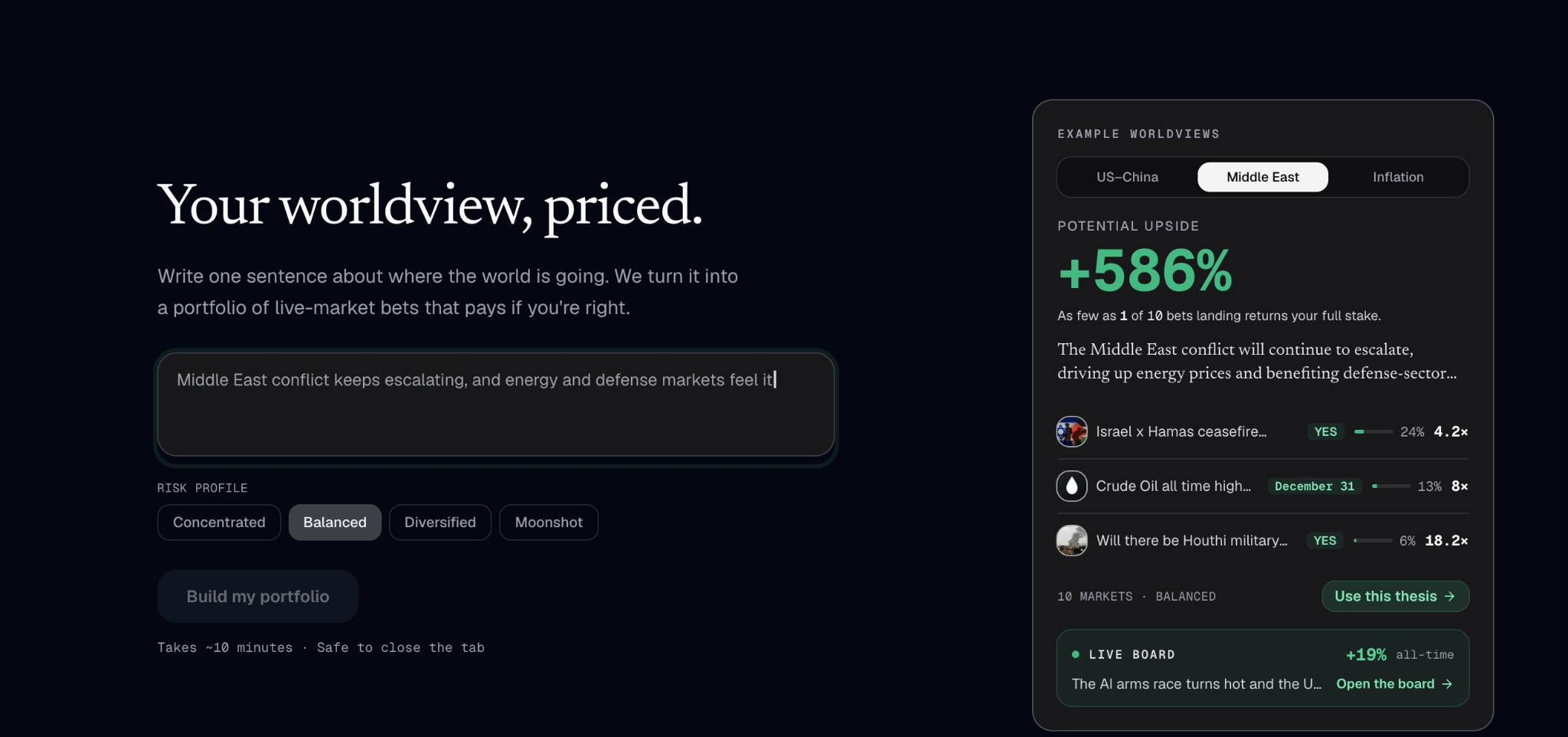
Their AI pipeline searches Polymarket’s live contracts, identifies the ones relevant to that thesis, builds a diversified portfolio of positions around it, sizes each position using a convex-optimisation layer, and packages everything into a single ERC-20 vault token that auto-rolls your capital into new contracts as old ones resolve.
Here, ZEIT is building a portfolio engine for views, but views are often quite hypocritical. For example, “US-China tensions escalate and semiconductor supply chains fracture” could be confirmed or invalidated by a single press conference. The portfolio has to respond in real time, rolling into new contracts as events unfold, adjusting sizing as probabilities shift, and doing all of this while valuing positions at what you could actually exit at on the live order book.
Just like how Nathan Most invented the ETF by borrowing the warehouse-receipt mechanism from grain markets, turning a farmer’s hedging tool into global commodity finance. ZEIT is taking the raw binary contracts of prediction markets and wrapping them into a composable, tokenised, portfolio-level product that ordinary people can hold and trade without understanding the mechanics underneath.
And if the wrapper works at scale, it could do for prediction markets what the ETF wrapper did for index investing: make the underlying accessible to millions of people who would never have touched it in its raw form.
And even Polymarket is trying to go beyond being a place to form views and now also price them. Right now, if you form a thesis on Polymarket about the Fed and then want to trade that thesis, you close the tab and go to Binance or dYdX or a traditional brokerage. All of the economic value of acting on the view you formed on Polymarket leaks to whoever runs the venue where you end up executing.
That’s why they launched perps to close that gap, making their platform where you form the view and where you also trade it, so the value of the entire chain stays inside one venue. Otherwise, Polymarket risks becoming the Nasdaq of prediction markets: processing all the trades and capturing only a small share of the economics.
I think the prediction market conversation needs to catch up with what is actually happening. The accuracy debate is very 2024, and prediction markets won it convincingly enough that ICE paid $2 billion for it. The regulatory fight will play out the way regulatory fights always play out when institutional capital lines up on one side.
The question that matters now is about who captures value from the signal prediction markets produce as it flows into the broader financial system. Lloyd’s coffee house began in 1688, when Edward Lloyd pinned shipping intelligence to his walls so merchants and underwriters could make better decisions about marine risk. Over the next three centuries, that room became the largest insurance market on the planet, still writing over $50 billion in annual premiums today, while every underwriter who ever sat in it has been replaced by successors.
The intelligence layer outlasted everything built on top of it. Prediction markets are now building their own version of it.
That’s all for today!
Vaidik
Token Dispatch is a daily crypto newsletter handpicked and crafted with love by human bots. If you want to reach out to 165,000+ subscriber community of the Token Dispatch, you can explore the partnership opportunities with us 🙌
📩 Fill out this form to submit your details and book a meeting with us directly.
Disclaimer: This newsletter contains analysis and opinions of the author. Content is for informational purposes only, not financial advice. Trading crypto involves substantial risk - your capital is at risk. Do your own research.