


Hello,
Businesses get a handful of moments when the market is paying attention. Think of a new product launch, a funding, or a big hire.
In my previous role as a financial journalist, I have seen many businesses put months into these announcements. They line up posts, chase numbers, and then nothing follows. Within a week, the attention moves to someone else’s launch.
It’s a short window when people who normally wouldn’t listen to you, briefly will. And during that short window, if your audience doesn’t get to hear from the mouth of the horse why they should care about your product, then your business has missed the chance. The companies that use it well plan who they follow up with, what they will ship next, and how they want people to engage with their product.
Attention is cheap to get once and expensive to get twice. Waste it, and you will have to spend on doing the entire exercise all over again.
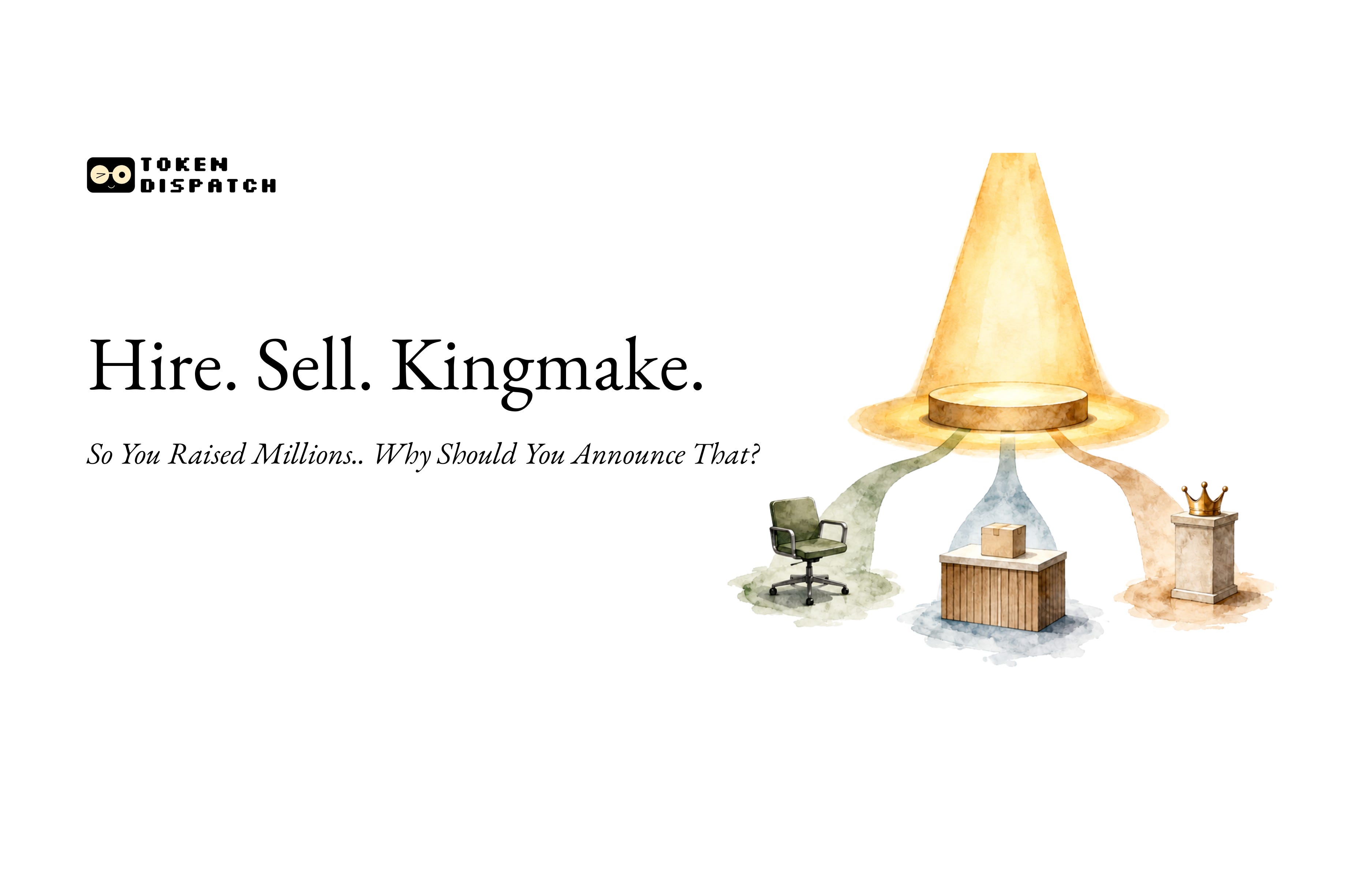
In today’s guest essay, Kram and Emma explain this by talking about the biggest window most startups get: the funding announcement.
On to their story,
Prathik

Frontrun: Early Bird Holds the Edge
Most people hear about a promising startup the day it announces its funding. By then, the investors who backed it have known about it for months. How did they get there first?
Hours of digging, who started the company, what they’ve built before, how to reach them, and understanding what to write to them so that you can join them early in their journey.
Frontrun does this digging for you. When top investors start following a young company on X, Frontrun flags it, finds the founder, and writes your opening message. You can read the draft, tweak it, and hit send without leaving the platform.
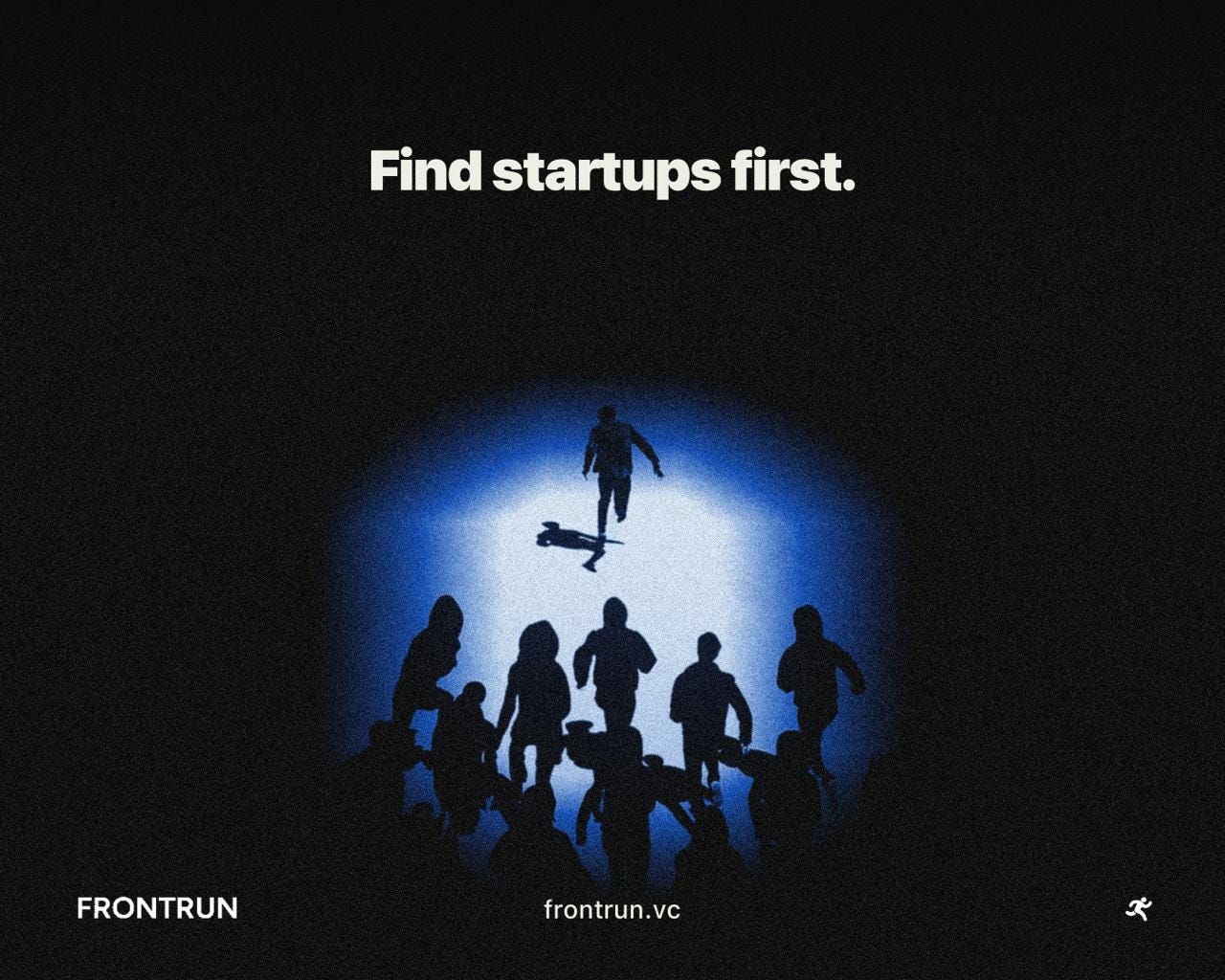
Frontrun gives you a ready brief on every company it flags.
You can also automate a daily morning report with the list of startups to track based on what your favourite accounts are following. Served hot, along with your breakfast.
To set the stage: You are the first nontechnical hire working at a deep tech startup about to finalise a $25 million seed round. You have no social accounts, no marketing people, and no one even knows the name of your project. So what do you do? Hire an agency or someone internal? Do a video, a blog, a podcast? Pitch media? Your founder wants coverage in TechCrunch and Bloomberg, but how do you reach them? You’ll probably just ask your investors…
OK Pause.
These are good questions, but deciding the what before the why is how you end up with an incredibly expensive launch video or a frantic CMO hire.
Know before you announce – Choose 1 primary goal:
Announce to Hire: You have the capital, now you need people who can turn it into something. Marketing a raise to attract A+ players, or what Keith Rabois would call barrels, is a fantastic use of attention.
Attract top-end talent
Show what great people could build here
Turn new hires into reasons for the next hire to join
Good example: Atoms
Announce to Sell: A raise is a great excuse to talk about your book, meaning anything you want to sell. It can put a product in front of new customers or give hesitant ones a reason to commit. Momentum around a product can also make the company behind the product more interesting to future investors.
Give customers a reason to buy now
Counterposition against incumbents or competitors
Make the product’s larger potential legible to future investors
Good example: Base Power Company
Announce to Kingmake: Give the company a face people can follow, reply to, and root for. Crown your champion. Birth reverence. Especially at the seed level, an ambitious idea can sound stupid before viewers are given a personality to follow.
Funnel attention into interest in a single person
Introduce outlandish ideas in simple words from a familiar face
Give people a reason to believe your leader should be their leader
Good example: Instinct
These goals will overlap. A good product story can attract talent, and a compelling vision can sell a product. The idea here is to focus on the main job based on what’s holding the company back: the people to build it, customers ready to buy it, or someone for people to identify with.
Below are a few examples of companies that announced to hire, sell, and kingmake well, including Atoms, Base Power Company, and Instinct.
Announce to Hire: Atoms
You have the capital, now you need people who can turn it into something. Marketing a raise to attract A+ players, or what Keith Rabois would call barrels, is a fantastic use of attention.
Keith’s explanation of barrels and ammunition below:
“If you think about people, there are two categories of high-quality people: there is the ammunition, and then there are the barrels. You can add all the ammunition you want, but if you have only five barrels in your company, you can literally do only five things simultaneously. If you add one more barrel, you can now do six things simultaneously. If you add another one, you can do seven, and so on.”
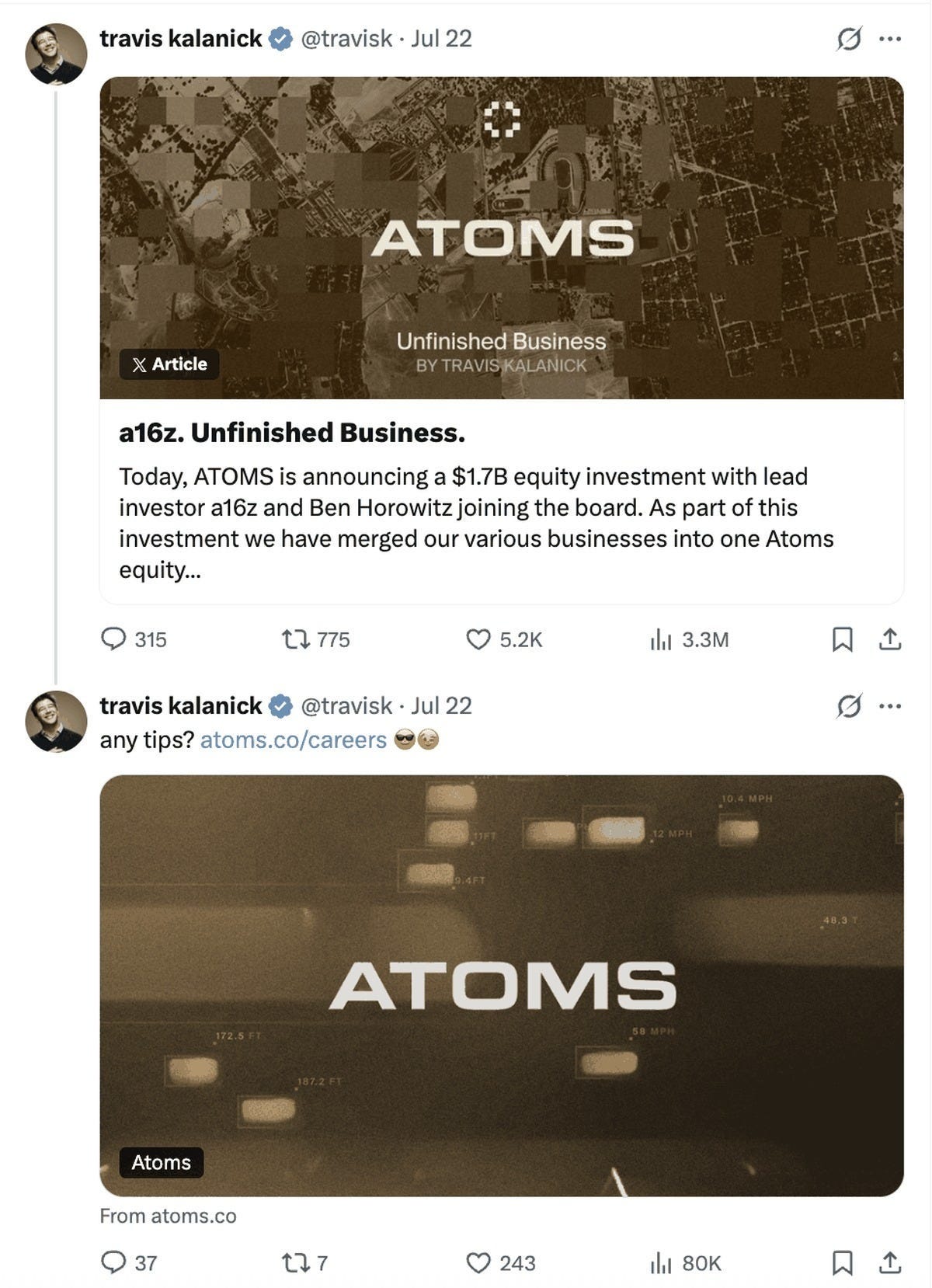
Atoms raised $1.7B in a round led by a16z to build physical AI across food, mining, and transport, including what they call food computers. With major capital in the bank, Travis Kalanick’s name, and a fresh stamp of approval from a16z, what else would Atoms want from this announcement? Talent.
The Atoms corporate account, a16z’s account, Travis’ account, and his talking points on TBPN all funnel toward hiring. All of the channels flooded with the big raise announcement held the same invitation: apply now.
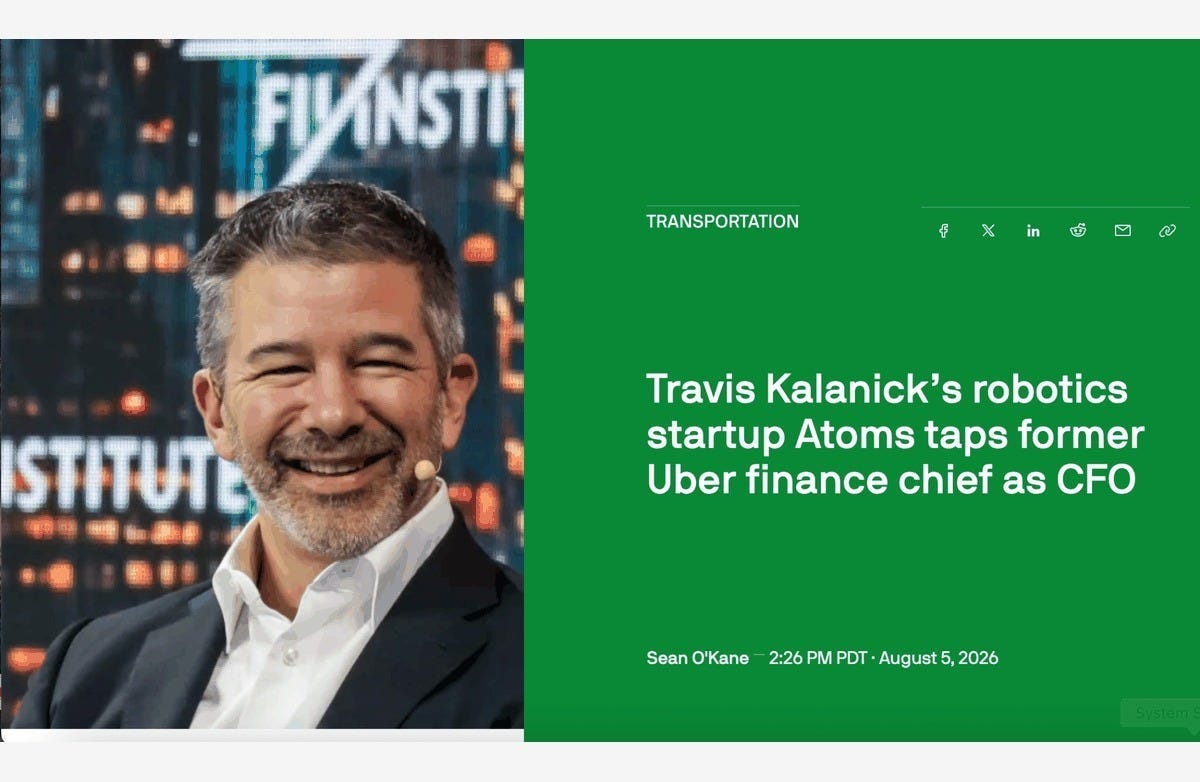
Atoms followed the raise with executive hires that dripped into the tech consciousness in the following weeks, keeping the talent story going after the original announcement.
Announce to Sell: Base Power Company
A raise is a great excuse to talk about your book, meaning anything you want to sell. It can put a product in front of new customers or give hesitant ones a reason to commit. Momentum around a product can also make said product more interesting to future investors.
As YC founder Jessica Livingston said in the WSJ, most marketing for startups shouldn’t feel like marketing… it should feel like sales:
“The most important thing an early-stage startup should know about marketing is rather counterintuitive: that you probably shouldn’t be doing anything you’d use the term “marketing” to describe. Sales and marketing are two ends of a continuum. At the sales end, your outreach is narrow and deep. At the marketing end, it is broad and shallow. And for an early-stage startup, narrow and deep is what you want -- not just in the way you appeal to users, but in the type of product you build. Which means the kind of marketing you should be doing should be indistinguishable from sales: you should be talking to a small number of users who are seriously interested in what you’re making, not a broad audience who are on the whole indifferent.”
Base Power’s $1 billion raise enabled mainstream coverage of their business in WSJ, TechCrunch, Bloomberg Tech, and by Molly O’Shea. This is a good use of leverage for pure mindshare, but their execution on direct channels like Twitter and investor relations was more interesting to me.
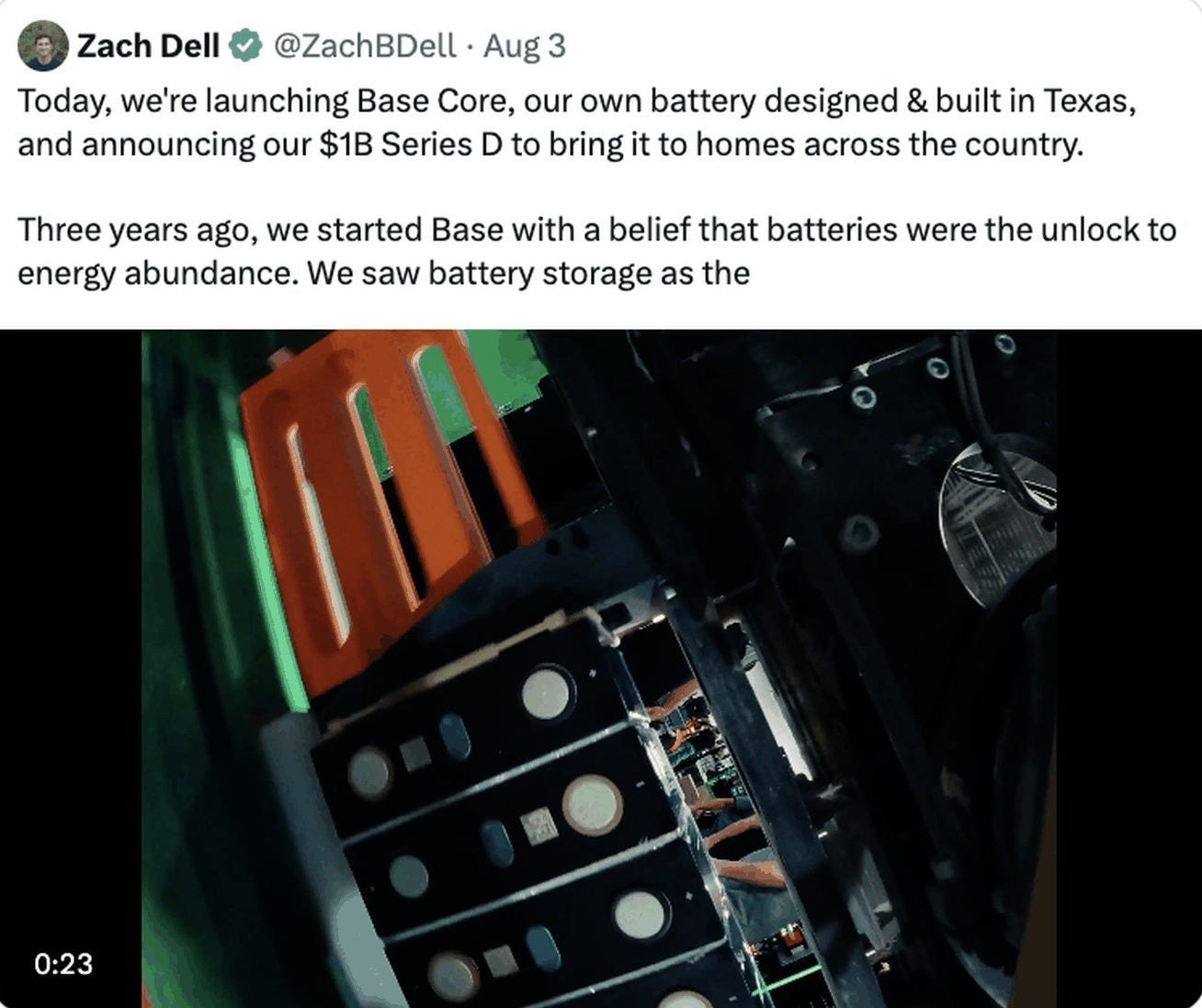
On direct channels, they specifically used this raise to launch Base Core, a new battery that Base owns and installs for customers.
A snippet from their announcement on X:
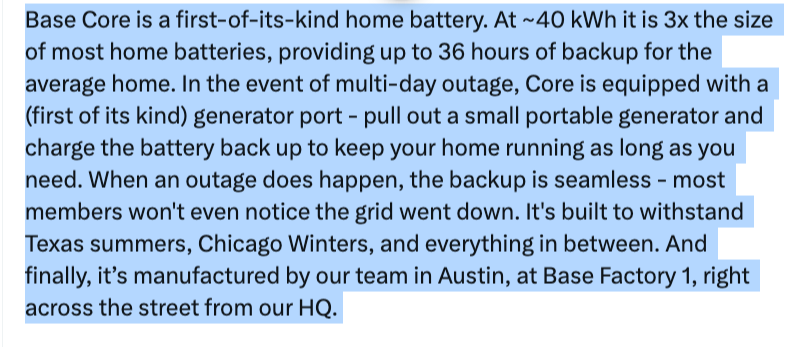
Base did a good job of speaking to two audiences: homeowners who want backup power and institutions (capital allocators and potential markets) who might fund or welcome a much larger battery network in the future.
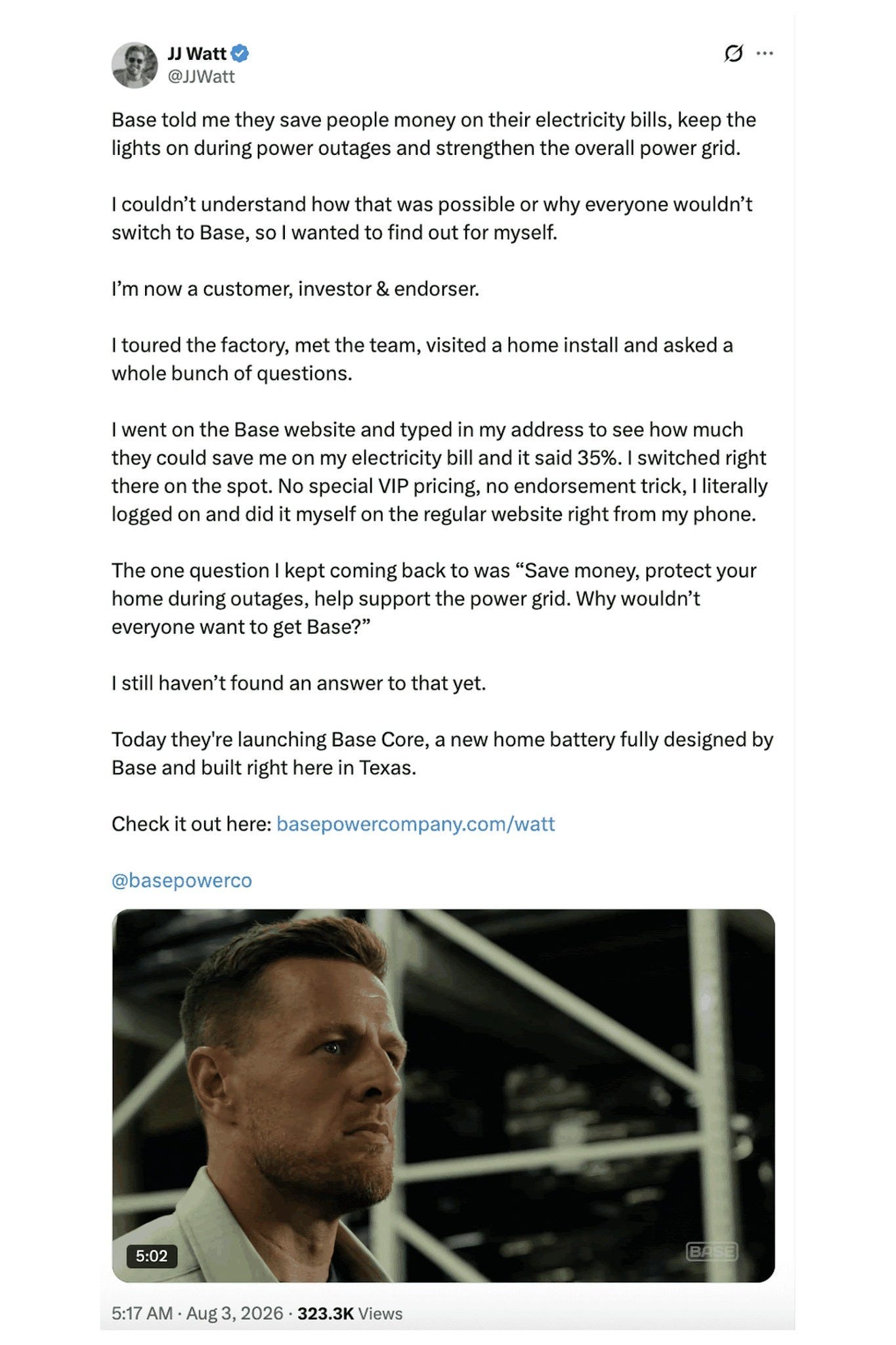
Homeowners: Base made a hard push into markets where the battery is available to sell to homeowners. For the Texas side of this push, they advertised with JJ Watt, a football superstar, a name that literally has power in it. They also used Anthony Rizzo for Chicago. This push on socials was complemented with direct-to-consumer ads in those markets.
Institutions: They also needed to convince future investors and governments in new markets that this can become much more than a good battery product. So they brought in the VCs and put out a bunch of pieces that help people in tech understand the power of a battery network. If you read these closely, you see the narrative of “great battery,” but you really see “wow, look what happens when you connect all these batteries”, which gets institutions interested in the economies of scale of Base. That could interest governments, VCs, or other capital allocators who might fund or help accelerate capital-intensive, regulation-heavy next steps for Base.
Announce to Kingmake: Instinct
So what do you do when your company is looking for talent and is looking to sell, but people don’t yet understand the idea or believe you can build it?
You kingmake. You crown your champion. Especially at the seed level, an ambitious idea can sound stupid before viewers are given someone to revere. The elixir of kingmaking narrative is described (and examined) by Joseph Campbell in The Hero With A Thousand Faces…
“A hero ventures forth from the world of common day into a region of supernatural wonder: fabulous forces are there encountered and a decisive victory is won: The hero comes back from this mysterious adventure with the power to bestow boons on his fellow man.”
When news of Instinct’s $250M Series B broke, Noah Shinn’s first public post on Twitter was a personal introduction: “I’m Noah, the founder of Instinct.” No mention of the raise or investors. Just hello, here’s what we’re building, and here’s what people are doing with it.
The post got about 2 million views, and Noah’s account went to 30,000 followers overnight. Suddenly, Instinct had a King to go with its agentic kingdom of users.
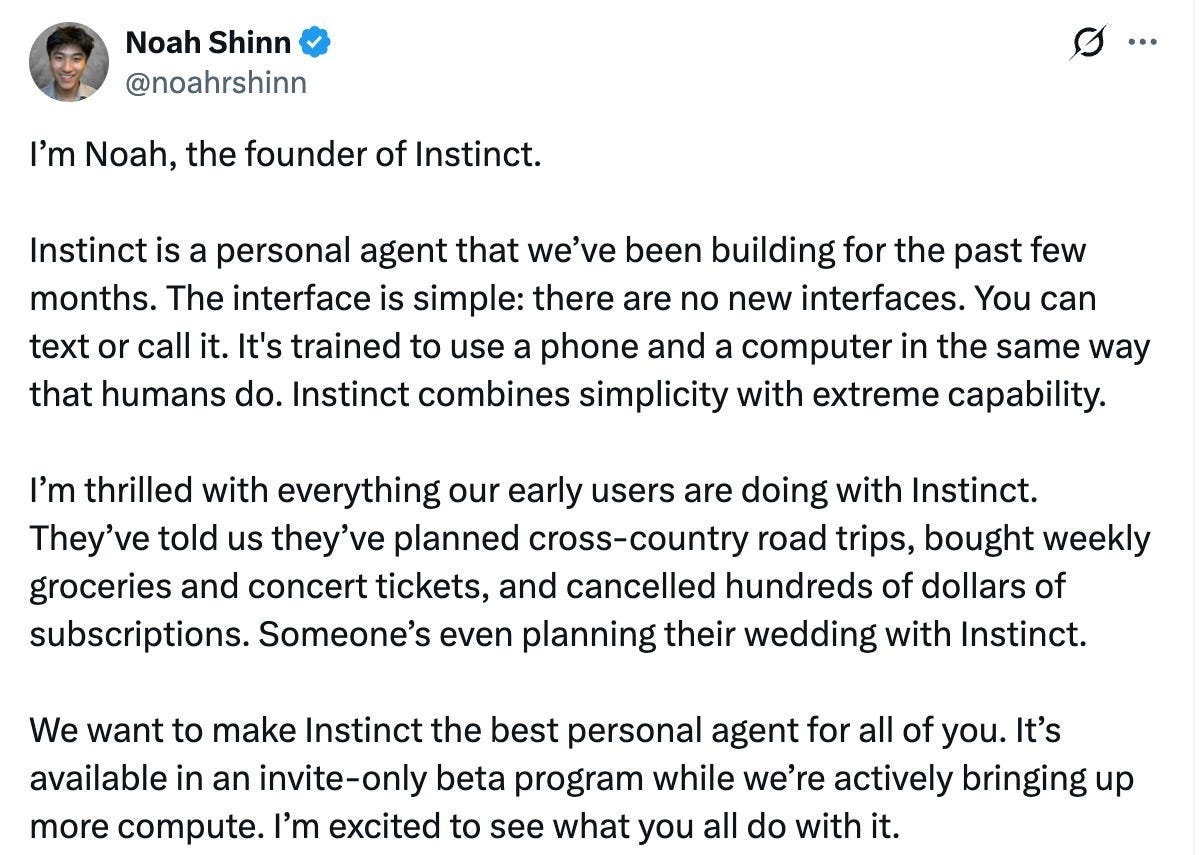
Instinct took the momentum from the raise and funnelled the energy toward Noah’s social presence for the battles to come. This was a social strategy borrowed from Jensen Huang, when Nvidia used his first X post to champion open models. That first moment can do a lot, especially when combined with a raise.
The next chapters for Instinct will have bigger stakes: raising again, shipping a more complex product, and taking on Meta’s Muse.
For these, Instinct will need a King to explain to the world why they should continue to believe in the product and thesis. Case in point: just days after the $250M raise, The Information reported Instinct seeking $1B at a $10B valuation.
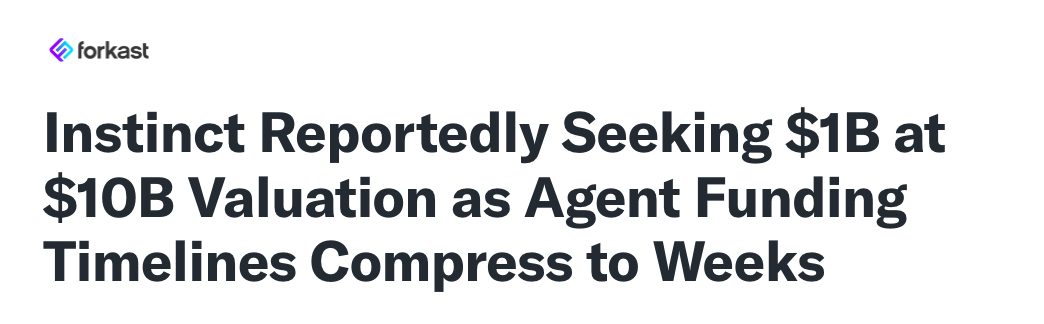
Noah now has an audience who knows the person taking that on, making it personal, giving people someone to root for or against.
Kingmade.
Choose Your Announcement Goal: Hire, Sell, Kingmake
Raise enough money, and the number alone might get you a headline. That’s fine and all. But you only get to announce this round once…
So let’s go back to the set stage:
You are the first nontechnical hire working at a deep tech startup about to finalise a $25 million seed round. You have no social accounts, no marketing people, and no one even knows the name of your project…
What do you do?
Nothing… until you and the rest of the organisation have picked a goal to sprint towards: hire, sell, kingmake.
From there, choose the story, the format, and the people who can get it in front of the right audience. All of that is downstream from the goal.
So you raised millions…what do you want that attention to do for the company?
Are you selling, hiring, or kingmaking?
An essay by Kram and Emma, as they think about Aurient.
Thank you to LJW for beta reading. And thank you, capital and capitalism, and such.
P.S.: This story was first published here.
P.P.S.: We will be featuring good writing and writers we love from time to time. If you have recommendations, send them our way.
Token Dispatch is a daily crypto newsletter handpicked and crafted with love by human bots. If you want to reach out to 165,000 subscriber community of the Token Dispatch, you can explore the partnership opportunities with us 🙌
📩 Fill out this form to submit your details and book a meeting with us directly.
Disclaimer: This newsletter contains analysis and opinions of the author. Content is for informational purposes only, not financial advice. Trading crypto involves substantial risk - your capital is at risk. Do your own research.
