


There’s a moment in Inception that I keep coming back to. Cobb is explaining to Ariadne how the dream architecture works, and he says, “You never remember the beginning of a dream, do you? You always wind up right in the middle of what’s going on.”
That’s the trick of the movie. You can build a dream that feels real because people don’t question the foundation. They just accept the environment they’re in and start acting within it. The architecture becomes invisible. It’s only when something changes, when the physics break or the scenery shifts, that people realise they’re in a constructed space.
What makes a good dream, Cobb says, is stability. If the dreamer suspects the foundation is unstable, the whole thing collapses. The architecture has to feel permanent, even if it’s not. You have to build something that is convincing, so solid, that the people inside it never question whether the ground beneath them might change.
I thought about that this week when reading about Ethereum’s ossification debate. The argument is that Ethereum needs to become dream-infrastructure, so stable and unchanging that people stop thinking about it. You don’t question TCP/IP. You don’t wonder if HTTP will work differently next year. The protocol just is, and that reliability is what makes it valuable.
Vitalik Buterin is explicit about this: “More and more ossification over time is good for Ethereum.” The base layer should harden into something permanent. Lock it down so institutions can build on it without fear that the foundation will shift.
But Sergey Gorbunov says that’s dangerous: “Ethereum is like a shark. If it stops moving, it will die.”
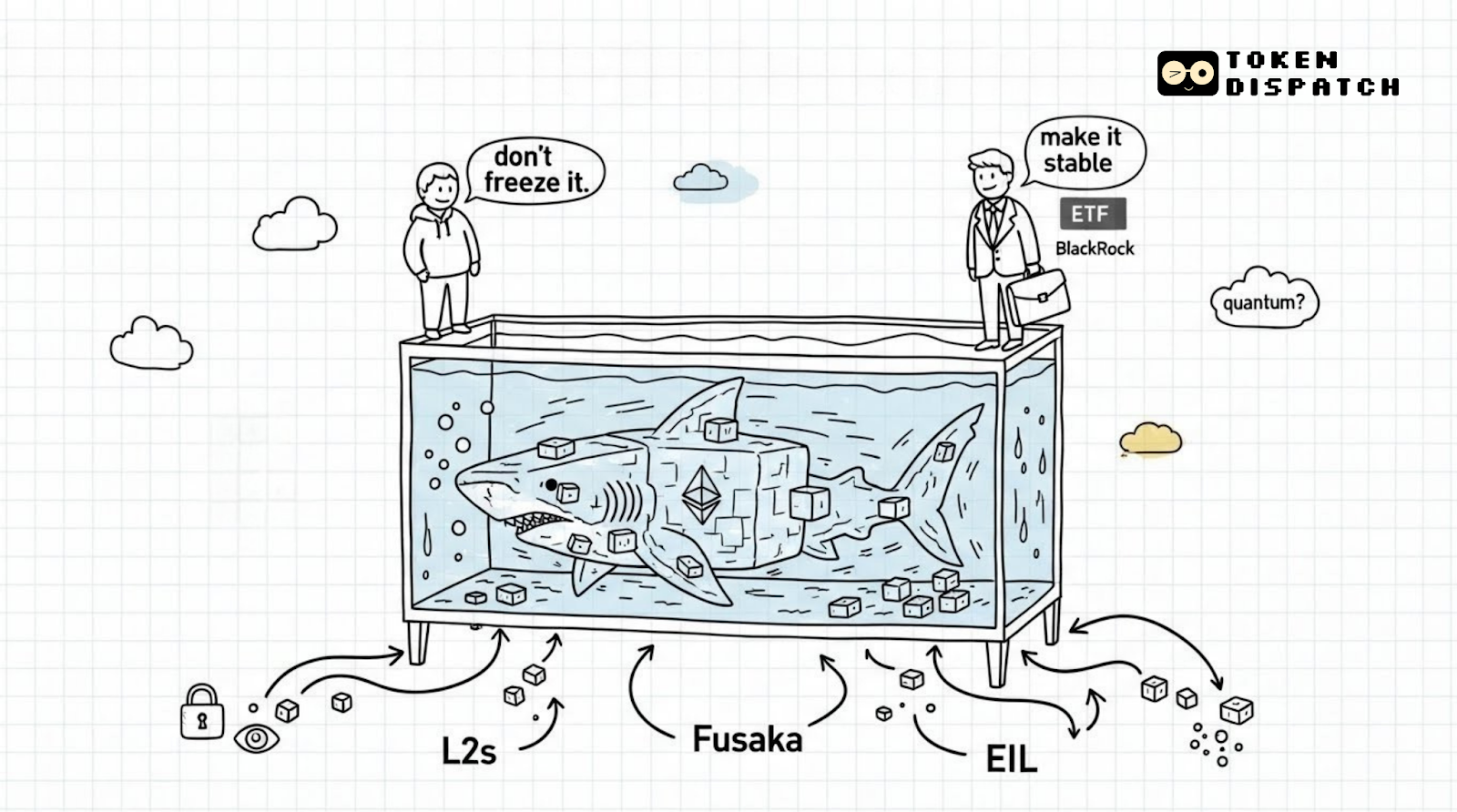
The tension is that Ethereum is trying to build dream-architecture while still competing with other blockchains that are faster, newer, shinier. It’s trying to make people forget they’re in a constructed system while constantly upgrading it to stay competitive. It’s trying to feel permanent while everything around it is changing.
Can you do that? Can you build a foundation that feels unchanging while replacing every component of it? Can you make people stop questioning the architecture while you’re still actively building it?

AI Agents that trade, predict, and evolve, on-chain.
DeAgentAI has built the largest AI Agent infra across Sui, BSC & BTC, solving what every AI dev struggles with, Identity, Continuity, and Consensus, the holy trinity for making AI actually autonomous.
Their flagship products?
AlphaX → A crypto prediction engine that hits 9/10 signals.
CorrAI → A no-code quant playground for designing and deploying DeFi trading strategies.
Truesights (launching soon) → InfoFi network that rewards real alpha, not just noise.
Backed by top-tier VCs, and a team from Carnegie Mellon, UC Berkeley, and HKUST, they’re scaling what’s basically the “ByteDance of Web3.”
Except instead of serving you TikToks, their algorithms are training autonomous AI Agents.
Check out DeAgentAI
The Shark with Frozen Bones
Here’s the contradiction Ethereum is trying to pull off: the base layer is supposed to ossify (stop changing, lock down the core rules, and become predictable), but the whole system is also supposed to keep swimming faster than ever. Layer 2s are scaling. Fusaka is opening the path to 10x data capacity over time. The EVM is being rebuilt. Validators are adjusting gas limits. Everything is moving.
The ossification argument says that Layer 1 can freeze while innovation happens above it. But is that really happening? Or is Ethereum just rebranding constant change as “minimalism” because it sounds more responsible?
Consider what Fusaka actually does. It introduces PeerDAS, which fundamentally changes how validators verify data. Instead of downloading entire blobs of rollup data, validators now sample random pieces and reconstruct the whole thing using erasure coding. This is a massive architectural shift in how the network operates, and it’s being rolled out as part of the “Surge” phase of scaling.
Then there are the Blob Parameter Only forks. These are miniature hard forks designed to increase data capacity in stages. After Fusaka launches on December 3, the first BPO fork happens on December 17, raising the blob target from 6 to 10. Then on January 7, another BPO fork pushed it to 14. Eventually, the goal is 64 blobs per block, an 8x increase from today.
Ossification? No. This is iterative capacity expansion on a fixed schedule. The rules are changing, just in smaller, more predictable increments.
And then there’s EIP-7918, which introduces a minimum reserve price for blob gas fees. Essentially, Ethereum controls the data availability market, and now they’re going to charge a floor price for it, even when demand is low.
This is Ethereum displaying pricing power and monetising its position as the data layer L2s depend on. That might be a smart business strategy, but it’s not ossification. It’s the opposite. It’s the L1 actively managing its relationship with L2s to capture more value.
So what does ossification actually mean here?
It means the protocol wants to stop changing the rules while constantly adjusting the parameters.
The consensus mechanism is frozen (Proof of Stake stays).
The monetary policy is frozen (EIP-1559 burn stays).
The core opcodes are frozen (smart contracts from 2020 still work).
But throughput, data capacity, gas limits, and fee structures? Those keep moving.
It’s like calling the Constitution frozen because amendments are rare, while the Supreme Court reinterprets it every decade. Technically true, but in practice, constant change.
The EIL Trick
If Ethereum wants to feel like one chain while actually being dozens of Layer 2s, it needs some kind of unification layer. That’s where the Ethereum Interoperability Layer (EIL) comes in.
EIL is designed to make separate L2s feel like a single Ethereum, but without introducing new trust assumptions. The technical mechanism is that users sign a single Merkle root that authorises operations across multiple chains simultaneously. Then Cross-Chain Liquidity Providers (XLPs) front the gas and funds needed on each chain, using an atomic swap process secured by L1 staking.
The key thing is that XLPs have to lock collateral on Ethereum L1, with an 8-day unstaking delay. That delay is longer than the 7-day fraud proof window for optimistic rollups, which means if an XLP tries to cheat, there’s time for a fraud proof to slash their stake before they can escape with the money.
It’s a neat design. But it’s also another layer of abstraction. Instead of users manually bridging between L2s, they rely on XLPs to do it for them. The system works if XLPs are reliable and competitive. If they’re not, you get fragmentation again, just at a different layer.
EIL only works if wallets and L2s actually adopt it. The Ethereum Foundation can build the protocol, but if major L2s decide they’d rather keep users siloed within their own ecosystems, EIL becomes irrelevant. It’s the HTTP problem. You can design a beautiful standard, but if platforms don’t implement it, the web stays fragmented.
BlackRock and the Comfortable Cage
Meanwhile, Ethereum is courting institutional money at scale. BlackRock launched the iShares Ethereum Trust ETF in July 2024, pulling in over $13 billion in inflows by mid-2025. Then they filed for a staked ETH ETF, because institutions want yield, not just exposure.
BlackRock is also using Ethereum as infrastructure. The BUIDL fund tokenises Treasury bills and money market instruments on Ethereum, then expands to L2s like Arbitrum and Optimism. It’s treating Ethereum as neutral settlement rails, the same way the internet treats TCP/IP.
This is validation, but it’s also capture. When BlackRock decides Ethereum is the infrastructure layer for tokenised assets, that’s a vote of confidence. But it also means Ethereum starts optimising for what BlackRock wants. Predictability. Stability. Compliance-friendly features. Boring, reliable infrastructure.
Read: Decentralisation, But Make It BlackRock 🪨
Vitalik has warned about this. At DevConnect, he talked about the risk of making L1 decisions primarily for Wall Street comfort. If the protocol optimises for institutions, the values-driven decentralised community drifts away. If it optimises for the cypherpunks, the institutions leave. Ethereum is trying to be both, and that tension is going to get worse.
There’s also the speed problem. Some proposals push for 150-millisecond block times, which would be great for high-frequency trading and arbitrage bots. But normal humans cannot meaningfully participate in governance or social consensus at that speed. If the network runs too fast, it becomes a machine for machines, and the political legitimacy that makes Ethereum valuable starts to erode.
Quantum Computers and Elliptic Curves That Die
And then there’s the quantum threat. At DevConnect, Vitalik said: “Elliptic curves are going to die.” He’s talking about elliptic curve cryptography, which secures user signatures and validator consensus. Quantum computers running Shor’s Algorithm can break ECC by deriving private keys from public keys.
The timeline? Potentially before the next U.S. presidential election in 2028. That gives Ethereum roughly three to four years to migrate the entire network to quantum-resistant cryptography.
This is the one scenario where ossification doesn’t matter.
If quantum attacks become viable, Ethereum will need a massive, invasive hard fork to survive. It doesn’t matter how much the protocol wants to be stable. If the cryptography breaks, everything breaks.
Ethereum is better positioned than Bitcoin here.
Public keys are hashed behind addresses, so they’re not exposed until you spend. Validator withdrawal keys are also hidden. The roadmap includes replacing ECDSA with quantum-safe schemes, such as lattice-based or hash-based signatures.
However, implementing this migration is an enormous coordination problem. How do you rotate keys for millions of users without risking funds? How do you enforce a deadline for upgrading wallets? What happens to old accounts that never migrate? These are not just technical questions. They’re social and political questions about who gets to decide the future of the network.
The quantum threat is the exception that proves the rule: ossification is a choice, not a law of physics. Ethereum can freeze its bones only as long as the environment allows it. When the environment changes, the network must either move or die.
Vitalik also donated $760,000 to encrypted messaging apps, Session and SimpleX, saying that privacy is “important for preserving our digital privacy.” He framed the next steps as permissionless account creation and metadata privacy.
The Ethereum Foundation launched a privacy cluster focused on making privacy a default feature, not an aftermarket add-on. Projects like Kohaku wallet are working on usable privacy tools that don’t require users to understand cryptography.
The framing here is “privacy as hygiene.” It should be as normal as washing your hands. You don’t need a special reason to want financial privacy. It should just be the default state.
But this creates tension with regulators, who demand transparency and traceability. Stablecoins, tokenised Treasury bills, BlackRock’s BUIDL fund — all of these come with compliance expectations. You can’t be the infrastructure layer for Wall Street and also be the privacy-first cypherpunk dream. Or maybe you can, but it requires very careful design.
The Shark That Says It Wants to Freeze
So can Ethereum pull this off? Can it ossify the base layer while the L2s keep moving? Can it satisfy BlackRock and the cypherpunks? Can it harden its cryptography before quantum computers arrive? Can it make privacy default without alienating institutions?
Maybe. The modular design is clever. The L1 handles security and settlement, while the L2s handle execution and experimentation. That separation of concerns could work. But it requires EIL to unify the L2 experience, and it also requires institutions to trust that the L1 won’t change in ways that break their assumptions.
It also requires the Ethereum community to accept that ossification means giving up control. If the protocol freezes, the community can’t just fork it to fix problems or add features. That’s the trade-off. Stability comes at the cost of flexibility.
Sergey is right that Ethereum needs to keep moving. But Vitalik is also right that it can’t keep changing forever. The trick is making the movement happen at the edges while the centre remains still.
The shark says it wants to freeze. The cryptographers say the bones need replacing. Wall Street wants something tame. The cypherpunks want something wild.
Ethereum is trying to be all of these things at once, and somehow, the blocks keep coming.
That’s Ethereum. Frozen bones, moving shark.
Until next time, keep building.

Token Dispatch is a daily crypto newsletter handpicked and crafted with love by human bots. If you want to reach out to 200,000+ subscriber community of the Token Dispatch, you can explore the partnership opportunities with us 🙌
📩 Fill out this form to submit your details and book a meeting with us directly.
Disclaimer: This newsletter contains analysis and opinions of the author. Content is for informational purposes only, not financial advice. Trading crypto involves substantial risk - your capital is at risk. Do your own research.