


On 15th January, Nikita Beir, the head of product at X, announced that X is now banning all the platforms that incentivise users to post on the platform.
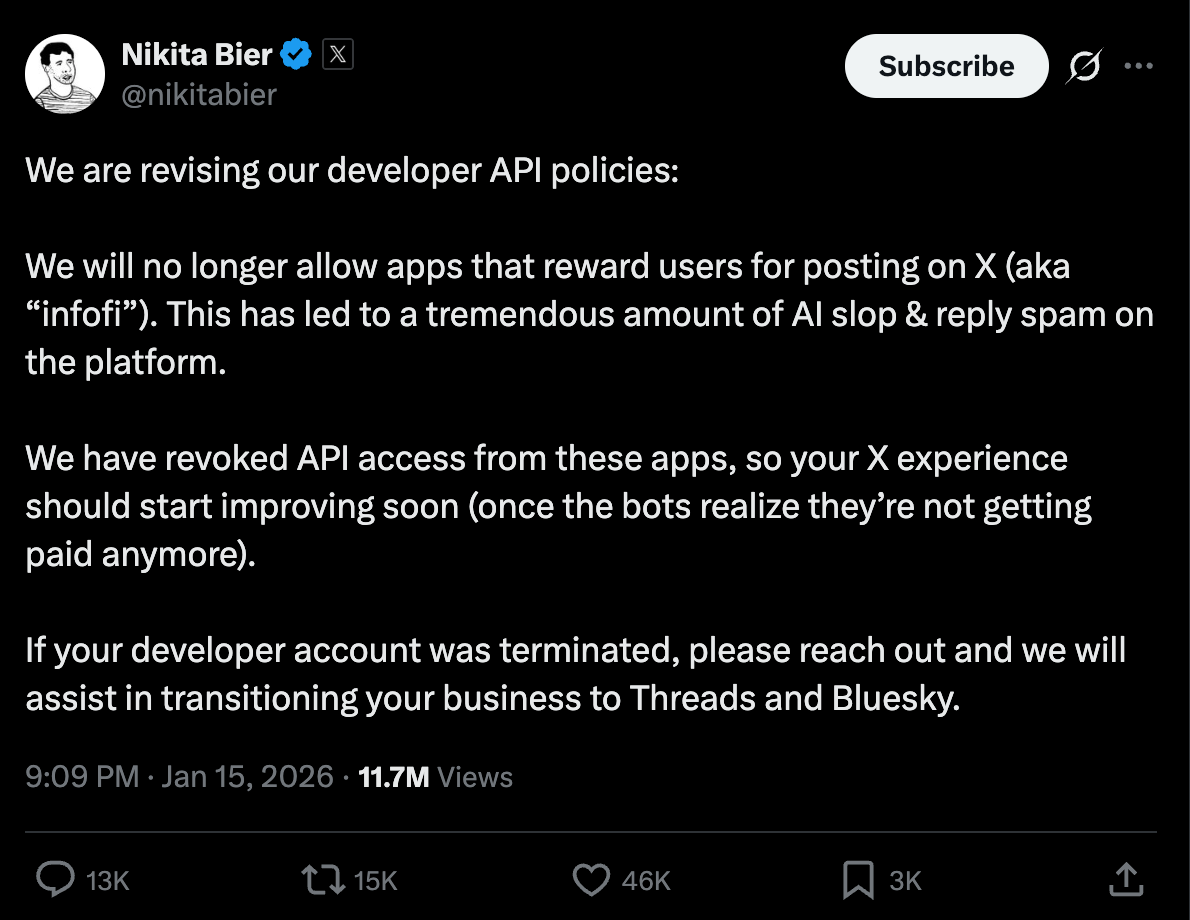
This means platforms like Kaito, Cookie, and Wallchain will no longer be allowed to run Mindshare marketing campaigns for teams. Expectedly, tokens and NFTs associated with these projects took a huge hit after the news. KAITO and COOKIE prices have dropped by more than 20% since the news.
Clearly, this was devastating news for some. The projects that built their entire product lines around a single API, their investors and finally all the creators who built their lifestyle from these earnings.
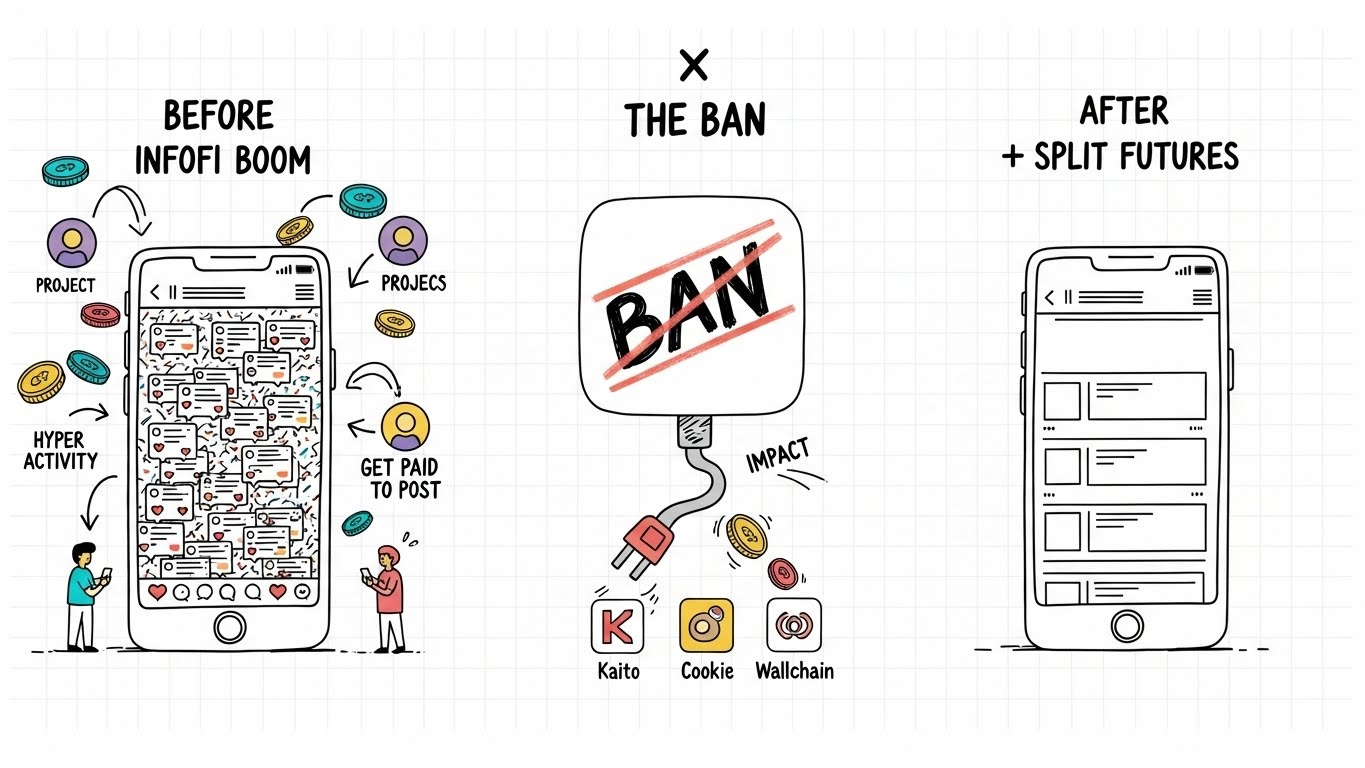
Meanwhile, the remaining CT was filled with joy in the expectations of a better feed, filled with less Kaito engagement farmers.
Today, we will discuss what went right, what went wrong, and how the creator and marketing platforms evolve from here.

Goodhart’s Law
The Kaito system was to monetise attention. Projects pay creators to capture the audience’s attention towards them. The more attention they can capture, the more valuable they are to the project and thus the more potential payouts they can get.
At first glance, this is not so different from Twitter’s creator rewards today; they, too, are monetising a creator’s ability to draw attention and keep the users hooked on the app. The more eyes you can capture, the more value you bring to us in terms of ad revenue and better engagement numbers, and hence more payouts.
Meanwhile, traditional platforms rely on creators but don’t give any rewards for their contributions. Such as Instagram. The creators on the platforms are why Instagram matters today, but the creators do not earn their income from the platform; they earn it from ad deals. Which means either the brand or a marketing studio reaches out to the top creators and gets them to market for them.
Kaito measured the creator’s ability and attributed them. Instead of reaching out to individual studios, brands could now directly leverage the open gamified creator attribution. This also benefits the creators because the small creators could see the leaderboard for exactly where they stand, compete and try to get better at their content game.
This is where the system was hit with its first problem - The Goodhart’s law.
When a measure becomes a target, it ceases to be a good measure. The moment you value a creator based on the attention they can grab, they start rage-baiting, spamming feeds with AI slop to see what hits, and posting irrelevant content in an attention-grabbing wrapper.
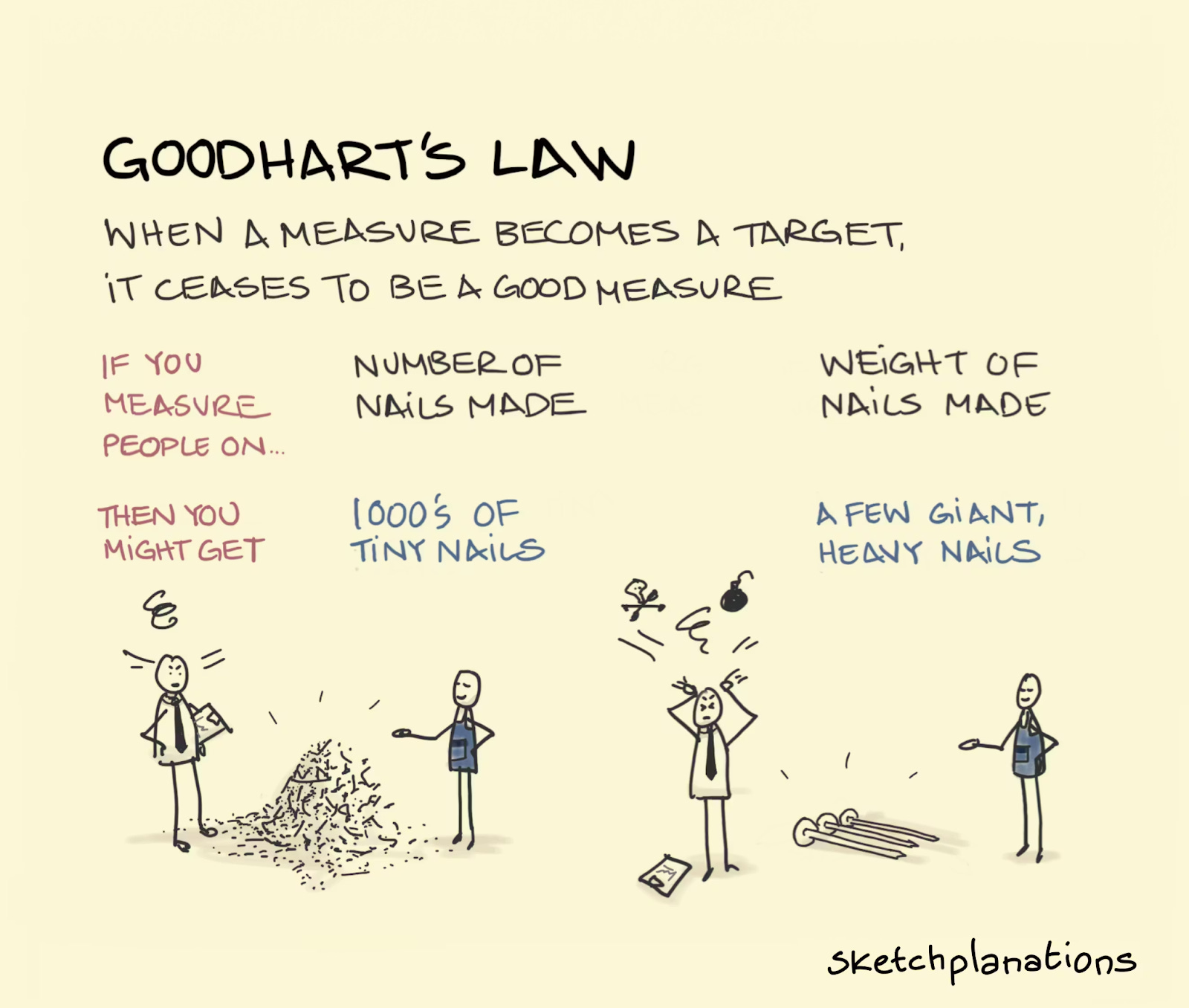
The quality of content on our feeds deteriorated because that is what the platform ended up incentivising. Low-quality content got engagement and became the norm. The more you did it, the more chances of earning from the InfoFi platforms.
The second major issue was with the projects being chosen. If every project is allowed to be listed on the Kaito leaderboard, then content becomes a function of who can pour more money, instead of who has a better product.
The plethora of non-PMF projects on these platforms, clubbed with content that is optimised to grab attention, bred a deadly combination that only benefited the platforms and the projects.
The projects were incentivised to generate short-term hype and attention prior to the Token Generation Event (TGE), and Kaito became an easy way to do that. Meanwhile twitter got clogged with low-quality engagement.
Burying the Innovation
While Kaito as a system incentivised and promoted wrong behaviours, I believe the underlying technology is still useful and should be put to good use.
I wish X issued stricter guidelines which gave room to improve the platforms instead of banning them altogether.
The idea of being able to measure and rank creators is a novel breakthrough. Kaito did a really good job with the algorithm. Especially if you see where we’ve come from.
Before InfoFi, projects used to optimise for follower counts and likes, replies and comments on posts. This was the era of Zealy and Galxe quests. Even if you typed a gm on Discord or on Twitter comments, it counted as an interaction. Kaito came along and introduced an algorithm that could now measure the quality and depth of a creator’s post. Typing a gm wouldn’t fly anymore; you’ll need to be creative and unique.
If you ask me, the adoption of AI was the biggest catalyst that led to the ban on InfoFi. The platform scaled up attention monetisation, but the frequency was relatively bearable. But with AI, users can automate the entire process of reading the tweet, drafting a reply and posting it. Feeds have become much more hazy with the fog that is AI slop.
The AI problem exists even after the ban. Killing InfoFi doesn’t kill the AI problem. Infact I believe only better reputation engines would. We need systems that can identify human writers from AI and reward quality.
The InfoFi algorithms attributed each creator and it’s a shame that it could never and will never be used for the wide-scale potentials it had.
Looking Ahead
While InfoFi has been banned, a project’s appetite for users’ attention hasn’t. Teams will still put out a budget for marketing and look to get eyeballs, as they always have.
While InfoFi provided a way to get there, it is hardly the only way to do so. Marketing agencies have always been the go-to for projects that didn’t have 100k-150k to give to Kaito. And these agencies will wake up even stronger on the death of InfoFi.
Even Kaito plans to transition its product to a ‘Kaito Studio’, with plans to use its existing data platform to guide project marketing campaigns.
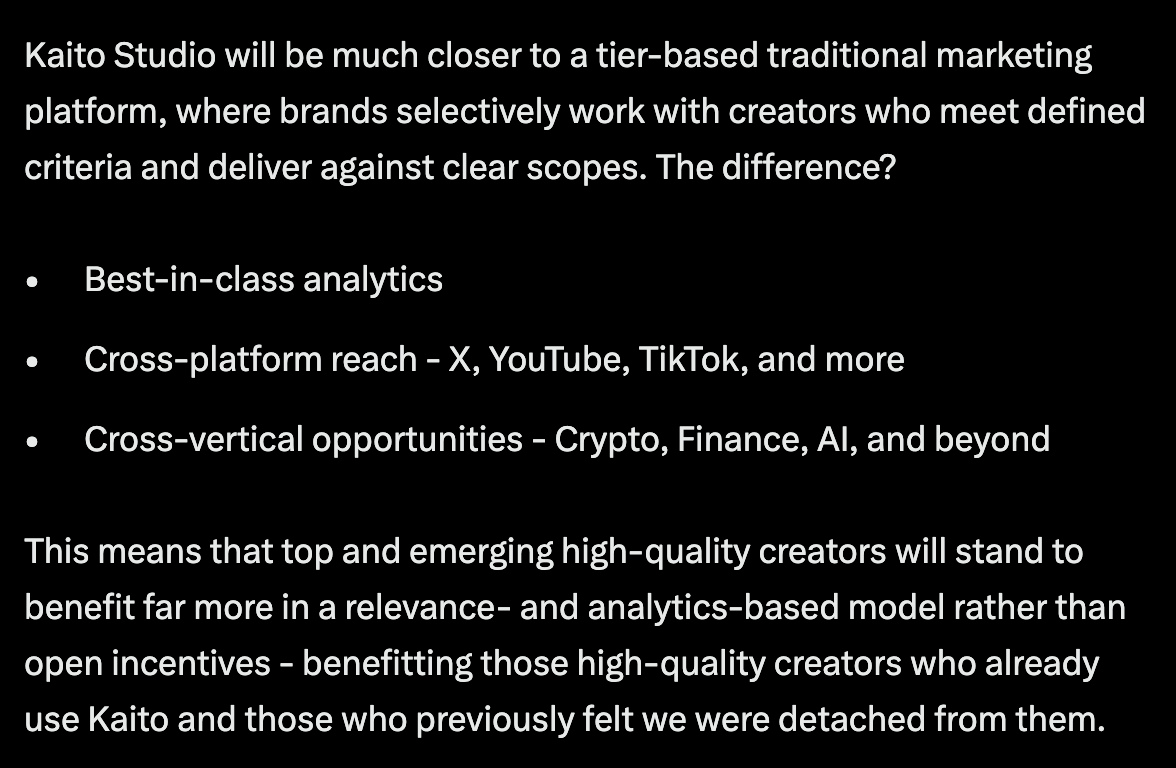
InfoFi dealflow can be expected to split in two directions from here on: to creator agencies like Kaito Studios, Radarblock or Surgence or as a Data and Analytics layer.
Agencies are more linear, while data/analytics layers are more exponential.
Personally, I think crypto projects should rely less on KOL posts and more on cold outreach and focus groups for feedback implementation. InfoFi, as an analytics layer, can be very helpful here.
I will be looking at the new slope-free X to see what happens next and will report my findings soon.
Until then, stay sharp,

Token Dispatch is a daily crypto newsletter handpicked and crafted with love by human bots. If you want to reach out to 200,000+ subscriber community of the Token Dispatch, you can explore the partnership opportunities with us 🙌
📩 Fill out this form to submit your details and book a meeting with us directly.
Disclaimer: This newsletter contains analysis and opinions of the author. Content is for informational purposes only, not financial advice. Trading crypto involves substantial risk - your capital is at risk. Do your own research.