


Hello,
Tokenised real-world assets (RWAs) have grown 179% this year. Hyperliquid now does more volume in stocks and commodities than in crypto tokens. And the story everyone is concluding with is that traditional finance is finally coming on-chain.
But when you trace back to who’s actually buying these RWAs, you will find that it looks nothing like institutional adoption, because most of the capital is coming from inside crypto itself. Protocols and DAO treasuries are loading up and converting their own reserves into tokenised treasuries.
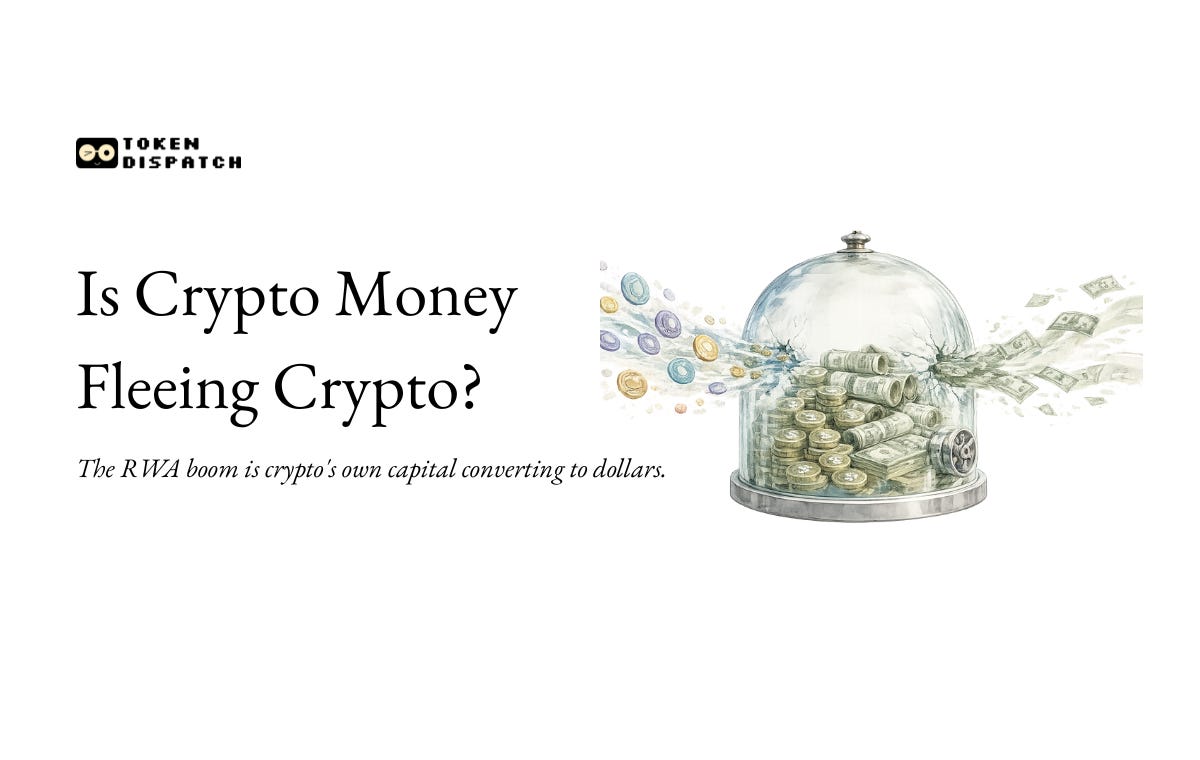
Today I’ll dig into how the RWA boom looks more like crypto’s dollarisation event than any institutional arrival, and what it means when crypto’s own protocols become the largest buyers of these tokenised Treasuries.

Who’s actually buying the RWAs
Let me take you back a few years: if you were paying attention to DeFi in 2020 and 2021, you would have seen yields that were absolutely bonkers. Lending pools were advertising 15%-20% annual returns on dollar deposits, sometimes up to 40%. Billions of dollars flooded in, but few questioned where this money was actually coming from.
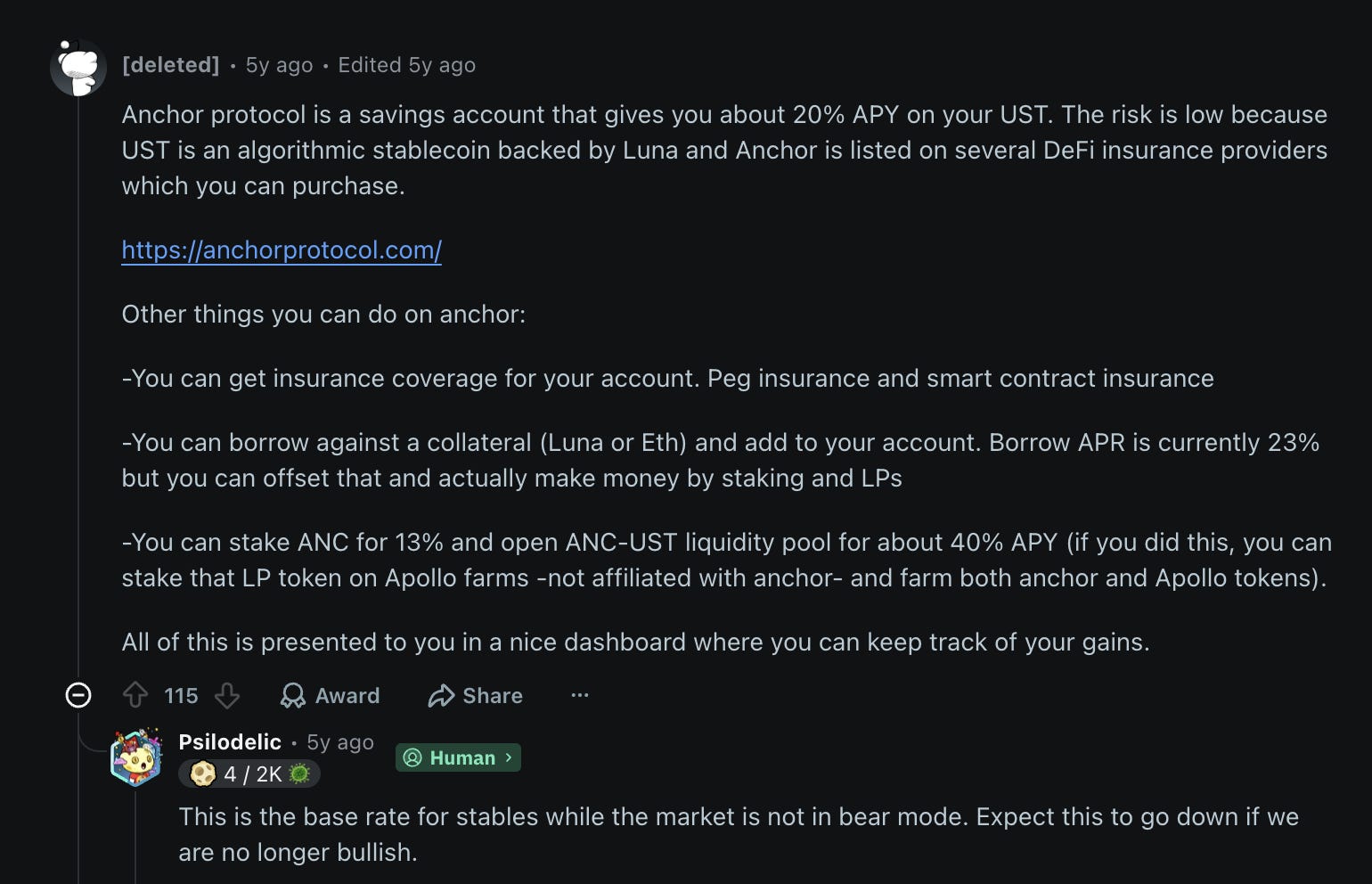
Because it was coming from token emissions, protocols would mint their own governance token, give it to depositors as a “reward,” and count that subsidy as yield. It was the ultimate gimmick to attract investors and boost TVL, but it only worked as long as the price of those tokens kept rising. Later, when the markets crashed and governance tokens lost 80-90% of their value, DeFi’s actual organic yield was just 2-3%.
That was less than what US Treasury bills offered, with far more risk. And it revealed that the financial system crypto had spent years building could never generate competitive returns from its own economic activity because those yields were coming from new entrants buying governance tokens, and not from any productive use of the capital itself. Once this stream of new money slowed, the whole model collapsed back into what it always was.
So now you had protocols sitting on treasuries worth hundreds of millions of dollars, denominated in their own governance tokens, with no way to earn a competitive return in crypto. And then in 2023, many tokenised versions of US Treasuries and dollar credit products began launching on-chain; for the first time, a protocol could park its reserves in something that earns real dollar yield without ever leaving the ecosystem.
Since then, it has become the norm. A recent on-chain buyer study by Arrakis traced $91.3 billion in deposits across more than 10 tokenised dollar-yield products and found that, of the $12.4 billion they could attribute to a named buyer type, two-thirds was attributable purely to crypto protocols and DAO treasury capital. The rest of it was split across crypto-native investors, exchanges, and market makers.
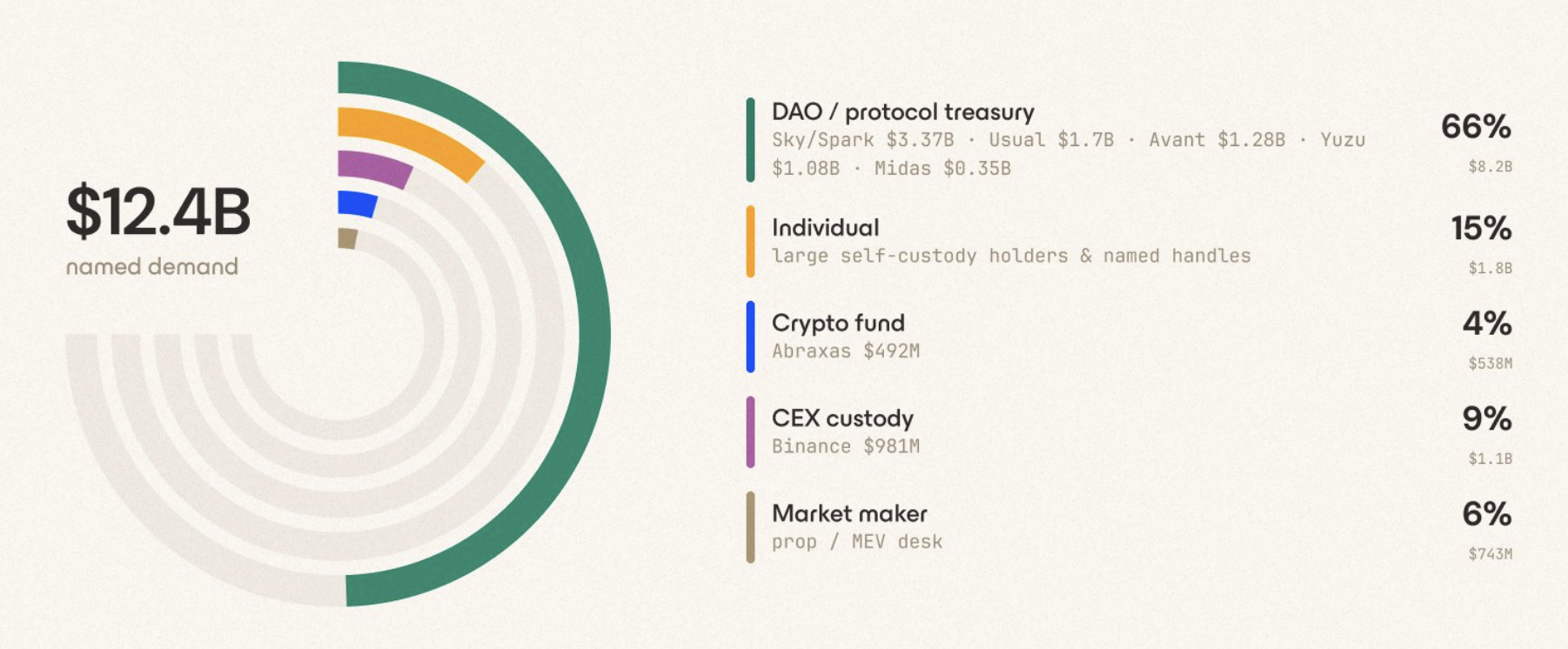
Source: Arrakis
And the amount traced to an institution such as a pension fund, an asset management company, or a bank was zero. In a $36.2 billion market that the industry keeps pushing as institutional adoption, traditional investors are nowhere to be found.
BlackRock launched its BUIDL fund to bring institutional capital onto Ethereum. This was a fully regulated, tokenised treasury fund with risk-free rates, designed specifically so that pension funds could buy it without having to explain crypto to their boards. But today, 98% of the funds are held by crypto-native buyers. Ethena accounts for more than half of the fund’s total value through its USDtb product. The rest of the top 10 holders are protocols like Ondo and Sky’s Spark Sub DAO.
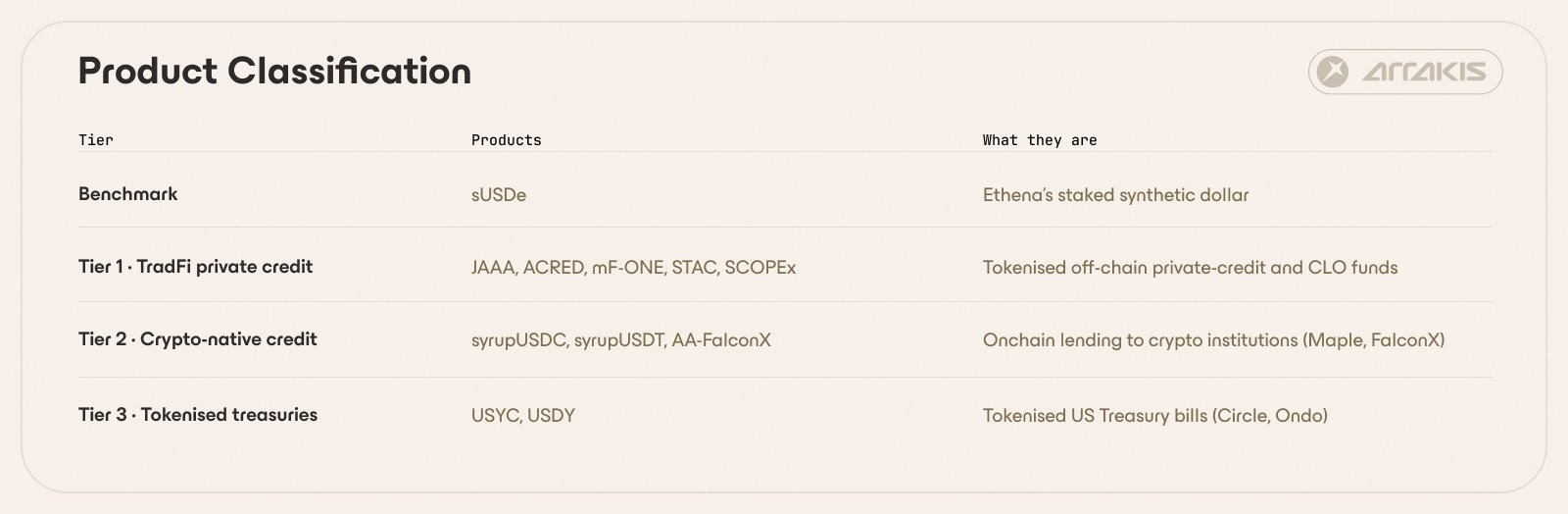
Source: Arrakis
And BUIDL isn’t the only one; across the market, the top five holders of nearly every tokenised RWA product control more than 90% of the supply.
If you want to see what it could look like in the future, the best example is MakerDAO. The protocol held about 17 million DAI in real-world assets in 2021. Today, that number is $4 billion, and more than half of its total collateral base is Treasuries rather than crypto. The entire vision of Maker was that you could run a stable currency backed by crypto-native collateral, overcollateralised enough to absorb ETH’s volatility. That trade-off was always expensive, as you lock up far more value than you mint, but the idea was that decentralisation was worth the capital inefficiency.
What it proved instead was that you can’t, at least not at scale and not without leaning on the very financial system it was trying to replace. After this, the protocol renamed itself and restructured its governance to build dedicated sub-DAOs and manage its Treasury portfolio.
And there’s a reason this keeps happening across the industry, not just at Maker. The problem is no protocol can hold meaningful reserves in its own governance token because the value is circular. The token’s price depends on the protocol’s success, which in turn depends on the treasury’s health, and even that would be related to the token’s price.
Uniswap’s DAO sits on a treasury worth nearly $6 billion, almost entirely in UNI tokens. But last year, its community passed a governance proposal called “Mobilizing the Uniswap Treasury” to diversify out of the native token into stable assets. The protocol’s own voters acknowledged that unless UNI’s price goes up forever, they are better off holding almost anything else. Holding the native token as reserves is like an emerging-market central bank counting its own government bonds as foreign-currency reserves. It only looks solvent as long as you never have to sell.
In international economics, there’s a name for this kind of trap called the “original sin.” It says that only about five currencies in the world can actually sustain borrowing and reserve accumulation in their own denomination. Every other country eventually has to be denominated in dollars, whether its government wants that or not, due to the sheer incumbency of the dollar as the world’s unit of account and because the switching costs are too high and the liquidity is already elsewhere.
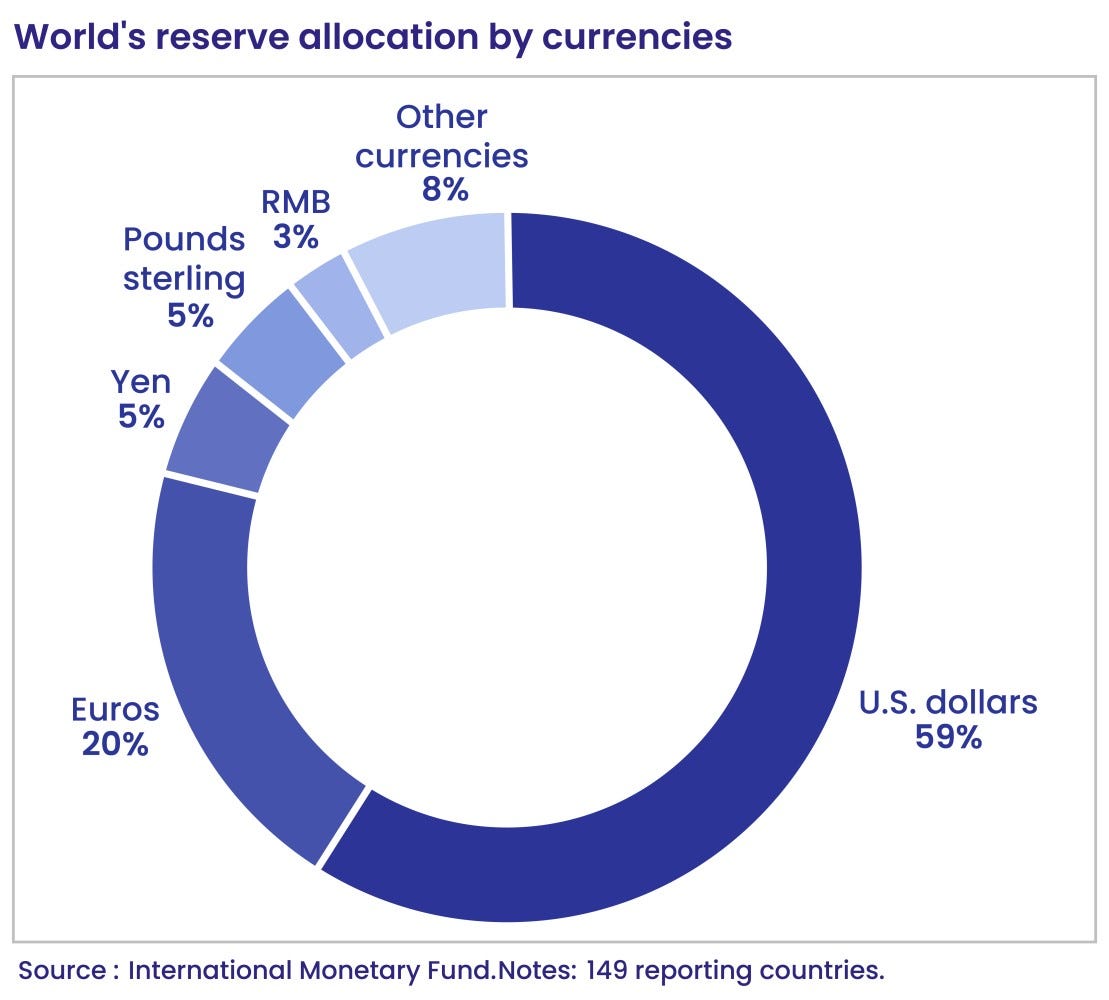
Every protocol sitting on a large treasury eventually comes to the same conclusion. The governance token can’t hold value during a downturn, the ecosystem can’t generate enough yield to be sustainable in the long run, and the only rational move is to convert it into something denominated in dollars. It is the same network effects that keep the dollar dominant in global finance that keep stablecoins dominant in DeFi. The move into tokenised Treasuries was actually the final step in dollarisation.
Economics of Dollarisation
The economics literature on dollarisation explains a very precise two-stage process, and crypto has now been through both.
The first stage is asset substitution. People in emerging countries often stop trusting their local currency to hold its value, and so they start saving in dollars instead. They might still be getting paid in the local currency and might still price goods in it, but their savings move into dollar accounts because that’s where purchasing power is more stable.
The second stage is currency substitution. Once enough savings are held in dollars, people start borrowing and lending in dollars too, because it becomes easier to do business in the currency everyone already holds. The two stages feed into each other, and in traditional emerging markets, the whole process typically takes a few years or even decades.
What’s interesting is crypto went through both in about three years. The asset substitution occurred during the bear market, when protocol treasuries began routing their dollar-denominated reserves, such as fee revenue and anything not locked in their governance token, into stable assets rather than redeploying them back into DeFi. The governance token still appears on the balance sheet, but the working capital has now been converted to dollars.
Once those treasuries began holding USDC and USDT, the second stage of currency substitution began almost immediately. Lending markets started to be denominated in stablecoins, and yield products were now being quoted in dollar terms. Trading pairs that had been ETH-denominated also shifted to stablecoin denominations. And now, with all the tokenised Treasuries, the denomination has gone even further: from synthetic dollars to actual US government-issued dollar instruments that earn risk-free yield on-chain.
What took countries like Turkey decades of political crises and currency collapses to reach took crypto only a handful of quarters. Oliver Wyman, in one of its reports earlier this year, said that stablecoins are compressing the traditional timeline of dollarisation from decades to just months. They were talking about emerging markets, but the analysis fits crypto even better because here there is no central bank trying to slow the process down with capital controls or compliance friction. The switching cost on the way in is close to zero.
But that’s also the paradoxical curse of dollarisation: the switching cost on the way out is enormous. Economists call it hysteresis. Once dollarisation takes hold of an economy, it is almost impossible to fully reverse it even if the original conditions that caused it have improved.
Because there is no crypto equivalent of a commodity super-cycle that can suddenly make governance tokens more attractive to hold than dollar yield. And it’s next to impossible for a protocol to impose capital controls or reserve requirements on stablecoin deposits. And unlike a country, crypto doesn’t have an institutional memory of a pre-dollarised era to return to, because for most of DeFi, stablecoins have been the default denomination from the start.
This is a one-way door, and the cost of walking through it is grave. Every time economic activity inside DeFi is denominated in USDC or USDT, the seigniorage or profit that comes from being the issuer of the money flows to Circle and Tether instead of the protocols where the activity is actually taking place. Tether made about $10 billion in profit last year for about 100 employees; Circle did its IPO, and Coinbase took half of USDC’s net interest income just for distributing it.
When Ecuador or El Salvador denominates in dollars, the seigniorage that would have funded their central bank transfers to the Federal Reserve instead. And when DeFi denominates in stablecoins, it accrues to Tether and Circle.
A protocol that denominates in someone else’s currency also loses its ability to manage its own economy because it can’t adjust the supply of its native token to respond to conditions inside its ecosystem, and because the core economic activity is no longer priced in that token. It is the same position as a fully dollarised country that can’t devalue its way through a downturn. The only tools you’re left with in this case are spending cuts, and that is what we’ve seen across DeFi over the past two years. The governance votes to reduce grants, which cuts contributors and slows protocol development, since otherwise the protocols have no other monetary lever left to pull.
There is a protocol called M^0, being built by former MakerDAO and Circle executives, which is described as “a governor of the Eurodollar System”. They are building infrastructure for multiple issuers to mint stablecoins backed by Treasury collateral and are targeting the $20 trillion offshore dollar market. They are not trying to replace the dollar, but instead building better rails for the dollar to run on. And this is what I feel the end state of crypto dollarisation looks like. Where the infrastructure reorganises itself around servicing demand for the dominant currency, and the native tokens become afterthoughts.
Isn’t the original thesis bitcoinisation? Even the most committed maximalists would tell you that it is a multi-decade arc, that it only becomes possible once the dollar itself loses stability. But the interesting thing is, crypto has also built the most efficient dollar distribution network ever. It did not impose its monetary logic on the world; rather, the world ended up imposing its monetary logic on crypto.
The entire industry is running behind to frame the RWA boom as some story about Wall Street discovering the efficiency of blockchains. And of course, the first buyers are crypto-native, but two-thirds of the identifiable capital is going only into tokenised Treasury bills. The safest and vanilla financial product in existence, wrapped in a smart contract.
That’s all for today!
Token Dispatch is a daily crypto newsletter handpicked and crafted with love by human bots. If you want to reach out to 170,000+ subscriber community of the Token Dispatch, you can explore the partnership opportunities with us 🙌
📩 Fill out this form to submit your details and book a meeting with us directly.
Disclaimer: This newsletter contains analysis and opinions of the author. Content is for informational purposes only, not financial advice. Trading crypto involves substantial risk - your capital is at risk. Do your own research.
Crypto isn’t disappearing - it’s evolving from speculation toward real utility, infrastructure, and sustainable financial innovation.