


Hello,
Paradigm, which is one of the largest dedicated crypto funds ever assembled, recently raised $1.2 billion to start backing startups in AI, robotics, and aerospace. They have also entirely scrubbed “crypto” from their website! Their thesis is that crypto was their first frontier, but there’s so much else happening right now that they can’t ignore it.
Framework Ventures also closed a $400 million fund in June to start investing beyond crypto, and they’re far from alone. Nearly every major crypto-specialist fund has started drifting towards broader themes and mandates over the past year. In Q1 2026, we only had eight new crypto-only venture funds launched, which is the lowest since 2020.

Today I will dig into whether crypto-specialised VC as a fund category is actually dying. If so, how does the shakeout map into the lifecycle of these funds, and what does it mean for crypto startups, which will now be competing for attention inside multi-sector portfolios?

The Specialist Fund Lifecycle
The reason crypto-specialised funds became a thing was that they were willing to spend time building the competitive advantage and were the only people willing to underwrite the risk at all. Understanding how Solidity contracts actually work and forging relationships with pseudonymous developers building in Discord channels was not something accessible to a growth equity partner at Tiger Global in 2017.
And to understand whether crypto VC is dying as a category, it helps to look at how specialised fund categories have lived before, because this has happened more than once in the past.
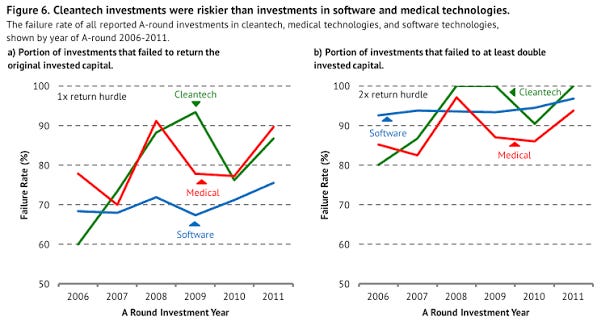
Between 2006 and 2011, climate tech went mainstream as an investment thesis, and VCs started raising dedicated clean energy funds for the same reason crypto VCs raised dedicated blockchain funds: thinking they spotted a generational technology shift before the generalists caught on, and wanted to build entire franchises around that conviction.
They poured in over $25 billion into clean energy startups and lost more than half of it. What’s Interesting is that the technology actually worked, and today’s clean energy market is enormous. It led to solar costs falling 85% over that period. But what VCs misinterpreted was that they applied the same software-company model and wrote $5 million seed cheques into companies that, in reality, needed $200 million of project financing and fifteen years to reach profitability.
MIT’s Energy Initiative ran a post-mortem and found that the venture model was fundamentally flawed for the sector. The specialist VCs who funded the experimental phase by taking the technical risk funded the early R&D and gave the sector the credibility to attract bigger capital, but once the technology matured enough for infrastructure lenders and project finance facilities to underwrite it, the specialists’ informational edge had evaporated.
SPACs played out a similar pattern. For context, a SPAC is a blank-cheque company that raises money through an IPO without having an actual business. It then later uses that cash to merge with a private company to take it public faster than a traditional IPO would allow. In 2020 and 2021, some investors saw this as a repeatable vehicle and built entire firms around them.
Chamath Palihapitiya had raised $1.6 billion in dedicated SPAC capital. But by 2022, two-thirds of 2021’s SPACs hadn’t completed a merger, and Chamath had to return the money he had raised. All of this happened in less than twenty-four months, which can give you a sense of how fast things change once the specialist edge disappears.
And there’s a big reason this keeps repeating itself across completely different industries. Carlota Perez documented it across 250 years of technological revolutions, calling it the techno-economic paradigm. She stated that every major technology goes through an early phase where only insiders understand it, and the people closest to the technology become its most valuable investors because they’re the only ones who can tell what’s real. Then the technology matures and starts integrating into existing institutions.
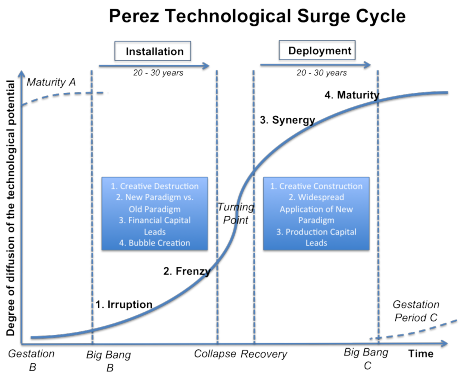
At that point, the insider edge that built these specialists doesn’t matter anymore because the asset class becomes legible to generalists with bigger balance sheets. Fred Wilson saw this coming for crypto specifically. He wrote about it in 2015, predicting that crypto would hit a major “financial break point” as it crosses from what Perez calls installation into the deployment phase.
That break point is hitting now, and you see what the deployment phase for crypto looks like. We had fintech like Stripe acquiring Bridge, and launching their own stablecoin chain. Institutions like BlackRock and Fidelity have launched their own tokenised money market funds. Even traditional payment giants like Visa and Mastercard are now building settlement layers on top of stablecoin rails.
These companies don’t need a crypto-specialist VC to explain MEV extraction and Validator economics because the specialist crypto knowledge doesn’t matter to them. What they need instead is regulatory approvals, distribution, and banking partnerships. Something that any other fintech would need to scale. Today, a generalist at Sequoia or Founders Fund can evaluate a crypto deal the same way they’d evaluate Stripe or Plaid.
The Barbell and the Drift
So if the specialist edge has dissolved, what actually happens to the funds that were built on it? Their fate depends entirely on the economics of their fund size.
See, venture capital has been splitting into a barbell for years. At one end, you have mega-platforms like a16z, Sequoia, and Founders Fund that can absorb entire asset classes as verticals inside their portfolio. On the other end are tiny cottage-industry funds that write small conviction-driven cheques into things they understand very deeply and can return the whole fund off a single breakout. Everything in between has become a kill zone, and that’s where most crypto-specialist funds sit right now.
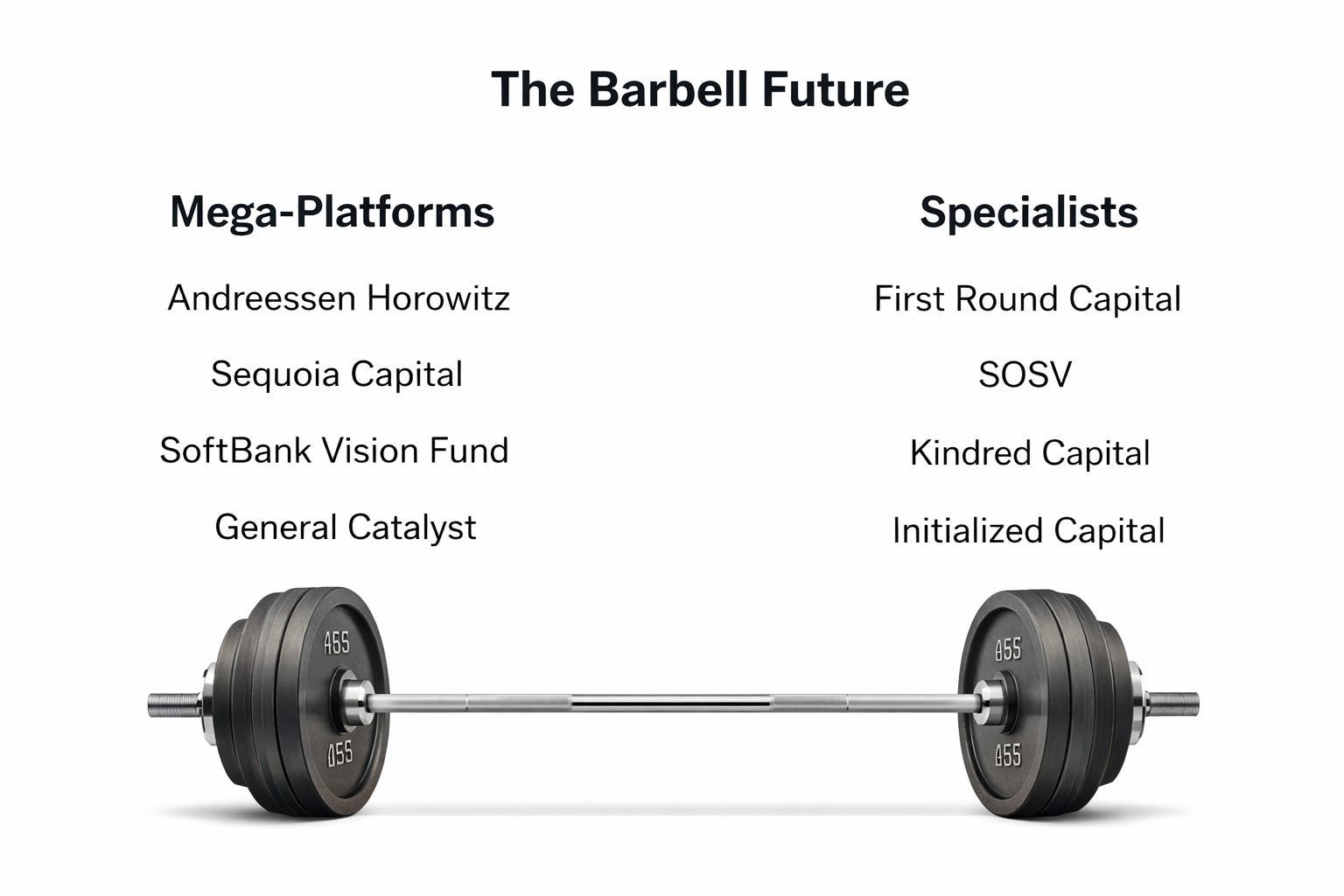
A $500 million fund needs to generate roughly $1.5 billion in total exits to return 3x net to its LPs, so you can’t get there from seed cheques alone because no seed portfolio produces enough breakouts at that scale. And you also can’t compete for growth-stage deals against $5 billion megafunds that are willing to write $100 million cheques without thinking twice about it. For example, in 2025, Founders Fund alone raised 1.7 times what every emerging manager combined raised in the first half of the year. The capital is concentrating at the extremes.
This barbell is also why Framework Ventures and Paradigm look like they’re doing the same thing, but in reality they are very different. Framework sits at $400 million, which is too large to return the fund off a few seed bets and too small to compete with megafunds for growth deals. At that size, crypto alone doesn’t generate enough exits, so they had to broaden. But Paradigm, at $1.2 billion, is large enough to try becoming a multi-sector platform altogether, which is strategically different. In simple terms, the size of your fund determines which end of the barbell you land on, and that determines what options are available to you.
Even the crypto VCs that say they’re staying on the course have completely redefined what ‘crypto’ means. Dragonfly had raised $650 million in February, which was oversubscribed by 30%. Still, they have been explicit that non-financial crypto has completely failed, and the firm is betting exclusively on stablecoins and prediction markets. A16z’s latest $2.2 billion crypto fund was raised in May 2026, and it’s half the $4.5 billion they raised in 2022; not just that, Chris Dixon has even shifted his framing from crypto being a new computing paradigm to finance being the foundation for everything in the space.

What these firms now call ‘crypto-only’ investing is a bet on financial infrastructure built on blockchain rails, which is exactly what the generalist funds with bigger cheques will fund too.
A major force driving all of this is also the LPs’ behaviour. The Venture industry is currently in a DPI crisis where 2021-vintage funds have returned roughly 0.08x. And LPs who got burned during the 2022 crypto crash now have an obvious alternative in AI, which is absorbing 70% of global funding this year. So when your LPs have been sitting on dead capital for four years and see AI companies generate the returns they once expected from crypto, the fund manager has no choice but to create exposure to AI forcefully.
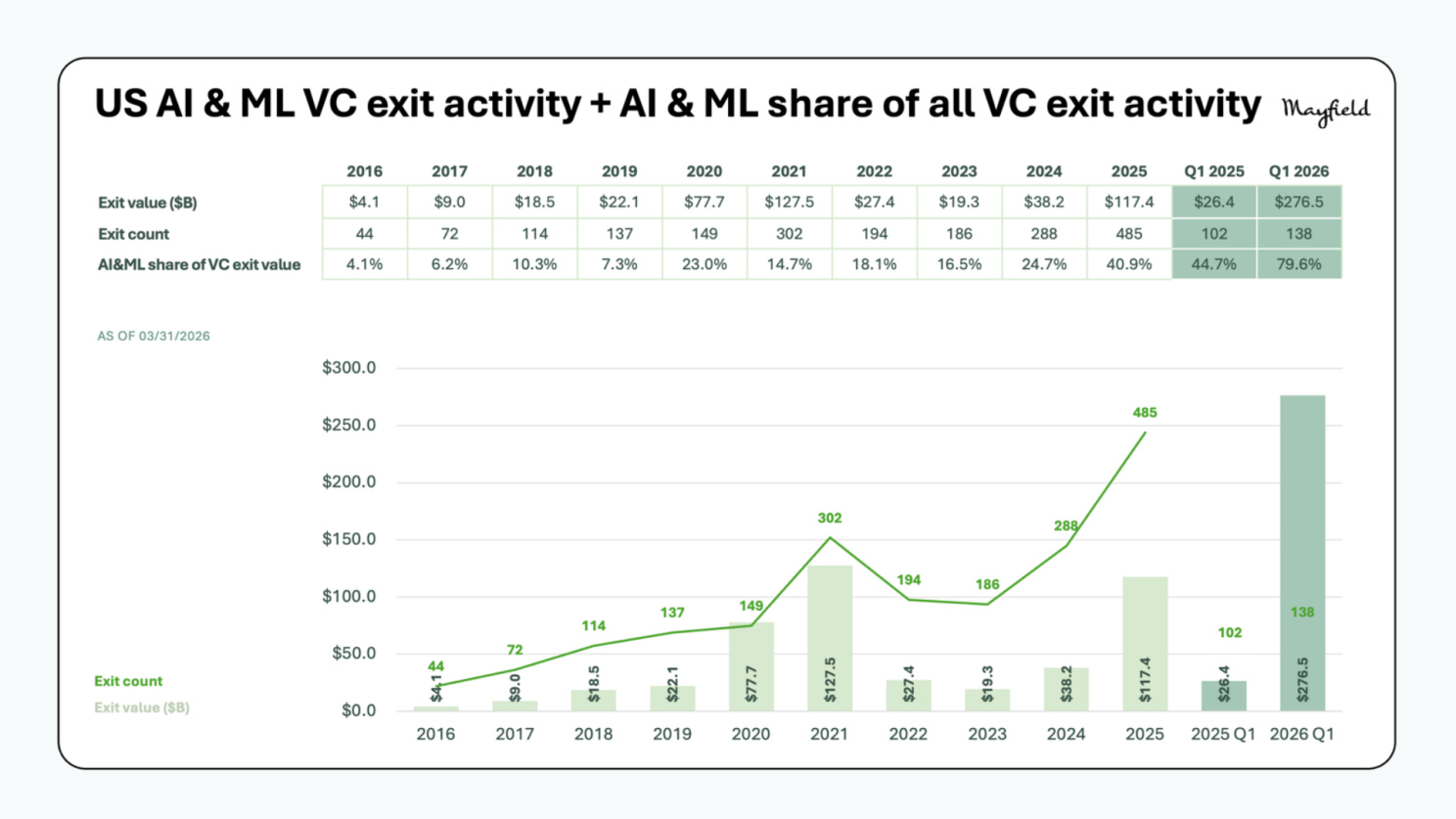
For crypto founders who are still building, this is concerning because it leaves a shrinking pool of investors who actually understand what they’re working on and are committed to backing them. The obvious response to the shrinking is to say, founders should just raise from generalists instead. And on paper that might sound accurate - Sequoia and Founders Fund can write bigger cheques, and they also bring in distribution that no crypto-native fund can match.
But there’s a problem with that. As AI companies are sucking up the majority of the dealflow today, a crypto founder inside a generalist portfolio will be competing for attention against that, and the deal would need to be exceptional just to get on the agenda, which is a very different game than pitching to a crypto-specialist who eats, sleeps, and breathes this stuff.
Another problem is the growth of the crypto ecosystem as a whole. Specialist VCs didn’t just write cheques but also funded the infrastructure layer that made the next generation of applications possible. Paradigm funded research into MEV, Dragonfly backed cross-chain tooling, and all this obviously doesn’t have the commercial returns on a deal-by-deal basis, but it builds the commons that the whole ecosystem runs on. A generalist fund will never fund that because they evaluate deals on standalone returns.
I think in a few more years, calling yourself a Crypto Investor will feel the same as calling yourself an internet investor. Crypto has now become plumbing, a set of rails that enable financial products. And you don’t build a fund thesis around the plumbing; you build on top of it. And if Perez’s framework holds, this is exactly what’s happening - Crypto is no longer the thing you invest in; it’s the infrastructure underneath the things you invest in.
But that doesn’t mean specialist crypto funds disappear entirely. As tokenisation and onchain securities like new categories keep emerging, there will be niches that generalists can’t touch, and small funds will keep forming around them every cycle. What’s dying is the current generation of large dedicated crypto funds that are too big to survive on niche crypto deals alone. The category will keep on reshuffling around the barbell, where generalists will take the big cheques, and small specialists take the frontier bets.
The early specialist funds of 2017-18 financed Uniswap and Ethereum, the tooling that made stablecoins work. But this era is changing; there are also cases where few of the most successful recent crypto projects, like Hyperliquid and MegaETH, have raised entirely through community rounds and zero-VC models. The specialist funds made crypto legible enough for generalists to move in, but there are also founders realising they can do it without them.
That’s all for today!
Token Dispatch is a daily crypto newsletter handpicked and crafted with love by human bots. If you want to reach out to 170,000+ subscriber community of the Token Dispatch, you can explore the partnership opportunities with us 🙌
📩 Fill out this form to submit your details and book a meeting with us directly.
Disclaimer: This newsletter contains analysis and opinions of the author. Content is for informational purposes only, not financial advice. Trading crypto involves substantial risk - your capital is at risk. Do your own research.