


Hello,
Wordle, one of my favourite games of all time, started as a small game that a software engineer in Brooklyn made for his partner.
On November 1, 2021, 90 people played it. By early January, more than 300,000 did, and a week later, over 2 million. It was everywhere. You could share your score without revealing the answer. At one point, group chats and social media feeds were full of it.
The New York Times bought it before the month was over.
As with anything loved too much, a few months later, people began writing that Wordle had lost its appeal. It also showed up less often online, and it looked like people had moved on.
But in 2023, Wordle was played 4.8 billion times. People kept coming back every day, even though they didn’t post about it.
Pokémon and Fortnite were written off the same way, and both came back with record numbers.
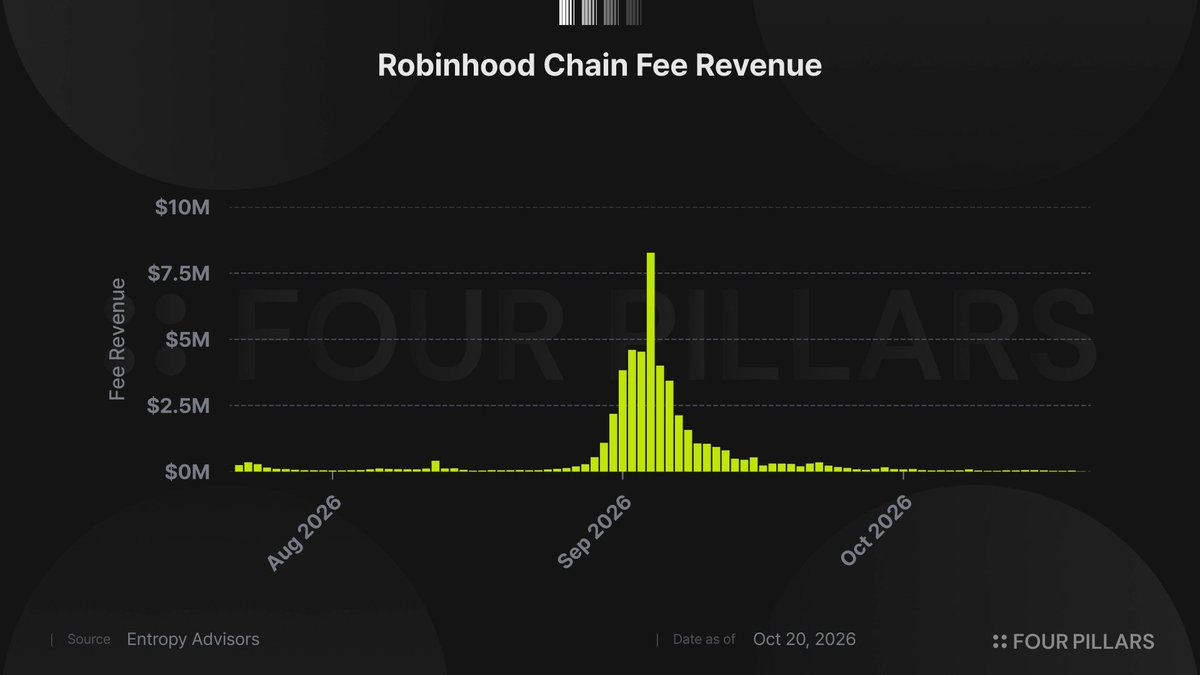
Robinhood Chain’s big number went quiet in a similar way. On September 4, memecoins paired with tokenised stocks jammed the network. The chain runs on Arbitrum’s technology, where the minimum fee per transaction climbs faster and faster as traffic piles up, and that one day earned it $8.27M in fees. By mid-October, daily fees were around $30K-40K.
In today’s guest essay, 100y from Four Pillars explores whether we're using a bad yardstick again.
On to 100y’s story,
Thejaswini


StablesReward: Your AI Agent Spends, You Earn
AI agents can surf the web, read reviews, and book hotels for you. All these tasks cost money. But what if these tasks could earn you back something?
StablesReward does just that. Once you connect your agent to an MCP endpoint, it gives your agent a menu of paid tools. Every call your agent pays for earns you miles or stocks. And this is in addition to the rewards you earn anyway on your own spending across 800+ merchants.

Every purchase pays you back. The best part is that you can choose how you’d like to be rewarded. Transfer miles to airlines and hotels, or let your stocks build a portfolio from the spend you were making anyway.
Launching soon. Free to join.
Key Takeaways
Launched in July 2026, Robinhood Chain saw daily network fees surge to $8.27M in early September, fueled by the frenzy around stock token-memecoin pairs. However, as memecoin activity cooled and network congestion eased, fee revenue plunged more than 99% from its peak.
Despite the sharp decline in network fees, Robinhood Chain’s core ecosystem remains surprisingly resilient. The USDG Vault continues to hold around $540M in TVL, tokenized stocks maintain roughly $150M in outstanding supply, and memecoins still account for a significant share of spot DEX trading volume.
Lighter and Arcus, two perpetual DEXs strategically backed by Robinhood, are emerging as potential drivers of the ecosystem’s next growth cycle, with trading volumes and open interest (OI) steadily increasing through points programs. The real test will be whether they can retain users and liquidity after their TGEs and airdrops.
For Robinhood Chain to experience another explosive growth cycle, it needs more than just a stable foundation. Stronger builder support, sustainable activity across existing protocols, and differentiated financial products will be critical. In particular, entirely new onchain financial primitives, much like stock token-memecoin pairs, could become the catalyst for its next wave of growth.
1. Is Robinhood Chain Dead?
If you had to name the hottest blockchain launch of 2026, Robinhood Chain would probably be everyone’s answer. Despite an unfavorable crypto market and Robinhood’s own crypto business losing ground, with crypto’s share of total revenue falling from 27.2% in Q1 2025 to 12.6% in Q1 2026, Robinhood made the bold move of launching Robinhood Chain on July 1, 2026.
Robinhood Chain was built with an ambitious vision: to create an onchain financial ecosystem centered around tokenized stocks. But shortly after launch, memecoin launchpads like Noxa and tokens like Cashcat began stealing the spotlight, making Robinhood’s grand vision of an RWA-driven ecosystem seem somewhat overshadowed by speculation.
Things got more interesting when launchpads like LONG and Pons introduced a novel concept: pairing memecoins with tokenized stocks. Trading volume exploded, and in some bizarre cases involving stocks like HIMS and AMC, memecoin-driven volatility in their tokenized counterparts even began influencing prices in the traditional stock market.
On September 4, 2026, Robinhood Chain generated an astonishing $8.27M in network fees in a single day. To put that into perspective, Robinhood’s entire crypto business generated roughly $100M in revenue during Q2 2026. That makes the chain’s single-day performance pretty remarkable.
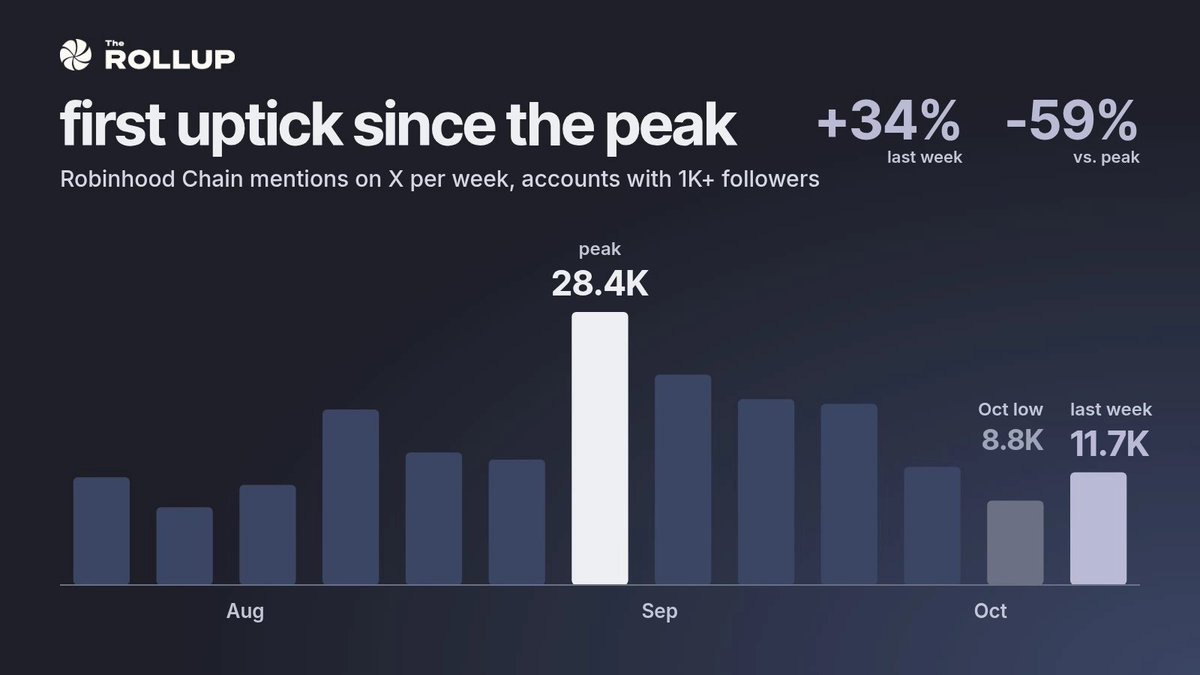
But the excitement didn’t last long. Against a backdrop of unfavorable macro conditions and a weak crypto market, the memecoin frenzy on Robinhood Chain began to cool. As network congestion eased, fee revenue collapsed just as quickly as it had surged. By mid-October, daily network fees had fallen to around $30K-40K, less than 1% of the September 4 peak.
So, did Robinhood Chain really become yesterday’s news almost overnight? Let’s take a closer look at what’s actually happening across its ecosystem.
2. Taking a Closer Look at Robinhood Chain
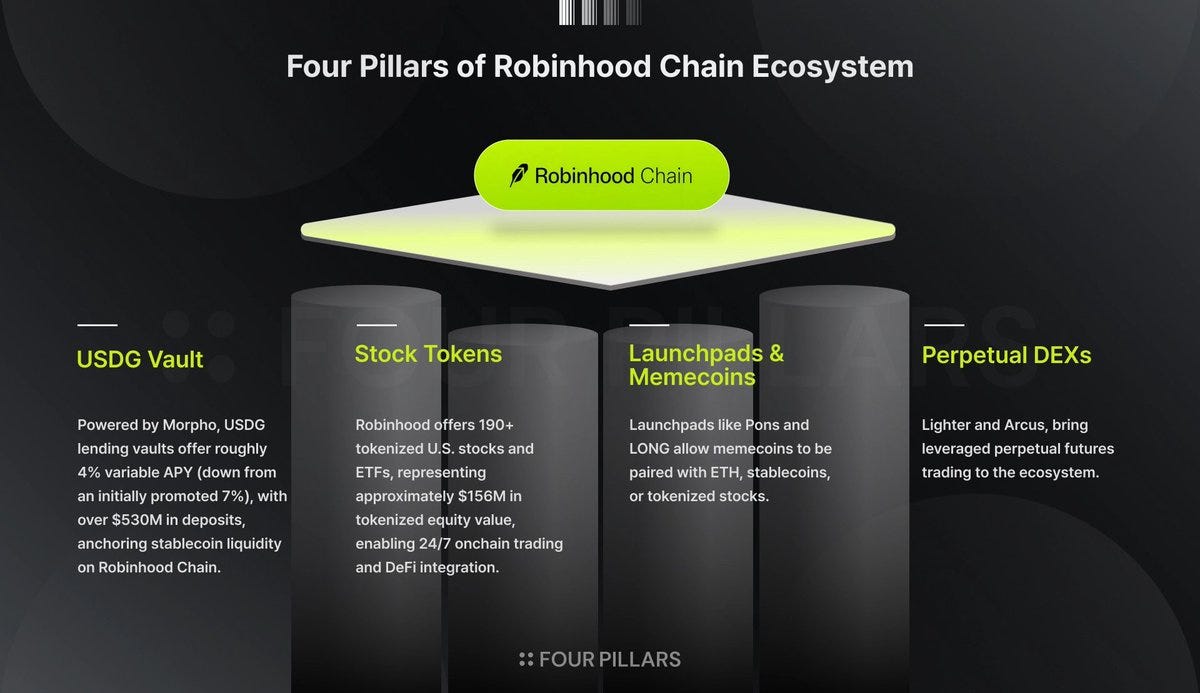
There are four main pillars supporting the Robinhood Chain ecosystem. These are Robinhood’s Four Pillars:
Steakhouse USDG Vault
Stock Tokens
Launchpads & Memecoins
Perpetual DEXs
2.1 Steakhouse USDG Vault
Robinhood Chain currently has around $1.1B in TVL, and there’s one particularly important vault that accounts for nearly half of it. That vault is the Steakhouse USDG Vault, curated by Steakhouse Financial, which allows users to earn lending interest by supplying USDG to Morpho lending markets. It currently holds approximately $540M in TVL.
What’s interesting is that, unlike the network metrics we looked at earlier, USDG Vault TVL has been steadily climbing. The biggest reason is its attractive yield. To attract users and grow TVL, Robinhood has been offering existing Robinhood users an APY of up to 7%, boosted by additional incentives. Considering that stablecoin-based Morpho vaults on other networks typically offer around 3-5% APY, a 7% yield is an extremely competitive proposition for investors.
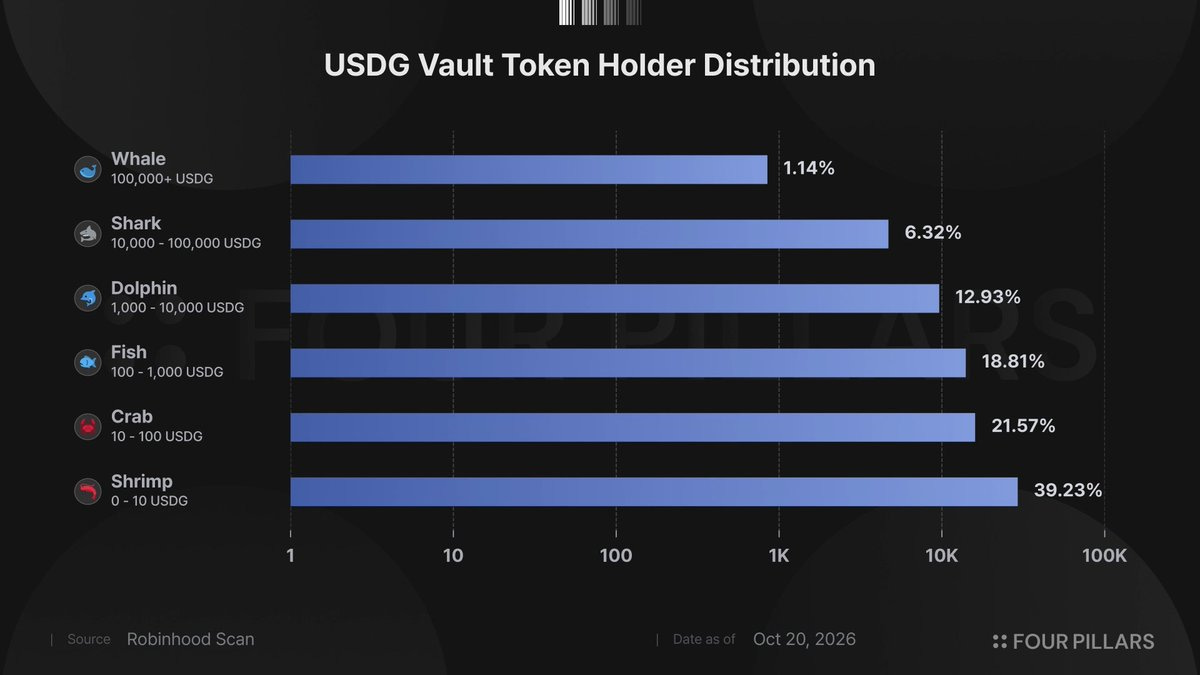
Looking at the vault’s depositor distribution, funds are fairly concentrated among larger holders, but roughly 75,000 wallets have participated in deposits. Interestingly, the largest depositor is NetNet, a protocol that uses USDG as a reserve asset. Taking this into account, the actual number of wallets indirectly participating in the USDG Vault could be considerably higher.
Within the crypto community, Robinhood Chain has developed a reputation as a playground for degens actively trading memecoins. But behind the scenes, Robinhood Chain has been quietly building a base of passive investors through its USDG Vault.
2.2 Stock Tokens
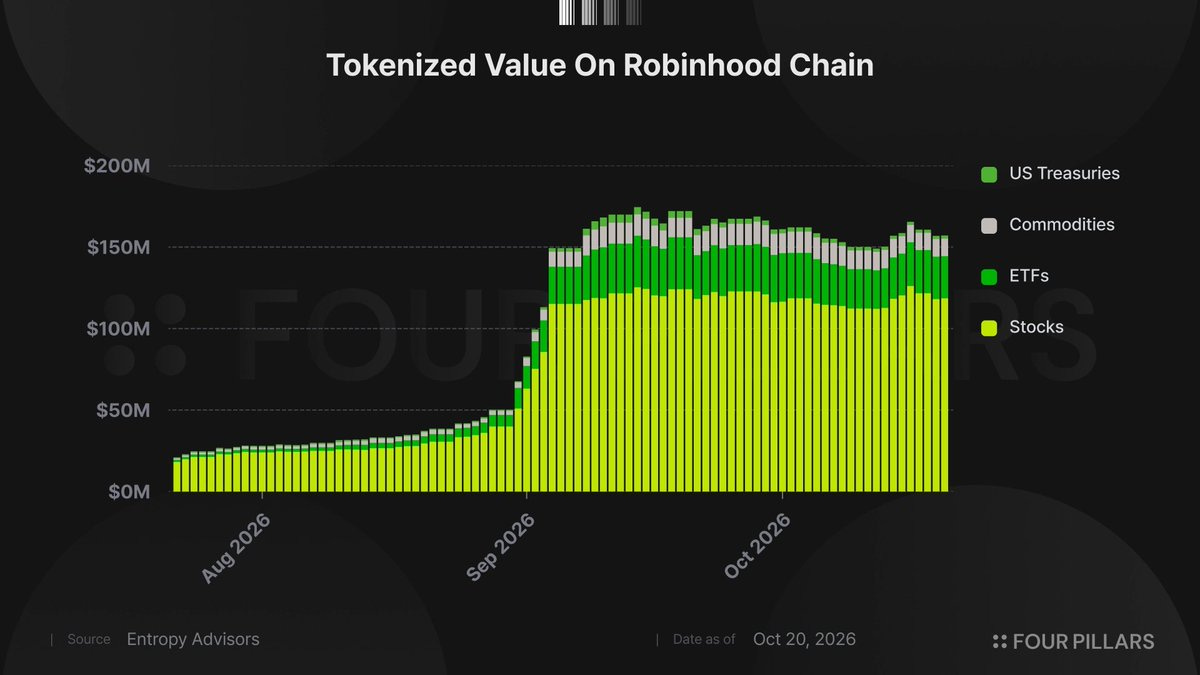
Robinhood Chain was originally designed to build an ecosystem around RWAs, particularly tokenized stocks. True to that vision, stocks and ETFs account for more than half of all RWA tokens issued on the chain, followed by commodities and U.S. Treasuries.
The value of tokenized stocks surged in early September. As discussed in the first section, this was largely driven by massive trading activity in memecoins paired with stock tokens, which required substantial amounts of new stock tokens to be minted to meet demand. Although the memecoin frenzy has cooled somewhat, many of those newly minted stock tokens have not been redeemed, leaving their outstanding value relatively stable. The roughly $150M worth of stock and RWA tokens issued on Robinhood Chain could serve as a solid liquidity foundation as the ecosystem moves into its next phase.
2.3 Launchpads & Memecoins
Starting with Noxa and followed by Pons and LONG, memecoin launchpads have played such a massive role in building Robinhood Chain’s current ecosystem that it’s hard to overstate their contribution. Traditionally, memecoins launched through these platforms are paired with a network’s native assets, such as ETH or SOL. But Robinhood Chain introduced a new concept: memecoins paired directly with tokenized stocks, which helped spark the chain’s memecoin frenzy.
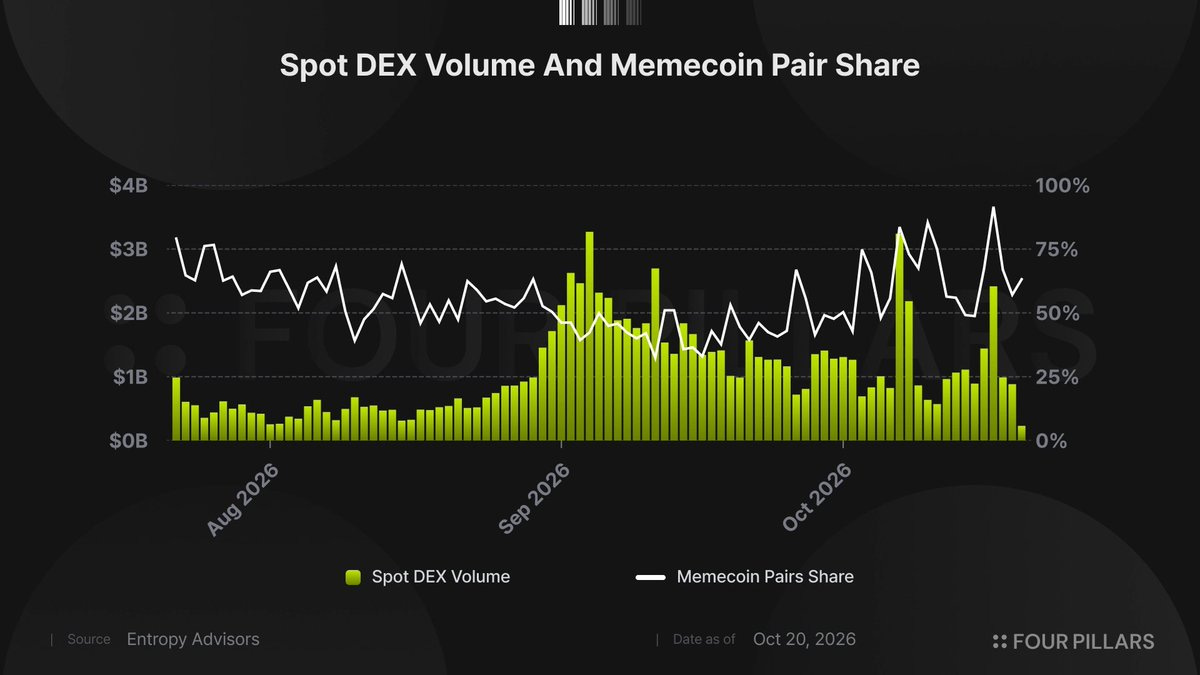
If you only looked at the network fee revenue chart, you’d probably think Robinhood Chain’s memecoin trading ecosystem was completely dead. But spot DEX volume tells a different story. On September 4, when network fee revenue peaked, spot trading volume reached $3.27B. Even after the hype faded, volume climbed to $3.24B on October 7, and the network has continued to consistently generate at least $600-700M in daily trading volume.
More importantly, memecoin-related trading hasn’t disappeared either. Memecoins still consistently account for more than half of total spot DEX volume. The memecoin ecosystem that everyone thought was dead hasn’t actually gone away. The fire may have cooled, but the embers are still burning.
2.4 Perpetual DEXs
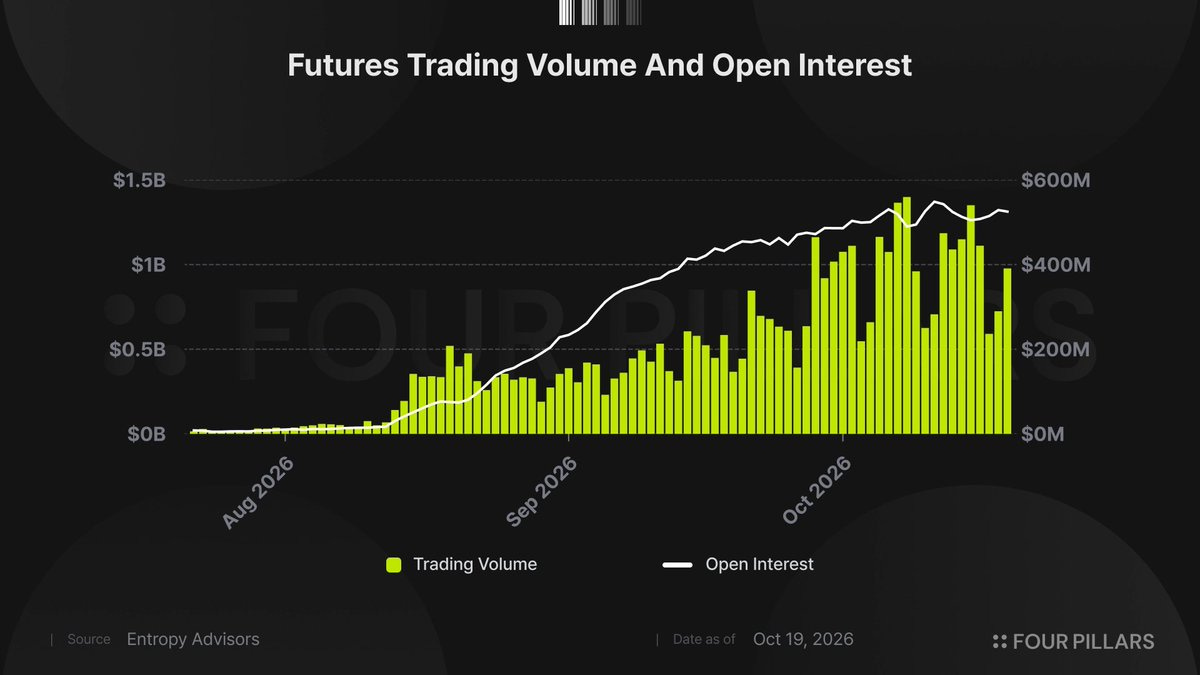
While Robinhood Chain aims to build an ecosystem centered around tokenized stocks, it also has a highly active perpetual DEX ecosystem where users can trade a wide range of assets, including RWAs. Two major perpetual DEXs operate on Robinhood Chain: Lighter and Arcus. Robinhood has made strategic investments in both protocols and has been actively supporting them. Lighter’s trading functionality is directly integrated into Robinhood Wallet, while Arcus has been integrated as a liquidity partner for tokenized stock spot trading.
If memecoins drove Robinhood Chain’s first wave of growth, perpetual futures are arguably the strongest candidate to drive its second. Both Lighter and Arcus have been aggressively attracting traders through points programs, and both trading volume and open interest (OI), which measures the value of outstanding positions, have been steadily trending upward. If these protocols can attract a larger user base and successfully execute their airdrops, Robinhood Chain could be on track for another golden era.
3. What Robinhood Chain Needs for Its Next Leap
The reason Robinhood Chain appeared to be dying was largely due to how dramatically its network fees surged during the congestion spike in September 2026. Robinhood Chain uses Arbitrum’s technology stack, which employs a fee pricing mechanism designed to increase the base fee exponentially when network usage exceeds its target processing capacity.
Meanwhile, key ecosystem metrics such as USDG Vault TVL, outstanding stock token supply, and memecoin trading volume have remained relatively resilient, showing nothing close to the collapse seen in network fee revenue. In fact, looking at the perpetual DEX sector, there’s a compelling case that Robinhood Chain could experience a second wave of explosive growth.
In my view, several things need to fall into place for Robinhood Chain to enter its next golden era.
Ecosystem Metrics: Key indicators representing both passive and active investors, including USDG Vault TVL, outstanding stock token supply, and memecoin trading volume, need to remain healthy. Maintaining these metrics would provide a strong foundation for Robinhood Chain’s next growth cycle.
Success of Perpetual DEXs: Leading perpetual DEXs in the Robinhood ecosystem, such as Lighter and Arcus, need to successfully attract traders and liquidity through their points programs. More importantly, they need to sustain meaningful activity even after their TGEs and airdrops.
Ecosystem Support: Compared with other L1s and L2s, Robinhood Chain clearly has fewer ecosystem and builder support programs or initiatives. Although the Arbitrum Foundation has been running various official programs to support Robinhood Chain’s ecosystem since early 2026, no separately operated program directly run by Robinhood has been identified. When it comes to investments, Lighter and Arcus remain the only confirmed cases. Of course, there’s plenty of debate over how effective ecosystem and builder support programs actually are. Still, if implemented thoughtfully, these initiatives could help Robinhood Chain attract higher-quality dApps and ultimately deliver a better experience for its users.
Original Concepts: Much of Robinhood Chain’s early success came from genuinely novel ideas, such as memecoin-stock token pairs and stock token airdrops. With core ecosystem metrics still holding up and perpetual DEXs potentially setting the stage for another growth cycle, the emergence of entirely new initiatives or primitives that don’t yet exist elsewhere in the onchain ecosystem could become a powerful catalyst for its next golden era. For example, we need to see more innovative initiatives like Standard Reserve, which will soon be featured in Four Pillars research article by Ponyo.
Robinhood Chain isn’t dead. It’s simply waiting for its next big leap. If you missed Robinhood Chain’s first wave of growth, now might be a good time to start paying attention again.
P.S.: This story was first published here.
P.P.S.: We will be featuring good writing and writers we love from time to time. If you have recommendations, send them our way.
Token Dispatch is a daily crypto newsletter handpicked and crafted with love by human bots. If you want to reach out to 165,000 subscriber community of the Token Dispatch, you can explore the partnership opportunities with us 🙌
📩 Fill out this form to submit your details and book a meeting with us directly.
Disclaimer: This newsletter contains analysis and opinions of the author. Content is for informational purposes only, not financial advice. Trading crypto involves substantial risk - your capital is at risk. Do your own research.
Fees going from $8.27M on September 4 to roughly $30K-40K a day by mid-October shows how much a single memecoin-driven spike can distort a usage picture. Judging the chain on sustained daily activity rather than that one peak seems the fairer yardstick.