


Tech strategists call it the “full-stack move,” but it’s a rarity in crypto. Most players are content staying in their lane.
The ultimate play in any industry is owning the entire vertical. When you control everything from the foundational infrastructure to the actual customer relationship, you build a position that is completely bulletproof.
From the outside, companies pulling this off always look like they’re doing way too much at once. Right up until the trap snaps shut, the stack closes, and suddenly they’re doing something nobody else can touch.
This is exactly what brought me back to Bostrom’s Superintelligence. Bostrom’s take on highly capable systems is that they refuse to stay neat and predictable. They relentlessly accumulate capabilities and resources, eventually bursting right out of their original boundaries.
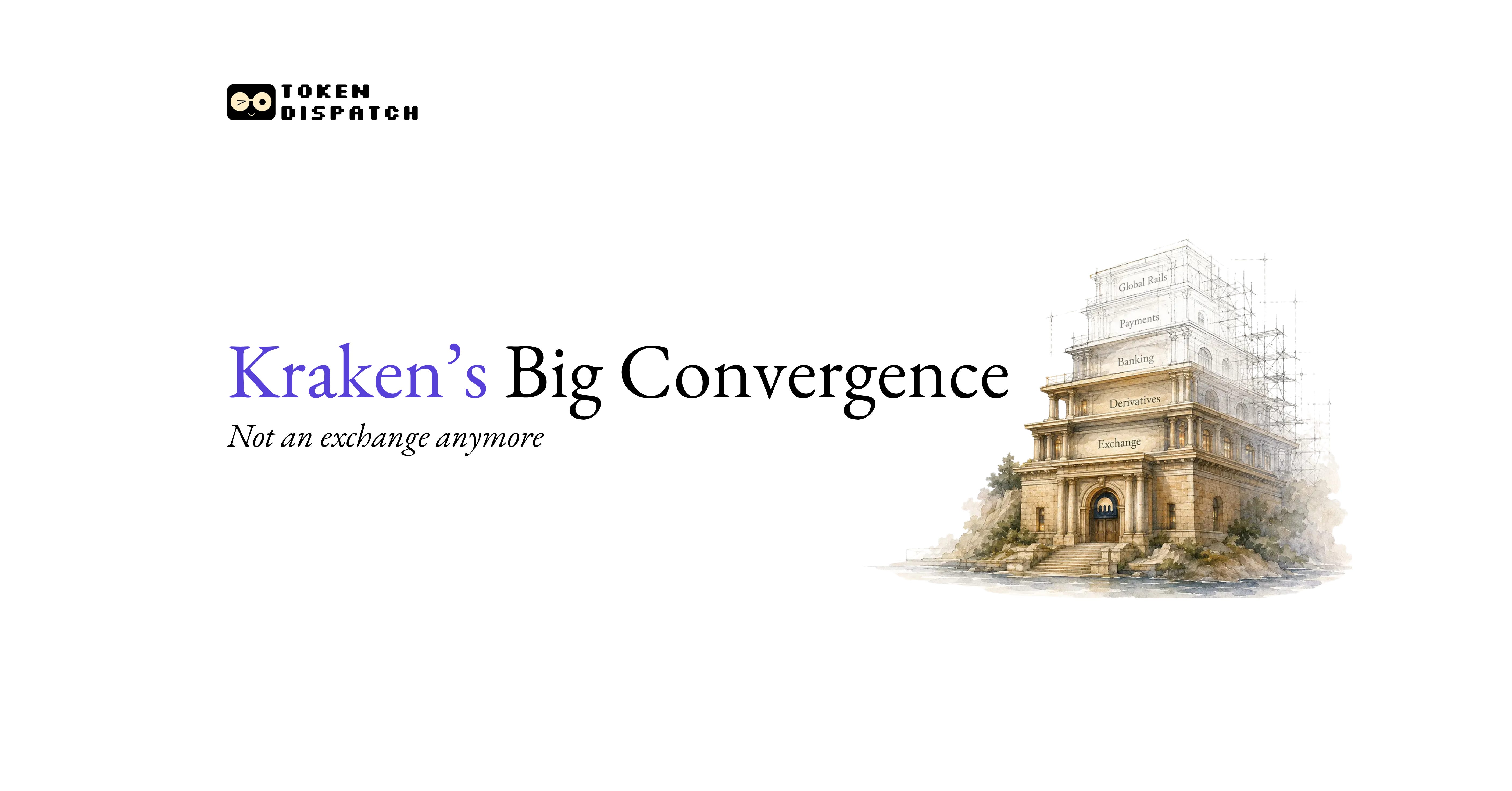
A true full-stack move is a system optimising so relentlessly for dominance that it completely sheds its original category, just as Google outgrew its simple search box to swallow the internet’s entire infrastructure.
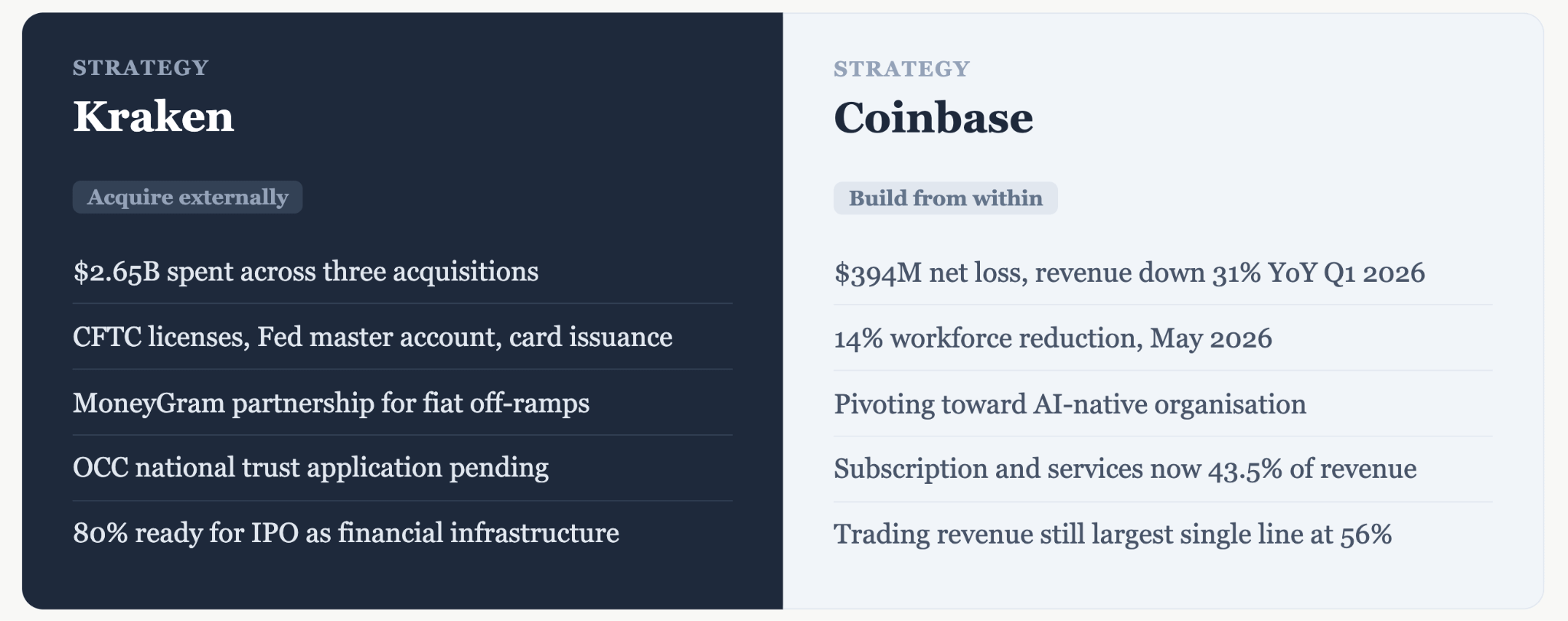
Kraken has been doing this. They started with an exchange at the base. Then they built a CFTC futures brokerage. Next thing you know, they’re the only crypto-native firm holding all three major CFTC licenses.
The stack is nearly complete, and the IPO is reportedly 80% ready. Watching a crypto company build an empire like a Bond villain is exactly why I wanted to talk about this today.

The Shopping Spree
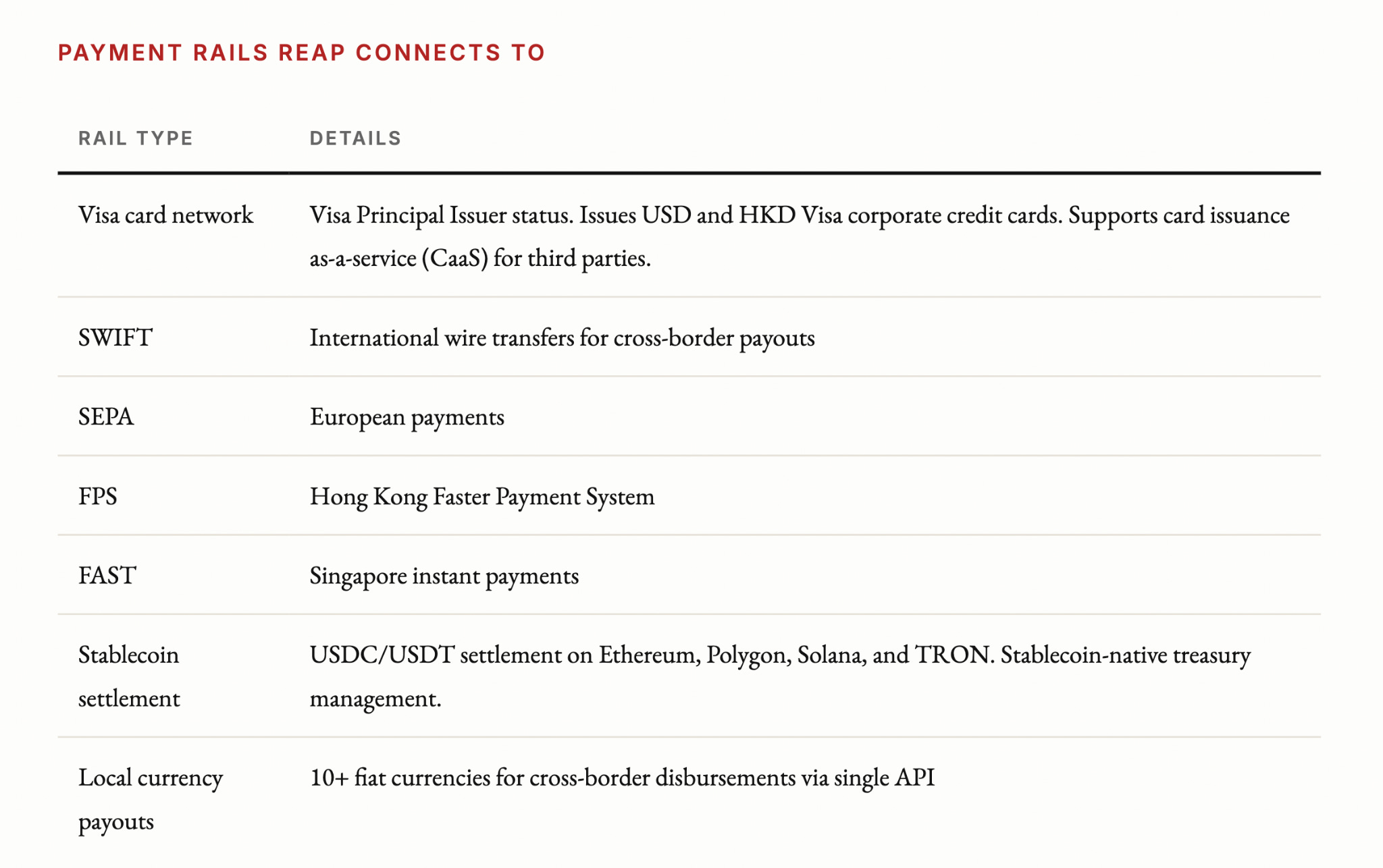
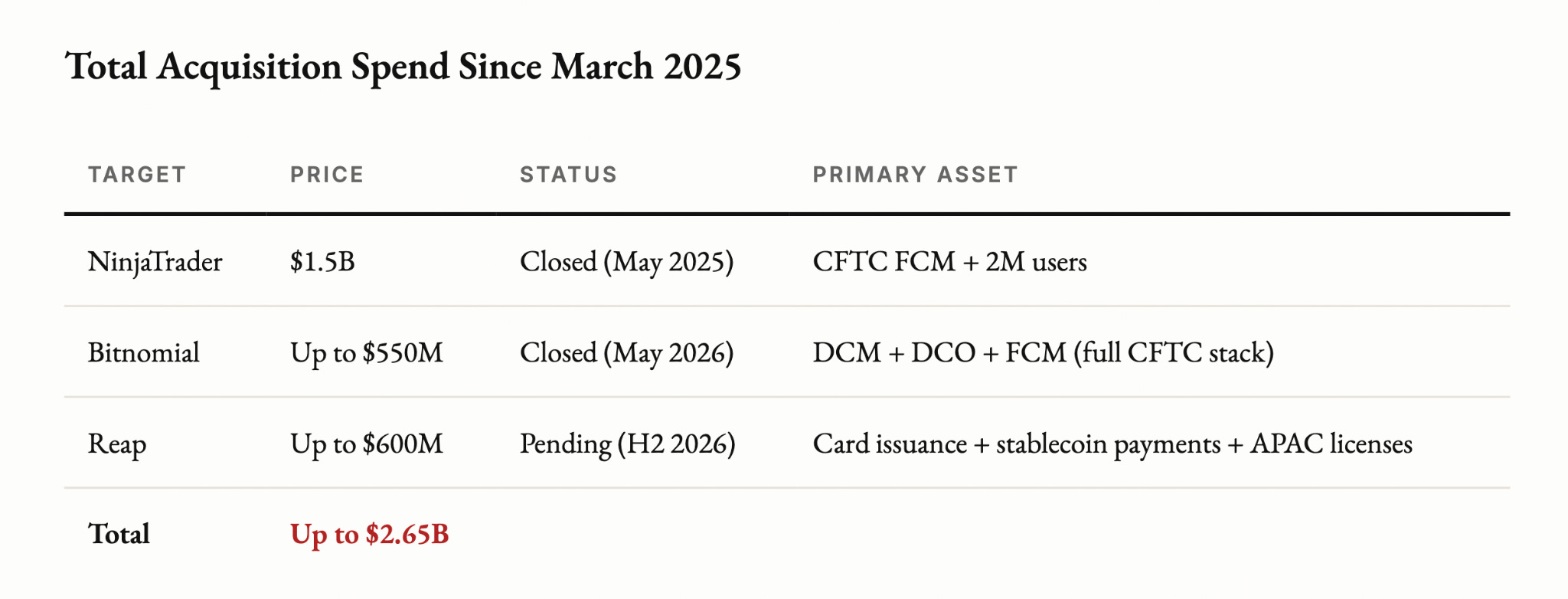
March 2025: Kraken kicked off its buying spree by dropping $1.5 billion on NinjaTrader. The public headline focused on acquiring a futures platform, but the prize was a coveted CFTC Futures Commission Merchant license and two million retail futures traders who had never touched crypto. Now registered as Kraken Derivatives US, this move has given Kraken an entirely new demographic of advanced traders accustomed to charting and automated strategies.
April 2026: Kraken spent $550 million to buy Bitnomial in a lightning-fast 14 days. The acquisition handed them the only crypto-native firm holding a full trifecta of major CFTC licenses. Bitnomial had also launched the first-ever CFTC-regulated perpetual futures in April 2025. They instantly absorbed exclusive infrastructure, including pioneering regulated perpetuals and unique margins. By closing the deal in two weeks, Kraken effectively bought four years of gruelling regulatory warfare.
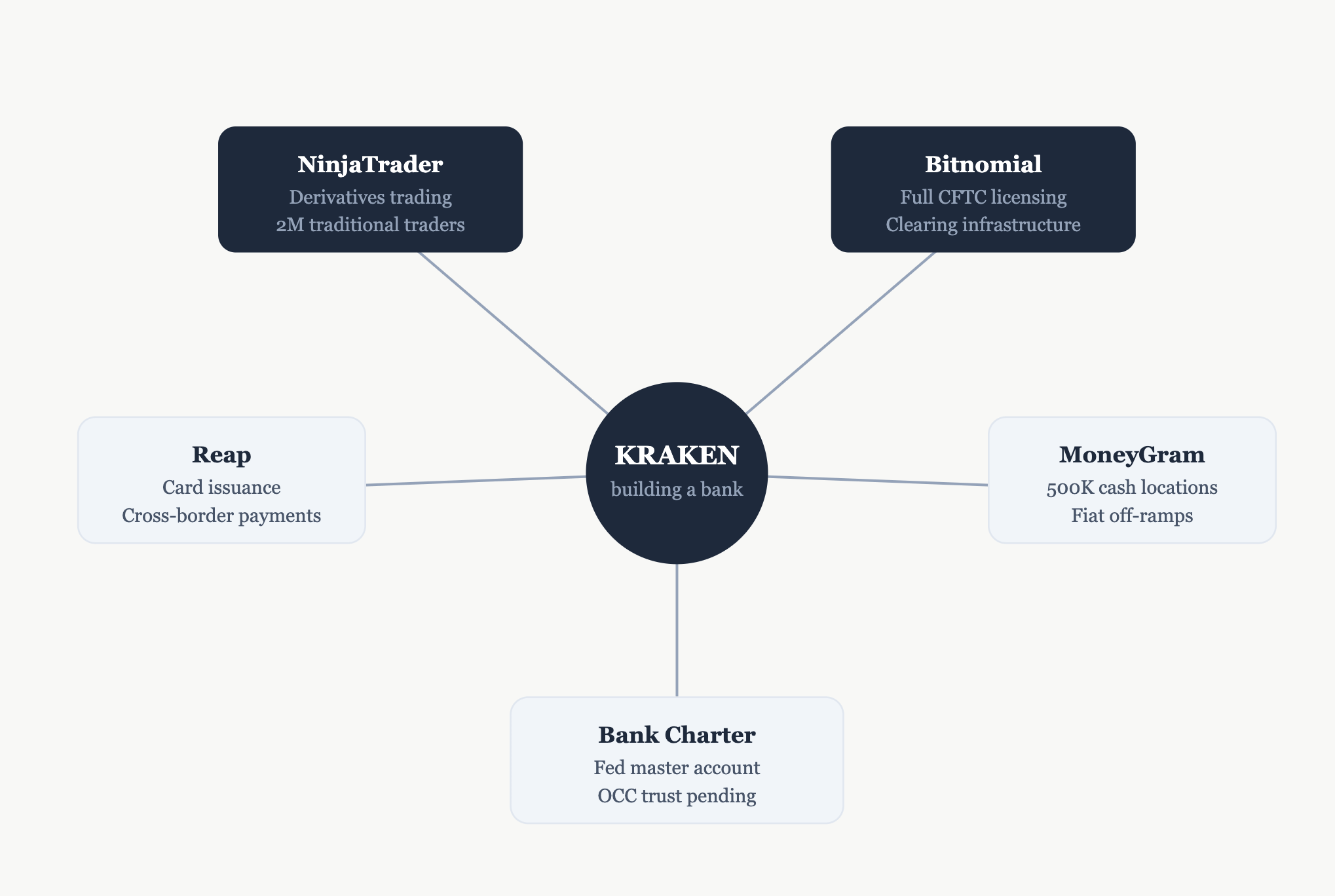
May 2026: Kraken announced up to $600 million for Reap Technologies, expected to close in the second half of the year. Reap is a pure global payment infrastructure, holding a Monetary Authority of Singapore Major Payment Institution license, Visa Principal Issuer status, and payment licenses in Hong Kong and Mexico.
It hooks directly into global rails such as SWIFT, SEPA, Hong Kong’s FPS, and Singapore’s FAST network, allowing it to issue Visa cards without a sponsor bank while settling in stablecoins on Ethereum, Polygon, Solana, and Tron. Having tripled its revenue and volumes in 2025, Reap gives Kraken immediate, bankless payment rails across Asia and Latin America, with an expanding footprint in MENA.
May 2026: Kraken locked down a massive distribution layer by partnering with MoneyGram. MoneyGram commands 500,000 physical cash pickup locations worldwide, serving as the primary financial lifeline in regions where people completely lack bank accounts. The integration allows crypto users to convert their digital assets and walk out with physical fiat currency at any of these half a million global locations.
It gives Kraken immediate, planetary-scale fiat rails that bypass traditional electronic banking systems entirely.
March 2026: Kraken Financial became the first digital asset bank in US history to secure a Federal Reserve master account, gaining direct access to Fedwire without a correspondent bank after five years of sustained regulatory engagement.
Then, on May 8, 2026 (exactly one day after Coinbase reported its Q1 results), Kraken pushed its banking play even further by filing an OCC national trust application for a federally regulated qualified custodian. Securing a federal charter that grants them the legal authority to take deposits, hold customer money, and issue loans, placing the firm on the exact same legal footing as JPMorgan.
Total spend since March 2025 is up to $2.65 billion. And the implied equity valuation from the Bitnomial and Reap deal terms is $20 billion.
Let’s go back to the MoneyGram partnership announced on May 5.
MoneyGram’s 500,000 cash locations are predominantly in emerging markets. Africa. Latin America. Southeast Asia. Places where people don’t have bank accounts but do have smartphones. Kraken users can now withdraw crypto as cash in hundreds of fiat currencies across more than 100 countries through MoneyGram’s physical retail locations. Kraken handles KYC. MoneyGram provides the licensed money transmission rails. That is phase one.
Phase two is cross-border remittances.
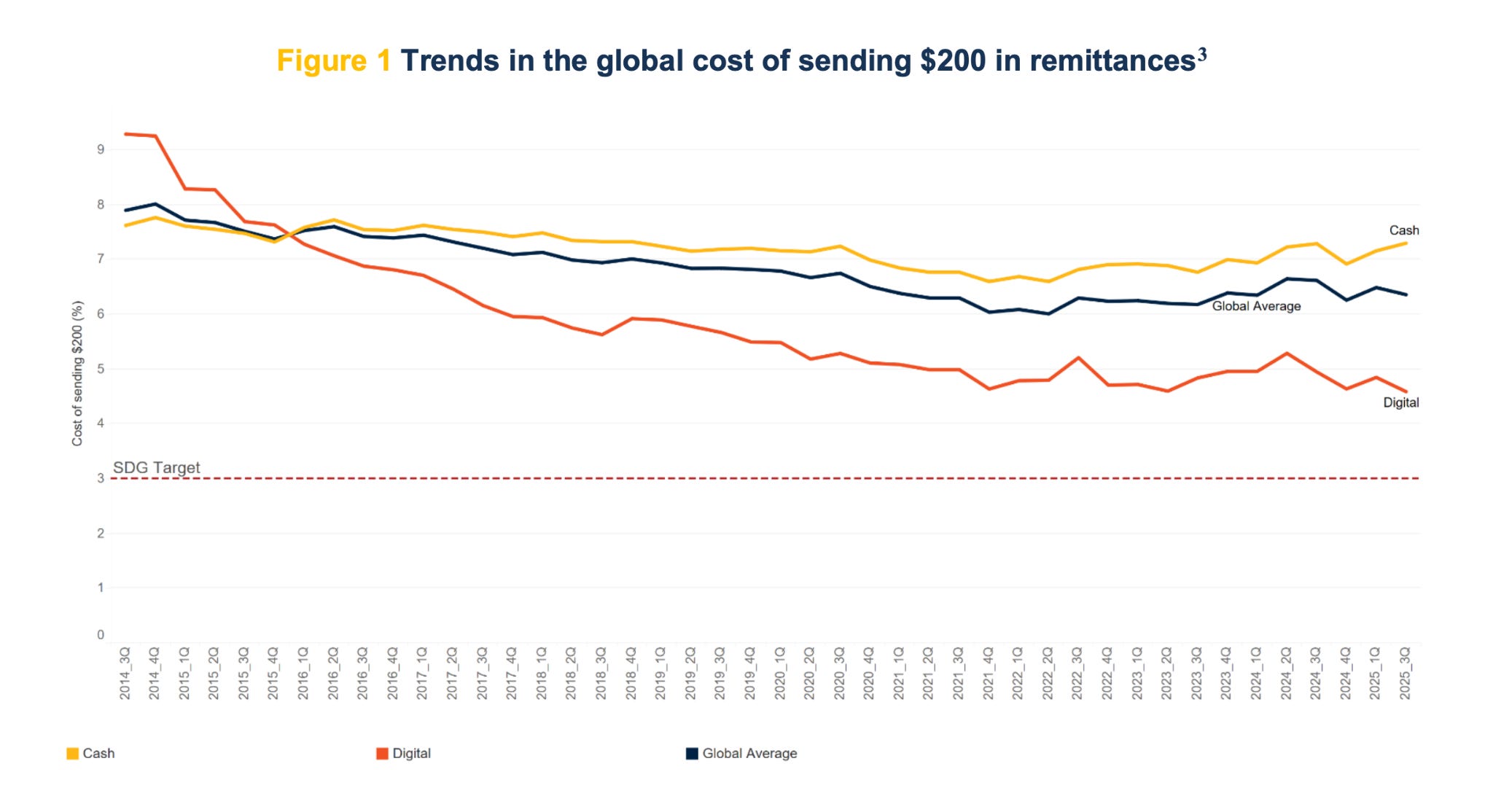
Talking about which, Global remittance flows were $905 billion in 2024. Sending $200 costs an average of 6.49% of the transaction value as of Q1 2025, per the World Bank. That figure has fallen from 9.67% in 2009 and remains more than double the UN’s 3% target for 2030. Banks charge an average of roughly 14.55%. Digital-only providers average 3.55%. Latin America’s remittance market alone is estimated at $174 billion, and stablecoins already account for 40% of crypto purchases in that region.
Kraken’s co-CEO, Arjun Sethi, told Fortune that customers in countries with more volatile currencies use Kraken like a bank already. They want to store in USD. They want yield. MoneyGram gives those customers a way to get cash in their local currency.
The same week Kraken confirmed 80% IPO readiness and announced the MoneyGram partnership, Coinbase had a bad week.
Q1 2026 revenue came in at $1.41 billion, down 31% year over year. The net loss was $394 million, driven largely by $482 million in unrealised losses on crypto assets. Trading revenue was $756 million, down 40% year over year. Fourteen per cent of the workforce, roughly 700 people, was cut two days before earnings dropped.
CEO Brian Armstrong tried to shift the narrative, framing the layoffs as a necessary evolution toward becoming an “AI-native” company. His argument is that billions of future AI agents will inevitably require blockchain-based financial rails, and Coinbase intends to be that underlying plumbing.
To be fair, Coinbase’s subscription business is growing at a massive clip. Stablecoin revenue alone now pulls in $305 million per quarter, which is nearly seven times their entire subscription revenue from the year they went public. The problem is that trading fees still make up 56% of their net revenue. Because of that heavy reliance, the company remains stubbornly tethered to volatile crypto market cycles.
When Coinbase dropped its S-1 filing back in February 2021, transaction fees accounted for 96% of net revenue, while subscriptions accounted for a tiny 3.9%. They were effectively a one-product shop serving a single type of user. They have spent the past five years aggressively trying to diversify from the inside out, stacking on stablecoins, derivatives, and prediction markets, all while trying to stabilise a core business that still violently swings with the market.
Kraken is taking a completely different route to its IPO. Instead of building from scratch, they spent billions to buy up ready-made, heavily regulated infrastructure that took other companies years to develop. Public markets will eventually decide whether this kind of bought infrastructure is more durable than a homegrown ecosystem.
When Robinhood went public in 2021, it filed as a brokerage. When Square went public in 2015, it called itself a payments company. This corporate framing dictates your valuation multiple. Financial infrastructure companies trade at premiums that differ markedly from those of simple consumer apps. The way a company describes itself on page one of an S-1 is the most expensive sentence it will ever write.
Kraken’s confidential November 2025 S-1 is currently paused, but when it reopens, it will undoubtedly pitch “financial infrastructure.” They have assembled an undisputed vertical: exchange, derivatives, clearing, card issuance, stablecoin payments, global settlement, and banking. This explains the implied $20 billion valuation from recent deals, pricing them at roughly 10x projected 2025 revenue. Investors are paying a premium because they are buying a unified infrastructure stack.
I started this newsletter with Nick Bostrom’s Superintelligence because I do believe the core challenge of AI, ensuring a powerful system does exactly what we want it to do, mirrors the grand struggle of crypto. The problem is the clarity of the instruction.
Kraken flipped this dynamic. In an industry that spent a decade arguing with regulators and hoping the rules wouldn’t matter, Kraken got incredibly specific about what they needed, then spent years doing the deeply gruelling work to get it.
That level of discipline is exceptionally rare in this space. It highlights a massive ideological divide that will define the next decade of finance: do you build a shiny app first and figure out the infrastructure later, or do you accept that the infrastructure is the product?
The upcoming IPO will slap a dollar amount on this corporate empire. The legacy will still be how this shifts the mindset of everyone else watching. Kraken made a definitive choice to build the foundational rails.
Personally, I think it’s the right call.
The rest of the industry is about to find out if they have the stomach to copy it.

Token Dispatch is a daily crypto newsletter handpicked and crafted with love by human bots. If you want to reach out to 200,000+ subscriber community of the Token Dispatch, you can explore the partnership opportunities with us 🙌
📩 Fill out this form to submit your details and book a meeting with us directly.
Disclaimer: This newsletter contains analysis and opinions of the author. Content is for informational purposes only, not financial advice. Trading crypto involves substantial risk - your capital is at risk. Do your own research.