


We confuse knowing something with being able to explain it. If someone can put their knowledge into words, we recognise expertise.
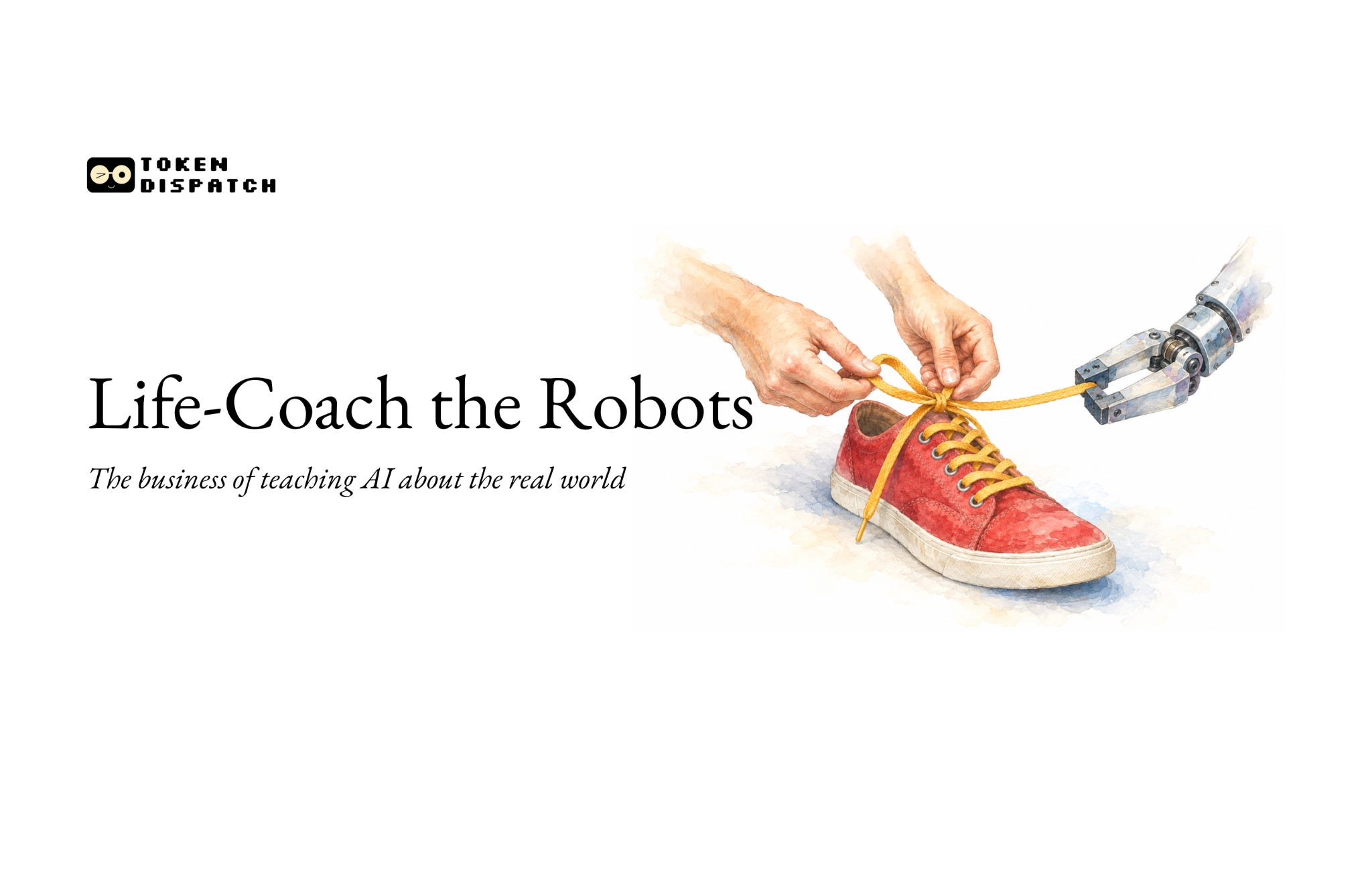
You can tie your shoelaces without thinking much about it. But explaining every finger movement to someone else is tough and confusing. You know how to do it, even if you struggle to put it into words.
AI has made that problem commercially valuable. Much of what people could easily explain is already available in books or online. Getting at the knowledge expressed through their actions requires a different arrangement. Someone has to persuade them to demonstrate it and capture enough of what happens. They need to work out whether a machine can learn from the result.
We are discovering a market for knowledge that rarely received much recognition. But does this mean the people who possess it will get a good price?
Physical AI is a newborn. Annoying, a little innocent and mostly clueless. They desperately need more information on mundane things, and they have no character arc to build over years. It has to be now.
Companies are building businesses around different parts of that process, with consequences for who owns human experience once it becomes training material.
Today we are looking at those working on teaching AI how to fold a T-shirt and the sustainability of that work.

StablesReward: Your AI Agent Spends, You Earn
AI agents can surf the web, read reviews, and book hotels for you. All these tasks cost money. But what if these tasks could earn you back something?
StablesReward does just that. Once you connect your agent to an MCP endpoint, it gives your agent a menu of paid tools. Every call your agent pays for earns you miles or stocks. And this is in addition to the rewards you earn anyway on your own spending across 800+ merchants.
Every purchase pays you back. The best part is that you can choose how you’d like to be rewarded. Transfer miles to airlines and hotels, or let your stocks build a portfolio from the spend you were making anyway.
Launching soon. Free to join.
In his 1988 book Mind Children, the roboticist Hans Moravec noted that it was fairly easy to get a computer to perform like an adult on an intelligence test or at checkers, and close to impossible to give it the perception and movement of a one-year-old.
This became known as Moravec’s paradox.
In July 2025, systems from Google DeepMind and OpenAI reached gold-medal level at the International Mathematical Olympiad. Meanwhile, robotics companies still post videos of a robot folding a T-shirt as evidence of progress.
How to fold a t-shirt as a human?
Lay the cloth flat on a table. Smooth out the wrinkles with your hands. Pick up the two corners nearest you and bring them to the corners on the other side. Put them down together. Smooth the cloth again, then fold it in half once more. Now it is folded.
You can find a corner without looking. You know whether you’ve grabbed one layer of fabric or two. If you notice a sleeve is inside out, fix it by shaking it out. Nobody ever wrote these steps down because nobody needed to.
Chelsea Finn, a co-founder of Physical Intelligence, has described an early laundry model that worked well on a controlled set of shirts but failed when it encountered a mixed pile.
This is the issue people are now paying to fix. Language models had a giant pile of human writing on the internet, produced for other reasons and easy to scrape. Ken Goldberg, a roboticist at UC Berkeley, estimates that the text and images used to train today’s big vision-language models work out to roughly 100,000 years of human experience when converted into time. Robots have nothing close to that for physical work. YouTube is full of people cooking and cleaning, but a video shows what hands look like, not how hard they grip or what a robot’s own camera and joints would register.
For example, there are so many types of bottle caps. Is there a tutorial video on how to open each one of them? How much pressure to apply, pull up or twist. Is there a course? no.
When Tesla shifted Optimus training towards mostly video in mid-2025, an outside researcher pointed out this missing sense of touch and contact.
Simulation helps, but not always, because if it’s a cloth, for example, it changes shape every time you touch it. In a 2024 study, researchers trained a system to find the corners of towels and T-shirts using only synthetic images. It reached 64% precision, climbed to 74% after fine-tuning on real photos, and the authors concluded that simulated cloth still needs to be much more realistic. Synthetic data also needs a judge. A simulator can produce a million folds, but a person still has to tell which of them count as folded.
Kled pays people to collect photos, videos and audio for AI companies. Its app shows tasks, such as filming an everyday activity, with instructions and payment details. Kled checks submissions, pays for accepted work, and sells access to datasets that AI companies use to train and improve their AI models. Kled can send a notification to people who are already standing in their kitchen, and with V3 it says it can steer contributors to specific jobs.
Late in September, Kled changed what you see when you open its app.
The old home screen was one big button for uploading whatever was already sitting in your camera roll. The new one is a feed of jobs, with the pay shown before you start. Kled says it can now push a request like that to more than 500,000 contributors and start getting data back within 72 hours.
Kled belongs to Nitrility Inc., a San Francisco company Avi Patel started in 2025. You upload files, Kled pays you, and Kled licenses them, cleaned up and packaged into datasets, to companies training models.
Patel has written that bigger rivals keep roughly a third of every dollar, which makes his own cut an obvious thing to ask about.
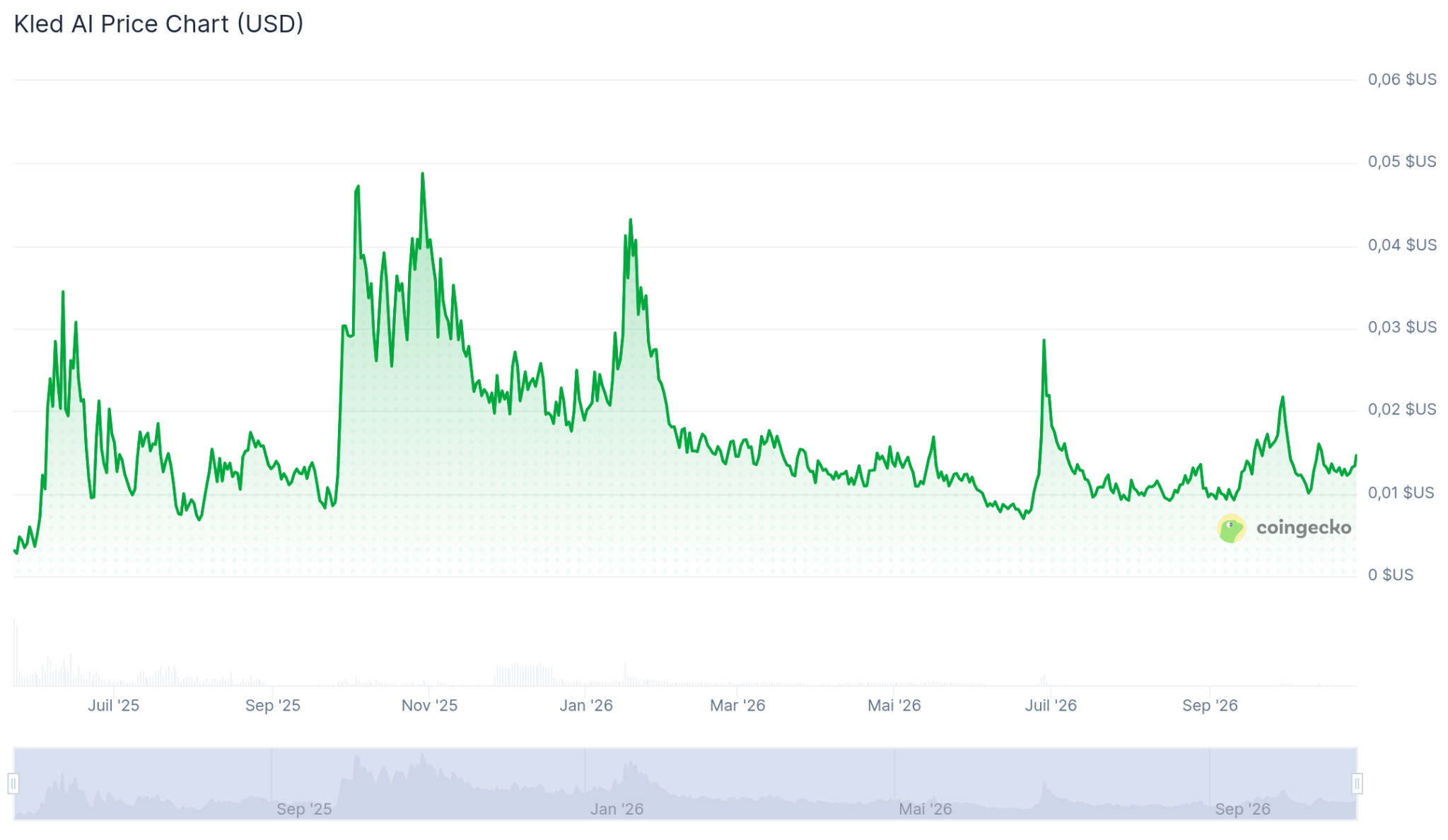
Contributors are paid in dollars through PayPal, Venmo or a Solana wallet. There’s also a KLED token on Solana, with a market value of about $10 million. This is small for a network claiming 500,000 contributors. KLED isn’t equity and gives holders no claim on company assets. The company can buy back tokens at its discretion. Kled does not claim labs must buy the token, and most contributors are paid in dollars.
It claims more than 500,000 contributors and about 8 million datapoints a day, and earlier this year it said it had paid out millions and had over $30 million of buyer demand in the pipeline.
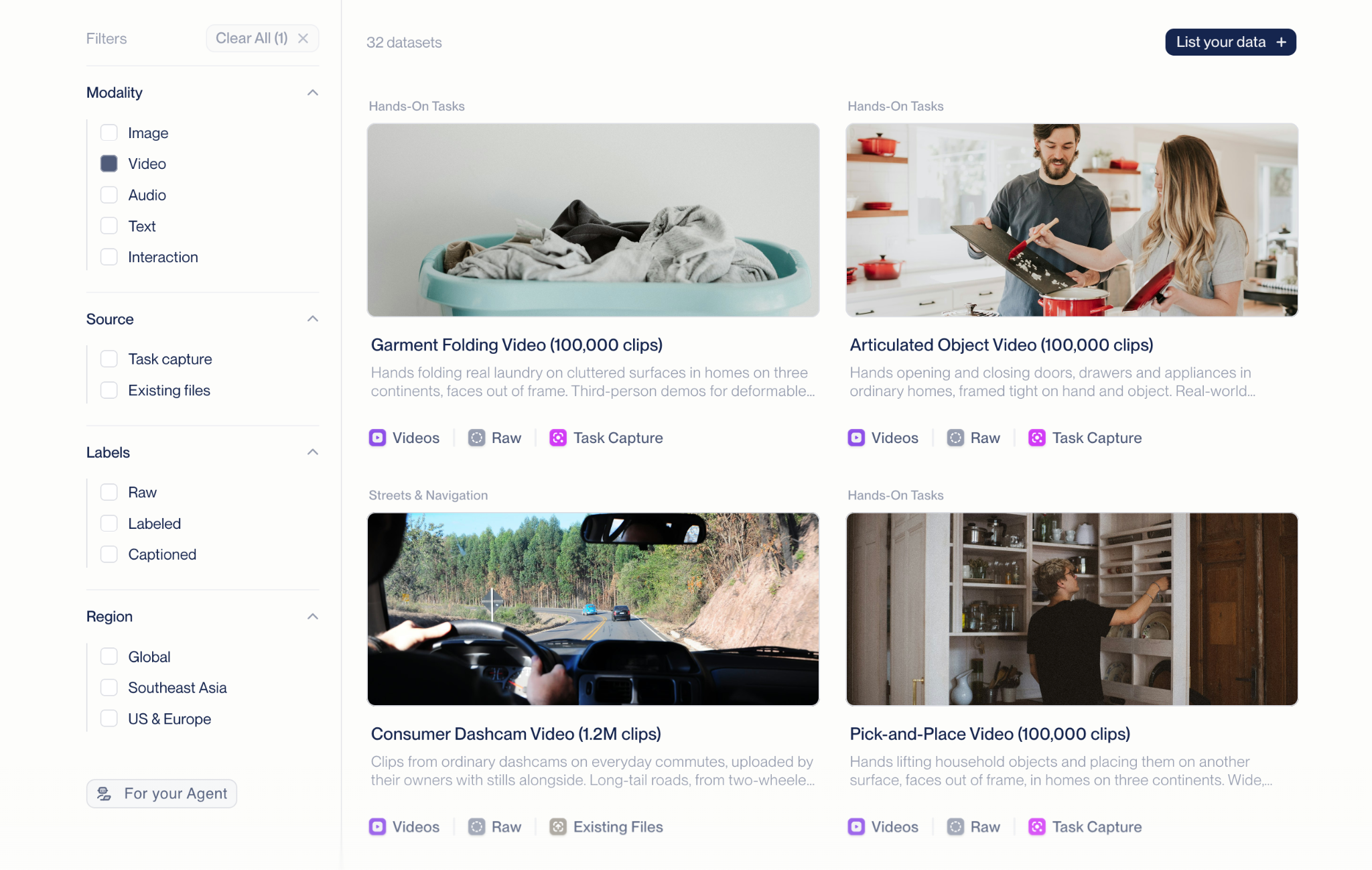
What people earn is murkier. App Store reviewers complain about getting a dollar for a hundred photos, and Kled’s replies say pay isn’t fixed and depends on how unique the upload is and what buyers want. Kled has also said its top contributor was making around $7,400 a month.
Public materials do not establish a standard contributor share of customer revenue or a reliable average hourly income.
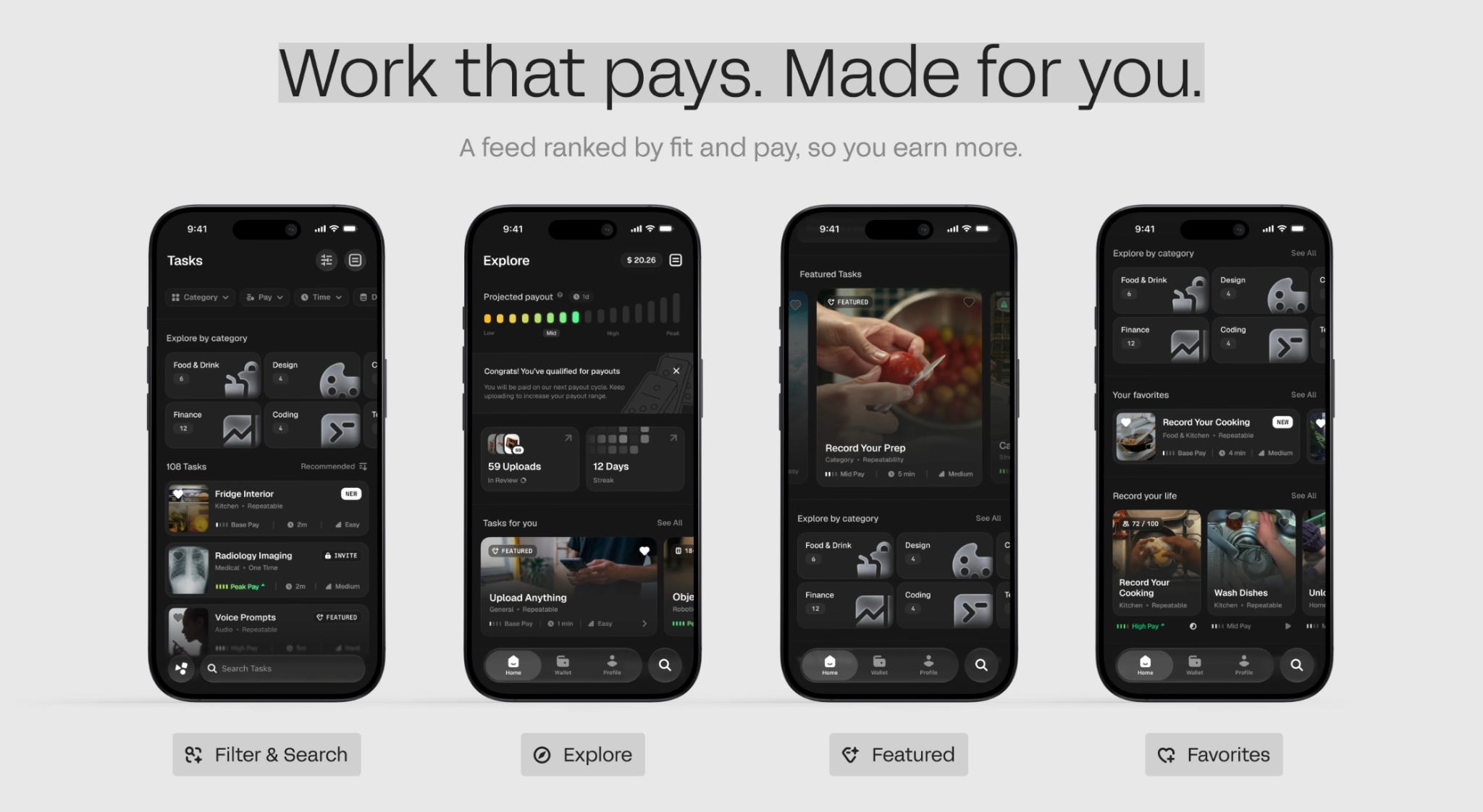
Kled’s terms say contributors retain ownership, while granting a perpetual, irrevocable and transferable licence. That licence is exclusive for specified uses involving third-party AI development and training. Keeping ownership therefore does not mean being free to license the same material to another AI data buyer. The terms also put responsibility for necessary permissions on the contributor. A home recording can still contain someone else’s personal information.
San Francisco startup PrismaX focuses more directly on robot training. PrismaX raised $11 million in 2025 in a round led by a16z’s crypto accelerator.
One way it collects this data is by having a person control a robot remotely. This is called teleoperation. The person might guide a robot arm to pick up a cup and place it in a bin. During the task, the system records both the camera footage and the robot’s movements. Those recordings help a model learn which movements to make based on what the robot sees.
A Kled video of someone tidying a room can show the actions involved. A recording made by controlling a robot also captures the commands used to move its arm and gripper. That gives the model information about how the robot performed the task, beyond what is visible in the video.
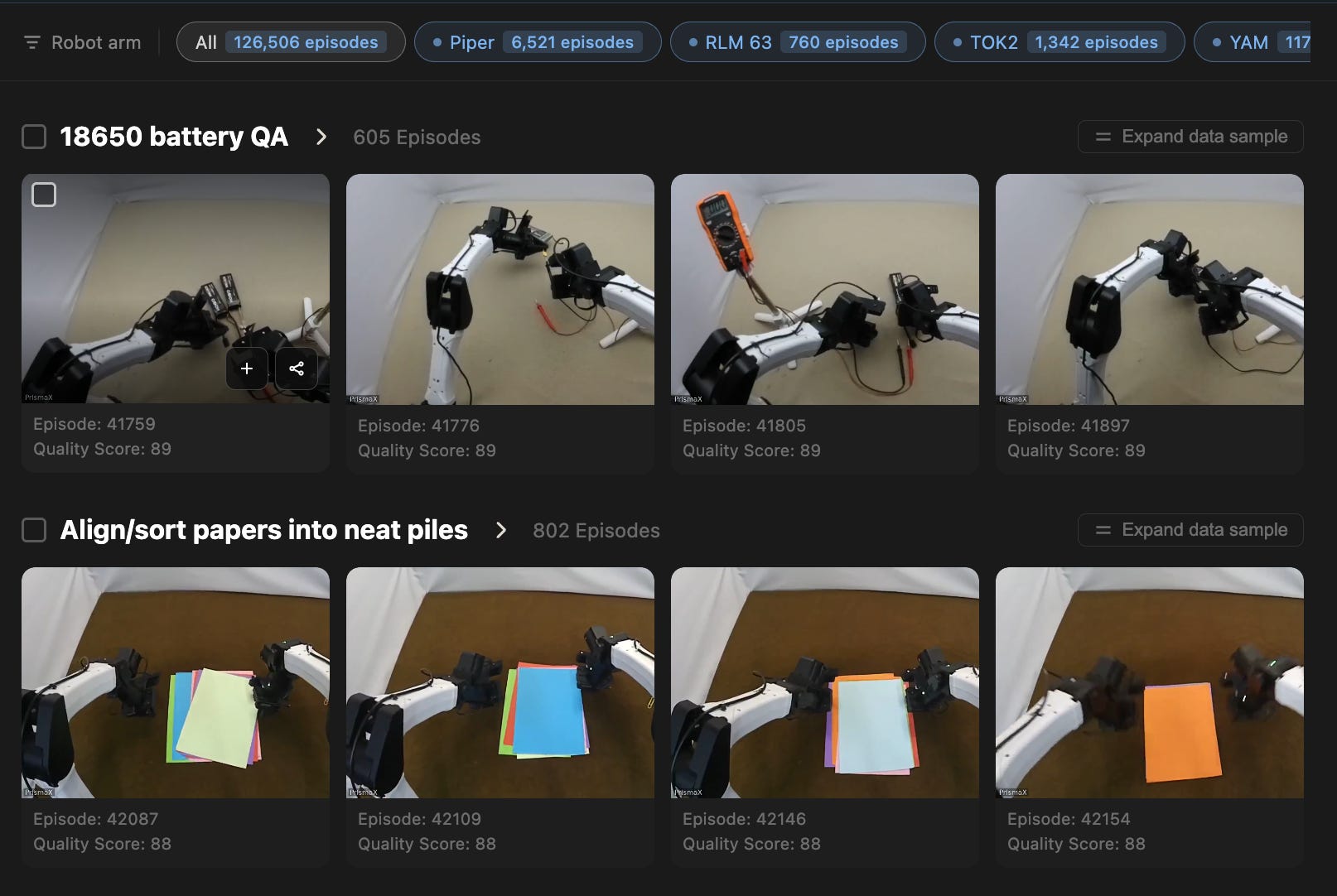
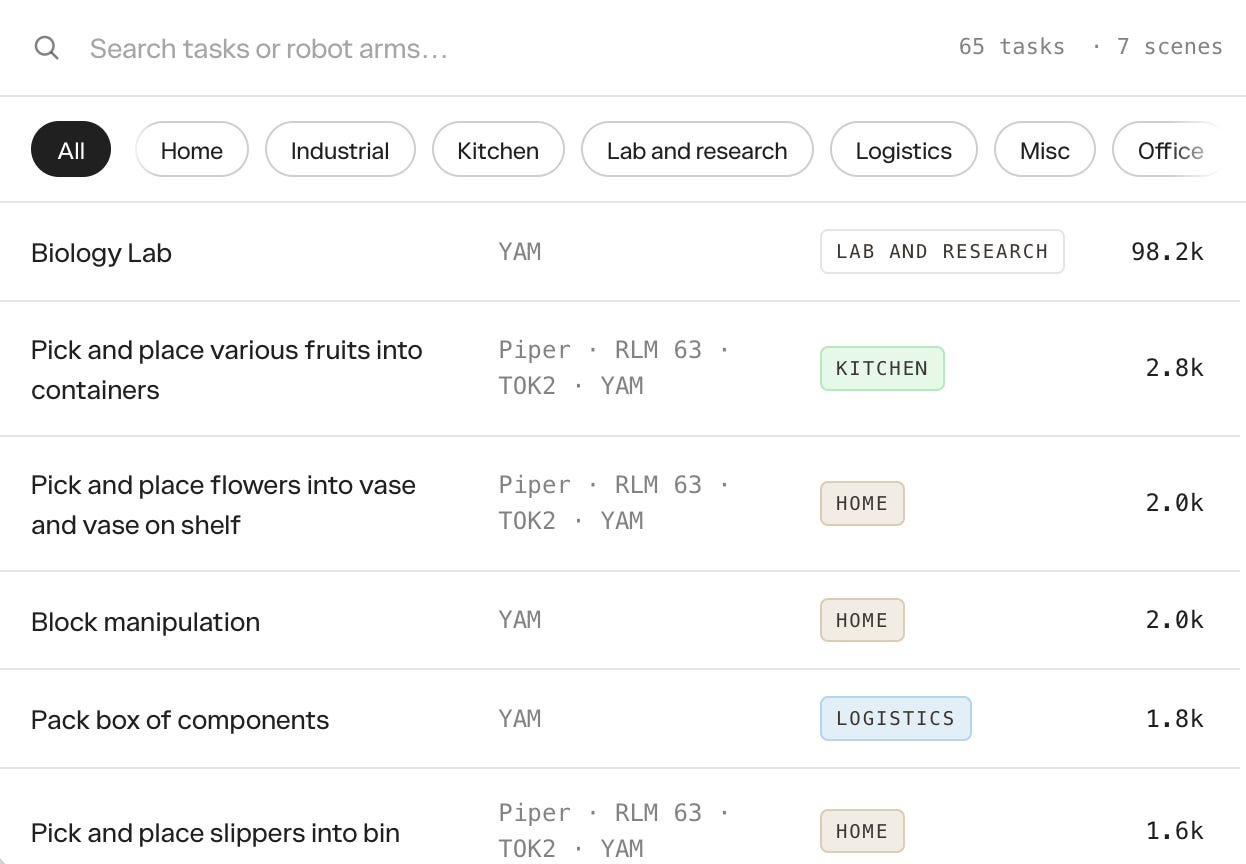
PrismaX claims more than 120,000 episodes delivered and capacity for 5,000 hours of custom data a month, and says it has paid contributors over $1 million.
Robot owners run sessions on their own hardware and get paid per valid session. It’s also opening first-person video collection, paying for clips that meet its “Operator Intent standard”. Every upload carries the serial number of the registered robot that produced it, and the main camera feeds go through QA and duplicate checks.
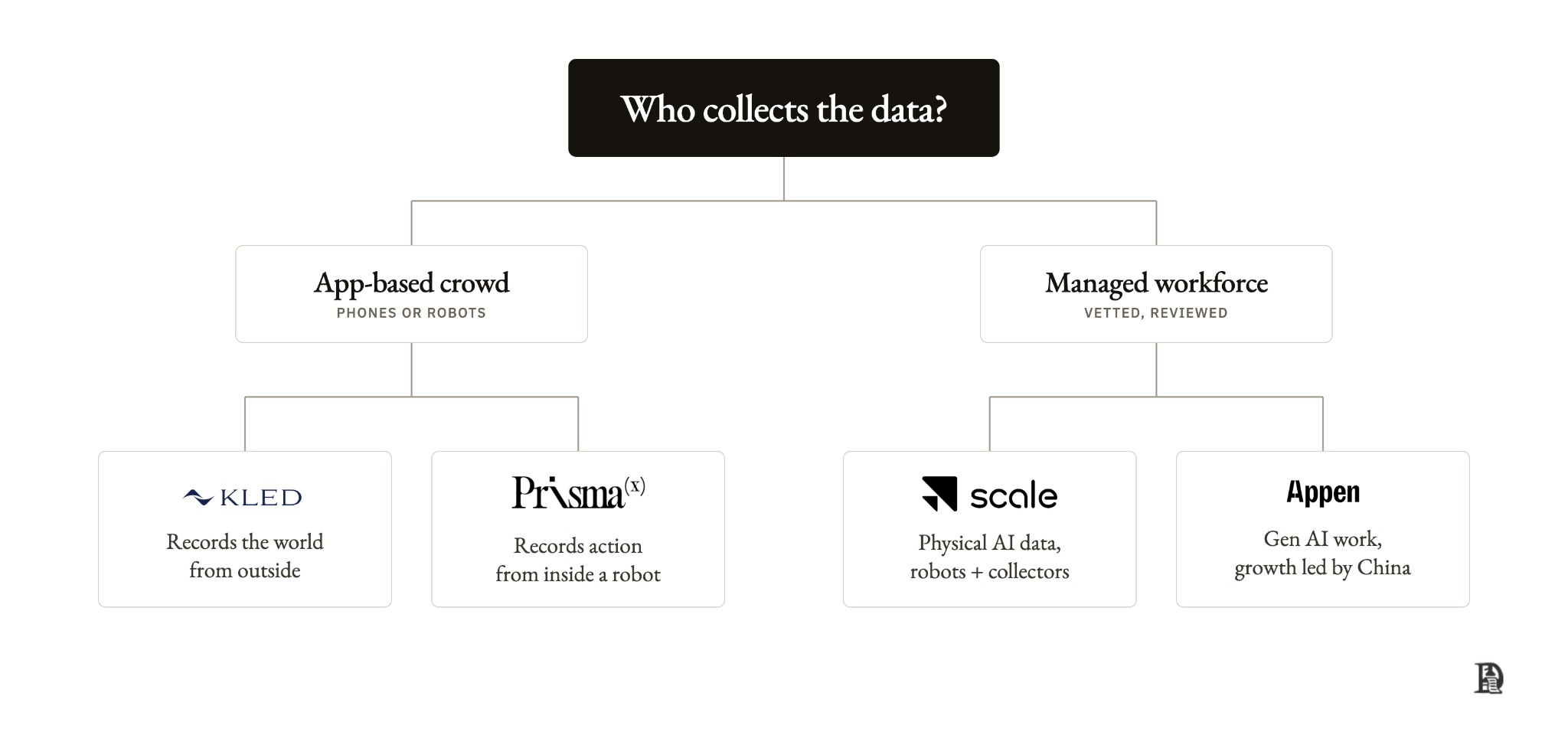
Kled mostly captures the world from the outside, which it can do cheaply and in bulk. PrismaX records action from inside a machine, which is slower and costs more because every session needs a robot. The two are also drifting towards each other. Kled’s V3 asks for first-person video of people reorganising rooms, and PrismaX’s video waitlist accepts smartphones.
These are early-stage products, and established names are already doing the same thing.
Scale AI records people steering robots through tasks. It also has what it calls a “robotless egocentric platform”, which records a task from the person’s point of view, with no robot involved. Its customers include robotics companies Generalist and Physical Intelligence.
Meta bought a 49% stake in Scale in June 2025. Scale says it delivered more than 150,000 hours of physical AI data that year. Its website says it now collects more than 1,000 hours of demonstrations a day from people’s homes and commercial and industrial sites.
Appen also collects recordings of people doing physical tasks. It adds information explaining what happens in the footage, such as how a person’s hands move and whether an object has been picked up or put down. These details help turn a video into material a robot can learn from.
Appen reported $230.8 million in operating revenue for 2025 across its business, not just robotics. Its business outside China fell about 21%, while growth in China helped lift overall revenue. Rising demand for AI training does not benefit every part of a data supplier’s business equally.
Some familiar tasks, such as labelling objects in images, can now be partly automated. At the same time, customers are buying work that requires different skills, such as checking a legal answer or recording a useful robot demonstration. A company can have thousands of contributors and still lack the people or equipment needed for a new contract.
Suppliers can also lose work that remains valuable. Google ended its Appen contract in 2024 and said the quality-rating work would move to other providers. That customer generated $82.8 million for Appen the previous year.
This matters for Kled and PrismaX. Building a large contributor network gives them people to call on, but buyers need particular kinds of data. Their prospects depend on how quickly they can organise the right collection work and prove that it meets the customer’s needs.
Reaching more contributors could make collection easier for Kled and PrismaX. They would still need to make sure the recordings are useful. Scale already uses homes and workplaces to collect data. That’s not the moat anymore.
Even DoorDash now pays couriers to record tasks such as washing dishes for AI training.
A more lasting advantage would be knowing what a customer’s robot struggles with and reliably collecting demonstrations that help it improve. That knowledge could grow with each project, as a supplier learns which recordings work and which contributors can produce them.
NVIDIA’s AdaDemo research supports the idea of targeting those weaknesses. The researchers collected additional demonstrations for situations where a robot struggled. Across 22 simulated tasks, this approach improved performance more efficiently than the methods they compared it with.
But better human demonstrations are only one way to improve a robot. NVIDIA’s SPARR research explores another. It trains robots on assembly tasks in simulation, then lets them practise on real hardware to correct mistakes, without human demonstrations. NVIDIA reports higher success rates and roughly 30% shorter task completion times than using the simulation-trained system directly.
Does that make Kled or PrismaX unnecessary? Not really. For a particular task, buying demonstrations might help a customer improve its robot more cheaply or quickly than collecting its own data or training through simulation and practice. Neither company’s contributor count nor hours of footage tells us whether it can deliver that advantage.
Even when a data supplier wins a customer, it may have to wait weeks to get paid. Meanwhile, contributors need to be paid, and the next collection project needs funding.
Other industries already have ways to cover this gap. Citi, for example, runs a programme that lets Walmart’s suppliers receive payment early. Once Walmart approves an invoice, the supplier can ask Citi to pay it before the due date, accepting a deduction for receiving the money sooner. Walmart pays Citi when the bill falls due.
That is how an agreed customer payment can help fund a supplier’s ongoing work. But there’s a big distinction for AI data businesses. With Citi, the buyer has already approved payment. A data supplier whose work is still being checked could face rejection.
Financing that earlier stage requires more than knowing that the buyer has money. A lender needs to understand what the lab ordered and whether the supplier’s recordings meet those requirements.
Masterpiece is a small startup trying to serve this particular market. Backed by Y Combinator, it says it lends to AI data suppliers while labs review their work and process payments.
Masterpiece says it checks a supplier’s invoices, past payments, data quality and finances before deciding whether to lend. Approved suppliers can receive money within two to four days. It reported securing a credit line of more than $10 million to fund loans and lending $200,000 at a reported annual yield of 24%. It also reported more than $65 million in signed letters of intent, which indicate potential business rather than completed loans. We have no public information about the borrowers yet.
It is still early. That makes it an example of lenders exploring this business, but it’s still too early to judge how well they can manage the risks.
Masterpiece says it gets lending money from banks and private credit funds, as well as a stablecoin pool called USDml. Crypto users can deposit stablecoins into that pool, which targets an annual return of 8% to 12%. That return is not guaranteed.
Masterpiece says the pool helps meet its “haircut capital requirements”. This usually means covering the portion of a loan that the main lender will not fund. Money in that position can absorb losses before the main lender does. If USDml works this way, its depositors could be taking greater risk than the credit fund.
Crypto has financed invoices before, with some familiar problems. In 2023, ConsolFreight warned that its largest borrower in a $2.7 million lending pool on Centrifuge faced liquidation following a legal dispute. That put $1.84 million of MakerDAO’s funding at risk. Moving the financing onchain did not remove the risk that the borrower would fail to pay.
AI data adds another complication when financing happens before the customer accepts the work. Even a well-funded lab can reject recordings that fail its quality checks. If it accepts only part of a delivery, the supplier may receive less money than expected and struggle to repay the loan.
Cheap data can be expensive
A lab that trains on fakes wastes compute and can end up with a worse model, so every company here is selling checking as much as collecting. A 2023 study by Swiss researchers estimated that up to 46% of workers on Amazon’s Mechanical Turk were using AI models on tasks meant for humans. A phone makes faking harder, since a first-person video of your own kitchen is harder to generate than a text summary, but not impossible.
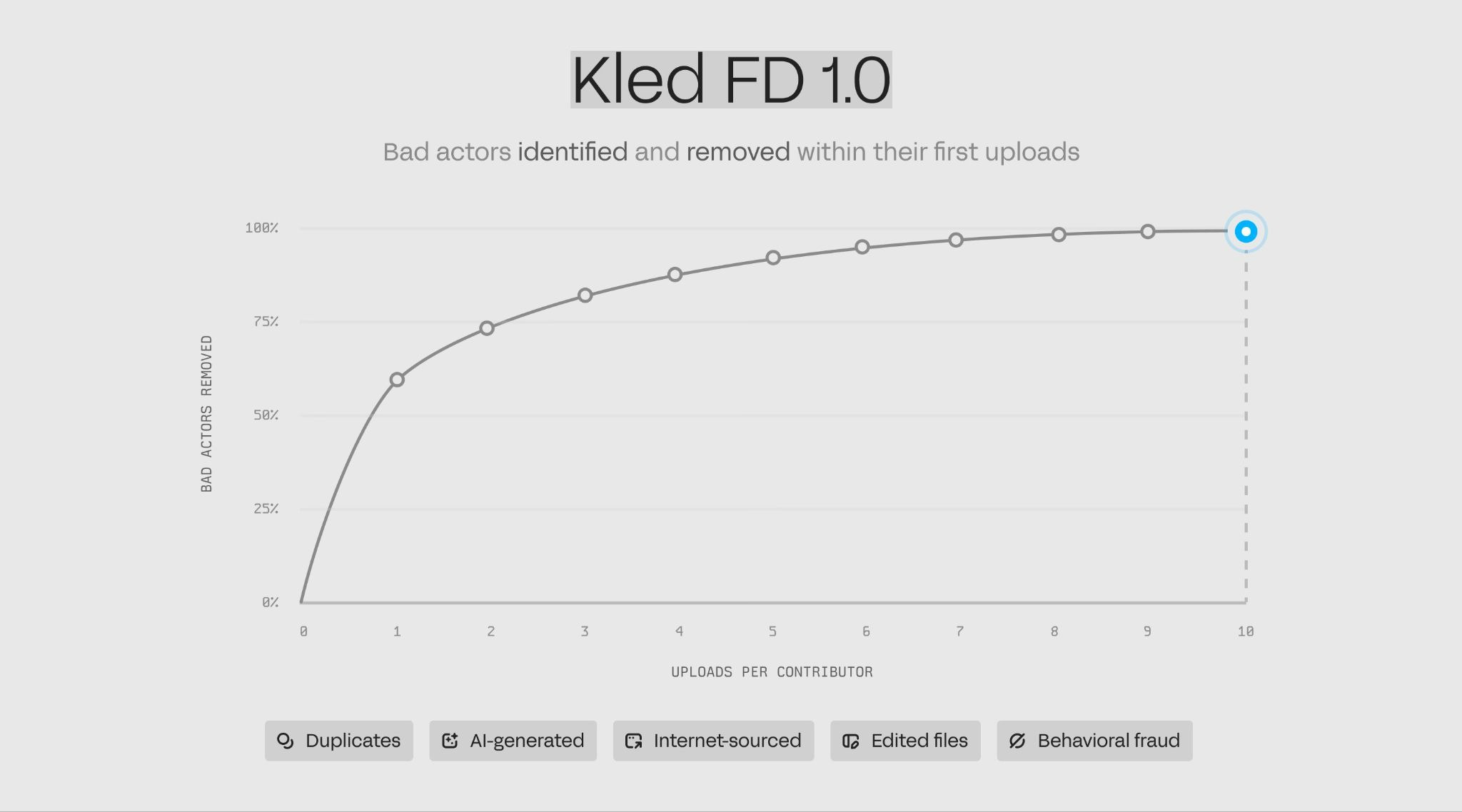
Kled says its fraud model, FD 1.0, removes 98.4% of bad actors within their first ten uploads, a figure from its own internal tests. It also writes a receipt for each accepted file to Trace, a public ledger run by The Data Foundation. I went through Kled’s Trace audit page. It showed about 282 million records, 99.2% of them images and 0.7% videos. Southeast Asia accounted for 74.5% of contributions and Sub-Saharan Africa for 22.7%, with North America at 2% and the EU at 0.4%. Today’s Kled corpus is mostly camera-roll photos from two regions, a long way from the first-person task video robotics labs want.
A recording can still be poor training material. The robot might learn unnecessary pauses from the person controlling it, or struggle because its camera shows a different view from the training footage. What matters is whether the data helps it perform the task better. PrismaX describes testing this by giving Physical Intelligence’s π0.5 model extra training on recordings of a robot picking up and placing objects, then testing changes to lighting and camera position.
There are different ways to check the work. Sapien asks data labellers to put up tokens they can lose if reviewers reject their submissions. NVIDIA and Lightwheel test trained robots in simulation to see how well they perform.
I haven’t found an independent checker that both suppliers and AI labs widely trust. I think a company that earns that trust could charge more for checking data than others earn from collecting it. Lenders like Masterpiece might also rely on its checks when deciding whether to lend.
I think this industry is pricing something real, which is why the price will eventually fall. What Kled or PrismaX pays for a tidied room shows what robots still cannot do, and as they improve, that rate gets cheaper.
For most people, this is a decent side income for now, but not something to build a life around.
Token Dispatch is a daily crypto newsletter handpicked and crafted with love by human bots. If you want to reach out to 165,000 subscriber community of the Token Dispatch, you can explore the partnership opportunities with us 🙌
📩 Fill out this form to submit your details and book a meeting with us directly.
Disclaimer: This newsletter contains analysis and opinions of the author. Content is for informational purposes only, not financial advice. Trading crypto involves substantial risk - your capital is at risk. Do your own research.