


Hello,
Every company treasury must regularly decide where to park spare cash overnight. More often than not, the cash goes into money market funds, Treasury bills, commercial paper or overnight repo.
All these instruments are default options for two reasons: the treasurer knows the rate (of interest) and date (of maturity). Certainty is what makes these instruments work. They let a finance team plan knowing how much interest to expect and over what tenure.
On-chain lending has seldom offered certainty. Rates there float by the hour, which is fine for traders and useless for a treasurer. This is why the biggest market in finance, the $60 trillion world of corporate credit that runs on fixed rates and dates, has stayed almost entirely off-chain.
In today’s story, I explore if Morpho’s new Midnight protocol can change that and make DeFi lending attractive for corporate lending and borrowing.
On to the story…

The Need for Fixed Rates
Companies borrowed roughly $13.7 trillion in 2025, the highest annual figure on record, and about $60 trillion of corporate debt sits outstanding today. This machinery funds factories, acquisitions, and payrolls. It runs almost entirely on fixed rates and fixed maturities, because no business can plan around a borrowing cost that changes frequently.
For a decade, a parallel version of this market has been trying to form on public blockchains. It never made a dent in the traditional instruments for this precise reason. Almost all on-chain lending has been built on floating rates. The interest you earn or pay varies continuously with the amount of the shared pool being borrowed at any given moment. That design works well for crypto traders, which is a niche, limited group. It is useless for corporates.
But why is the on-chain credit market not offering fixed-rate lending and borrowing? It had, on many occasions in the past. But all those who offered fixed rates hit the same wall.
Yield Protocol wound down in October 2023 after peaking near $22 million in deposits. Notional Finance’s TVL climbed above $975 million in November 2021 before falling 90% within two years.
To promise a fixed rate for a fixed term, these protocols asked lenders to lock their money to a chosen maturity up front. That capital then was frozen, waiting for a borrower to take the other side. Much worse, that frozen capital was split across pools with different maturity dates, making liquidity thin in each. Thin markets set bad prices, bad prices drive users away, and the market starves to a slow death.
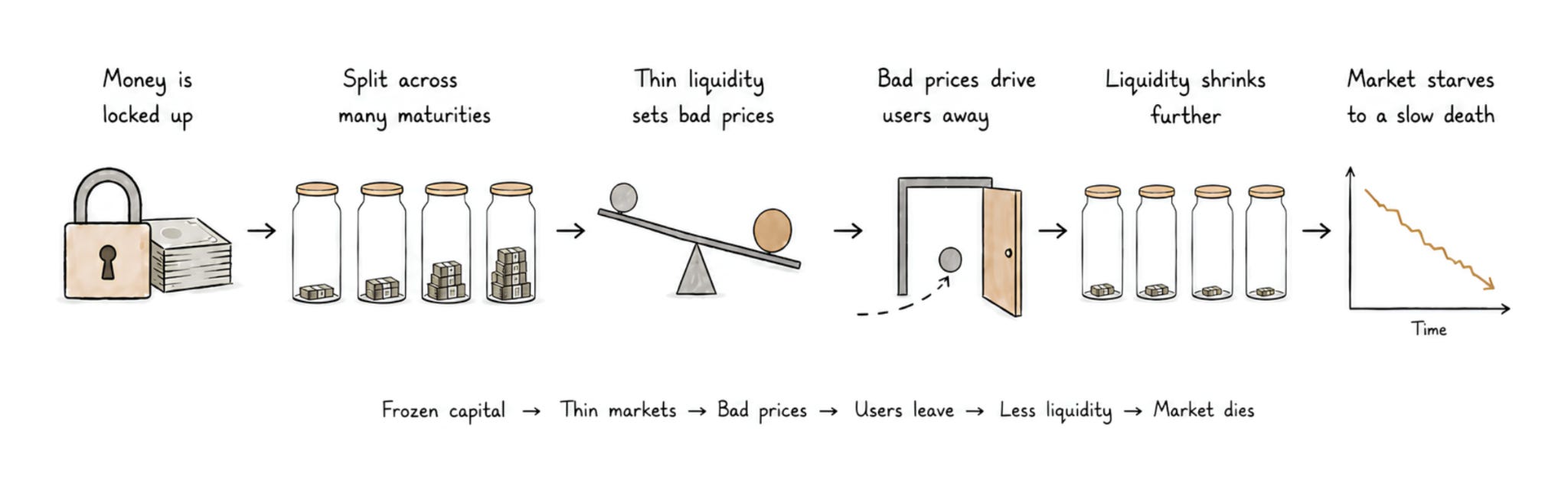
The problem was the steep cost of providing certainty. Each of those protocols was designed to keep every dollar passive until it was deployed.
This is the problem Morpho’s Midnight wants to solve.
Morpho is already one of the largest lending networks in crypto, with more than $11 billion in deposits.
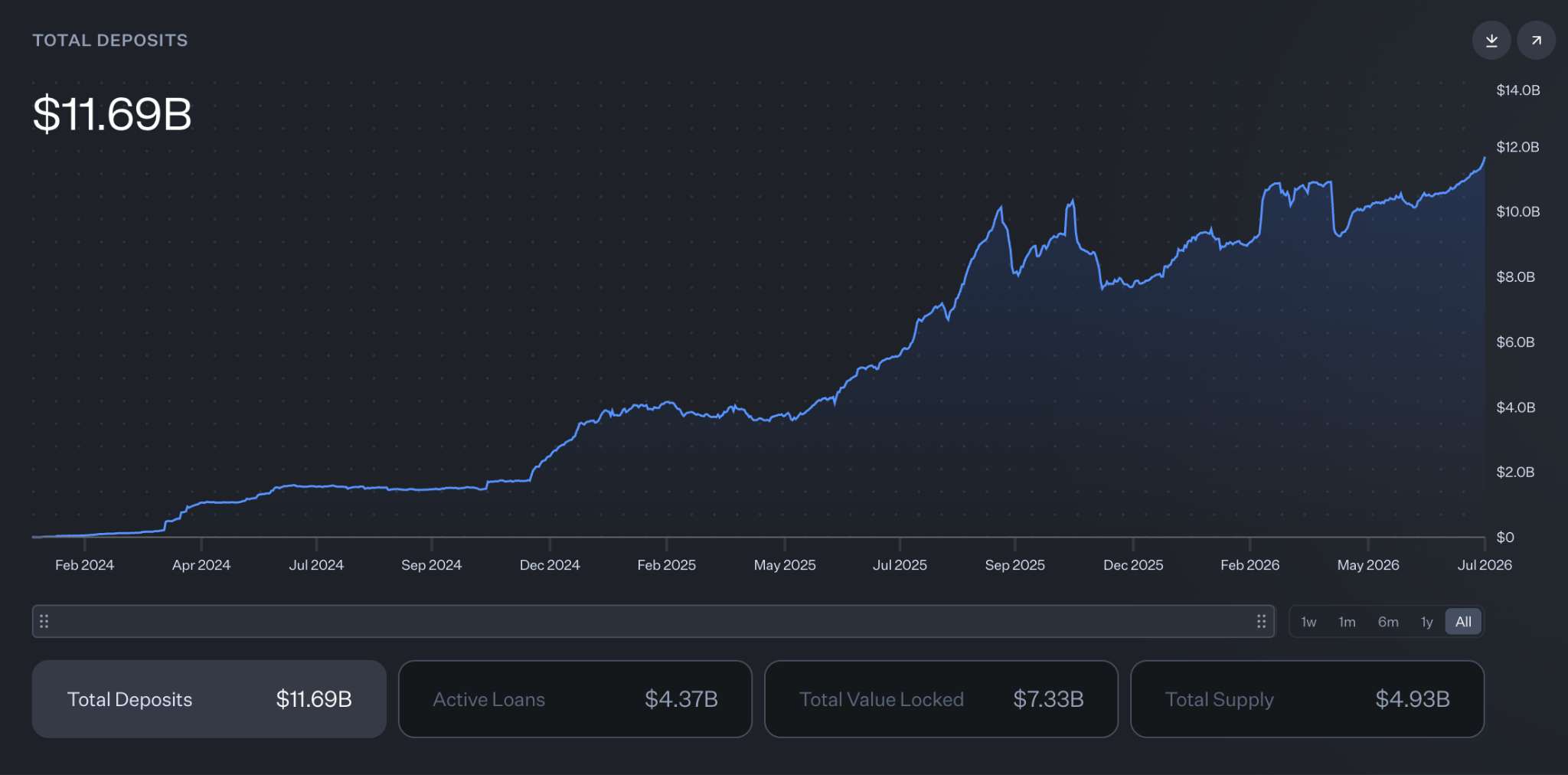
Morpho’s infrastructure powers many consumer products, from Coinbase to Robinhood. Most users of those apps never know it is there, and that is its biggest moat.
On July 21, Morpho launched Midnight, a protocol built specifically for lending at a fixed rate for a fixed term. Instead of a shared pool with a rate set by a formula, Midnight works as a market of offers. A lender posts the rate it wants along with the maturity. A borrower posts what it is willing to pay. When two offers meet, the terms lock. Just as it would happen with a bond or a term loan.
But what happens to the lender’s money while it waits to be matched with a borrower with similar rate and term preferences? While the earlier protocols froze the funds, Midnight is designed to allow those funds to continue earning a floating return on Blue, Morpho’s legacy lending primitive. The capital doesn’t sit idle here.
This is a promising upgrade for every corporate treasurer who wants a known rate, a certain maturity and a defined counterparty. But this works only with scale.
The Time is Ripe
For the first time, an on-chain instrument is designed with a corporate treasury’s preference for a fixed rate and maturity in mind, rather than expecting the treasury to adopt a product centred around crypto traders.
The timing of a few other catalysts makes DeFi lending more practical for corporate treasuries this time.
Firstly, starting in 2024, the FASB Accounting rules let companies mark qualifying digital assets at fair value rather than treating every dip as a permanent writedown. Under the old rule, a treasury had to write down its digital assets each time their prices dipped. But a price recovery wouldn’t let them mark the asset back up. This meant that a bad quarter could permanently dent their balance sheet. This discouraged companies from holding digital assets altogether. The new rule lets the company record fair value to reflect both unrealised gains and losses.
Secondly, new stablecoin legislation has given corporate finance teams a clearer legal footing for holding these instruments.
The distribution Morpho has already put in place helps it gain adoption from the existing institutional networks of those platforms.
Coinbase has originated more than a billion dollars in loans through Morpho’s infrastructure.
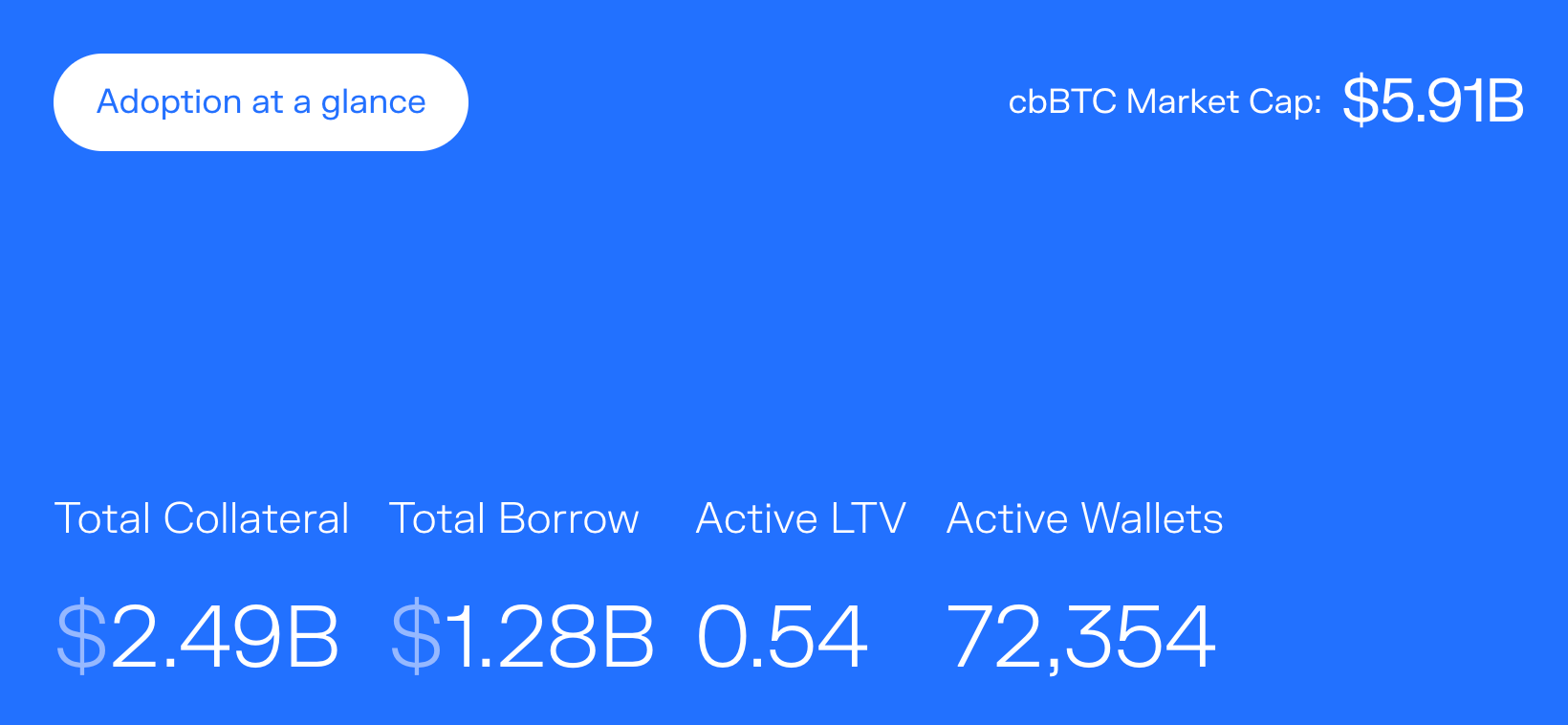
Robinhood routes its savings product through Morpho. Société Générale’s digital arm, FORGE, runs lending markets on it. These establish Morpho’s credibility as a reliable integration via on-ramp platforms that corporate treasuries are familiar with.
But the DeFi mechanism isn’t as perfect when you swap the corporate treasury use-case with that of corporate debt.
The Corporate Borrower
The same DeFi lending protocols can even be used by corporates for borrowing on-chain. Except that it has some structural issues to fix before on-chain corporate debt becomes attractive.
Corporate debt is largely unsecured. When a company issues a bond, lenders are betting on its business, which is a function of its cashflows and its ability to pay. The company does not pledge assets worth more than it borrows. That is the entire point of corporate debt. It is raising money precisely because it does not already have that kind of money.
On-chain lending, including Midnight, works the opposite way. It is overcollateralised. No corporate treasurer will want to pledge $100 to raise $70. That resembles a margin loan more than a corporate financing. Corporate bonds work because it is a borrowing secured against the company’s future, not its present. This is what Morpho or any other DeFi lending protocol cannot do yet.
If Morpho Midnight wants corporates to prefer raising debt on-chain over their time-tested traditional channels, then it has to close this gap with unsecured, credit-based lending.
Why the Infrastructure Is Still Promising
Traditional public bonds need scale to make sense. Only when they scale up to at least a few hundred million dollars can they grab the attention of underwriters, rating agencies, lawyers, and roadshows. All-in issuance cost via public bonds can eat several percentage points of the money raised and weeks of time. A market on Midnight can be created by anyone, with protocol fees measured in fractions of a percentage. That removes the gatekeepers who price small and mid-sized companies out of public debt entirely.
Speed and liquidity are the next advantages. A leveraged loan can take twenty days or more to settle, and most corporate bonds are barely tradable once issued. A loan made on Morpho Midnight settles in a single step, and the position becomes a tradable unit instantly. A lender who needs cash early does not need to break the loan or hunt for a bilateral buyer. They can simply sell the units. Similarly, a borrower who wants out can buy units back. Credit that was locked until maturity becomes liquid without a secondary-market desk taking a cut in the middle.
Enforcement is another aspect in which on-chain lending contrasts with off-chain lending. Traditional default is slow and expensive, moving through breach, negotiation, restructuring, and sometimes bankruptcy. On-chain, a position remains healthy as long as its collateral covers its debt; the moment it does not, liquidation occurs automatically. On-chain lending cuts the entire manual procedure.
But faster, automatic liquidation comes with a price. Liquidation can be instant only because the borrower has already posted more than what they took.
Another advantage is composability, a feature traditional credit lacks. An on-chain position is much more valuable than a traditional loan entry on a balance sheet. A tokenised credit position can be moved, sold, or posted as collateral somewhere else. A fixed-rate credit unit can become the raw material for the next product built on top of it. Traditional corporate debt sits still until maturity.
None of this makes Midnight a viable substitute for the corporate bond market today. But it still makes it a prospective candidate that can offer a better set of rails than the one corporate credit currently runs on.
On top of the advantages I mentioned above, the whole thing plugs into the distribution that treasuries already use through Coinbase, Robinhood, and a regulated bank like Société Générale.
The one missing piece is DeFi’s ability to price a borrower’s creditworthiness in addition to its collateral. The infrastructure is ahead of the use case. That’s all the more reason I believe it should be further developed rather than written off.
The Case for Being Optimistic
Many crypto protocols already offer bitcoin-backed loans. But I think the path to making DeFi borrowing and lending credible substitutes to their traditional counterparts runs through tokenised real-world assets as collateral.
A corporate treasury is more likely to deposit a tokenised money market fund, a tokenised pool of receivables, or a tokenised slice of private credit, and borrow against it at a fixed rate than post a volatile crypto token as collateral. This is already happening as you read this. A tokenised version of an Apollo credit fund has been used as collateral inside Morpho’s markets. It’s evidence of a ready infrastructure. Yet the pool of tokenised real-world assets that a treasury could actually pledge is still only a few billion dollars, compared with a $60-trillion debt market. That’s because tokenised collateral is still overcollateralised borrowing. So, the main part of the puzzle to fix remains the overcollateralisation problem.
The closest historical parallel is the Eurobond market, which began in 1963 when borrowers went offshore to raise money faster and with fewer constraints than their home markets allowed. A parallel credit market formed outside the gated incumbent, the same move Morpho Midnight is making now by building credit rails outside the slow, permissioned machinery of traditional debt. But the Eurobond market took decades and an enormous amount of rigid settlement infrastructure to grow into the multi-trillion-dollar system it is today.
On-chain credit is at the same early stage. A corporate treasury can lend on-chain at fixed terms today, and Morpho Midnight can be the biggest beneficiary in enabling that. But for it to become a preferred substitute to off-chain corporate borrowing, it will have to resolve the overcollateralisation problem as a priority.
That’s it for today. I will be back with the next one.
Until next time, stay curious,
Prathik
Token Dispatch is a daily crypto newsletter handpicked and crafted with love by human bots. If you want to reach out to 170,000+ subscriber community of the Token Dispatch, you can explore the partnership opportunities with us 🙌
📩 Fill out this form to submit your details and book a meeting with us directly.
Disclaimer: This newsletter contains analysis and opinions of the author. Content is for informational purposes only, not financial advice. Trading crypto involves substantial risk - your capital is at risk. Do your own research.