


Hello,
Exactly a month ago, a company called Sentora posted a proposal on a governance forum. About 25 days later, it was running a lending business. It’s surprising because it didn’t raise any capital, applied for no licence, and has no back office. Starting a lending business is not that easy. In 2025, only four new banks opened in the U.S., and each had to raise between $20 million to $40 million before accepting a single dollar in deposits.
Sentora’s lending desk runs on Aave V4’s Hub-and-Spoke architecture. The arrangement is unique because it lends PayPal’s and Ripple’s digital dollars against tokens tied to American home-equity loans, a Wellington Management credit portfolio, and short-term loans to payment companies. It’s a case of unlocking DeFi liquidity by using real-world assets as collateral.
In this arrangement, Aave retains the contracts, the pooled money, and the power to switch Sentora off. But it has handed over the job of deciding what is safe to lend against to Sentora. Although that might seem like ceding power, I think it’s a bet that the venue hosting everyone’s lending desk ends up worth more than any single desk on it.
Let’s explore what Aave needs to price in to make this bet pay and what value arises out of the new lending architecture.
On to the story…


StablesReward: Your AI Agent Spends, You Earn
AI agents can surf the web, read reviews, and book hotels for you. All these tasks cost money. But what if these tasks could earn you back something?
StablesReward does just that. Once you connect your agent to an MCP endpoint, it gives your agent a menu of paid tools. Every call your agent pays for earns you miles or stocks. And this is in addition to the rewards you earn anyway on your own spending across 800+ merchants.

Every purchase pays you back. The best part is that you can choose how you’d like to be rewarded. Transfer miles to airlines and hotels, or let your stocks build a portfolio from the spend you were making anyway.
Launching soon. Free to join.
Unbundling the Lending Desk
On-chain lending has so far come in two shapes. In the first, one protocol runs one big pool, and one committee decides what goes into it. Aave V3 worked this way. Every new asset went through the DAO and its paid advisers, and every saver shared the same pool, so a single bad asset could hit all of them, as April’s KelpDAO exploit showed.
In the second shape, anyone can open a market, but each one starts empty, and nobody can veto a bad one. Aave’s V4 is a third shape. It separates where the money sits from where the lending happens.
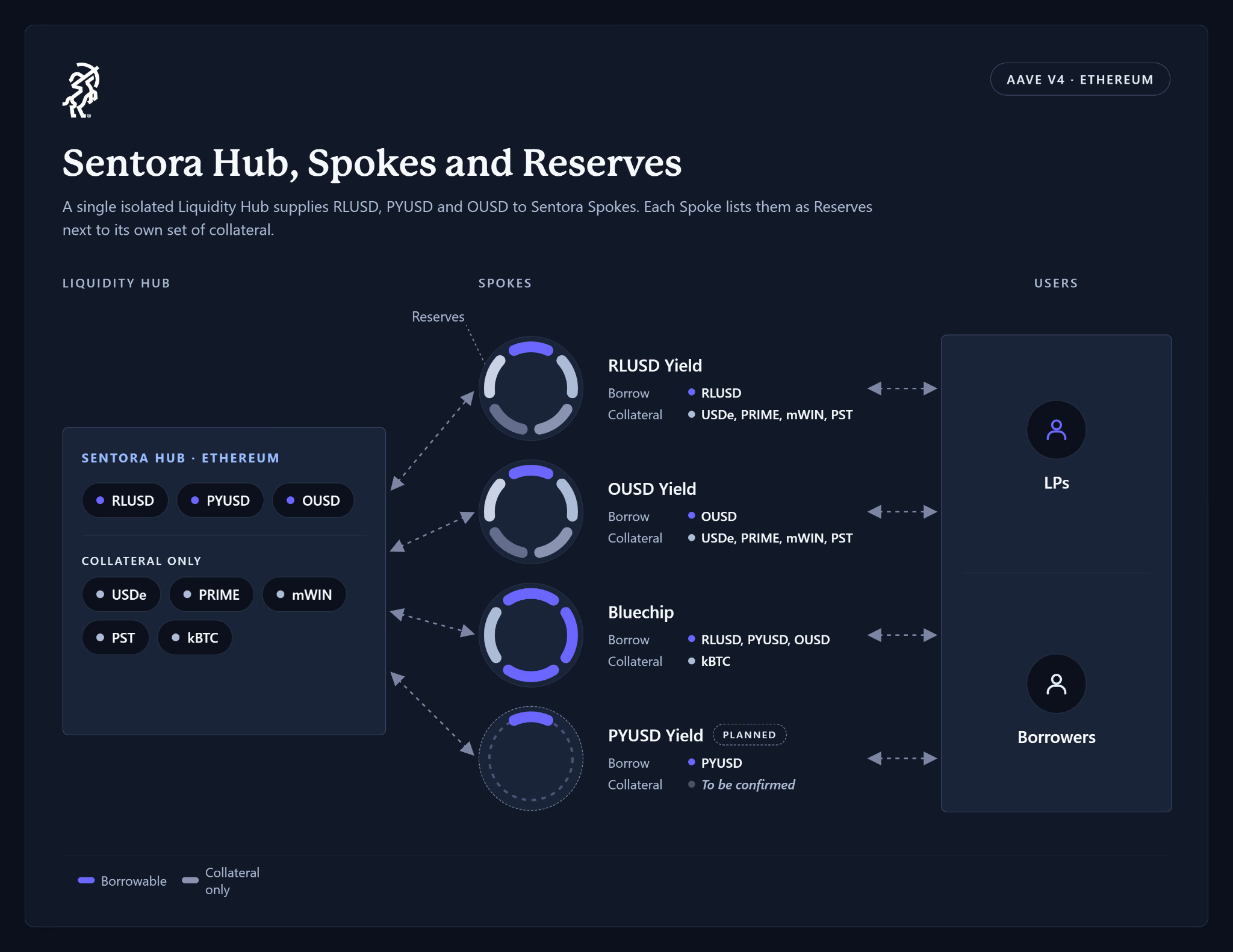
Aave’s V4 hosts a Liquidity Hub where all the savers pool their deposits in a shared vault. This is then routed into lending counters called Spokes, where each counter has its own rulebook. Each spoke decides independently which collateral it accepts, how much it lends against each asset, what interest it charges, and where it gets its prices from.
Borrowers pledge their collateral at any of these spokes. If the collateral matches its standards and covers the loan, then the Hub disburses the loan.
Sentora runs one such Hub on Ethereum with three spoke counters. Only three stablecoins can be borrowed through these spokes: Ripple’s RLUSD, PayPal’s PYUSD, and Origin’s OUSD. The interesting part is the collateral it accepts.
PRIME, a token backed by Figure’s home-equity loans
mWIN, a Wellington credit strategy issued by Midas
PST, Huma’s payment-financing token
Ethena’s USDe and Kraken’s bitcoin token kBTC
Sentora lends up to 89.5% of PRIME’s value and 84.6% of mWIN’s. The borrowing costs move based on how much of the liquidity from the Hub is being exhausted. The interest rate is 4% when 90% of the pool is lent out, but it jumps to 16% when it runs dry.
Although Sentora reserves the right to decide the interest rate and assess collateral quality, Aave retains the kill switch. The Aave DAO owns every contract and can strip Sentora’s permissions with a vote. Any change that adds risk is put on a public 48-hour delay, and new collateral faces a two-week review.
In return for opening its architecture to external lending desks, Aave charges 50% of all the fee income the desks make through the lending business.
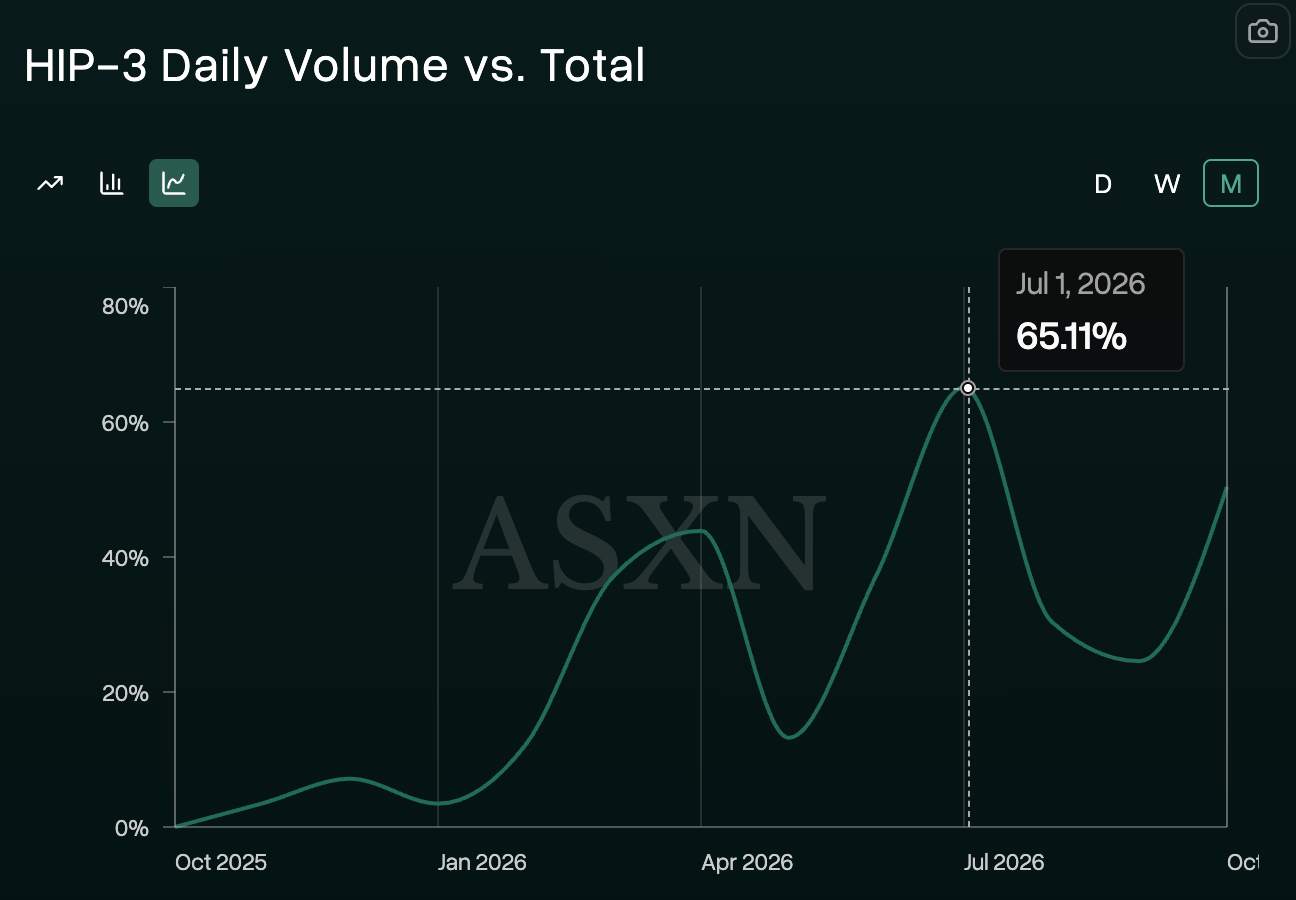
But isn’t Aave giving away its core business by opening the lending model to external players? It’s difficult not to mention how Hyperliquid’s HIP-3 deployer markets often overtake its native perp activity by volume.
The Hub-and-Spoke architecture is walled off from Aave’s main markets. The V4 explicitly bans USDC and USDT in the Hub, so Sentora or any other lender cannot poach Aave’s core business.
This is what sets V4 apart from the earlier models. On Aave V3, the DAO and its paid advisers decided everything, and every market shared one pool. That meant a single bad asset could hit every saver in it. In April, an attacker minted unbacked rsETH, a staked-ether token, posted it as collateral on Aave V3 and borrowed against it. Estimates of the resulting bad debt ran as high as $230 million, and Aave’s deposits fell by about $10 billion as savers pulled out. On Morpho, Aave’s main rival, anyone can open a market, but nobody can veto a bad one. V4 sits in between. One pool feeds several counters with different lending rules, which are set by an outside specialist. Yet Aave’s governance keeps a veto.
There’s one more break with banking. Unlike a bank, the loan on V4 doesn’t burden anybody’s balance sheet. Neither Aave’s nor Sentora’s. A bank books your deposit as its liability. Here, the savers are the lenders. They own the shares of the deposit pool. Every loan, limit, and pending rule change is visible on a public ledger in real time.
The entire architecture brings together stablecoin liquidity and marries it with a tokenised pool of real-world assets as collateral.
Much of the $300 billion in circulating stablecoins earns little yield or is chasing crypto-native interest. Meanwhile, some of the steadiest credit in traditional finance, such as home-equity lines, investment-grade bonds, and trade receivables, is hard to borrow against unless you’re big enough to negotiate a facility with a bank. Tokenisation has made those assets transferable. But the same tokenisation, when married with lending counters, can also make the real-world assets financeable.
Let’s follow a dollar in this architecture
In Aave’s V4, a saver first deposits PYUSD into Sentora’s Hub. A borrower pledges their PRIME - a token backed by Figure’s Home Equity Line of Credit (HELOC), and receives the loan in PYUSD.
PRIME earns its yield from Figure’s warehouse of home-equity loans that are going to be packaged into bonds. Senior slices of those bonds have carried AAA ratings. It’s interesting because a stablecoin deposit now funds American homeowners’ credit lines, which was a job that belonged to warehouse banks.
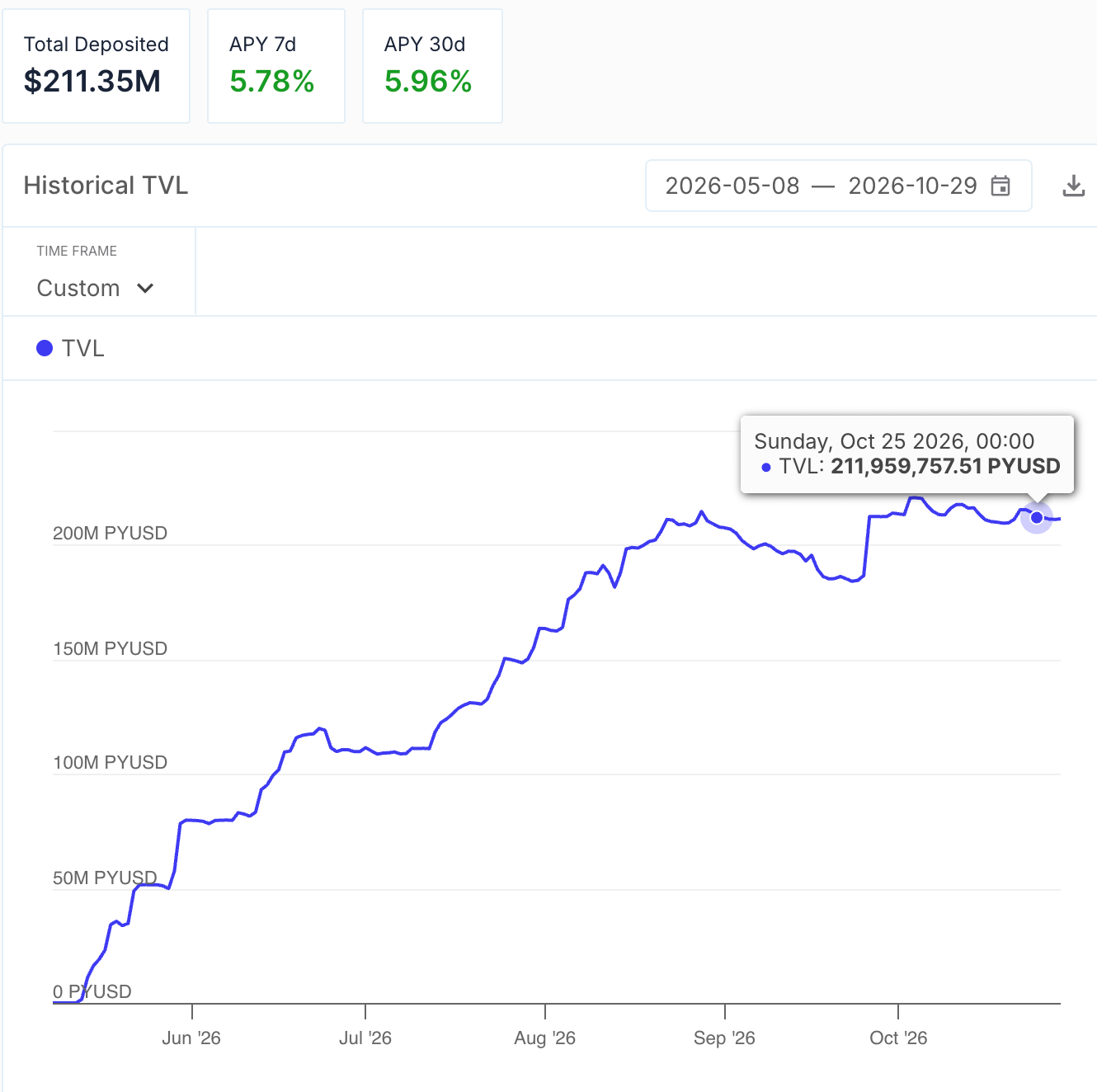
Sentora’s PRIME vault on Morpho has drawn over $211 million of PYUSD since its launch in May this year.
Even other collaterals that Sentora accepts follow similar logic.
mWIN is a tokenised investment strategy that tracks the performance of an investment-grade credit portfolio run by Wellington, which manages more than $1.3 trillion. Borrowing against it is what private banks call securities-based lending, except that here it runs around the clock on-chain without any relationship manager.
PST, Huma’s payment-financing token, represents one-to-five-day loans to licensed cross-border payment firms that need to pay out before money arrives. Pledging it turns trade finance into dollar liquidity on a Sunday when banks don’t function.
All these strategies have existed in the past. Warehouse lending, securities-based lending, and receivables financing are all decades old. But what Aave’s V4 enables is the low cost of entry for specialist lending desks, removing the time restriction and democratising who can run them.
It also changes who makes money throughout the flow, and how much.
Follow the Money
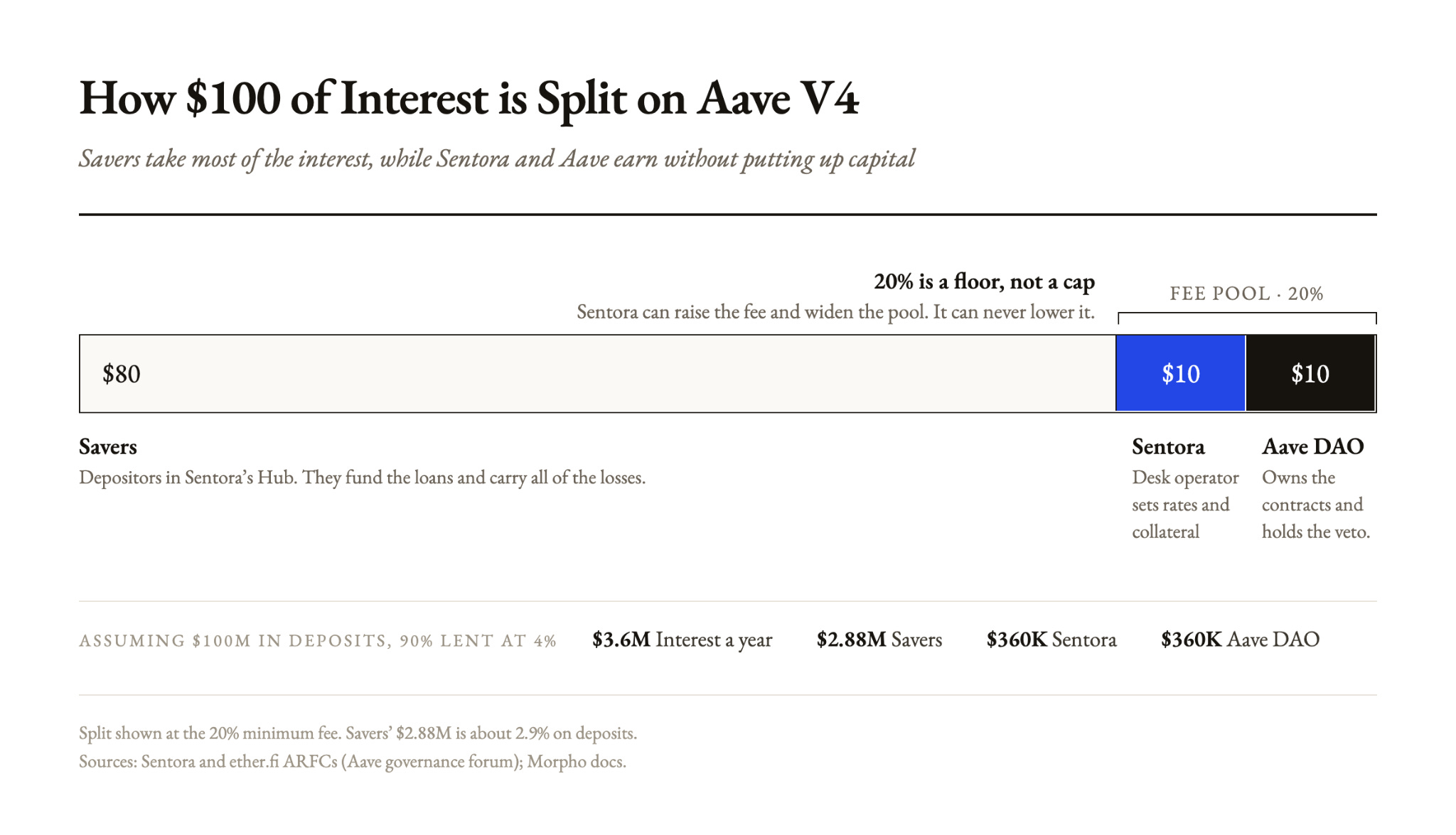
Take a desk with $100 million deposited and $90 million lent out at 4%. Borrowers pay $3.6 million a year in interest. At least 20% of that, $720,000, goes into a fee pool, which Sentora can raise but never lower. The pool splits evenly, with Aave’s DAO pocketing $360,000 and Sentora taking the other half.
Savers keep the remaining $2.88 million, about 2.9% on their money.
The actual numbers might still be insignificant. In October, Aave’s DAO made barely a million dollars from fee income on V4. Aave V3 already earns more than that daily. But short-term revenue isn’t the point. The DAO wins anyway because every dollar it makes from V4 is virtually free revenue that it earns from someone else’s labour. All this while it retains the kill switch if any tenant misbehaves.
The entire risk rests in the hands of the savers. Aave’s V4 model still ends up pulling in more savers, who pool more of their deposits. Sentora, too, earns its fee share without investing a single dollar of its money. But it captures value for managing the depositor relationship. It already curates about $440 million of RLUSD and $366 million of PYUSD in vaults on Morpho.
PayPal and Ripple also benefit from increased borrowing. If nobody borrows a stablecoin, then it just remains as a source of float revenue. RLUSD has hit an all-time high circulation of $2.6 billion this week. PYUSD’s circulation is around $3 billion, down by a third from its March peak. Both need borrowers to survive, and they pay for increased visibility.
When Sentora’s mWIN vault launched on Morpho in August 2026, PYUSD rewards supplied 7.61 percentage points of its 8.31% headline yield. The savings rate of depositors is often subsidised by the stablecoin issuer.
Figure, Wellington, and Huma gain more adopters, and consequently more business. A token that you can borrow against is a better asset to hold. Lending counters help turn financial instruments of these asset managers from investments into working capital.
Aave earns a thin rent and hasn’t settled the price. Sentora pays 50% of the fee pool.
Value in this stack flows to those who control the relationship with depositors and borrowers. The lending venue in the middle earns the least. Here, Aave is looking like a landlord who rents neutral rails to specialists by moving underwriting off its own books.
Lesson from the Past
Hyperliquid ran this experiment a year earlier, with trading instead of lending. Under its HIP-3 programme, a builder who stakes 500,000 HYPE, can launch its own futures markets on Hyperliquid’s engine. Those markets charge double fees, where the builder retains half. Validators can confiscate the stake if the builder runs bad price feeds or lets markets go down. Builder markets reached $4 billion in daily open interest (OI) this week.
HIP-3’s share of daily OI out of the total daily OI across Hyperliquid has remained above 20% consistently since February this year.
Both Hyperliquid and Aave are renting their core engines to specialists so that they can earn excess revenue and split it down the middle. All of this still happens under their respective brand names.
Hyperliquid prices trust before a market opens by asking the deployer to post a bond and losing it if they mess up. In Aave’s case, if a borrower’s collateral collapses and debt is left over, Sentora’s savers absorb the shortfall.
This makes the lending business into something that can be rented by specialists. Specialists can compete on judgment instead of carrying the burden of loans on their balance sheets. There are many high-quality collateral waiting to be financed. Home equity, fund units, and receivables can back dollar loans at any hour. They need not be saved for the end of the month valuation cycle.
Such a Hub-and-Spoke model unlocks gains for even those who seldom think about crypto. It enables a savings app to pay a rate funded by home-equity loans. It also allows homeowners to use their lines of credit and draw on a global pool of dollars instead of a handful of warehouse banks. A fund investor can borrow against their holdings on a Sunday.
Most of these institutions might never hear about Aave. And probably that’s the entire point. To make crypto work as an underlying infrastructure that is running someone else’s product.
That’s it for today. I will be back with the next one.
Until next time, stay curious,
Prathik
Token Dispatch is a daily crypto newsletter handpicked and crafted with love by human bots. If you want to reach out to 165,000+ subscriber community of the Token Dispatch, you can explore the partnership opportunities with us 🙌
📩 Fill out this form to submit your details and book a meeting with us directly.
Disclaimer: This newsletter contains analysis and opinions of the author. Content is for informational purposes only, not financial advice. Trading crypto involves substantial risk - your capital is at risk. Do your own research.