


How to tokenise a rock? Take a rock, mint a token that stands for it while the rock is stored somewhere, and now the rock trades all day and splits into fractions. The token is fast, it’s liquid, it settles in seconds, and increasingly there’s a regulator who’ll bless it.
This way, you can put anything on-chain, but also, you can’t. We are not there yet; the relationship is still complicated.
A tin of tuna in a Lisbon supermarket now carries a code you can scan to see the boat that caught the fish, the date, the ocean, the whole line back to the water. But if the person unloading the boat mislabels the catch, the whole system fails. Tracking only works after the data is entered. The entire process depends on one human making an honest record, and we underfund this critical first step.
Similarly, in the case of blockchain chickens, it worked because it wasn’t a tradeable asset - the whole idea was an immutable provenance record. To prove that it was genuinely premium free-range poultry after years of food safety scandals.
Nobody should be asking whether you can put an asset on-chain. You can. But the ability to verify real-world facts is what tells you what a good and bad tokenisation project.
That’s why we should look at the environmental markets; that’s where I saw identical technology going two ways. One is to record verified truths, and the other to record claims that could be totally fabricated.

Renewable energy certificates work on a blockchain, and carbon credits do not. As the cost of addressing this reason decreases, the financial market for physical assets is opening up.
Start with what a token is, in economic terms, because the industry has spent a decade describing it wrong. A token is a claim. It asserts that some unit exists, and that it belongs to the holder. A blockchain is very good at enforcing the last part. It solves the double-spend problem for the token, so the claim cannot be copied or forged in transit and its ownership is legible to everyone at once. What it cannot do is verify that the underlying thing the claim points to is real, or is what the claim says.
A renewable energy certificate, a REC, says one megawatt-hour of clean electricity went onto the grid. This market is worth around $22-28 billion and grows 14% every year. Why are RECs easy to put on a blockchain?
Because all electricity on the power grid mixes together, it is impossible to separate clean energy from dirty energy once it is flowing through the wires. To solve this, physical meters are placed directly at solar and wind farms to measure the exact amount of clean power they produce before it enters the main grid. When the meter records a specific amount of clean energy being generated, it creates an official document called a REC. Companies use these certificates to prove that a specific amount of clean energy was actually created and added to the system.
This is how the grid works:
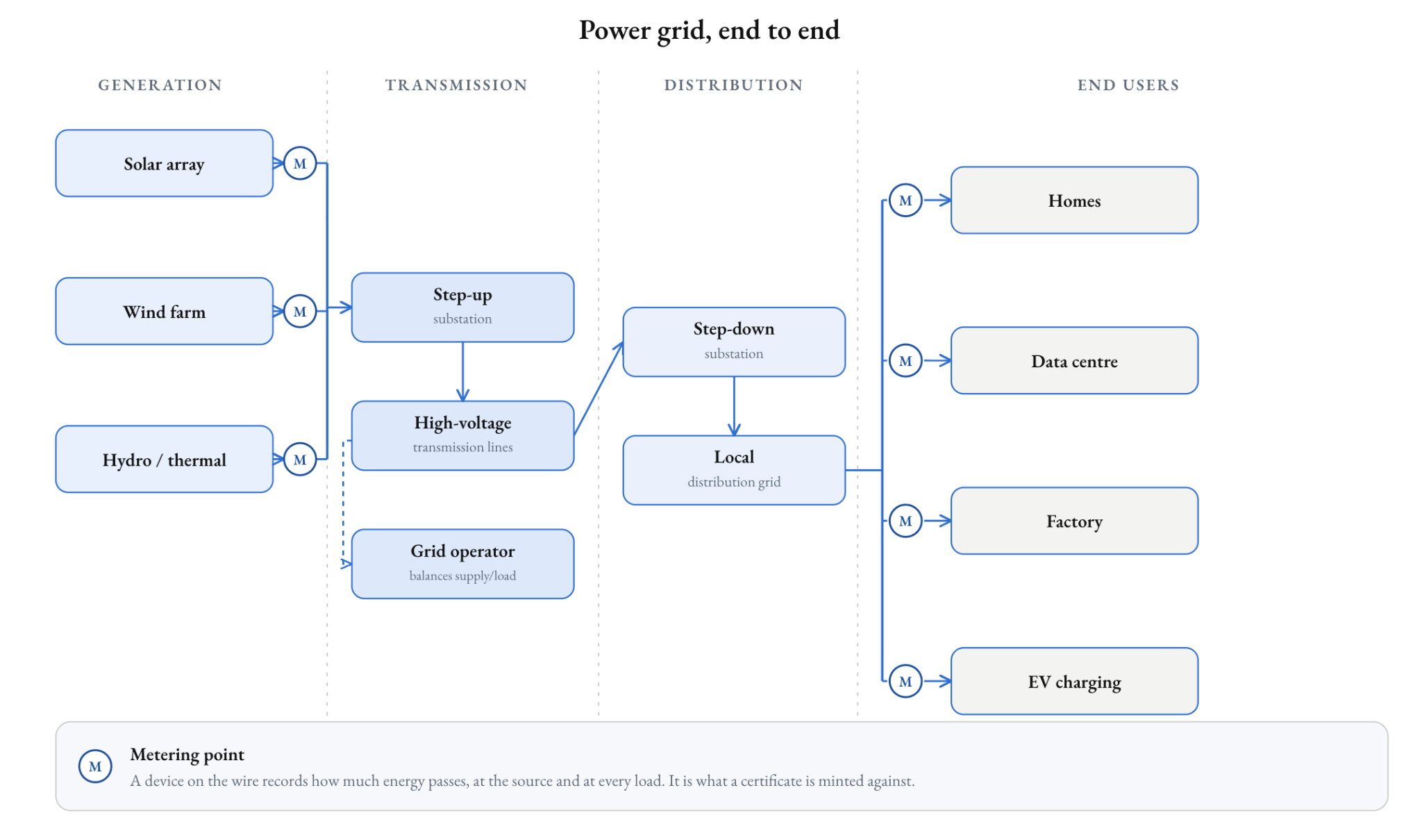
The economic significance is that the party certifying the unit is not a human with an incentive to shade the truth. It is a meter, and behind it, the grid, an involuntary third-party verifier with no stake in anyone’s sustainability report. Falsifying its reading would mean corrupting physical infrastructure the seller does not own. In the language of information economics, there is almost no asymmetric information about the core attribute. Buyer and seller face the same hard number, produced by a device neither controls.
When you tokenise a REC, then you are wrapping a unit whose quality has already been established by an independent measurement. The blockchain inherits a fact. And what it contributes is transaction-cost reduction, which is precisely what a liquidity technology is supposed to do.
Power Ledger, an Australian firm that spent years on peer-to-peer solar trading between neighbours, now runs a REC marketplace called TraceX, where generators and corporate buyers trade certificates on-chain instead of through weeks of bilateral paperwork and legal brains. It cleared over 1.2 million RECs in a single month in early 2025, and it plugs into the registries that actually issue the certificates. It connected to M-RETS, one of the largest voluntary REC registries in North America, and in mid-2025 to ERCOT, the Texas grid operator that issued more than 32 million RECs in 2023 alone. Power Ledger says users cut administrative costs by up to 72%.
Now the same idea didn’t work when it comes to carbon credits, which look like RECs. Each credit acts as a numbered, tradeable unit for one ton of avoided carbon. Many corporations promise their shareholders and the public that they will become “carbon neutral” or reach “net-zero” emissions. Because they cannot actually stop polluting entirely, they buy credits to mathematically cancel out the pollution they continue to create.
In 2021, a protocol called Toucan built a bridge to haul them on-chain as tokens, and a project called KlimaDAO offered a clever incentive to pour credits into its treasury, buying them up to prop the price and, in theory, make polluting more expensive. Money rushed in, and KLIMA, the token, touched $1 billion marketcap before people looked at what had been bridged.
The core problem with a carbon credit is that it measures a hypothetical scenario, like trees that were supposedly never chopped down. There is no independent hardware to verify this, making the units entirely subjective. Tokenisation could not fix this underlying flaw, but it did make it a bit more dangerous. By pooling these credits together on-chain, protocols like Toucan treated every asset as identical.
It wasn’t that the blockchain itself was bad, but the specific way they pooled these credits together caused a problem.
Then KlimaDAO manufactured demand for that pooled token, buying it up with its own freshly minted KLIMA, at a price propped far above what the junk inside the pool was actually worth. That combination sorted the market. If you held a good credit that fetched a fair price in the normal market, turning it into a pooled token priced at the junk level was a bad trade, so you stayed away. If you held a credit nobody wanted, the pooled token was priced above your credit, so you bridged it and sold. The pool filled with the lowest-quality credits, because those were the only ones the trade made sense for.
A researcher at CarbonPlan in 2022 found that most of the credits bridged to Toucan came from projects already excluded from serious offset markets on quality grounds. Because Verra’s retirements are public, CarbonPlan was able to read exactly which credits went on-chain. It found that 99.9 per cent of them came from projects too old to qualify for the standard aviation offset market, and that 28 per cent came from ‘zombie projects,’ ones that hadn’t sold a credit in years until crypto demand revived them. One hydro project in China logged its first ever retirement only when it bridged on-chain, fifteen years after it started.
A 2024 meta-analysis in Nature Communications looked at nearly a billion tonnes of carbon credits, about a fifth of every credit ever issued, and found that fewer than one in six represented a real emissions cut.
Verra, the largest carbon registry, watched its retired credits get turned into tradeable digital ghosts and, in May 2022, banned the practice outright. KLIMA fell from three thousand six hundred dollars to single digits. KlimaDAO spent over a million dollars of its own treasury retiring the worst of what it held.
Tokenising a broken unit doesn’t repair it, but industrialises it. You take a measurement problem, and you bolt a liquidity engine to it, and now the bad units move faster, price higher, and reach more buyers.
Which gives you a test you can carry to any tokenisation pitch, and it has nothing to do with the token. Is there an independent witness measuring each unit? Can that witness be faked? And, the one people forget, can the borrower own the witness? That’s the tough one.
If you tokenise a barrel of oil in a tank, or a tonne of grain in a warehouse, the whole thing rests on someone attesting the barrel is in the tank and stays there. If the person doing the attesting is the same person borrowing against it, you don’t have collateral.
Commodity trade finance has blown up this way for a century, warehouse receipts written against metal that had already left, or was never there.
Look at livestock, one of the biggest stores of value on earth for people with no access to credit. Banks have always hated lending against it, discounting a cow’s value by as much as 60%, because they had no way to know the animal was healthy, or where it was, or whether it was still breathing. A cow is collateral that can walk away, get sick, or quietly die in a field while the loan sits open. Who is watching the barn?
Three days ago, on a dairy farm in Paraná, Brazil, ten cows became the first livestock formally registered as collateral on the country’s stock exchange.
Each animal wore a smart collar from an agtech company called Cowmed. The collar tracked its health, behaviour and location, hashing that stream into an encrypted identity tied to the loan. The farmer borrowed around twenty thousand dollars against ten cows. The system can even tell if a cow dies, and let the farmer swap in a live one. Cowmed already monitors a hundred thousand animals valued at nearly four hundred million dollars.


If a lot of farmers adopt this, a smart collar tells you a collar is transmitting health and location data. It does not, by itself, tell you the collar is on the cow it’s registered to, that the animal is the one pledged, or that a real cow is on the other end at all. Every failure a farm inspector used to catch is still there. You can strap the collar to the healthiest cow and pledge a sick one. You can move the collar between animals. In principle, you could feed it fake data. So no, it doesn’t end the farm visit on its own. But it can turn one yearly visit into a daily record, so fraud has to be kept up full-time. The same cow now can’t be pledged to three lenders at once, since there’s a record.
A grid meter is placed at a fixed spot the seller can’t move. A cow is mobile, and the collar is only as honest as whoever strapped it on.
A cow with no collar is nearly unverifiable, so banks cut its value by sixty per cent. A cow with a collar isn’t perfectly verifiable either. But, verifiable cheaply enough that a lender takes the bet at a smaller haircut. So, the asset moved up the spectrum. This deal is also three days old, and we don’t have a lot of examples to argue for.
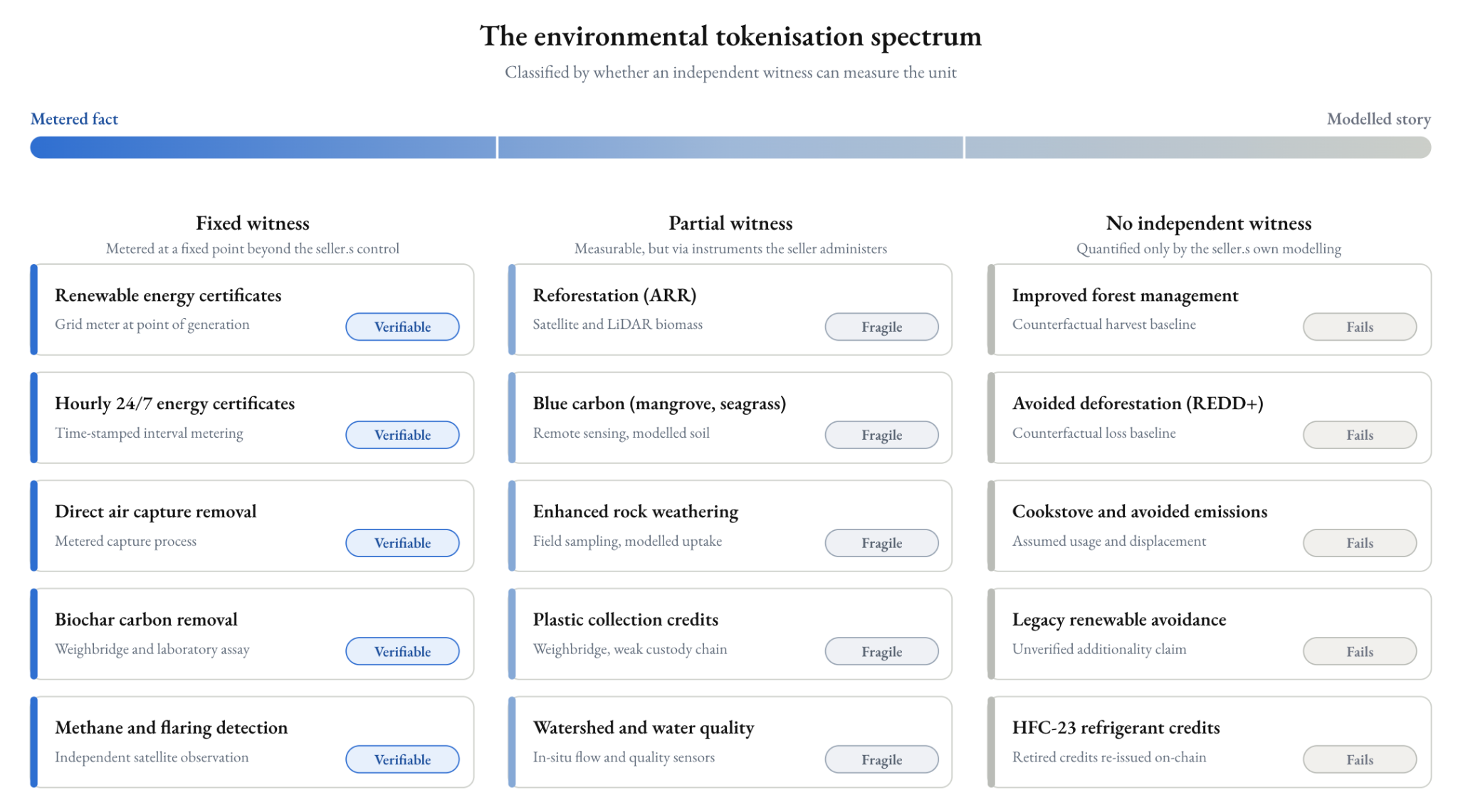
Successful tokenisation relies on a spectrum of measurement reliability. High-quality assets use automated, tamper-proof sensors like power grid meters, satellites, and weighbridges that sellers cannot alter. Low-quality assets depend on hypothetical projections and self-reported math, such as avoidance carbon offsets.
Even the metered end isn’t as settled as it sounds. A meter proves a megawatt-hour existed, but not that it existed near you, or when you needed it. For years, a company in Ohio could buy a certificate from a wind farm in Texas that generated at 3 am and claim to run clean.
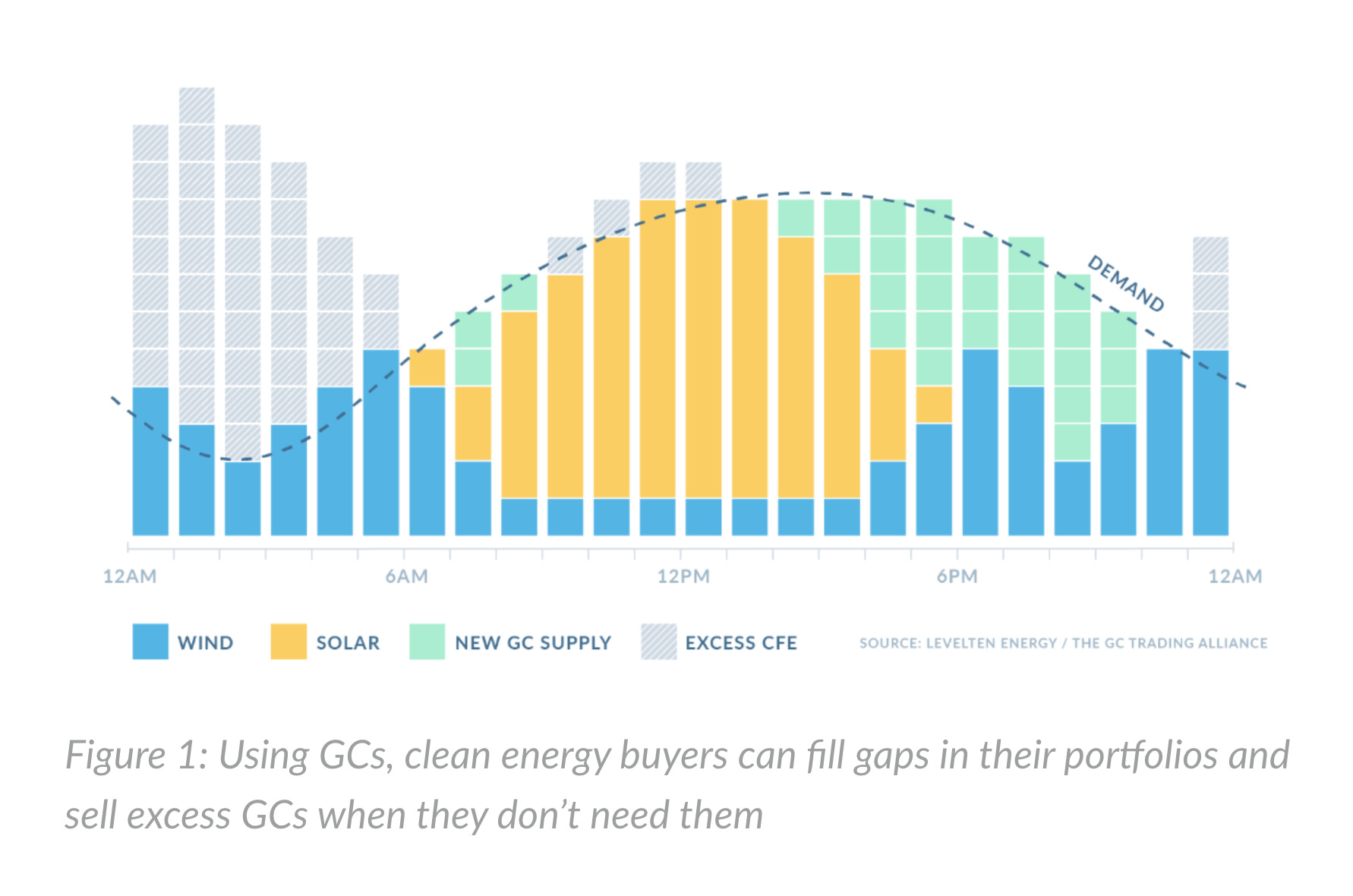
So the market is now splitting the unit finer, stamping each certificate with the hour it was made and the grid it was made on. Water credits are following the exact same pattern. A watershed credit is easy to sell and hard to trust, because measuring that a river got cleaner is one thing and proving your project is why it got cleaner is another. The instrument decides how honestly an asset can be tracked. Each time the instrument improves, the market revises what the certificate was really claiming to be.
In a normal market, buyers and sellers will constantly argue over what an asset is worth, causing the price to fluctuate. That is perfectly healthy, but it only works if there is a hard, physical truth anchoring the asset. Like the actual revenue of a company or the physical weight of a barrel of oil. Eventually, the trading price will align with that reality. If you remove that physical proof (like with a subjective carbon credit), the price is completely disconnected from reality. There’s no baseline for the number to fall back on.
Tokenisation is just an accelerator. If the underlying asset is verified, tokenisation builds wealth. If the asset is unverified, it just accelerates a scam. The blockchain cannot check which is which. Crypto projects often defend themselves by pointing to their high liquidity and institutional capital as proof of their legitimacy. Liquidity does not create a true fact. You can build the most efficient, frictionless trading system on earth, but if the physical asset is of no value, the entire market is just a highly optimised fraud.

Token Dispatch is a daily crypto newsletter handpicked and crafted with love by human bots. If you want to reach out to 200,000+ subscriber community of the Token Dispatch, you can explore the partnership opportunities with us 🙌
📩 Fill out this form to submit your details and book a meeting with us directly.
Disclaimer: This newsletter contains analysis and opinions of the author. Content is for informational purposes only, not financial advice. Trading crypto involves substantial risk - your capital is at risk. Do your own research.