


Hello,
The value of tokenised stocks has grown five times in the past year to roughly $3 billion. As more players offer a once-rare product, it stops being rare, and the prize up for grabs gets split into smaller pieces.
So the money in tokenised stocks no longer goes to whoever puts the most shares on-chain. It gets captured by whoever controls different layers of the stack: when new tokenised shares can be issued, which network they trade on, and which app people use to buy them.
On the Robinhood Chain, one company controls all three. Ironically, the fastest-growing source of demand for its tokenised stocks is memecoins. Long.xyz, a launchpad on the Robinhood Chain, makes every coin on it tradable against a stock token. This turns speculating gamblers into stock buyers and vice versa. This could bring in a steady flow of buyers and more trading, with investors and gamblers feeding into each other.
In today’s piece, I will explore if this is sustainable and who captures value in this entire stack.


Hermes Business: One Budget for Your Team’s AI Needs
Most teams pay for AI across different platforms. A few seats here, some tokens there, and a few API keys from multiple vendors that the company can no longer track. You may still be able to track the spending bill at the end of the month, but you will not know whether it’s paying off.
Hermes Business puts your whole team on one tab. Every member gets their own AI agent, reachable on Slack, Telegram, WhatsApp, or Discord. You can set how much each person can spend and track every dollar in one place.
Your team can pick from every model on Nous’s platform or bring their own keys.
The longer your team uses it, the more it knows your team members.
Need the agent to run on your own servers? Hermes Enterprise runs on infrastructure you control.
How Memes Sell Stocks, and Back
Most memecoins die within a day. This is why most serious stock investors and traders stay away from memecoins. The average investor with a 9-to-5 and a family would prefer putting money into retirement accounts and ETFs and not into tokens that can vanish overnight.
So LONG made one design choice. Every token launched on its launchpad trades against a Robinhood stock token, like NVDA, AAPL, MSFT, and TSLA, instead of ETH or a stablecoin.
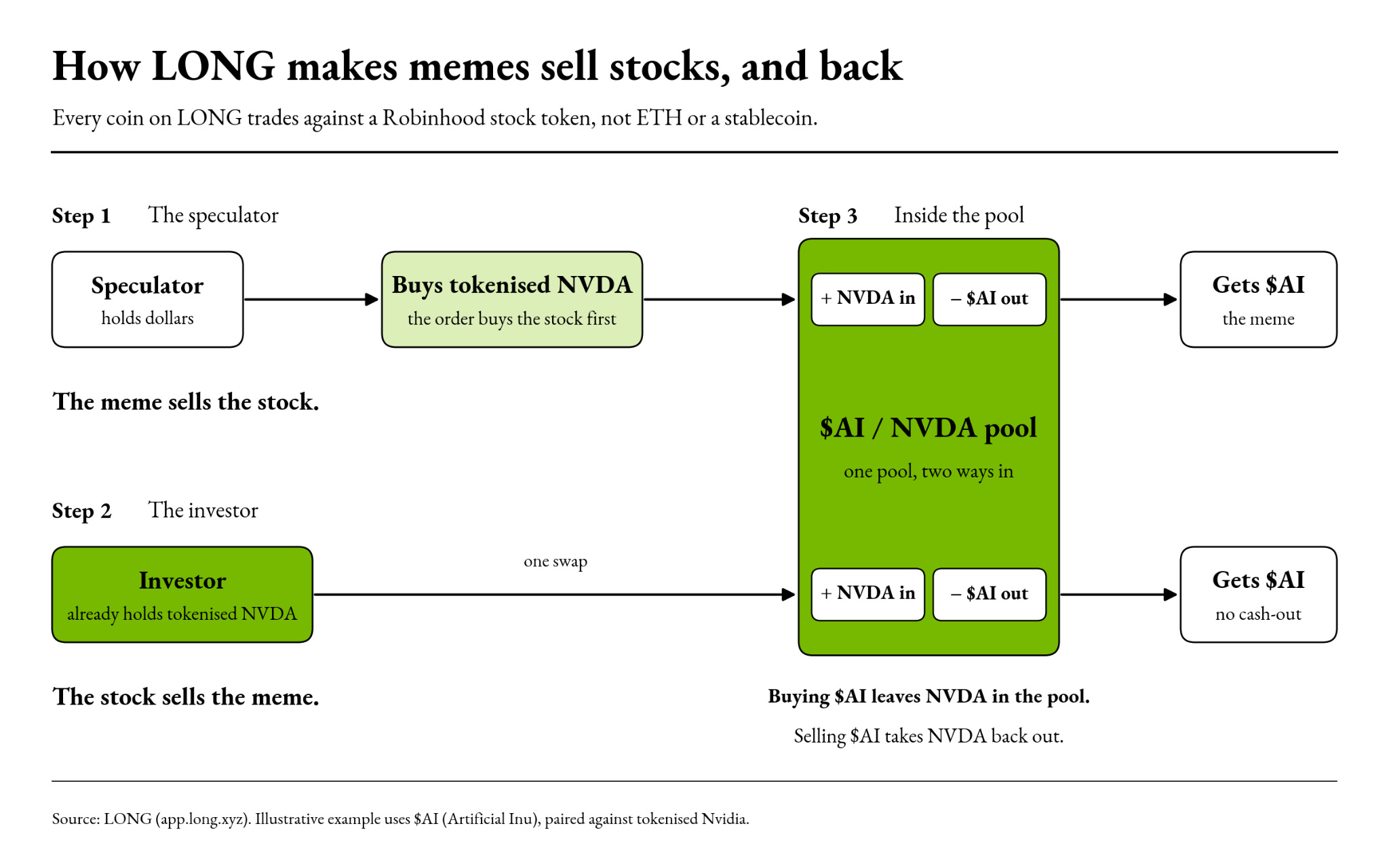
This pairing creates a two-way sale. When someone buys a memecoin paired against tokenised Nvidia, the order first has to buy and stock Nvidia. The meme sells the stock. It works in reverse too. Anyone holding tokenised Nvidia on-chain can swap straight into a memecoin without cashing out. The stock then sells the meme. The stock and the community coin act as two sides of a coin. Every stock LONG supports adds another route between the two kinds of participants - a speculator and an investor.
These routes have been busy. By September 8, LONG had processed over $1 billion in tokenised-stock volume, which accounted for about 15% of all tokenised-stock DEX volume since Robinhood Chain went live. In the next week, the figure crossed $1.4 billion, including its leveraged products.
The average asset on LONG trades about $45,000 a day, which is three times the average asset on Robinhood Chain. As of September 10, seven of the top eight tokens by daily volume were LONG launches. The list included A Meme Coin, paired against AMC, and Artificial Inu ($AI), paired against Nvidia.


LONG has started building on top of this momentum.
It launched LongX on September 1, which wraps a 3x leveraged Nvidia position from Lighter, a perpetual futures exchange, into a token that can be paired like any stock. LongX soon held 16% of all Nvidia Open Interest (OI) on Lighter.
On September 12, LONG launched pre-IPO pairs through Lighter’s perps against stocks like OpenAI and Anthropic.
Last week, it launched LONG 500, which is being pitched as the S&P 500 of tokenised stocks. It covers over 70 stocks and 5% of stock-token fees from every new pool goes to the $AI community vault. Another 5% of fees is used to buy back and burn the coin paired with that stock.
Can the Demand Last?
This flow of buyers on LONG only sustains if there are enough stock tokens to go around. But LONG isn’t short of stocks to pair against. Robinhood lists more than 190 stock tokens on its chain, and for a company that already has the licences, adding a ticker is mostly paperwork. What is scarce is the number of tokens per stock.
Robinhood’s stock tokens are debt notes issued from Jersey, each backed by a real share. Only one authorised firm, BBVI, can create or destroy them, and only between Monday 2 AM and Saturday 2 AM, Central European Time. The real share has to be bought before a token is minted, so almost nothing new appears on weekends.
This is where the investor and the gambler collide. As Vaidik covered in Robinhood’s Wealth Effect, BONER, a coin launched on LONG.xyz, absorbed more than half of the tokenised Hims & Hers shares on the chain. That pushed the on-chain price above the NYSE close until minting resumed. So the constraint in ensuring a continuous flow of trading between stocks and memecoins is that gamblers can grab the float faster than anyone can refill it.
Trading is also cooling. Even the DEX volume on Robinhood Chain fell by almost half from its peak. Pons, the largest launchpad on the chain, saw its weekly fees drop from about $51 million in the week ending September 5 to $14.8 million by September 27.
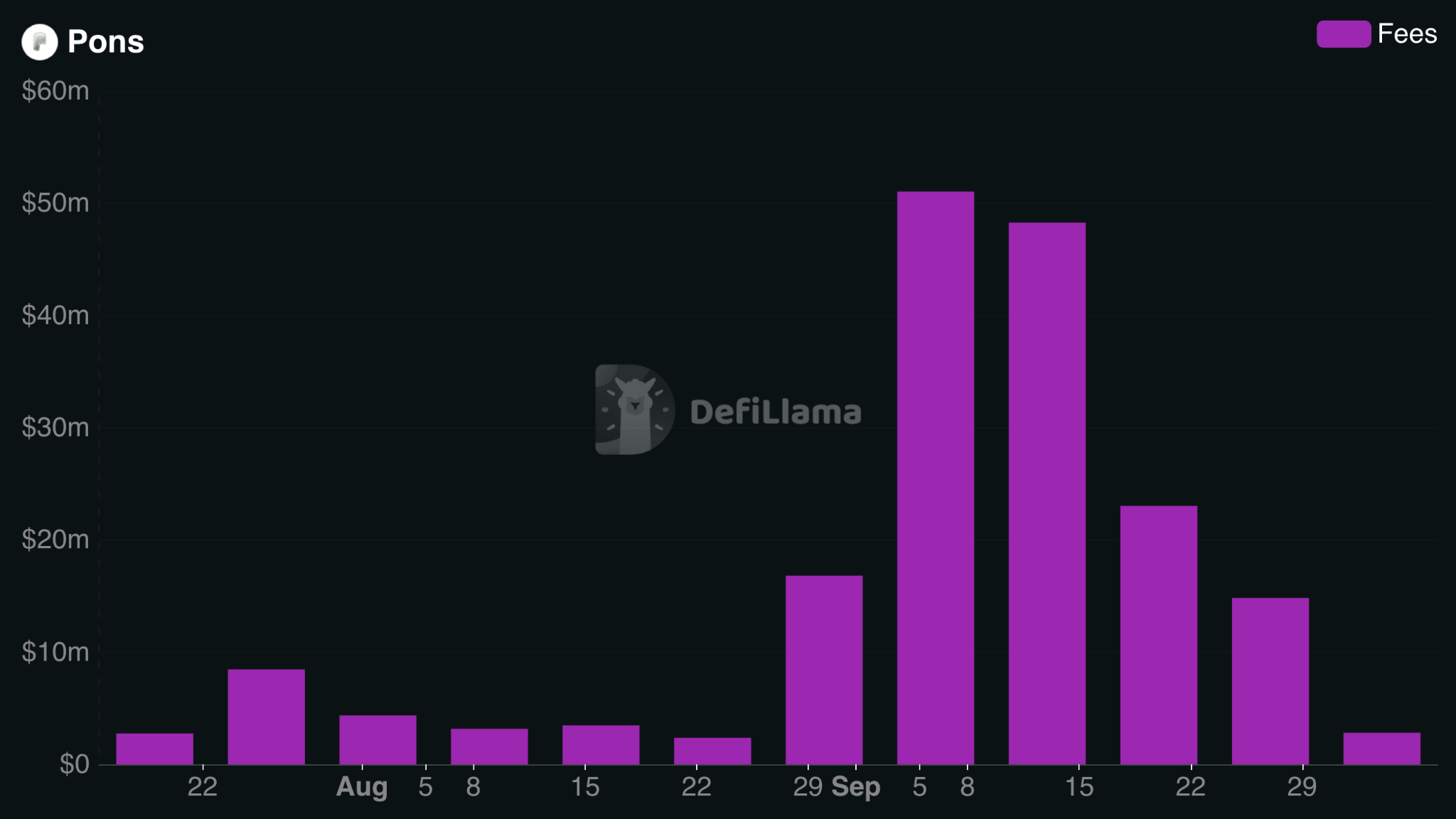
Yet the money parked on the chain kept rising, to $1.02 billion on September 28. Traders are trading less, but they haven’t abandoned the venue altogether.
LONG’s answer is to build coins that last longer than a day. That means deeper pools, a genuine stock on the other side to trade these coins against, burns on every trade, and an upgraded launch system that blocks bots from sniping new coins.
LONG is also funding the depth in these pairs.
On September 7, it added about $135,000 of tokenised Nvidia to the AI/NVDA market, nearly all its recent app fees. A day later it added another $55,000 to deepen the Nvidia stock sitting in the pool that absorbs sellers without letting the price collapse.
An important caveat is that memes only lift trading activity, not depth. LONG can fund some depth through its fees, but only as fast as its fees grow. Lasting depth comes from the supply of stock tokens, and that in turn comes from the tokenised stock factory, that is Robinhood.
Who Owns the Bridge
Every company’s stock can be brought on a chain, but it is not straightforward. One needs to facilitate four things: 1) a securities licence, 2) a custodian holding the underlying stock, 3) a legal wrapper that regulators approve of, and 4) a firm that is allowed to create and destroy tokens.
Only a handful can offer the company all four. These act as bridges between the stock market and the blockchain. On the Robinhood Chain, Robinhood is the bridge. On Solana, Backpack wants to be one. Kraken, through xStocks, and Ondo are the others.
Merely creating tokenised versions of stocks doesn’t create much value. Robinhood’s issuer charges almost nothing to create a token. Redeeming one is free for the first 90 days and costs 0.05% after that. Enabling the crossing of shares off-chain to on-chain is more of a free utility. So bridges earn most of their money from what they build around the crossing.
Robinhood’s bundle makes money at different layers of the stack.
It owns the chain the tokens trade on, and every trade pays a fee. Robinhood keeps 50% of that revenue until it collects about $50 million, 70% until about $150 million, and 85% after that. Arbitrum, whose technology the chain uses, gets the rest. Daily fees hit a record $6.04 million in early September.
Robinhood also owns the firm allowed to create tokens. Its legal documents name Bitstamp Global Ltd as the sole authorised seller, and Robinhood bought Bitstamp in 2025.
Robinhood’s stock token documents allow the shares underneath to be lent out and used as collateral. This also helps it earn just like a trader’s position can earn through stock-lending programmes on a traditional brokerage.
One of the biggest earning capabilities Robinhood has is its nearly 30 million funded user base. It can always tap into that captive user base to cross sell its tokenised stocks and allied products.
Backpack is building a similar bundle on Solana. In January 2025, it bought FTX’s European arm for its licence and distribution, and launched a brokerage in June 2026. Users can hold US stocks there and convert them into Solana tokens and back. On September 26, its CEO Armani Ferrante said he wants to bring “the entire stock market to Solana,” as many as 10,000 stocks.
Backpack earns like a broker and an exchange from trading fees. But on Solana, the issuer, the chain and the app belong to different companies, and each takes a thin slice. This is precisely why Robinhood Chain overtook Solana’s main venues for tokenised-stock trading within weeks of launch.
Where Does That Leave LONG?
Every LONG coin needs a Robinhood token, and every trade pays Robinhood’s network. As LONG grows, the Robinhood bridge grows faster. LONG is even spending its fees to buy tokenised Nvidia for its pool.
LONG 500 is LONG’s bid to become the list that decides which on-chain stocks matter, the way index providers do in traditional markets. Except the index providers get paid because people who buy an index own what is in it. Here, $AI holders have no right to redeem anything from the vault.
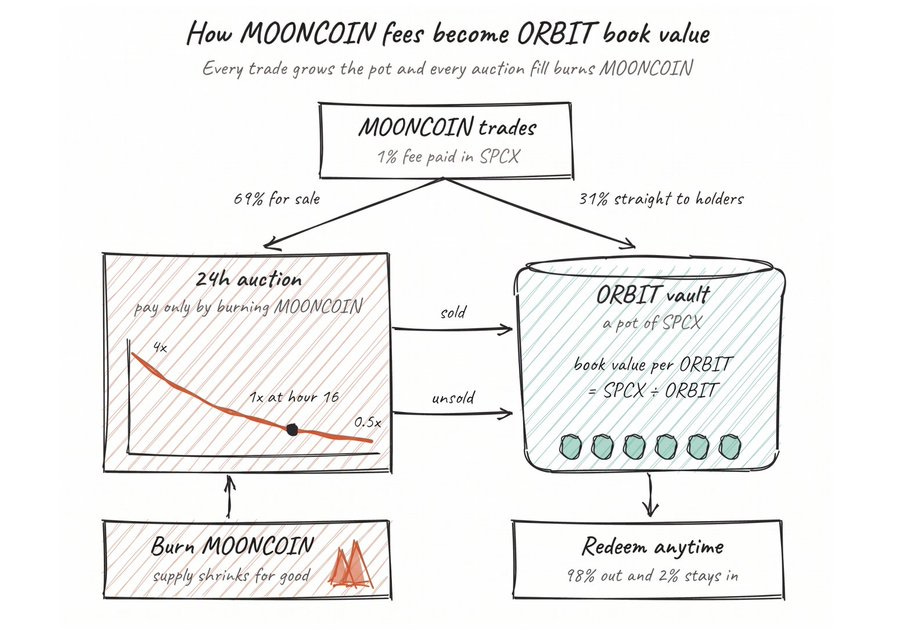
Some projects are already trying to fix this. Mooncoin, a memecoin paired against tokenised SpaceX, splits the job between two tokens. Every Mooncoin trade pays a 1% fee in SpaceX tokens, which go into a vault. A second token, ORBIT, is a share of that vault, and holders can redeem it anytime for 98% of its value. Mooncoin itself has no claim on the pot. Instead, most of the daily fees are auctioned, and the only way to pay is by burning Mooncoin, which hands the buyer new ORBIT.
So the gambler holds the meme and the saver holds ORBIT. It is closer to a real fund than anything LONG has built so far. It is also brand new and unproven, and a redeemable share in a pot of stocks may look a lot like a fund to regulators.
Is this sustainable?
The cross-selling is practical, and LONG offers a reason that was lacking for a set of gamblers to buy a tokenised stock. This relationship can go either way. If Robinhood starts minting tokens around the clock and backs its own launchpad, LONG’s edge will be tied to the fate of Robinhood. But if LONG takes its stock communities to other bridges, pairing coins against xStocks on Solana or Backpack’s tokens, it can expand beyond one network. Bridges would then compete for LONG’s demand, just the way exchanges compete for order flow today. LONG’s move onto Lighter’s perps suggests it already sees this. Also, if LONG bolts something like ORBIT onto LONG 500, its ‘S&P 500’ starts can resemble an actual fund.
Until one or both of these happen, LONG will keep selling the stocks and Robinhood will keep capturing the utmost value across the tokenised shares stack.
That’s it for today. I will be back with the next one.
Until next time, stay curious,
Prathik
Token Dispatch is a daily crypto newsletter handpicked and crafted with love by human bots. If you want to reach out to 165,000+ subscriber community of the Token Dispatch, you can explore the partnership opportunities with us 🙌
📩 Fill out this form to submit your details and book a meeting with us directly.
Disclaimer: This newsletter contains analysis and opinions of the author. Content is for informational purposes only, not financial advice. Trading crypto involves substantial risk - your capital is at risk. Do your own research.