


Hello,
Every major publicly listed bitcoin miner has spent the last four quarters facing an existential crisis. A look at their earnings releases over the past year shows they are moving away from their identities as miners of magic money.
They are now recategorising themselves as “energy infrastructure platforms,” “vertically integrated AI Cloud providers,” or “digital infrastructure companies built around power, land, and compute.”
The rebranding is backed by a shifting revenue mix and a growing market cap that has surpassed what these companies were worth as bitcoin miners.
It looks like a story of struggling miners finally finding their salvation by upgrading to meet the growing demand for compute and AI inference. Except that it isn’t as simple when you zoom out and look at what they are forgoing.
In today’s piece, I will explain why miners’ 180-degree pivot away from bitcoin mining could come back to bite them.

What Drove the Pivot?
First, the halving of block rewards in April 2024 pushed miners to either hold their mined bitcoin and sell it at a higher price, or diversify by using their processors for High-Performance Computing (HPC). But bitcoin’s rally from under $70,000 in October 2024 to $124,000 in October 2025 drove some miners to keep mining and stack their mined bitcoin.
But the October 10 liquidation event, which wiped out $19 billion of the crypto market cap in 24 hours, led to a market downturn the industry has yet to recover from.
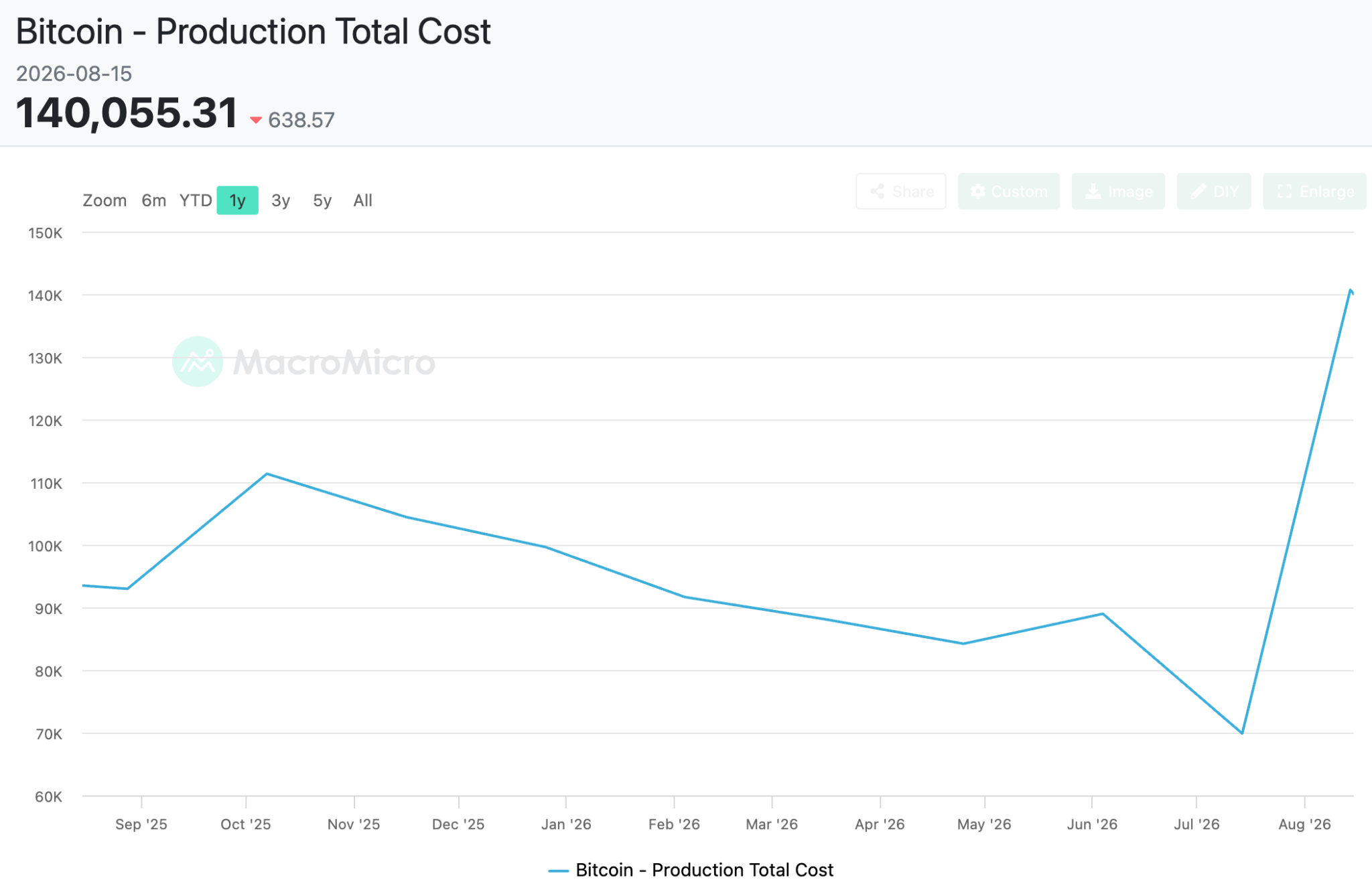
Today, bitcoin price is down almost 50% from October’s peak at ~$63,000. At these levels, it’s almost impossible to mine BTC and sell it at a profit. Bitcoin mining costs vary with electricity costs and the Bitcoin network’s difficulty. Yet the average BTC mining cost rose from about $40,000 in February 2024 to $90,000-$110,000 between October 2025 and July 2026. In August, the all-in cost of BTC mining shot up to an all-time high of $140,000.
The unfavourable environment for BTC mining over the past year has coincided with the capital glut flowing into AI and inference markets.
Bitcoin miners use ASIC mining equipment that runs complex algorithms to win bitcoin as block rewards. This equipment is similar to what is needed for HPC and AI inferencing. This made the pivot from bitcoin mining to AI inferencing easier than starting from scratch. It is also a no-brainer for most miners looking to use their equipment for a profitable cause.
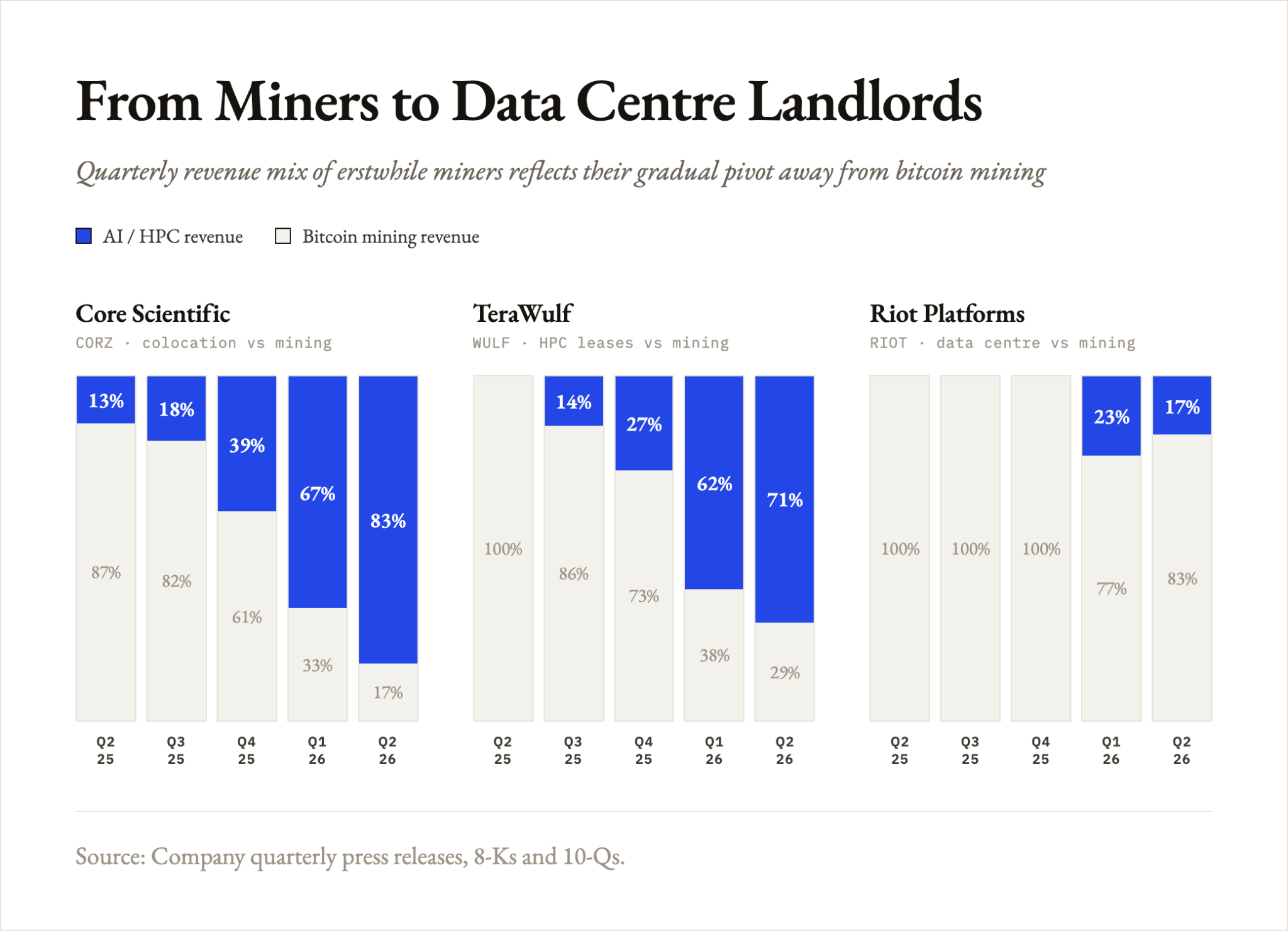
Nearly the entire listed mining sector moved at once, in the same direction. The scale of the shift is evident in how their revenue mix has shifted in the past few quarters.
Consider Core Scientific. In Q2 2025, revenue from colocation, the business of renting out data-centre capacity for AI and HPC, totalled $10.6 million a quarter. In the same quarter, revenue from mining and selling bitcoin stood at $62.4 million from mining bitcoin. Twelve months later, those numbers have almost exactly swapped. In Q2 2026, revenue from colocation is $136.7 million, while revenue from mining has shrunk 65% to $21.5 million.
Colocation now makes up roughly 83% of the company’s revenue, up from 14% last year.
TeraWulf’s HPC lease revenue is already 71% of its total. Its HPC leasing revenue rose from nonexistent this time last year to $32 million in Q2 2026. During the same period, its digital asset revenue shrunk about 75% to $13 million.
The shift is also apparent in how many of these miners have repurposed their existing mining buildings and equipment for AI or HPC operations.
The Worrisome Land Grab
The pivot from bitcoin mining to AI and HPC operations looks like a stampede. Beyond just reallocating existing capacity to AI, these erstwhile BTC miners are also racing to acquire as much power, land and contracted demand as they can.
The contracts already signed run into the tens of billions.
Core Scientific has committed up to 2.5 gigawatts of capacity to AMD and CoreWeave, deals worth north of $24 billion over their terms. Hut 8 has 949 megawatts under contract at a base-term value of $26.6 billion, backed by $7.5 billion in fresh project financing.
TeraWulf signed a 20-year lease with Anthropic for ~$19 billion and acquired a gigawatt-scale campus in Kentucky to meet compute demand.
In the last six months, Riot Platforms has executed leases totalling 241 megawatts of capacity for about $10 billion. Just last week, IREN delivered its first of four AI Cloud deployments to Microsoft under a five-year, $9.7 billion services contract announced in November 2025. It also has a five-gigawatt partnership with Nvidia and is buying power sites in Texas and Spain to feed it.
These deals and contracts explain the excitement around the AI landscape. A 20-year lease with a reputed hyperscaler tenant signals a more stable revenue pipeline than what these companies ever had before. After a year of mining BTC at a loss, a decade and a half of contracted cash flow feels like solid ground.
Except that there are caveats that many of the commentators are underestimating.
Bitcoin mining, for all its pain, has a property that AI hosting does not. Bitcoin mining has a self-restoring feature. When mining becomes unprofitable, miners switch off their machines. When enough of them switch off, the Bitcoin network difficulty drops, so whoever is still mining earns more per machine by spending less to run their equipment.
If enough miners exit the BTC mining landscape, those who remain may find it relatively cheaper to mine. As miners defect to AI, network difficulty has fallen sharply from its 2025 peak of ~156 trillion to 127.5 trillion.
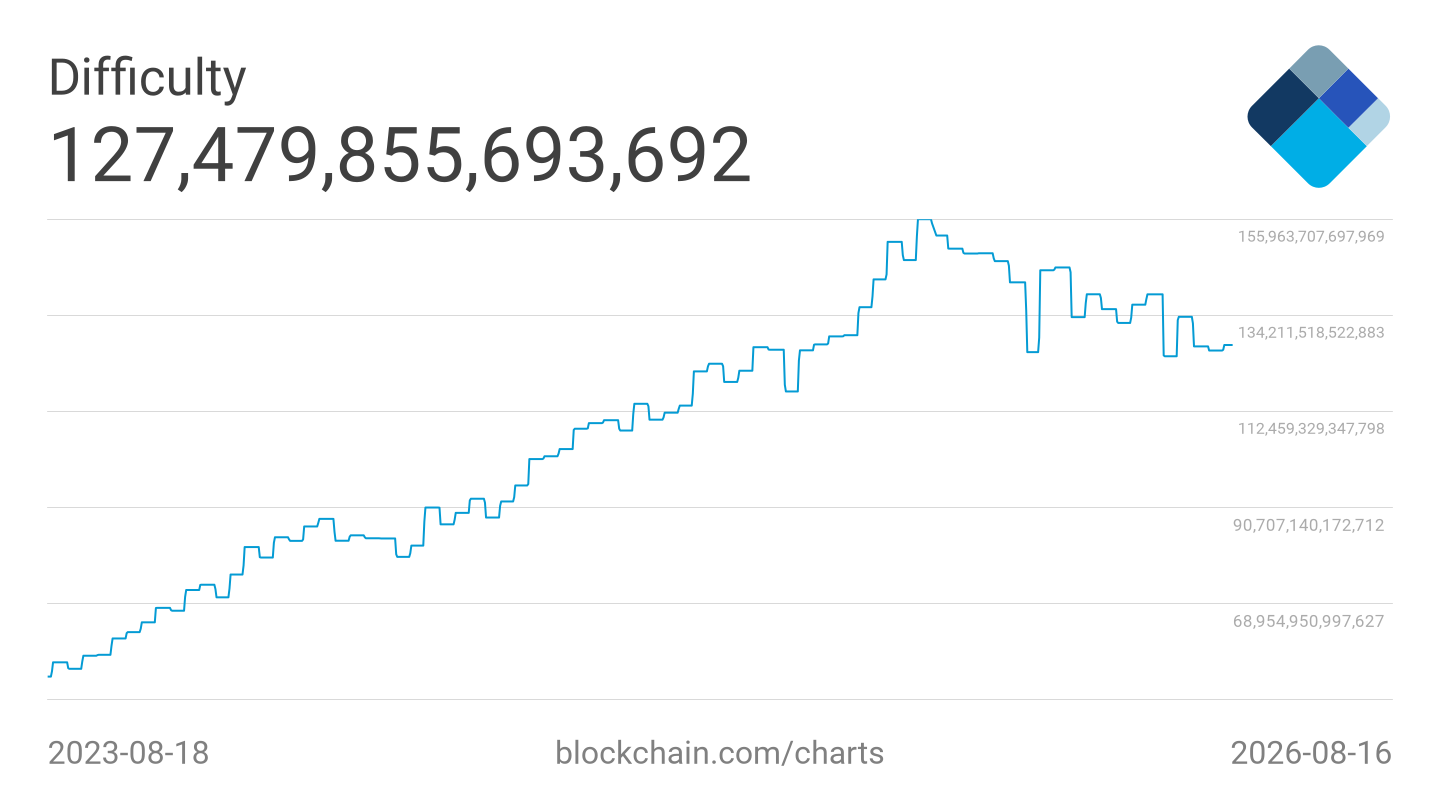
Every company rushing out of mining is making mining more profitable for whoever stays back.
AI compute has no such mechanism. If the industry crowds with too many players offering compute power, the supply eventually overshoots and brings prices down.
Although the demand for AI and compute power is going up, the prices are likely to fall down - contrary to economics 101. In fact, AI companies are already slashing prices. That’s because in a nascent industry, resources are scarce, and so are those building and offering these resources. Scarcity creates a case for charging a premium. Today, the prices these AI companies are locking in carry a premium because compute is scarce. Today, GPU orders are placed even when they are temporarily out of stock. Every hyperscaler on earth is bidding for the same megawatts. This scarcity is driving more BTC miners and data centre providers to ramp up supply. But once this ramped-up capacity tightens the demand-supply gap and compute power becomes more readily available, prices will fall faster.
When those prices fall, the same 15- to 20-year lease that these miners are signing at today’s rates will seem overpriced.
The worrying part about the pivot away from mining to AI and compute processing is that the shift is easy to make only one way. Turning a mining setup into an AI campus is straightforward since the power is already there. But once they replace their ASICs with H100s and sign 20-year leases, those commitments will bind them for the next two decades and prevent them from switching back.
Bitcoin mining will inevitably swing back to profitability, driven by lower network difficulty and BTC’s price recovery from the $60,000 lows once the market downturn flips. When that happens, the fully pivoted erstwhile miners, bound by the multi-year leases, will have to watch it happen from the sidelines. It would hurt them even more if the AI and HPC prices they get out of their deals aren’t as attractive as they are now.
So should the miners not pivot to AI and simply wait for the mining equation to flip? I don’t think so. For most of them, the pivot was driven by survival. Mining at a $140,000 all-in cost against a $63,000 coin doesn’t make business sense. AI money was the only lifeline within reach. But the question of survival can often drive businesses to take extreme measures. Here, too, the problem is with those who completely went all-in on AI. Driven by desperation, these businesses fled BTC mining entirely, repurposed all their ASICs, and locked themselves into decades-long deals in a nascent industry already seeing price corrections across the sector.
But even as most miners did a full 180-degree pivot, some others are treading carefully.
Hedgers Hold an Edge
Marathon Digital, the BTC miner with the largest BTC treasury, is treading carefully. In Q2 2026, the company sold 30% of its BTC holdings to cut its debt obligations. But it chose a different approach to fund its AI expansion instead of scrapping its BTC mining rigs.
MARA drew $150 million under the 2026 Line of Credit using its remaining BTC holdings as collateral. As of June 30, 2026, the company still holds more than 35,000 BTC on its balance sheet and is planning to keep mining alive on a flexible load.
Hut 8 is also not abandoning BTC mining. It is spinning out its BTC mining business into a separate, majority-owned subsidiary called American Bitcoin Corp., allowing the parent company to pivot its core focus toward high-performance computing and AI infrastructure.
By keeping rigs warm and treasury intact, these operators hold an option the all-in converters liquidated. When mining turns profitable, they can redirect power back to it. The fully pivoted can only watch.
Miners going all-in on AI and treating their old BTC mining business as dead weight are betting on a future few have seen. But the trend is not difficult to predict. Every nascent technology, including chips, computers and smartphones, got cheaper as the industry and ecosystem matured. AI and compute industry is already seeing this happen.
Companies like MARA and Hut8 aren’t entirely out of the AI opportunity. But by retaining some mining capacity and BTC treasury instead of liquidating completely to buy GPUs, they are treating AI as a diversification play rather than committing all capital to an industry that hasn’t fully matured or been repriced accordingly. The stocked ASICs let them switch the load back to mining BTC when it pays the best and the compute premium thins.
When you zoom out, all these companies are essentially power companies that are topped with either ASICs or H100s. But those that can redirect power between mining and AI compute, depending on what pays best, will not be completely at the mercy of market cycles and narratives.
That’s it for today. I will be back with the next one.
Until next time, stay curious,
Prathik
Token Dispatch is a daily crypto newsletter handpicked and crafted with love by human bots. If you want to reach out to 170,000+ subscriber community of the Token Dispatch, you can explore the partnership opportunities with us 🙌
📩 Fill out this form to submit your details and book a meeting with us directly.
Disclaimer: This newsletter contains analysis and opinions of the author. Content is for informational purposes only, not financial advice. Trading crypto involves substantial risk - your capital is at risk. Do your own research.