


In 1487, Henry VII needed money. He had taken the English throne two years earlier at Bosworth Field, and holding it was expensive. The job of collecting the money went to John Morton, his Lord Chancellor.
The story goes that Morton had a method. He would visit a nobleman’s house and look around. If the man lived lavishly, Morton concluded he was rich and could clearly afford to give the king a gift. If the man lived modestly, Morton concluded, he was saving money and could therefore also afford to give the king a gift.
There was never a third house, and no matter what Morton observed, the result was the same and the nobleman paid.
We only have this second-hand. Francis Bacon wrote it down in 1622 as a tradition people still repeated, and the name Morton’s Fork only entered common use in the 1800s. But the shape of it stuck around because it is useful. A fork, in this case, refers to a situation in which both arms lead to the same result. The opposite of win-win.
Ethereum and Solana are standing at such a place right now.
Both chains pay their validators with newly created tokens, and both are attempting to reduce those payments. Ethereum’s effort has faced strong opposition, while Solana’s initiative is currently being voted on, with the vote concluding on 18 August.
On one hand, if you continue to pay validators their current yield, staking favours the largest operators with institutional funding. On the other hand, if payments are reduced, smaller operators suffer first because their costs are fixed and their margins are razor-thin.
Fewer validators either way. So today, we are pulling apart the issuance debates on both chains to see how they are being forced to choose which flavour of centralisation they prefer.


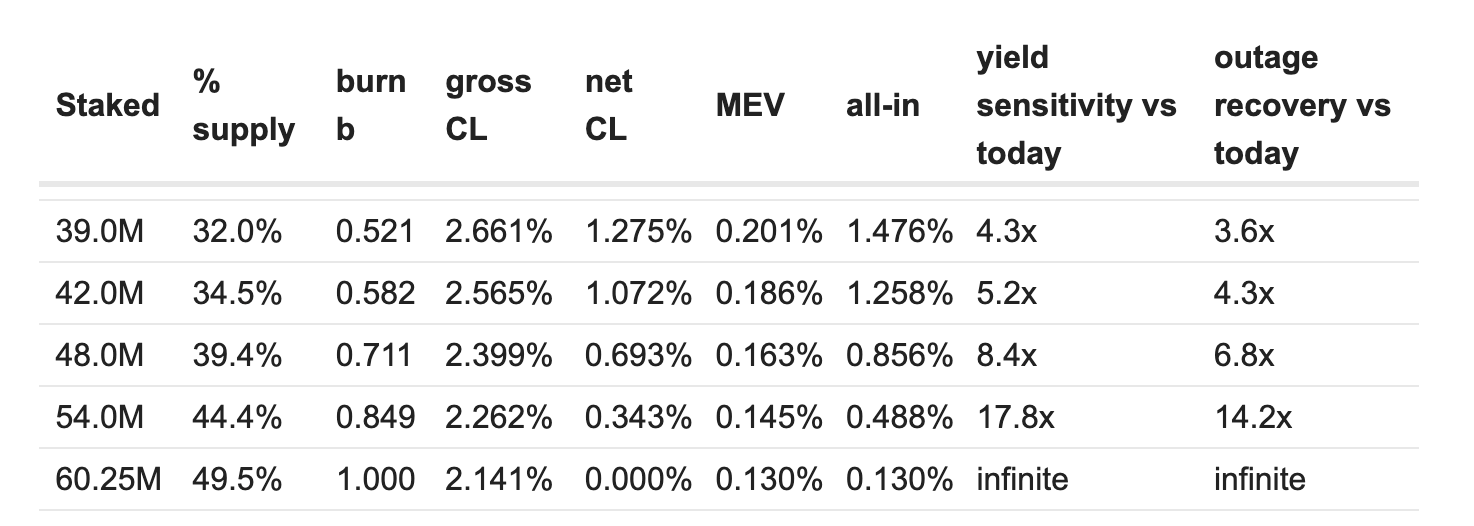
On 4 August, Ethereum researchers, including Justin Drake and Jérôme de Tychey, issued a draft known as Tapered Issuance Burn, referred to as EIP-8363. The idea is that as more ETH is staked, the protocol burns a bigger slice of the validator reward.
Once staking reaches 60.25 million ETH, roughly half the supply, the burn hits 100%, and issuance yield goes to zero.
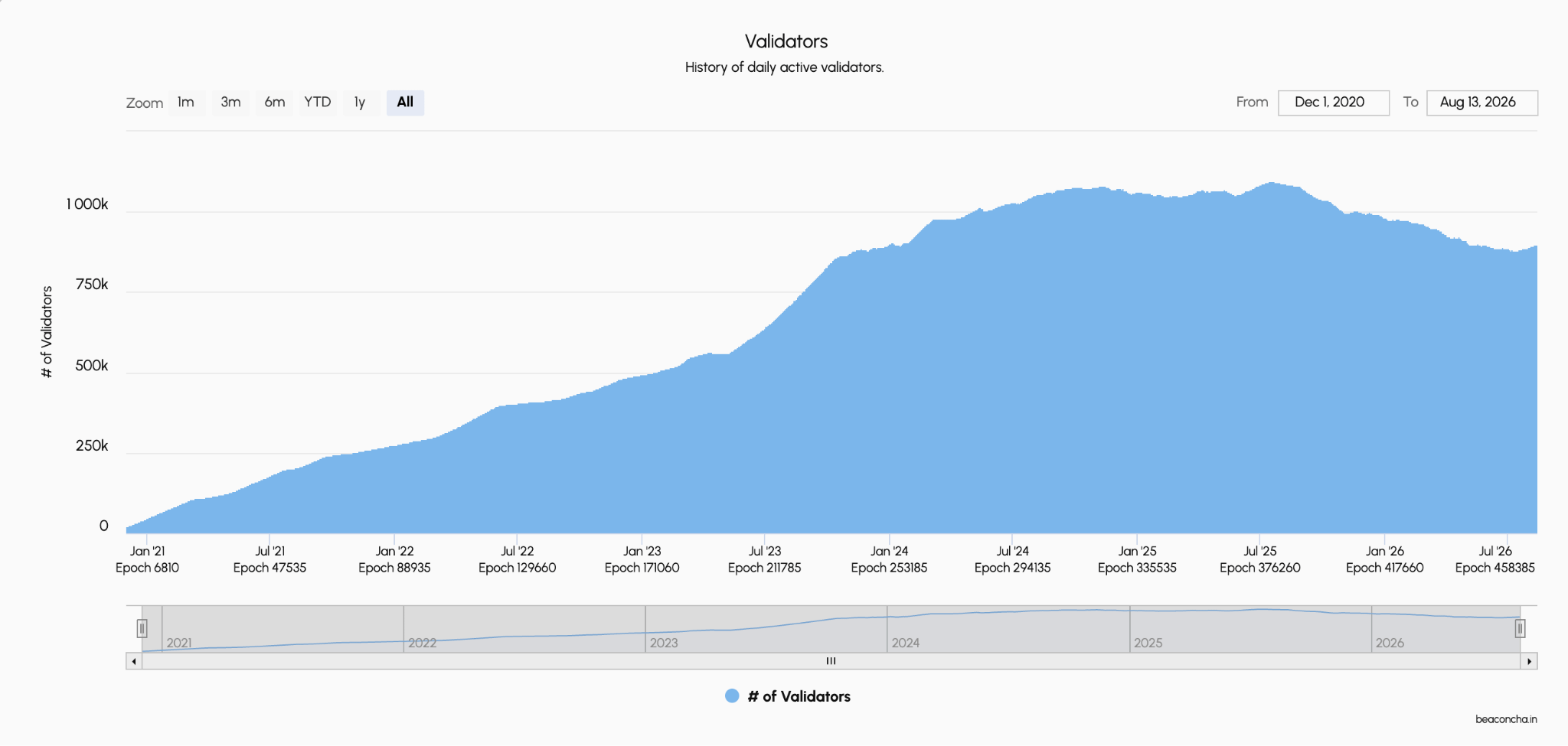
Today, about 41.4 million ETH is staked, representing 34% of the total supply, by about 890,000 validators earning an average rate of 2.67%. When Stani Kulechov from Aave put forward the proposal at that level, validator income dropped from 2.862% to 1.476%, that being just under half.
Within three days, Kulechov, SharpLink CEO Joseph Chalom and ether.fi’s Mike Silagadze had all come out against it publicly.
EIP-8363 is still an early, unapproved idea actively undergoing initial review on GitHub, and is not near being finalised or implemented. It missed the deadline to be included in Ethereum’s upcoming Hegotá upgrade. But it could be approved for a future network upgrade.
To understand why stakers are fighting these cuts so fiercely, you have to look at the sheer size of the pie. Ethereum pays people to secure its network. The protocol creates about 1.1 million new ETH a year and hands it to validators. At $1,921, that’s a $2.1 billion annual payroll.
Solana does the same thing, just on a much larger scale relative to its usage. It issues roughly 19 to 22 million SOL a year, about $1.5 billion at today’s price. Users pay 6,400 to 9,600 SOL a day in fees and Jito tips, around $225 million a year. So users cover about 13% of what Solana’s validators earn, and new supply covers the rest. Ethereum is no different. Chalom puts tips at roughly 15% of staking yield, meaning issuance funds the other 85%.
Solana creates 3.7% more SOL every year. Ethereum creates 0.85% more ETH. So a Solana holder who doesn’t stake gets watered down more than four times as fast as an ETH holder who doesn’t stake.
In traditional finance, the National Securities Clearing Corporation (NSCC) is involved in almost every US stock and bond trade. Its parent, DTCC, processed $4.7 quadrillion in securities transactions in 2025 and has $115 trillion in custody. NSCC’s protection fund (the money available if a member defaults) is $19.7 billion, contributed by members. NSCC’s own contribution to that fund is $130 million.
To compromise Ethereum, an attacker would have to overpower 41.4 million staked ETH, a $79.6 billion wall of capital that is four times larger than NSCC’s fund. This is just floor; if someone actually attempted to buy millions of ETH, the sudden demand would drive the market price through the roof. Furthermore, the attacker would have to fund a massive, global network of servers just to put those coins to work. And because Ethereum is designed to defend itself, one malicious move triggers the network to instantly burn the attacker’s stake. A failed attack means losing every single penny forever.
But unfortunately, these systems don’t work the same way, right?
NSCC members post that $19.7 billion as a cost of membership. The price of access to the market, without a yield from that money. Members would prefer the number were smaller. Ethereum pays people 2.67% a year to post the equivalent. Solana pays 5% to 8%.
When you pay someone a yield for four years straight, businesses grow on top of that yield. Right now, about $35 billion in special reward-earning tokens like stETH are held as locked deposits in crypto lending apps. Traders use these tokens to run a repeating money loop. Traders put them on Aave or Morpho, borrow WETH against them, stake that again, and repeat. The trade only works if you earn more from staking than you pay to borrow. Pendle constructed fixed-rate markets on the same yield. Curve has pools where people can get out. SharpLink has a $3 billion ETH treasury and stakes most of it through Coinbase, Anchorage, Figment, and Galaxy.
Staking yield serves as the fundamental benchmark interest rate across DeFi. A 50% haircut to consensus rewards flips the looping trade from profitable to negative, forces Pendle’s fixed rates to correct, and mandates a network-wide revaluation of LSTs by lenders.
Before the Merge, Ethereum issued around 13,000 ETH per day to miners, but after the Merge, it issued only about 1,700 ETH per day. That was an 88% reduction, which was carried out all at once. Since miners had invested years and billions of dollars in hardware, they resisted the change, ended up forking the chain into ETHW, and that token is now trading at less than 1% of ETH’s value.
Miners were entirely disconnected from the DeFi economy. They provided a service and collected a paycheck, but nobody was building complex financial products on top of that paycheck. Because their income wasn’t being used as collateral for loans across the network, wiping out their revenue overnight had zero impact on the lending markets. When miners walked, the rest of the system carried on without making any adjustments.
Stakers do two jobs at once. They secure the network, and the tokens they get back are collateral in half of DeFi. So you can’t remove their income without touching everything built on it.
As Mancur Olson pointed out in 1965, a small group that has a great deal to gain can outperform a large group with only a small stake because the smaller group takes the initiative and shows up.
Running a validator costs money whether you earn or not. A machine, power, a connection and so on. Stake 32 ETH today and you earn about 0.92 ETH a year, roughly $1,760. Under the new taper proposal, revenue drops to just 0.47 ETH ($900). The machine costs the same either way, so a bill that was eating a fifth of your income is suddenly eating close to half. If you miss an attestation, and you lose the same ETH you always did, you lose half the revenue.
The big group (as per Olson’s theory) is the regular token owners. Every year, Ethereum creates new coins to pay stakers. This makes regular ETH slightly less valuable. They don’t fight because it costs each regular holder only a few pennies or a fraction of a per cent a year. It’s so small that not many notice or care enough to protest. The small group is big staking companies. They get all of those newly created coins, which add up to billions of dollars. Their whole business depends on that money. If the network reduces those payouts, these companies lose millions.
The main argument for is that the pay is so good it keeps pulling ETH in, and most of it goes to a few large exchanges and staking providers. Staked ETH rose about 15% in the first half of 2026 on institutional flows. Their fix is to cap staking by making the marginal stake unprofitable.
The counter is that if you cut the pay, the everyday people running small setups at home will go broke first. Both sides actually want the same thing, which is to stop a few rich companies from controlling Ethereum. They still disagree on whether cutting pay or keeping it will ruin the network faster.
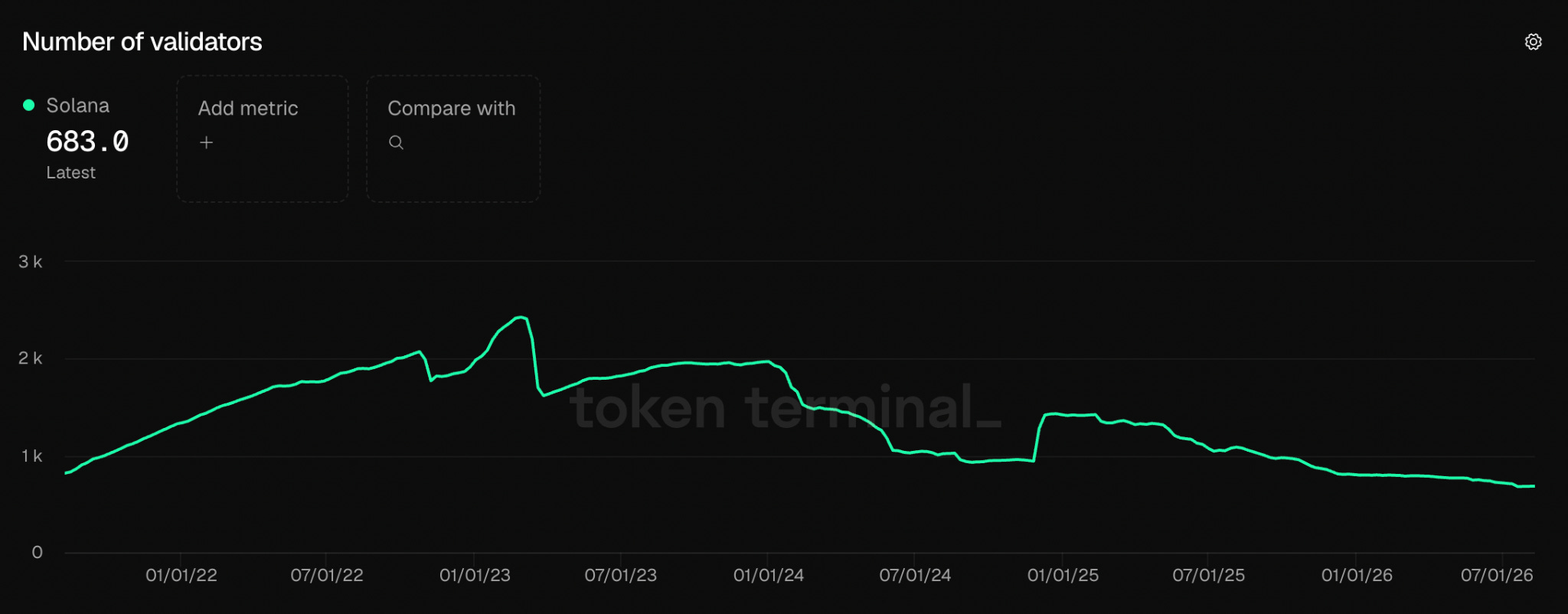
A Solana validator pays a vote fee of about 389 SOL a year. You pay it whether you earn anything or not, whether the market is up or down, whether anyone delegates to you. At today’s staking yield of around 6.5%, break-even sits near 200,000 SOL of delegated stake. Active validators fell from more than 2,500 to roughly 683 now, while total staked SOL climbed to about 430 million, near 68% of eligible supply.
Solana is voting to reduce the rewards. SIMD-0550 would double the disinflation rate from 15% to 30% per year, pulling the terminal inflation rate of 1.5% forward from 2032 to 2029 and removing an estimated 18.9 million SOL from future issuance. SIMD-0553 reworks fees based on resource usage and burns them, lifting daily burns from around 648 SOL to between 7,500 and 9,000 SOL. Even at the high end, that’s a fraction of the 60,000 SOL a day going out. Voting closes on 18 August and needs a 66.67% supermajority of stake.
We like to treat blockchain governance as an exercise in sovereign self-determination, where code and community votes dictate the future of digital economies. Yet the structural drift of both Ethereum and Solana suggests that software protocol rules are ultimately downstream of financial realities. The original architects designed the economics, hoping the market would naturally stay decentralised. Yet, when an asset becomes the bedrock of global liquidity and institutional treasuries, the brute-force mechanics of yield, leverage, and corporate capital expense will always overpower those intentions.
If the network is scaling by paying people to lock up their money, it will always run into this wall. It doesn’t matter how Solana votes on Monday, or what Ethereum decides to do with its proposals down the line. They are only picking how quickly we get there and hit the wall.
Token Dispatch is a daily crypto newsletter handpicked and crafted with love by human bots. If you want to reach out to 170,000+ subscriber community of the Token Dispatch, you can explore the partnership opportunities with us 🙌
📩 Fill out this form to submit your details and book a meeting with us directly.
Disclaimer: This newsletter contains analysis and opinions of the author. Content is for informational purposes only, not financial advice. Trading crypto involves substantial risk - your capital is at risk. Do your own research.
Love it!!! something to think about and how to plan for the future.