


Hello,
Did you know that crypto card spending crossed $759 million in July, across 9 million purchases? That is nearly two and a half times what it was just a year ago. And over 90% of that volume still runs on Visa.
And every one of these cards will sell you the same story: we put payments on Stablecoin rails to cut out the card network fees and hand the savings back to the merchants. It is the same idea we explored when we wrote about how Stripe is building its own Stablecoin-powered cross-border payment chain.

So I went deep looking into what actually happens if you try to remove a card network. Does avoiding Visa or Mastercard really save the merchant money? And which layer do stablecoins actually replace in the payment stack?
The answers were not at all what I had expected.

How the Payment Stack works
To get answers to those questions, I first had to understand where the money actually goes when someone swipes a credit card. And the first thing I realised was that most people, including people in crypto, assume that the card network like Visa is the one taking the biggest cut.
Wrong! When a merchant accepts your $100 purchase on a rewards credit card, they pay what is called a merchant discount rate of approximately 2.2%, which comes out to $2.20. But here’s the interesting thing: that $2.20 does not go to Visa; rather, it gets split between three different parties, and the split is not even equal.
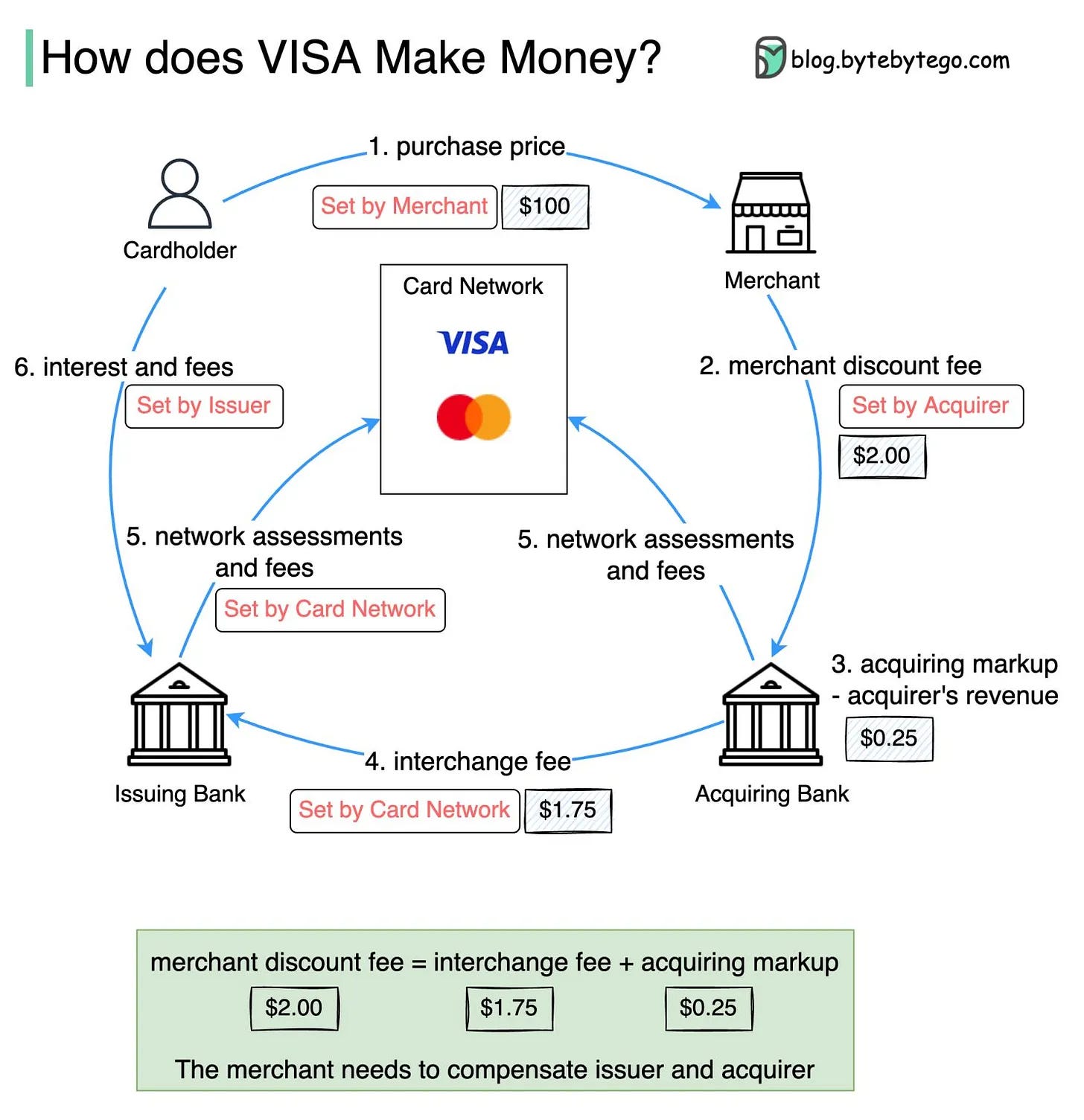
The largest share, about $1.75, goes to the issuing bank, i.e the bank that gave the customer the credit card. These fees are called interchange, and they make up 70-80% of the entire merchant fee. Next, the merchant’s payment processor, also known as the acquirer, takes somewhere between $0.30 and $0.70 as its markup. And finally comes Visa or Mastercard, the actual card network that everyone in crypto wants to disrupt, which takes around $0.13 to $0.18 as its assessment fee. Which is roughly just 7-9% of what the merchant paid in total.
So if you remove Visa from this equation, you are just removing the smallest line item in the entire stack, and there is also a reason why Visa earns such a small fee.
See, Visa does not lend money to anyone, and so it does not have to deal with all the credit risk, chargebacks or fraud disputes. In fact, Visa does not even move the money. It is simply a messaging network which only activates when you tap your card at a store. Visa’s job is to send the authorisation message from the merchant’s terminal to the issuing bank and back, and it sets the conditions under which everybody in the system operates. The party that is actually doing most of the heavy lifting is the issuing bank. It is the one that extends the credit to the consumer and the risk that they might never pay it back. It is also the one which absorbs the float between the purchase of the good and the statement due date and uses the interchange to fund the rewards programme that got the customer to use the card in the first place.
This is also what makes Visa’s business so fascinating. In 2025, Visa processed $14.2 trillion in payments volume across 257.5 billion transactions and generated $40 billion in net revenue at a net margin of close to 50%. It earns roughly $0.13 cents per transaction on average, and that’s its entire business model. The reason why Visa is one of the most valuable companies on earth is not that it charges a lot per swipe but because it processes a quarter of a trillion transactions every year with almost no marginal cost and zero credit risk.
Now let’s talk about the part where things start to get really uncomfortable for stablecoin cards.
Every single stablecoin card is a debit product. The money is already sitting in the user’s wallet as USDC or USDT even before the purchase happens. Also, there is no float and no revolving balance generating interest income on the side. This puts these cards in an entirely different economic category.
Another thing is that in 2010, Congress passed the Durbin Amendment, which capped debit card interchange for any bank with more than $10 billion in assets at $0.21 cents plus five basis points per transaction. The way most stablecoin card programmes get around this cap is by partnering with a small sponsor bank (neobanks) that falls under the $10 billion asset threshold, which makes them Durbin-exempt. And this is the exact reason why there is a sponsor-bank model that exists in fintech.
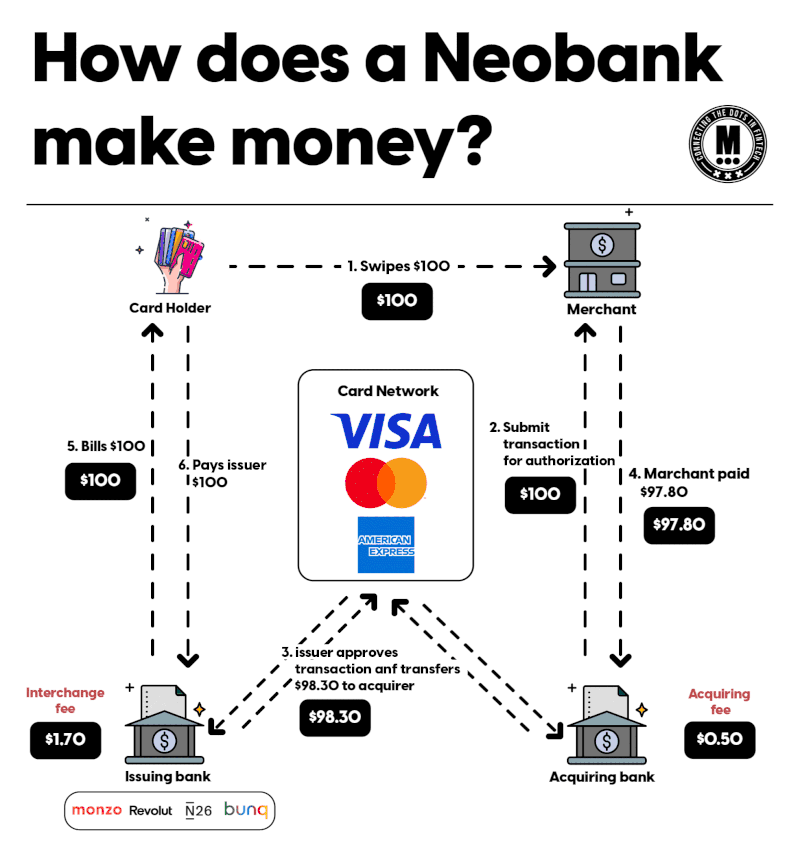
And the exempt debit interchange on dual-message networks currently averages at about $0.62 cents per transaction. So here’s the thing: a rewards credit card works with about $2.20 of gross revenue on a $100 transaction. But a stablecoin debit card, even at the higher exempt rate, still works with just $0.62 cents. And out of those 62 cents, the programme still has to pay the network, its processor, sponsor bank and also cover its own fraud losses and operating costs before anything at all is left over for the merchant.
So What Actually Gets Replaced?
So the point is, fee savings from removing Visa are tiny, and the economics of running a stablecoin card on debit interchange are extremely tight. But maybe the real value of stablecoins in payments is not about saving a few cents on the network fee. Maybe it is about replacing something more important in the payment stack.
To figure that out, I went back to our piece on why Stripe built its own chain, where we had broken down a cross-border payment into seven toll-collecting functions: Acceptance, Orchestration, Licensing, Custody, FX, Issuance, and Settlement. I wanted to map a domestic card swipe against those same seven layers and see what actually changes.
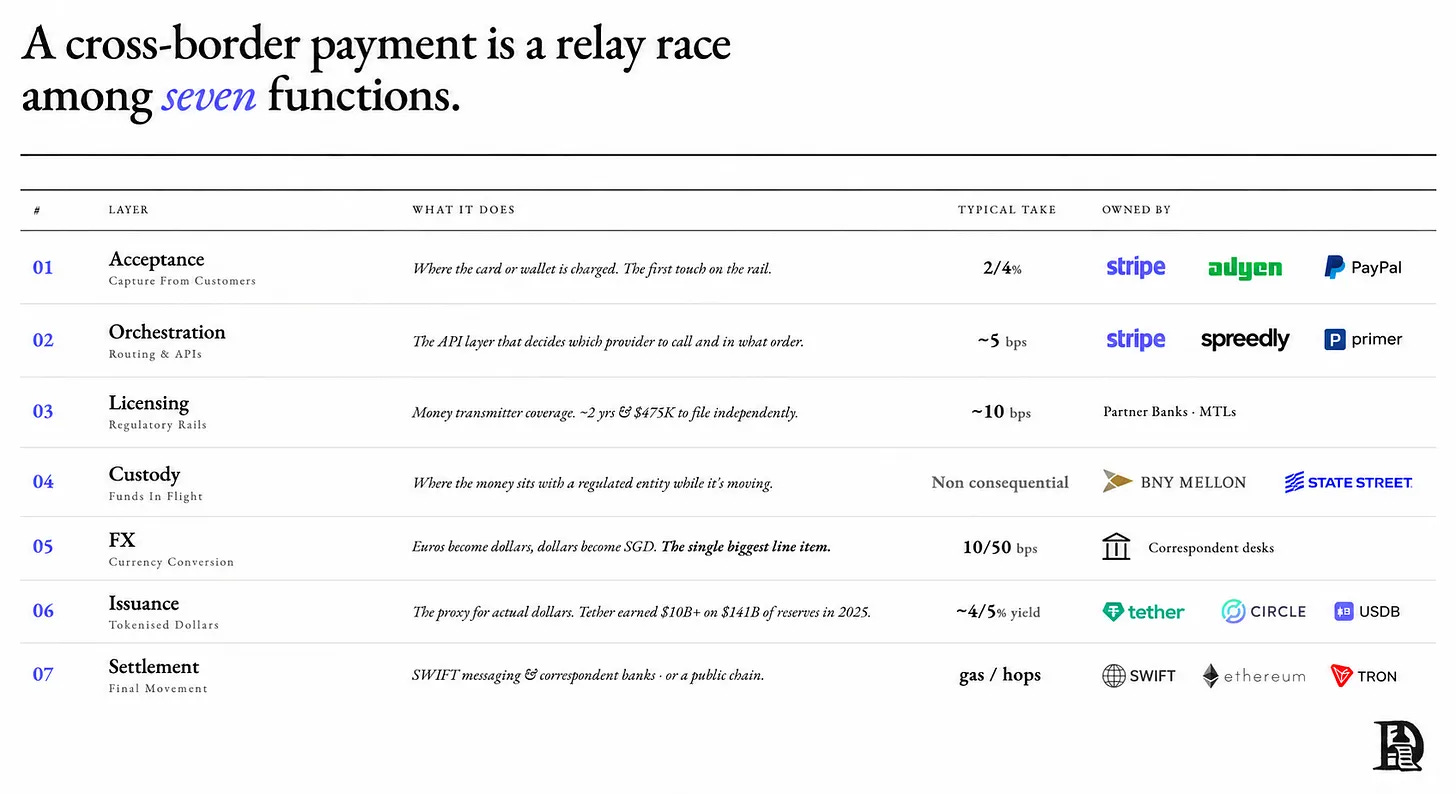
So if we look at this from a merchant perspective, Acceptance, which is where the transaction starts, is still completely untouched. Meaning the process is still the same: the merchant has a terminal, the customer hands over their card, and they still pay the same merchant discount rate to an acquirer.
The merchant does not even know that the funding source behind the card was USDC. As far as they are concerned, a Visa transaction still shows up in their batch just like any other transaction. Similarly, the Orchestration layer still routes through Visa or Mastercard, and Issuance still happens through a sponsor bank and a BIN under a network’s brand. Fintechs have been doing this since well before stablecoins existed, and nothing here has changed.
Where exactly things start to change is on the backend, and that’s where it starts doing numbers on your psyche.
Settlement is the only layer where stablecoins make a fundamental difference. Traditionally, when a card transaction settles between the issuer and the network, there is a T+2 cycle, with weekend delays and batch processing. To fix this, companies like Rain provide daily settlement with Visa in stablecoins, and Mastercard has also started settling in stablecoins like USDC, PYUSD, and RLUSD with intraday settlement cycles. This compresses the T+2 settlement to something much closer to real-time and frees up working capital that issuers would otherwise have sitting locked in the settlement float.
But the working capital benefit goes entirely to the card issuer, and the merchant’s discount rate also does not change because of faster settlement. The consumer or merchant notices absolutely nothing different during checkout.
The only party that benefits from the T+0 stablecoin settlement is the programme operator who no longer has to fund two days of float. And the actual innovation here that stablecoins enable is treasury improvement for the issuer, which at scale is worth a lot but doesn’t provide any marginal benefit to the merchant or the customer, to say. This also does not give Visa any reason to lower its fees, because Visa was never the one funding the settlement float in the first place; the issuer was. So even though the issuer’s working capital cost goes down with stablecoin settlement, Visa’s own costs have not changed at all, and neither has the merchant’s discount rate.
And then you should also note that Visa and Mastercard are not fighting stablecoin settlement. They are rather actively building it into their own networks. Visa has been settling in USDC on Ethereum and Solana since 2021 and is now running it at a $7 billion annualised run rate. Mastercard also acquired BVNK a few months ago to expand its own stablecoin infrastructure. They even said they “don’t see stablecoins disrupting the current payment landscape, infact they reinforce it.”
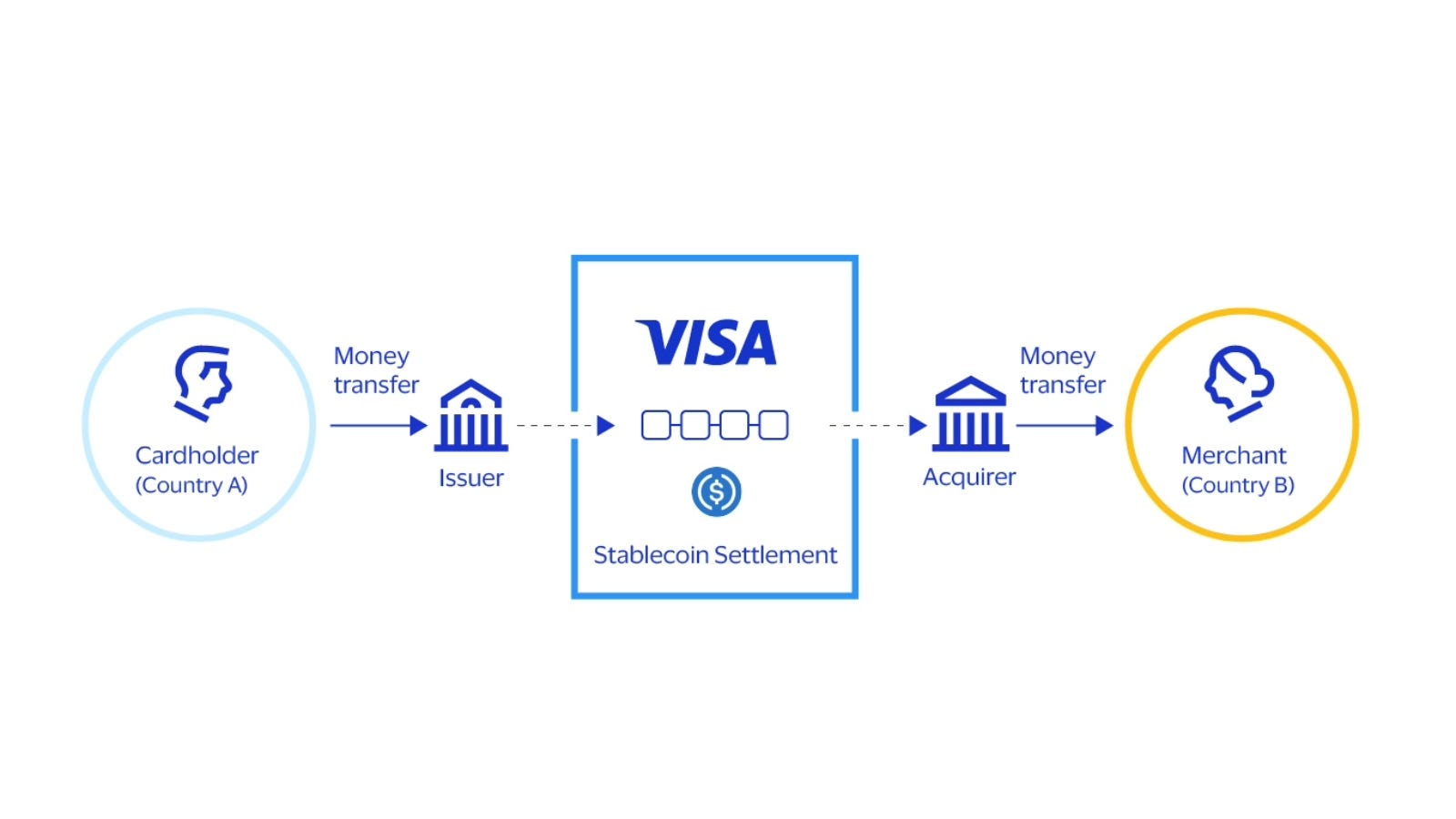
The networks are not being disrupted or replaced by stablecoins; rather, they are absorbing them as an upgrade to their own settlement layer. Every stablecoin card that runs on Visa adds transaction volume to Visa’s own network and pays Visa’s assessment fee while ironically claiming to disrupt it.
One thing I would also mention is that in our Stripe piece, we did argue that stablecoins are actually attacking cross-border payment costs because they remove the chain of intermediary banks entirely, and there’s nothing misleading about that claim. But the whole difference is that one is a cross-border FX problem, and the other is a domestic network fee. The industry took legitimate insights about cross-border payments, where stablecoins genuinely save money, and then also stretched it to cover domestic consumer spending, where the economics are completely different.
The cross-border thesis is strong, but the domestic one falls apart if you look at where the fees actually come from.
So what do stablecoins ultimately replace? Honestly, the answer can be settlement and cross-border FX. But what is being replaced exactly is the plumbing behind the transaction. And the plumbing behind a domestic card swipe was never really where the money was anyway.
That’s all for today!
Token Dispatch is a daily crypto newsletter handpicked and crafted with love by human bots. If you want to reach out to 170,000+ subscriber community of the Token Dispatch, you can explore the partnership opportunities with us 🙌
📩 Fill out this form to submit your details and book a meeting with us directly.
Disclaimer: This newsletter contains analysis and opinions of the author. Content is for informational purposes only, not financial advice. Trading crypto involves substantial risk - your capital is at risk. Do your own research.