


Jesse Leimgruber co-founded OpenHome, an AI hardware company. He also holds Anthropic shares. A few months ago, he hinted on X that he might be open to selling them.
He built a CRM just to track who was asking because he had hundreds of replies and wire-ready cash offers.
A “very well-known growth fund” bid a $1.05 trillion valuation for the company. He said a large VC firm(we don’t know the name) offered him a general partner title at their fund, on the condition that he pledge his Anthropic shares. He said afterwards that the partnership had no existence outside the shares.
The demand was off the charts. A banker offered his own $4.8 million Marin County house to early Anthropic employees willing to part with a slice of stock. Another investor offered a 14-acre estate on LinkedIn at an implied valuation above $800 billion. A secondary firm said a shareholder was buying stock at $1.15 trillion. The head of Rainmaker Securities described the market as having no sellers at all, just an imbalance.
Leimgruber said he used Ventuals to gauge what his own shares are valued at.
Ventuals was a Hyperliquid book where traders posted leveraged bets on Anthropic’s valuation.
We don’t know what Leimgruber did with his shares. May have sold some, all, or none, because private transfers are not usually announced in public, so from rom the open trail, he was a would-be seller.
But Ventuals shut down, and the founders joined Phantom. trade.xyz took almost all HIP-3 flow.

Anthropic is obviously going to be the next most sought-after public stock. But there’s no endpoint for retail investors to access private equity unless they are accredited investors. To be that, you should be wealthy af to begin with.
The other option is Hyperliquid’s HIP-3, where Ventuals lived. Now we have Entropy instead of Ventuals on HIP-3. But how is it a better story than Ventula’s? Do we know if it is? Let’s go down the rabbit hole.

Crypto Investing On Autopilot
You’ve probably had your brain fried tracking 50 things for the few tokens you handpicked from a pile of random. Crypto is not a joke. If anything, it is a sad place that robs people off their money. Glider builds on the opposite philosophy. It helps you pick a basket of assets and programmatically rotate it based on conditions you define.
One basket holds the Mag7 at equal weight.
Another mirrors congressional stock trades, the Pelosi Tracker.
Everything stays non-custodial. No gas fees either.
Today’s issue was sponsored by them, and it comes in the week they launched ATPs with Bitwise. More on their release on Bloomberg here. Explore how Glider combines RWAs and programmatic finance directly in its product here.

Let your strategy run itself at Glider.fi.
On 13 October 2025, Hyperliquid launched HIP-3, which lets anyone launch a perp DEX on Hyperliquid. But only if you have $40 million. The trading fee is double the native Hyperliquid rate. The deployer retains 50% of this fee, and Hyperliquid uses the remaining 50% to fund token buybacks. Roughly 30% of HL perp volume now flows through HIP-3 markets.
Entropy met the Hyperliquid HIP-3 deployment requirement on August 24 by locking a 500,000 HYPE bond worth $40 million, backed by a $14 million investment from Ribbit Capital.
Entropy’s ANTH uses a market-cap quote (1 = $1 billion) to bypass unknown share counts. So if the price is $2,000, that means a $2 trillion valuation. Like everything on HIP-3, you don’t get to own Anthropic shares, and Anthropic doesn’t care that you exist. You hold a smart contract entry on the Hyperliquid ledger. This entry mathematically tracks the price of Anthropic’s implied market capitalisation as quoted by the Entropy exchange. You have no pathway to convert this synthetic position into actual company shares, regardless of whether the company goes public.
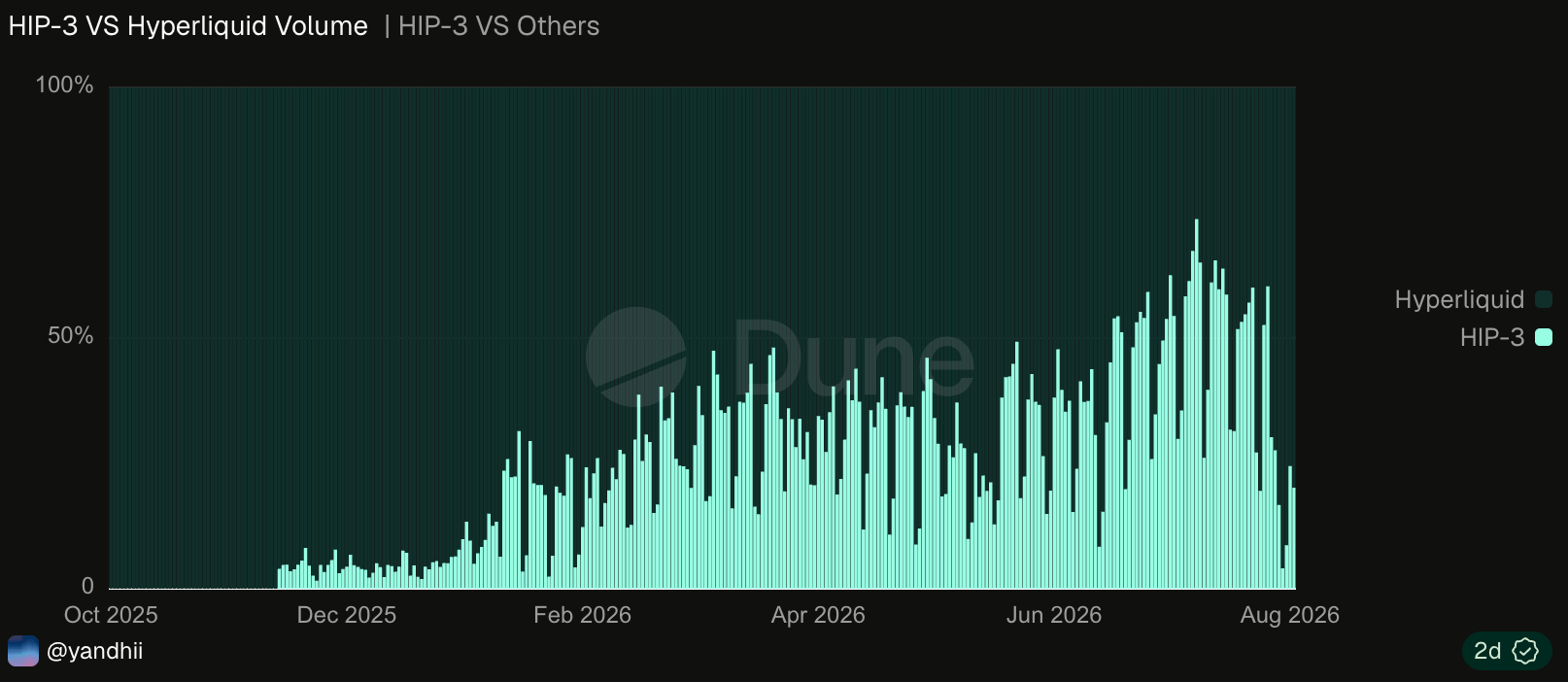
If Anthropic has not listed by 18 August 2028, ANTH cash-settles at a thirty-day average of its own mark. Funding keeps running through that window. Nothing off-venue has to be correct for the contract to pay.
Hyperliquid deployers tested two other pricing engines this year to manage pre-IPO synthetic assets.
The first one was Ventuals, which we mentioned earlier. It used blended private-market valuations with its own order book prices but left funding rates uncapped.
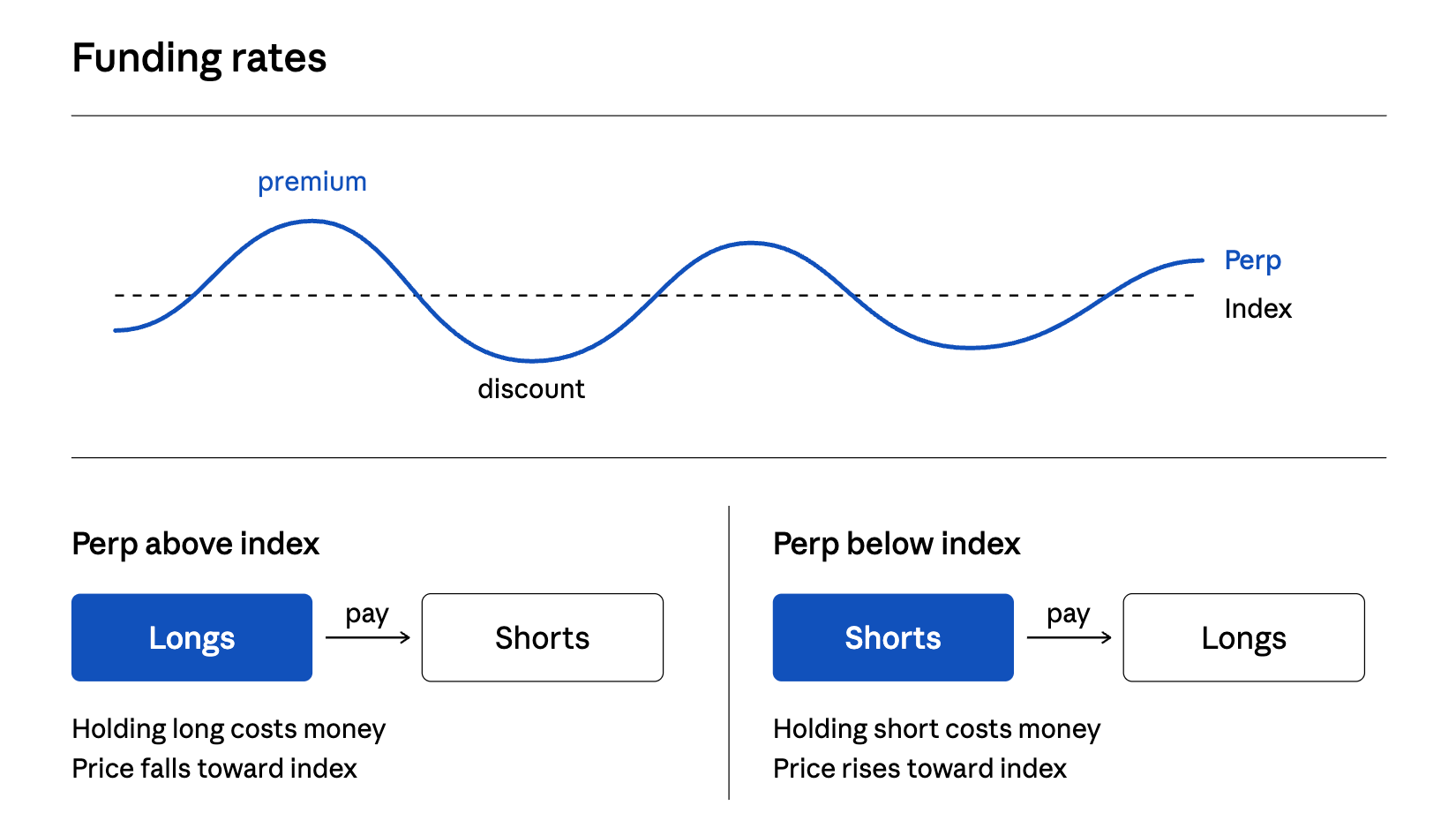
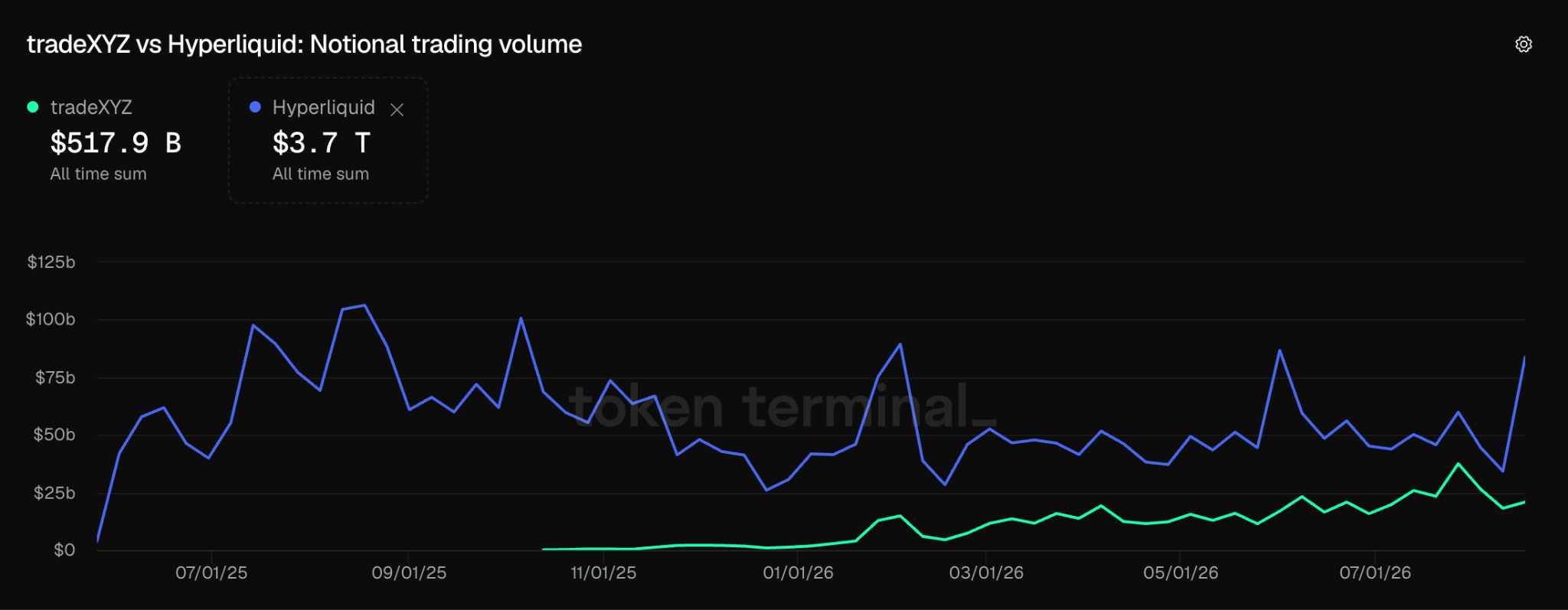
The other one, trade.xyz ignored outside valuations entirely, pricing contracts solely on a 30-minute average of its own internal trades. It still brings the majority of the volume in HIP-3.
trade.xyz was launched by Hyperunit with the first HIP-3 ticker in October 2025 and did $1.3 billion in three weeks. Trade.xyz accounts for more than half of Hyperliquid’s total monthly trading volume, as the dominant third-party builder on the platform.
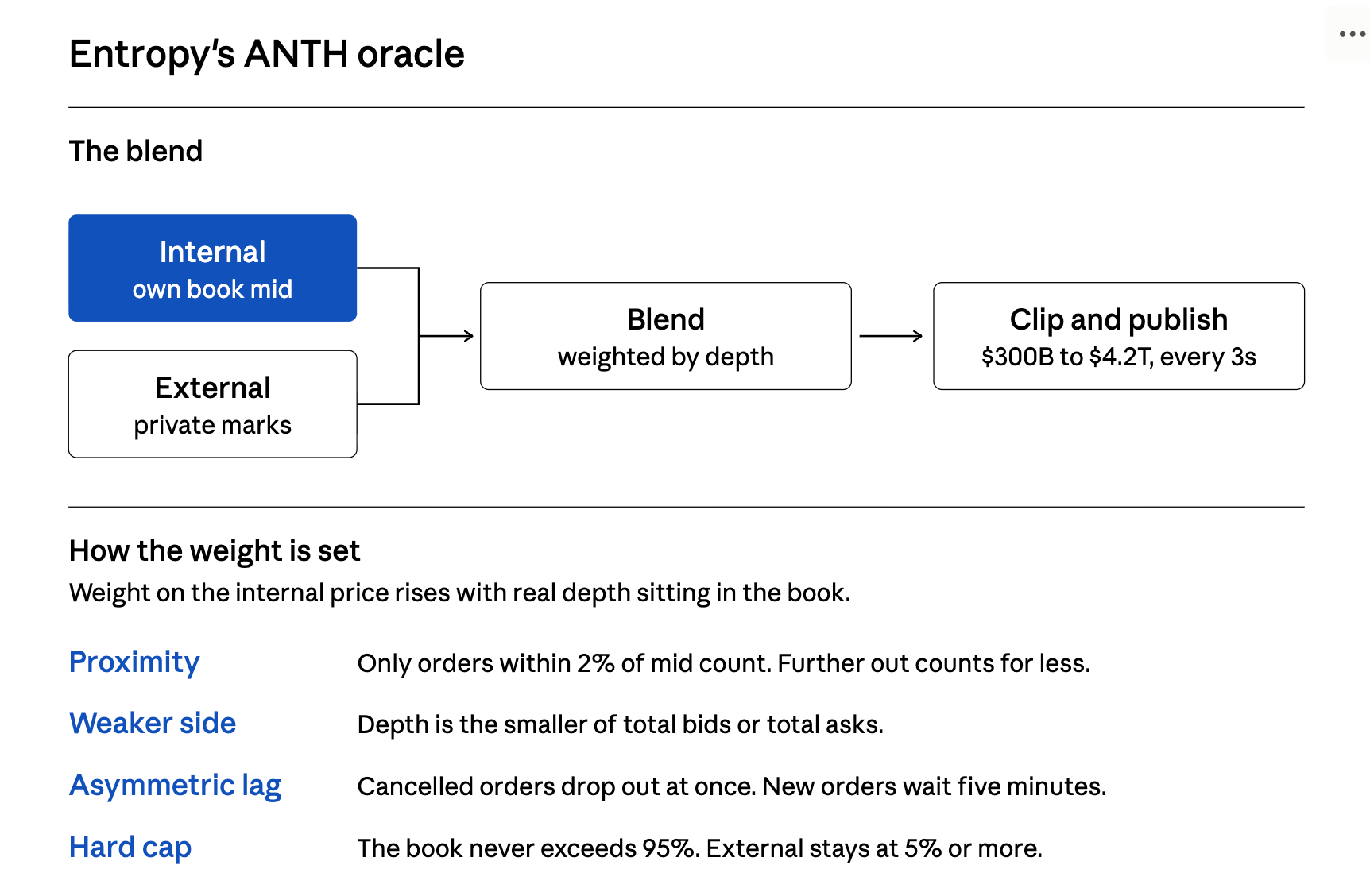
Trade.xyz relies strictly on a 30-minute average of its own internal trades for its oracle. It tightly caps funding and converts the contract to a standard derivative upon an IPO. Entropy, compared to that, uses a hybrid oracle that blends its live order book with private-market valuations, giving the book up to 95% weight only if liquidity is deep.
Otherwise, it defaults to stale secondary marks. Also, as we mentioned earlier, Entropy quotes total market capitalisation instead of a share price.
Ventuals are the one you want to know to understand how far Entropy can go. That’s the first one to launch synthetic pre-IPO perpetual markets for Anthropic. That was not a very pleasing story.
Alvin Hsia, Emily Hsia and Aris Samad built Ventuals in late 2025. Paradigm backed them. They were the first people to run pre-IPO perps on HIP-3.
The bond was their first problem. Three founders do not have 500,000 HYPE sitting around. So they built a vault called vHYPE. You deposited HYPE, got a receipt token back, and the vault posted the bond while paying you staking yield the whole time it was locked. The traders funded the exchange that they would then trade on.
Ventuals opened books on OpenAI, Anthropic and SpaceX. The first $100 million of volume took 73 days. The next $100 million took 17. By February 2026, the venue had passed $200 million, and more than 11,000 people had traded there. Hsia wrote later that employees at SpaceX, OpenAI and Anthropic had told him they were using the book to mark their own equity. Late-stage funds said the same thing so did Leimgruber. That was the high point.
Ventuals’ SpaceX contract fell 45% in one session for nothing happening to SpaceX that day. The book emptied out, and a handful of orders drove the price down. The team reimbursed traders afterwards, which was a decent thing to do. But Ventuals charged a standard 15% annual fee as long as its price stayed within 5% of the real-world valuation. If the price difference grew larger than 5%, the penalty fee increased exponentially. Toward the end, funding for the Anthropic book was reported as high as 8,700% annualised.
Normally, traders correct incorrect prices by buying the cheaper asset and selling the expensive one. Here, they couldn’t. The Ventuals contract was strictly synthetic and could not be settled with actual Anthropic shares, especially after Anthropic restricted secondary stock transfers.
vHYPE traded at a 20–30% discount to standard HYPE because depositors wanted to exit their one-year lockups early. Then, they shut it down.
Entropy sounded so much like Ventuals, and therefore it first addressed the specific failures. First, it caps annualised funding rates at approximately 10%, preventing the runaway 8,700% fees that collapsed Ventuals. Second, it utilises a hybrid pricing oracle that relies on internal order book data only when liquidity is deep, otherwise defaulting to private-market valuations. Like Ventuals, Entropy prices Anthropic based on total market capitalisation rather than per-share prices.
But Entropy lacks trade.xyz’s straightforward protocol for converting contracts if an IPO occurs. If Anthropic is still private on 18 August 2028, ANTH settles in cash at a 30-day average of ANTH’s own price. If there is an IPO, Entropy says the oracle switches to a 1-hour average of the mark three days before listing, then tracks the public market. Hyperliquid cannot convert a market-cap contract into a per-share contract, so ANTH would still be quoted in billions after the listing. trade.xyz quoted share prices from the start, so it did not have this problem.
The common argument is about the big names behind Entropy. Ribbit Capital put Fund I money into Bitcoin and Coinbase’s 2013 Series A, then into Robinhood from 2014, including the 2021 rescue round. It also backed Ripple, Xapo, and Blockstream. It still holds HOOD and COIN in public filings. Later crypto checks include Polymarket, Lighter, Tempo, Morpho, Bridge, and a $14 million lead in EntropyIO on 24 August 2026.
Ribbit’s job is to pick distribution businesses in money, like brokerage (Robinhood), exchange (Coinbase), prediction (Polymarket), and on-chain perps (Lighter, now Entropy). But raising $14 million from Ribbit just means that it owns equity in Entropy. The bond can still be slashed.
Citadel, Optiver, Polymarket, and Millennium are former employers, which doesn’t guarantee anything either.
Entropy listed SanDisk (SNDK) apart from Anthropic. SanDisk already trades on Nasdaq, so every venue can copy the same cash price. Within days, SNDK was also live on trade.xyz, Lighter, Ondo, Variational, and Aster. Trade.xyz had about $174 million in open interest and $276 million in 24-hour volume. Entropy had about $5.6 million in open interest and $55 million in volume.
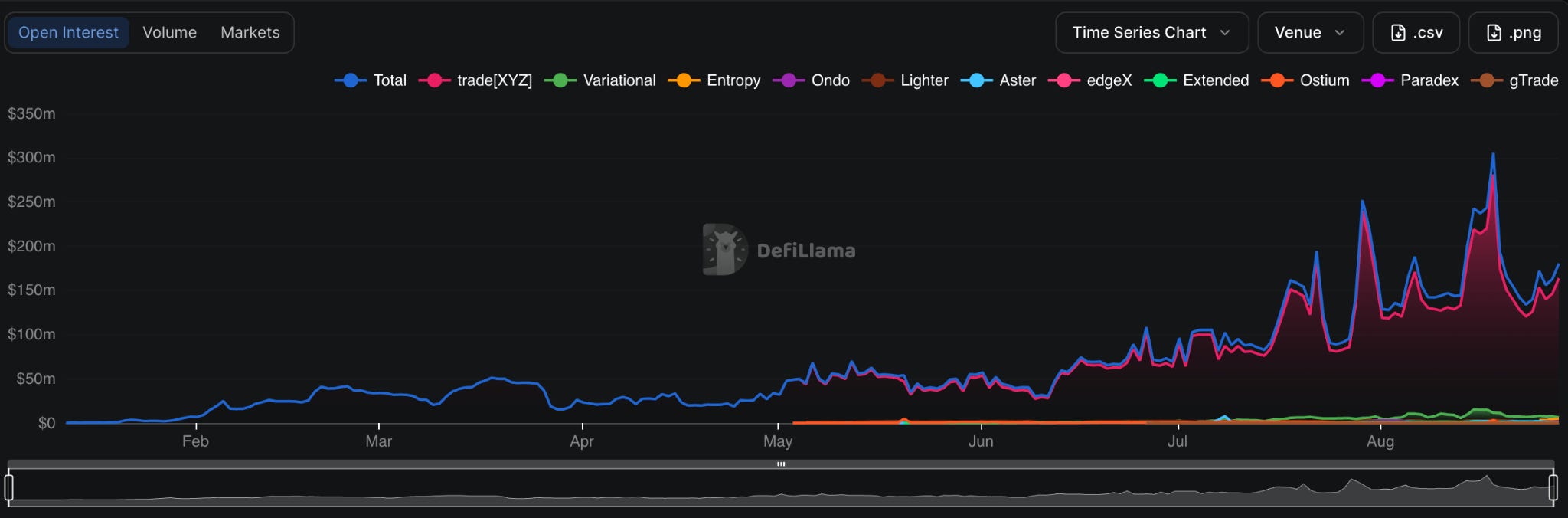
If volume is high but open interest stays low, that suggests traders are entering and exiting quickly, which is consistent with arbitrage, market making, or bot-driven price alignment between venues. Durable demand usually shows up as rising open interest because traders are taking positions and keeping them on the books.
In other words, the SNDK contract stays accurate because automated bots constantly match its price on the crypto exchange to the live Nasdaq stock market. ANTH cannot do this because there is no live stock price to copy.
So, ANTH contract is forced to rely on outdated private valuations, past funding rounds, or rumours whenever trading activity is low. Essentially, Entropy doesn’t change the fact that decentralised exchanges function well for public stocks but struggle to accurately price private companies.
On 19 August a deployer named “Kraken HIP-3 test DEX” turned on Star gating on the Hyperliquid testnet. Blockworks analyst Shaunda Devens saw it whitelist ten wallets and use three of five new admin tools - Cancel a user’s open orders, force positions closed, and move collateral out of an account. A validator registered under the name “Kraken Exchange Validator” appeared in the same testnet validator registry around the same time.
Neither Kraken nor Hyperliquid has confirmed ownership of the testnet DEX. Devens thinks it may be real because Payward, Kraken’s parent, already put xStocks on HyperCore, and those three tools are what a regulated firm usually wants. Until someone confirms it, you don’t want to treat it as an official product.
Entropy outright bans users from strictly regulated regions (US, UK, EU, Canada, Australia, Singapore). If these users are ever permitted to trade, it will likely be through permissioned, centralised setups that can legally seize assets and manage risk, such as Kraken.
Traditional stock exchanges (like Nasdaq or the NYSE) rely on human “listing committees” to vet and approve which assets are allowed to trade. Hyperliquid’s HIP-3 protocol dictates that instead of asking a committee for permission, anyone who locks up a $40 million token deposit is automatically permitted to launch a market.
The possible Kraken testnet activity indicates that regulated financial institutions want to use this tech, but they cannot legally operate in a permissionless environment. To comply with government regulations, these institutions are adopting the HIP-3 blockchain infrastructure, but they are hard-coding their own strict rules, approved user lists, and manual oversight teams (risk desks) right back into the system.
Should Entropy succeed, it will bridge an entirely new class of private equity onto Hyperliquid's rails. If it fails… well, another data point for the next builder. It’s fascinating to watch this network evolve and learn from its own wreckage.
The market will eventually turn upward, so the best move right now is to keep building before the quiet ends.
With a highly leveraged amount of hope,
Token Dispatch is a daily crypto newsletter handpicked and crafted with love by human bots. If you want to reach out to 170,000+ subscriber community of the Token Dispatch, you can explore the partnership opportunities with us 🙌
📩 Fill out this form to submit your details and book a meeting with us directly.
Disclaimer: This newsletter contains analysis and opinions of the author. Content is for informational purposes only, not financial advice. Trading crypto involves substantial risk - your capital is at risk. Do your own research.