


I went into Prediction Machines assuming parts of it would belong very clearly to another era of AI.
I usually think twice before reading AI books now, and even more before recommending one, because they can become dated very fast. A book written five years ago can feel like it is describing a completely different industry.
Still, this one had me hooked for a week because it gave me a way to think about AI without trying to predict every version of what comes next, despite the name.
This one was published before ChatGPT, before Claude, before people were simply asking models to write code, operate browsers and call other software on their behalf. The AI examples in the book include fraud detection, recommendation systems, self-driving cars, translation, and inventory management. Fair enough, all of them are still relevant. But then, Alexa is still impressive enough to appear near the beginning of the book.
These days I have been looking at a rather different version of AI. There are agents with wallets, agents buying API calls, agents asking for permission to access Google Drive, and entire companies being built around controlling what these systems are allowed to do. Every week, another product claims to have solved some part of the journey from giving an AI a task to letting it complete that task with no humans.
That made me curious about what an economics book written before all of this would make of the current moment.
Ajay Agrawal, Joshua Gans and Avi Goldfarb are economists rather than computer scientists. Probably the reason why they don’t do much of trying to define intelligence or asking when machines will become conscious, no scary stuff.
The authors argue that the internet made search, communication and distribution much cheaper. Computers made arithmetic cheap. Artificial light became so cheap that we stopped thinking about whether turning on a lamp was worth the money. When the price of something useful falls far enough, we start using much more of it, including in places where we had never previously thought of using it. Their argument is that machine learning does the same thing to prediction. It is a wonderfully casual way to explain AI, and I mean that as a compliment.

Sharpen Your Investment Research with Amsflow
Wall Street and crypto used to run on separate screens, logins, and research stacks. That gap is closing everywhere else. Why not yours too?
Enter Amsflow - an all-in-one intelligence platform for investment research, covering every major global equity market, commodities, and deep crypto analysis, all in one place. Sentiment reading from Wall Street to the EU, India, Japan and China - down to gold and crypto.
Amsflow lets you run a Screener across 70,000+ securities with 550+ metrics. Track your Portfolio with real factor attribution, not just a P&L line. Watch entire industries rotate over a decade of history with Rotation, scrubbing through time instead of squinting at a static chart. Built sleek and clear, for anyone curious enough to look past the ticker.
You’ve been among Token Dispatch’s most loyal readers, so here’s an offer just for you - 20% off your Amsflow subscription, every month, for six months.
Use code ‘TOKENDISPATCH20’ at checkout for 20% off.
For the last few years, it has become difficult to talk about artificial intelligence without eventually arriving at civilisation, or human replacement. Prediction Machines drag the conversation back towards prices.
What do we consume more of because it became cheaper? What becomes more valuable around it?
With that, a surprising amount of the AI industry becomes easier to look at.
Prediction is the process of taking information you have and using it to generate information you do not have yet. Information you do not have yet does not even have to be about the future. Detecting whether a transaction happening right now is fraudulent counts as prediction. Translating an English sentence into Japanese counts too, because the machine is using one set of information to produce another.
Considering the way things are going these days, I am not sure that prediction can comfortably hold everything we now put inside the word AI. A language model does predict the next token. An image model also generates an image by estimating what visual information should come next or fit together. So if you stretch the word “prediction” far enough, you can still put most modern AI inside that definition.
The problem is that this starts becoming a little too broad to be useful. Today, an AI system might research something, make a plan, choose a tool, write code, spend money, check the result and try again. All of those actions may ultimately be powered by prediction, but calling the whole thing “prediction” leaves out a lot of it. So the point here is that prediction may still explain the mechanism underneath AI, but it may no longer fully explain the economic or practical thing we are interacting with.
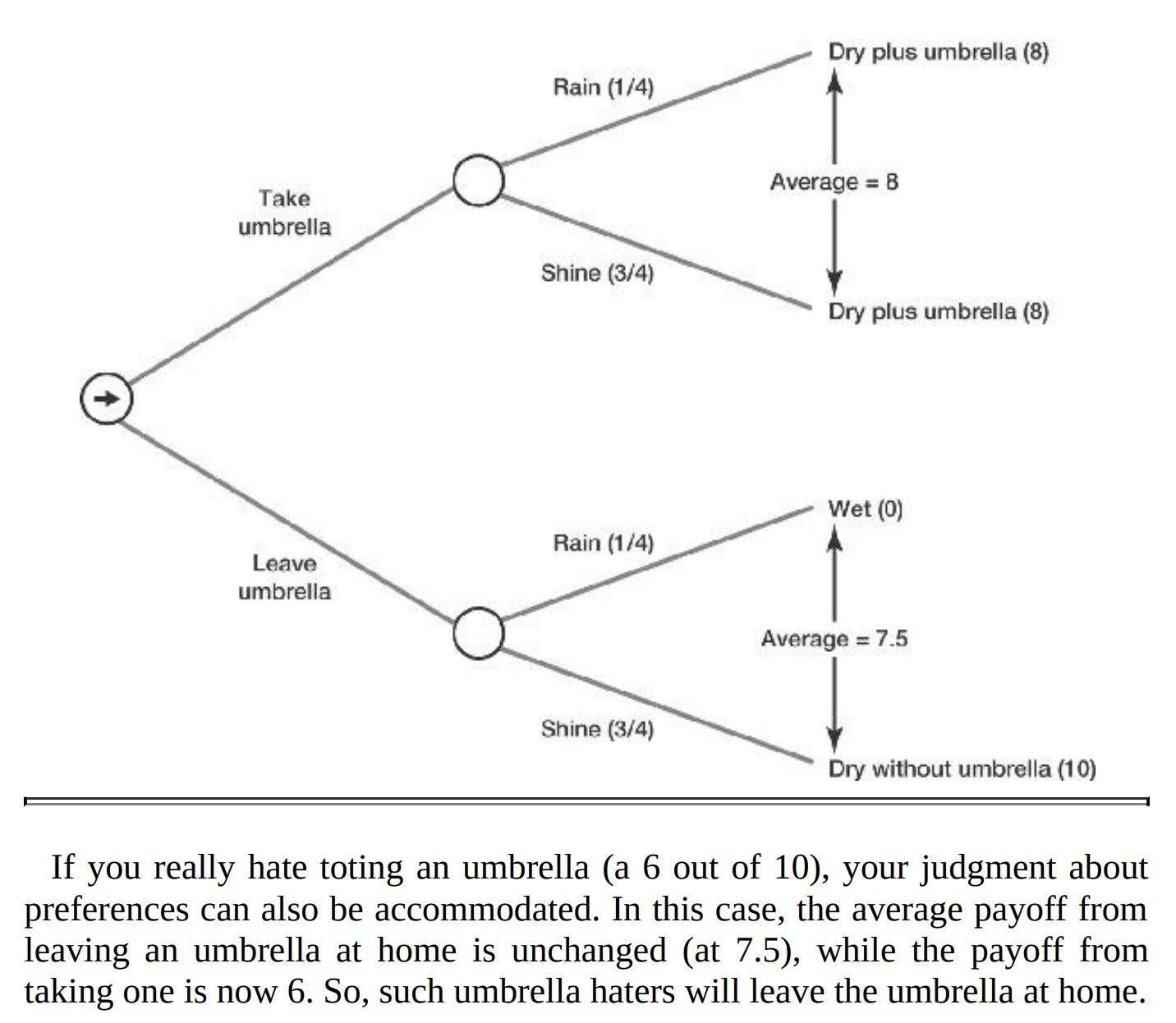
Knowing what is likely to happen and telling you what you should do about it are two different things. The authors talk about rain and umbrella to explain that. A weather forecast gives you the probability that it will rain. You still have to decide whether to carry an umbrella. That depends on how much you dislike getting wet, how much you dislike carrying an umbrella and what you are doing that day.
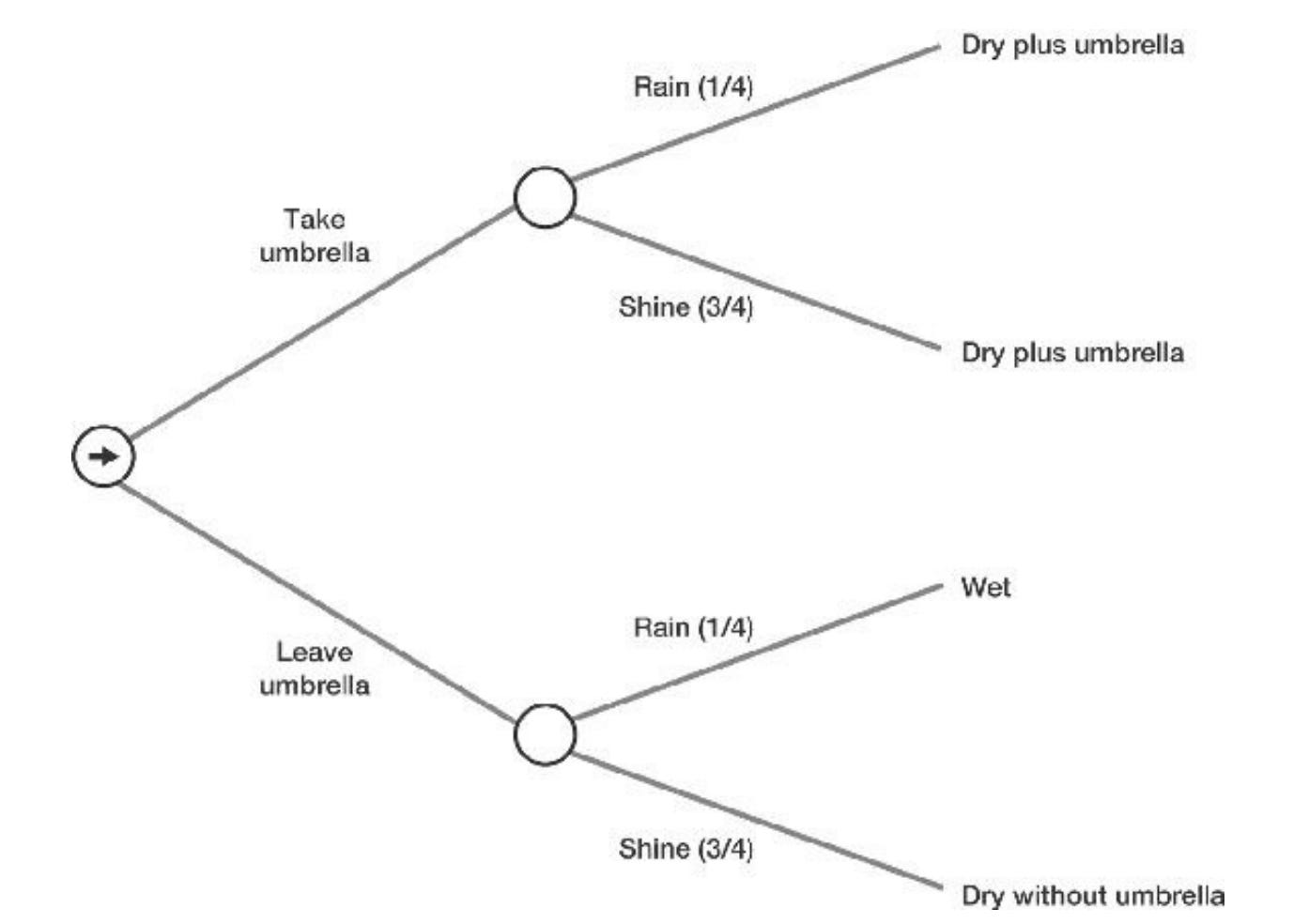
The prediction can improve enormously while the preference remains yours. The book calls that second part judgment. At this point, I feel like I am teaching you “how to be a human.” Anyway, the book says that as prediction becomes cheaper and more widely available, judgment can become more valuable because more decisions can now be made using good predictions.
An agent can find flights, compare hotels and work out an itinerary, but once it has to actually book something, another set of questions appears. Now somebody has to decide whether the agent can spend ₹5,000 or ₹50,000, and whether it can buy a non-refundable ticket.
We are getting better at solving the “can the agent figure this out?” problem. Now we have to decide what it is allowed to do once it does.
I wrote about a similar argument recently through Aident, a company building a permission layer for AI agents. The product works between the agent and the software it wants to use, handling things like credentials, approvals, spending limits and an independent record of what the agent actually did. In my test, I let an agent use outside tools to research products, generate images and audio, publish posts and deploy a small website. It searched for tools as it went, checked their cost, switched when one failed, and kept moving.
Spending approval is one thing. Action approval is another. An agent might be allowed to spend a small amount on research, for example, while still needing permission before sending an email or changing a customer record.
That made me think differently about what “judgment” looks like once AI starts acting on its own. In the book, judgment is about assigning value to possible outcomes and deciding what matters. In an agent system, some of that judgment then has to be translated into rules the agent can actually follow, like how much it can spend, which accounts or tools it can access, and so on.
This is also why I think the permission layer around agents is more interesting than it appears now. It is really where companies start turning their own judgment into something software can follow.
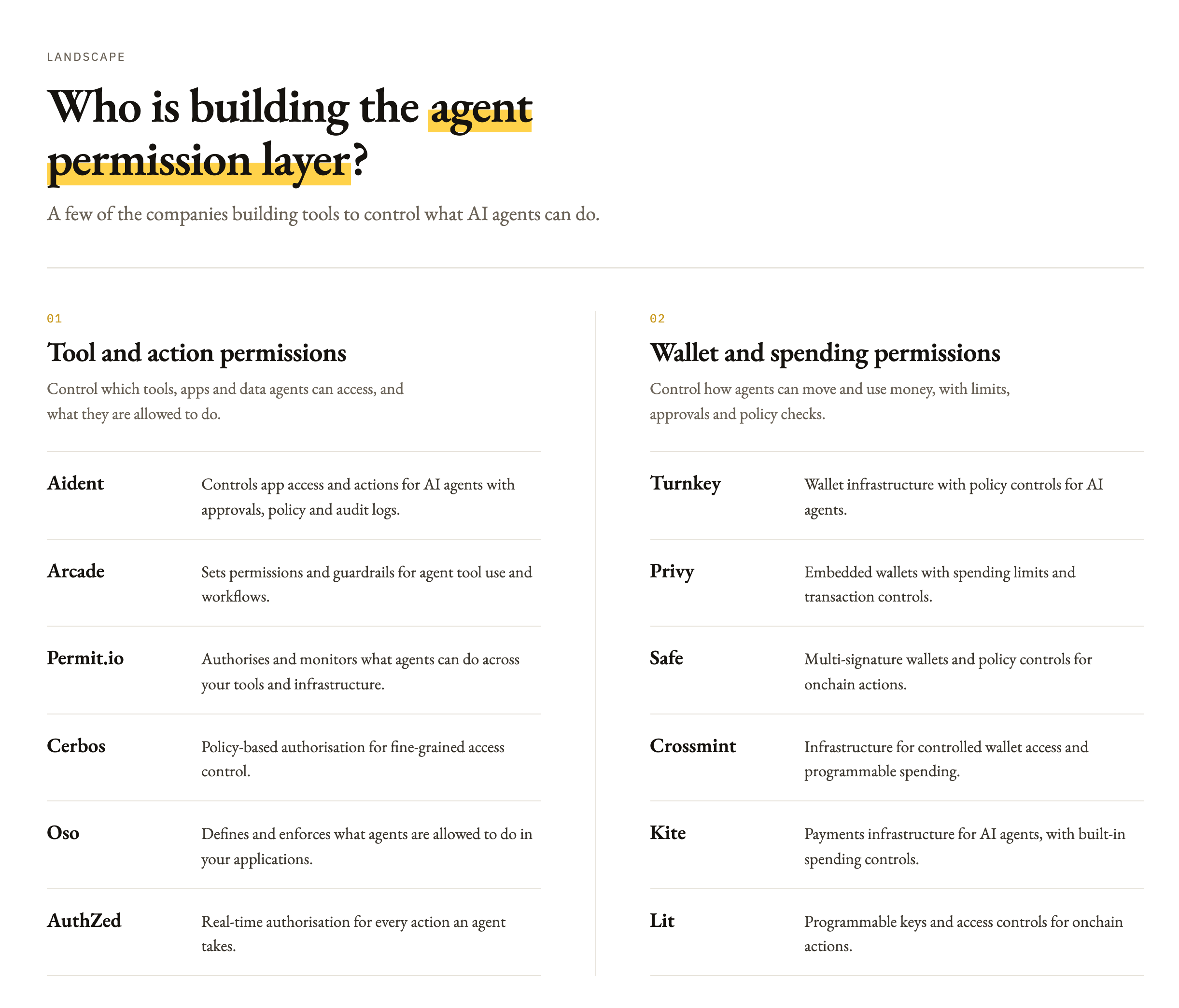
In the Aident piece, I described that layer as an enforceable job description for an agent, defining what it can see, spend, alter, publish and escalate.
Read: Who Gets to Say Yes?
Crypto already has systems where software can hold value, move money and execute rules automatically. AI brings in systems that can decide when to use them. But have we built enough judgment around AI now before things turn into an irreversible action…Especially now, when some of the people building the most powerful AI systems are themselves asking whether things are moving too fast.
A smart contract can execute automatically, but first it needs some way to know what is happening outside the blockchain. An oracle brings in information such as an asset price or the result of an event. The contract then has rules for what should happen with that information. If collateral falls below a certain level, liquidate it. If a condition is met, release the payment. The oracle supplies the information, while the judgment about what that information should trigger is written into the system beforehand.
AI agents make that arrangement more complicated. The software is no longer only waiting for a number and following a rule that somebody already wrote. It can interpret information, choose between possible actions and decide which tool to use next. Crypto has been figuring out how to give software reliable information from the outside world. AI is pushing us towards the next problem of what happens when the software can also decide what to do with that information?
When something important becomes cheaper, the things needed around it can become more valuable. The authors call these complements. In the case of AI, those complements include data, judgment and action.
A bad transaction, liquidation or payment is harder to undo. So as AI gets better at producing decisions, more value may move towards the systems that check the information, define the rules and control what happens next.
The book also argues that asking whether AI will replace a job can be the wrong unit of analysis. Jobs contain many tasks, and technology may remove some of them while making other parts more important.
People who had previously spent large amounts of time manually calculating figures did not necessarily become useless once spreadsheets arrived. In many cases, their knowledge became more useful because they could spend less time performing arithmetic and more time asking better questions of the numbers.
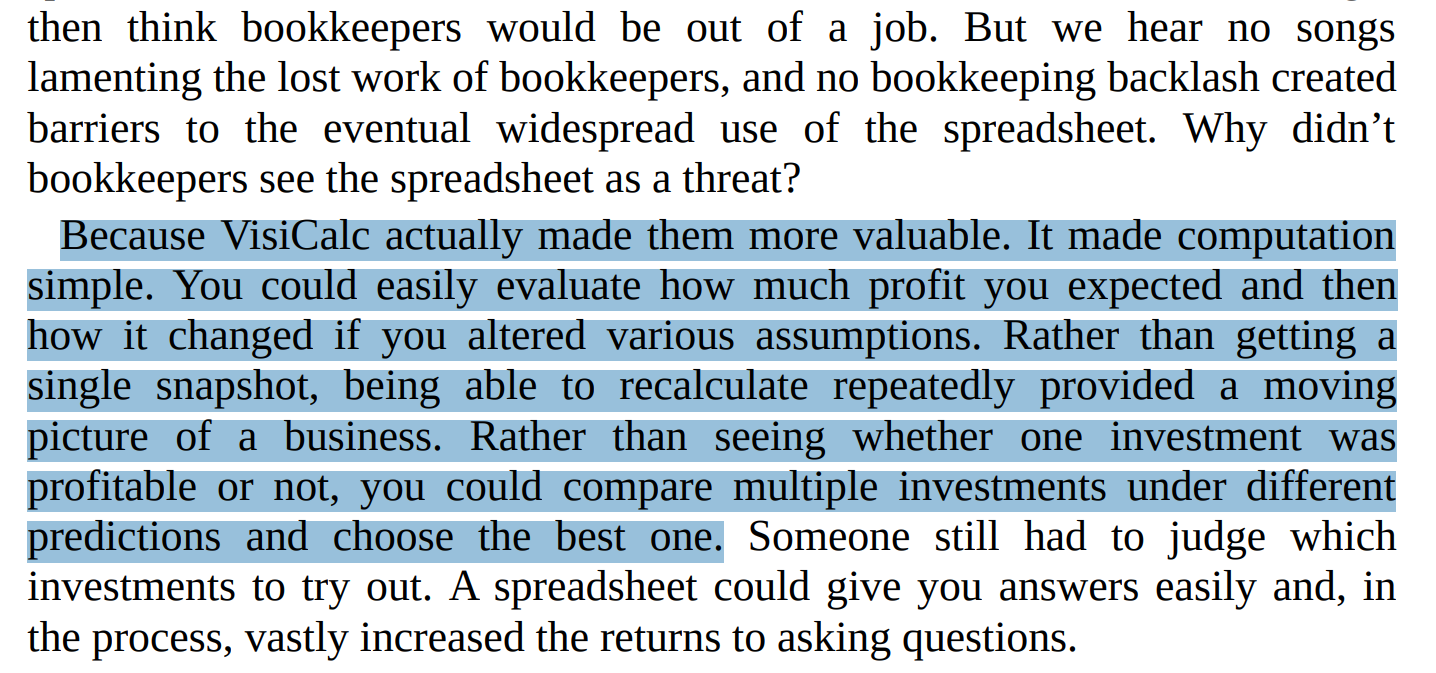
The authors expect something similar with AI. Workflows get broken into pieces, machines take over some tasks, and the job is then assembled again around whatever remains.
Blockchains made it easier to create and move assets, but that made things like custody, liquidity, identity and compliance more important. Stablecoins made moving dollars easier, so more businesses appeared around issuing them and controlling how they’re used.
Read: Dollars Are a Technology
I am not even sure its central definition of AI would survive unchanged if the authors were writing the book today.
I still came away from it with a better way of looking at the industry.
The book wants you to stop staring at the technology itself and look at the economic system around it. That is one of the most useful habits I might have got from this book, and it felt like a useful antidote to how AI is usually discussed.
When I look at a new AI product now, I find myself trying to identify the thing whose price is actually falling. Then I look around it and see who is building to fix the gap that is exposed. If software can make thousands of decisions without waiting for us, somebody still has to decide what those machines are allowed to optimise for.
Crypto makes those decisions financially real because an agent can move money, interact with smart contracts and trigger transactions directly. That makes trusted data, permissions and spending controls much more important once AI starts acting on its own. Another reason why these two systems fit together almost too neatly. They are lobsters!
Token Dispatch is a daily crypto newsletter handpicked and crafted with love by human bots. If you want to reach out to 170,000+ subscriber community of the Token Dispatch, you can explore the partnership opportunities with us 🙌
📩 Fill out this form to submit your details and book a meeting with us directly.
Disclaimer: This newsletter contains analysis and opinions of the author. Content is for informational purposes only, not financial advice. Trading crypto involves substantial risk - your capital is at risk. Do your own research.