


Hello,
Missed trades hurt the most. The kind where you spot a big profit, every sign says it’s the right one to bet your money on, and yet you don’t. Then you wake up one fine day to see a bumper profit that could have flipped your blood-red portfolio into the green. Alas! It wasn’t to be.
Last week, this happened to me with Zcash (ZEC) - the privacy cryptocurrency that rallied over 50% in two weeks. I had a few hundred dollars sitting idle in my wallet that I wanted to use to buy more ZEC and add to my holdings. But because I am not a regular trader, I asked an LLM what to do. It returned a confident, reasonable-sounding answer with no live price or context for what I was trying to achieve with my trades. Then I added more details about how much I could spare, and the analysis changed drastically. The LLM’s advice didn’t make my decision any easier.
This restricted access to information hurts ordinary retail investors disproportionately more than institutions with large quant desks. Institutions have been trading with automated machines for almost three decades. Algorithmic trading now accounts for most trades in major markets, up from about 10% in 2011 to 60-70% in 2025.

TOKEN2049: The Largest Crypto Stage
Over 25,000 attendees, 300 speakers, 500 exhibitors and 1,000 side events will come together at TOKEN2049 to rewrite the future of finance. And you are invited!
TOKEN2049 Singapore is just over three weeks away. The global crypto industry meets at Marina Bay Sands, 7-8 October, for the world’s largest crypto event.
Book by Wednesday, September 23, to lock in the current rate of $539 ($599) and get the exclusive 10% discount before the price goes up next week.
Today, a handful of specialist non-bank trading firms, like Jane Street and Citadel Securities, are increasingly expanding their share in facilitating global trading. BCG expects the share to reach 30% by 2030. When you buy a share through an app, your order is often sold to the firms running those machines. Your trade acts as their raw material.
Small retail investors are left fighting the giants with far less access to information and compute power that could help them make high-speed, automated, and well-informed trades. So when a professional-grade tool, LLM-assisted trading, finally arrived cheaply, they reached for it. But reaching for a tool and trusting it are two different things, and the distrust has grown over time as generic LLMs have increasingly commoditised intelligence.
A general-purpose AI works fine for seeking technical knowledge and understanding the reasoning behind the trades. But the edge LLMs offer vanishes as AI models get commoditised.
When a researcher tracks a stock-picking strategy built on ChatGPT, the return it produced for the risk it took shrank dramatically as more people copied the same approach. A tip stops being a tip once everyone has it. It’s similar to how every market inefficiency gets ironed out as more people start booking arbitrage profits.
The point of using machines for trading isn’t accessing exclusive information. No tool can be right about the market all the time. The edge in automated trading is cutting down unknowns until a trader can make a well-informed decision and sleep peacefully.
So if information is no longer the edge, what is? When intelligence becomes a commodity, two things gain relevance in its place. The first is context, where the analysis is true for you specifically, given what you hold, what you have done before, and what you are trying to do. The second is distribution, wherein the platform owns the screen where a decision turns into a trade. A general-purpose model has neither. It doesn’t know your book, and it doesn’t own your order flow. That gap is where these specialised platforms must tap into.
TrueNorth fills this gap by researching an asset, proposing a specific trade, where to get in, how to cut losses, when to book profits, and letting you place that trade through your connected wallet. It then follows up with research and trade strategy with position tracking by letting you set customised reminders.
TrueNorth’s automation systems are acting on a real-time flow of market data collected from over 40 live feeds.
A couple of days back, I connected my wallet to TrueNorth’s dashboard and asked it what to do about all the action in privacy coins. Part of me wanted to add more ZEC to my holdings, hoping the rally would continue further. But the agent asked me not to. It told me to hold my current Zcash exposure, which I bought over a week ago. It felt the lower entry point was long gone after the coin rallied over 60% in the last week.
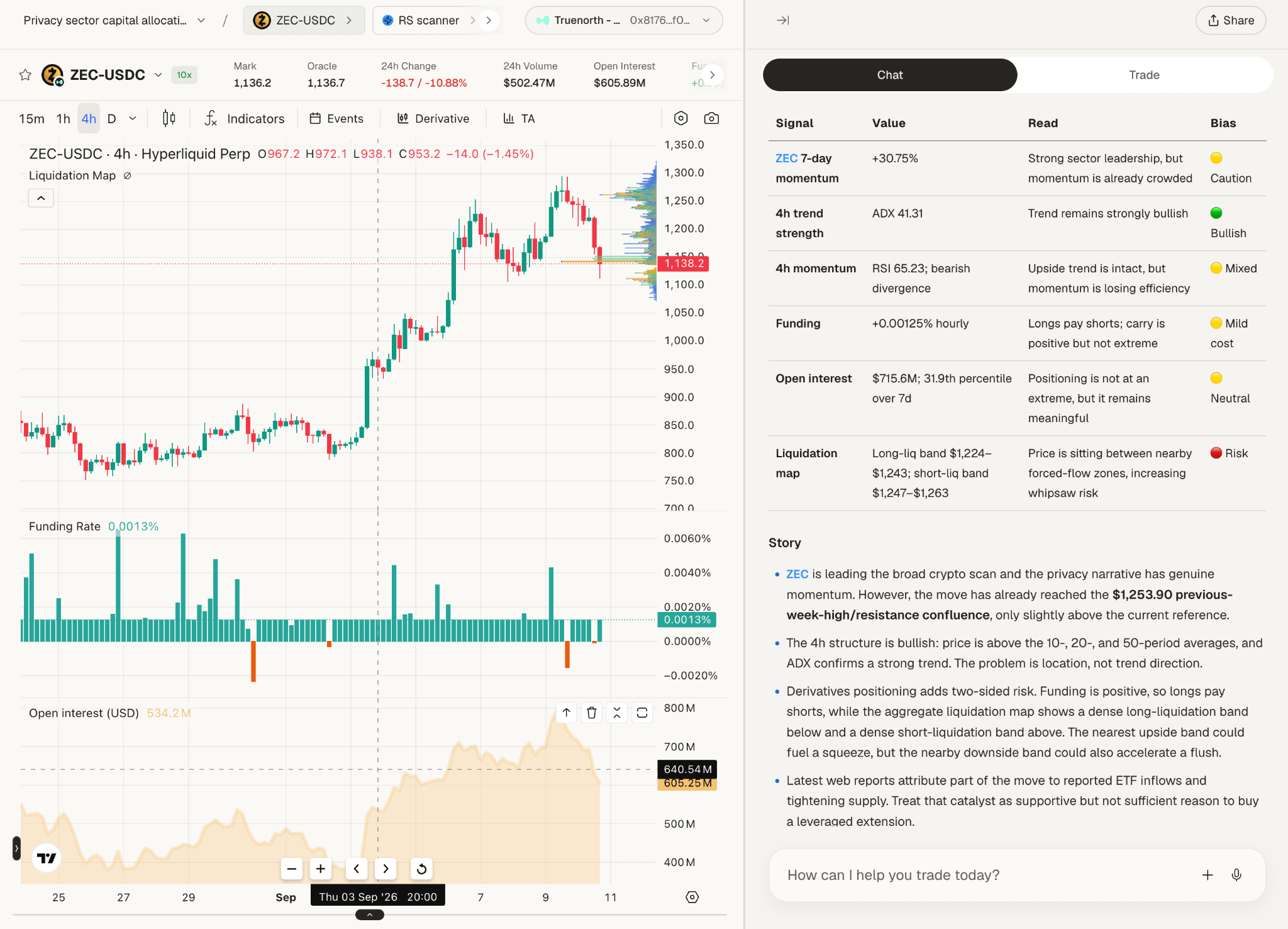
Rather than just an LLM-generated text, the protocol backed its reasoning with a chart. It marked the level where a fresh rally would stall, the level a pullback would need to hold before the trade made sense again, and the band where a leveraged position gets automatically closed out at a loss. It explained what each line meant using a table and a risk matrix. For someone who doesn’t trade, this justifies why they should make or avoid a trade. TrueNorth can also read my wallet in real time while being fed live market data. This helps the agent know what I held, the leverage I had, the idle cash in my account, and what my past trades looked like.
It reasoned about my privacy-coin question in the context of a portfolio that was already too concentrated in that trade.
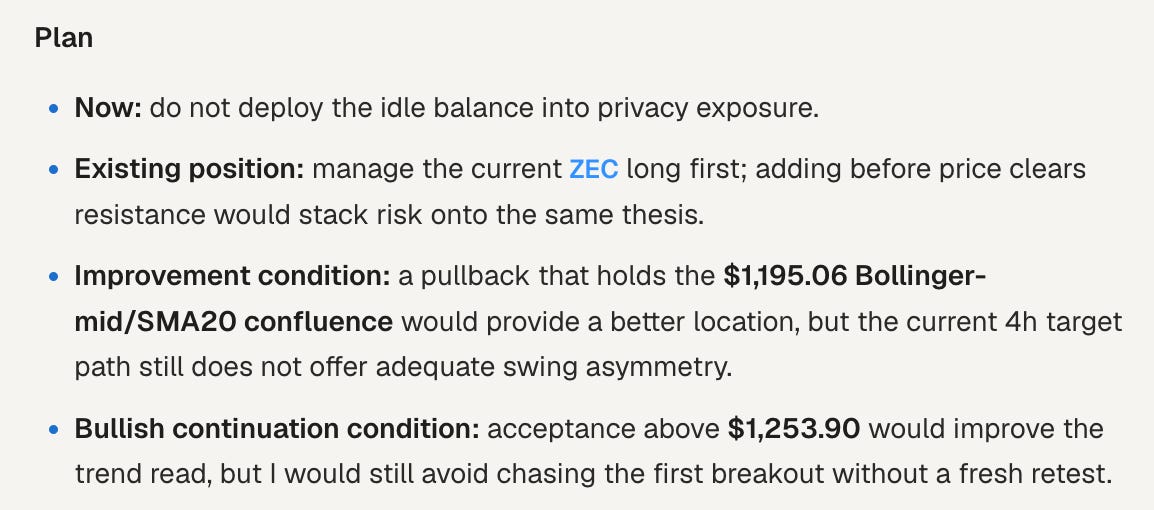
This is the part that a general chatbot cannot copy. It can be fed the same market data as everyone else. But it can’t track my book, wallet, and leverage in real time. It also can’t keep tracking my trades to see how they turn out and learn from them to rectify my future trading strategies. When the information is identical for everyone, the only thing left to differentiate on is the context you bring to it.
Over enough trades, the agent’s strategies start feeling more tailor-made to match my risk appetite, help me avoid the mistakes I repeated, and replicate the setups that worked for me in the past. It builds my trader personality from my past behaviours, then advises that personality.
All this is achievable for an average trader. What makes TrueNorth accessible for a new trader is that it lets anyone vibe-code a strategy that works for them.
I never wrote a line that makes me sound like a professional trader. I just described what I wanted in ordinary sentences. It was along the lines of “watch my portfolio, tell me each morning what’s moving, flag the trades I should be thinking about”, and its agents built a routine around it.
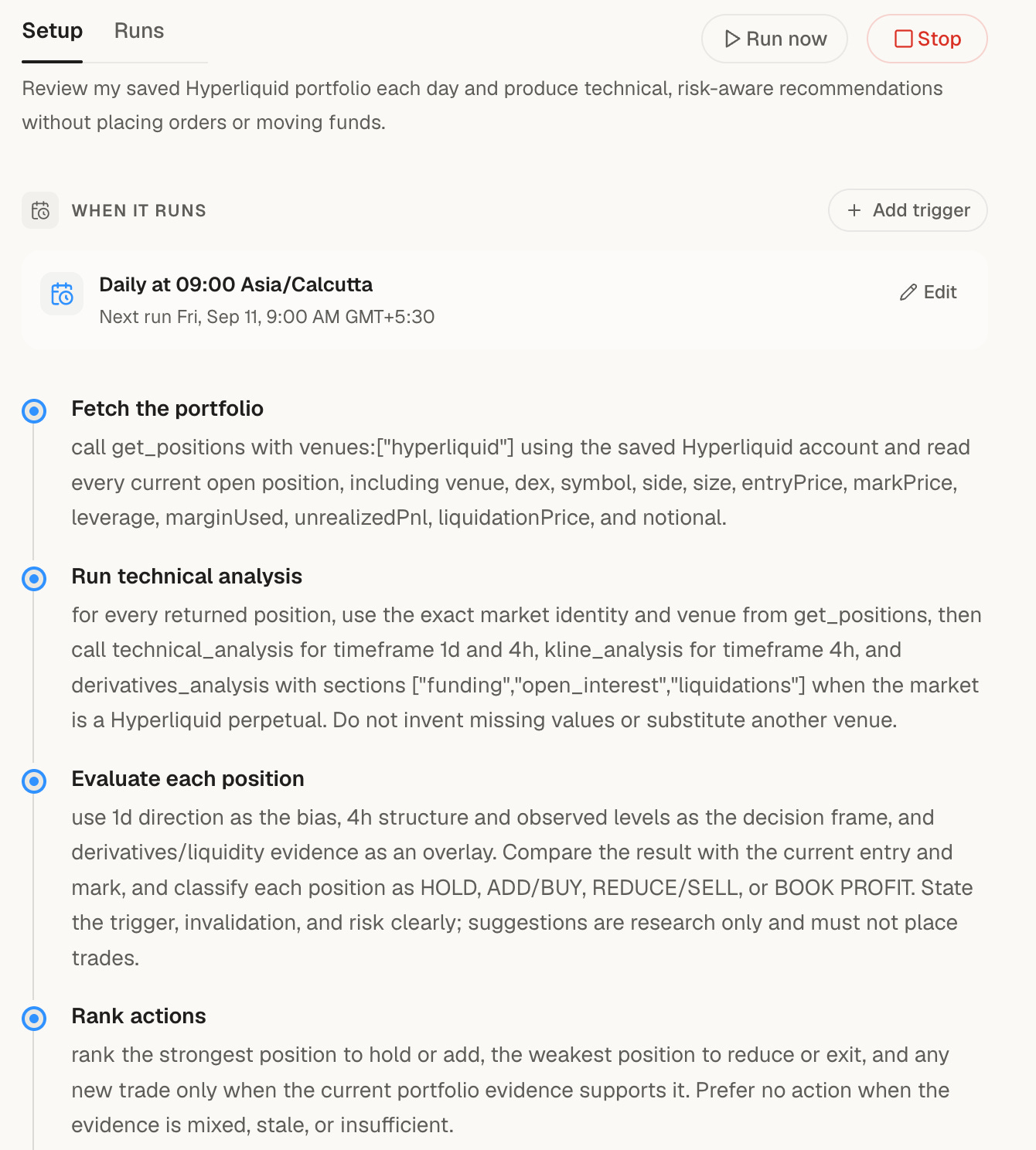
You can also connect your Telegram app so that TrueNorth’s agents deliver their daily strategies right in your inbox.
But the most interesting part for me was how it retains the human in between all the analysis and the execution of a trade. A tool like this solves two of the retail trader’s four problems: the structural disadvantage against automated institutions, a general AI you can’t trust with money, the way any edge decays once everyone shares it, and the exhaustion of stitching research, execution and tracking across a dozen tabs.
TrueNorth first narrows the trust gap by keeping you in charge and tying every answer to live, specific data and charts, not a chatbot’s textual response. Then it ends the exhausting juggling by putting research, execution, and tracking on one screen.
Yet none of this makes a retail trader better than somebody else with similar access to information, research, and analysis tools. The more people act on the same setups, the faster those setups commoditise.
So, where does TrueNorth capture value in a universe that is fast commoditising?
Show Me the Money
Trades made on TrueNorth’s frontend platform route through Hyperliquid, which lets any frontend app add a small fee (builder code) to each trade. Many frontend platforms like Based, Phantom and pvp.trade route trades through Hyperliquid. An estimated 40% of Hyperliquid’s active traders trade through such frontend platforms rather than the exchange’s native website.
The value in such systems migrates to whoever controls the friction point. For a retail trader, that friction point is the screen where a vague impulse to buy or sell a position becomes clearer or less vague with the help of all the data and analysis that the platform can conduct.
So TrueNorth is making two bets. The first one is that it can be the analyst that retail traders can trust. The second, larger one is that trust turns into ownership. Once the screen you make your decisions on also becomes the screen you trade through, it gets captive users who will keep paying a portion of the builder code fees to TrueNorth via Hyperliquid.
In the first bet, TrueNorth’s product holds an edge as the first AI-powered brokerage. The second bet will be won on distribution, where the protocol must compete with dozens of other apps chasing the same orders and wallets that already have millions of users.
But the distribution game can swing based on many factors. Platforms that enable faster trades and quicker decisions will have an edge.
TrueNorth is early to this play. It has raised a $3M pre-seed led by CyberFund in December 2025, part of Z.ai’s startup program, no token, and no audited revenue or user figures it has chosen to disclose. Builder-code fees only matter at volume, and there’s no public evidence it has that volume yet. But it has a model that can be indifferent to who’s trading.
A good technology doesn’t discriminate between the type of trader - institutional or retail. Automation should let ordinary people trade like the institutions. In a market where everyone can access the same analysis, the edge is no longer in having more information. It is the context no one else has about your own money. I bought my first ZEC long ago and held through the market downturns. The decision to hold was driven partly by hunch and partly by helplessness (of selling at a loss). Such tools can help retail investors avoid acting solely on a hunch or being at the mercy of helplessness.
That’s it for today. I will be back with the next one.
Until next time, stay curious,
Prathik
Token Dispatch is a daily crypto newsletter handpicked and crafted with love by human bots. If you want to reach out to 165,000+ subscriber community of the Token Dispatch, you can explore the partnership opportunities with us 🙌
📩 Fill out this form to submit your details and book a meeting with us directly.
Disclaimer: This newsletter contains analysis and opinions of the author. Content is for informational purposes only, not financial advice. Trading crypto involves substantial risk - your capital is at risk. Do your own research.