


Hello,
Running a lending business is a two-part job. The first moves the money, using the accounts, infrastructure, and software that bring the dollar from a saver to a borrower and back. The second part is deciding whether the money should be lent in the first place. The first part is an engineering aspect, while the second involves judgment.
For over a decade, crypto has been improving the infrastructure to address the first aspect. That infrastructure has evolved well enough to replace the job that required a banking charter with a simple, tailor-made API that can be plugged and played. Yet, a lot of work remains on the second aspect of the lending process.
Both these halves are evolving in our banks’ savings accounts. When you tap “earn” inside your fintech app, your dollars pass through a smart contract that you will not even realise exists and get lent to a stranger. They will then earn interest without even knowing about how blockchain powered this entire process. All you care about is the familiar app you have been using all along.
In today’s piece, I will explain how curated vaults powered by blockchains can serve as backends to optimise your savings accounts and where they still fall short.


Vaults as Software
Almost every fintech we use wants to pay its customers a return, because that’s what stops us from leaving for a better app. A savings balance is the perfect sticky product to do this. The problem is that paying interest historically required you to become a bank, which could take years of paperwork and lobbying. The shortcut was to rent a bank’s balance sheet through a partner, or integrate with a money-market fund. Both these options are still slow and permissioned.
A curated vault that runs on blockchains removes these obstacles. But what is a vault? It is a pool of deposited assets run by a smart contract. Think of it as a traditional fund, except here, a curator instead of a fund manager is the one who decides where the pool gets lent. Every vault is wired into a tokenised vault standard, ERC-4626, which lays out how any app can plug into any vault the way it plugs into Stripe.
Aave Labs turned this into a shelf product in July 2026 with Stable Vaults. This product offered predictable stablecoin yield any business can embed without building the machinery underneath. The operator of the vaults picks the rate it offers and keeps whatever the strategy earns above it. The spread is the business model. It is a net interest margin business, except the fintech here never had to build a bank to earn it.
The recent momentum in this business shows there is enough demand.
Deposits across 60 curated vaults reached $8.9 billion in August 2026, up 33% in a year, while the rest of on-chain lending shrank 40% over the same stretch.
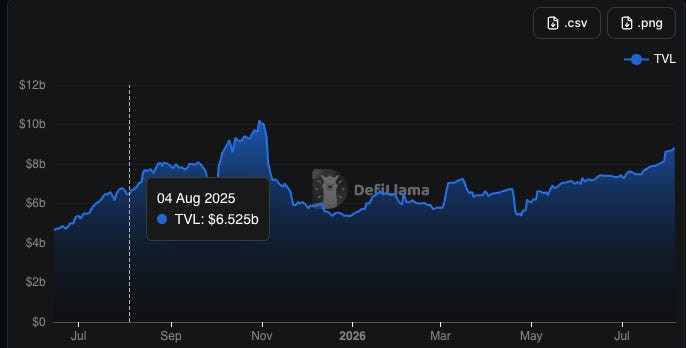
This tells us that capital didn’t merely pour into vaults from some other industries. It actually moved out of raw DeFi lending pools, where you deposit directly into a protocol and accept whatever yield the market pays, and into curated vaults where a curator decides how your deposit is lent.
This is evident from many front-end platforms integrating with curated vaults to offer an “earn” feature to their customers. Coinbase runs its in-app USDC lending through a Steakhouse-curated Morpho vault; Robinhood’s Earn uses the same infrastructure; Kraken’s DeFi Earn routes exchange balances into Sentora-curated vaults and has cleared $600 million in balances, surpassing 80,000 active depositors within six months. Deel, a payroll company, now sends contractor stablecoin balances into a Sentora-curated Morpho programme.
The Commodification of Vaults
Running these vaults seems like the difficult part because the smart contracts are audited and their isolated-market design seals each pool so that the risk doesn’t spread to the other pools. But none of this makes managing these vaults the difficult part. The more challenging part of the job is the judgement about whether the loan is any good in the first place. When you strip away the contracts, a curator is the one who does the unenviable job similar to what a fundhouse manager does. They pick which loans to make, set the exposure caps, rebalance the portfolio and take a fee. While the software that moves money is commoditised, thanks to the curated vaults, it’s the judgement of curators that is still valued. This is evident in how the market pays for each part of lending.
Anyone can deploy a vault in a day because the code is open. Yet the top three curators — Steakhouse, Sentora and Gauntlet — account for $6.8 billion, which is over 75% of all curated deposits. The fourth-largest curator, K3 Capital, manages a whole billion dollars less than the third with ~$400 million in its vaults. If the vault were the moat, deposits would spread across everyone who can deploy one. Instead, they keep piling into vaults managed by three players. This tells us that deposits chase the manager and not the vaults.
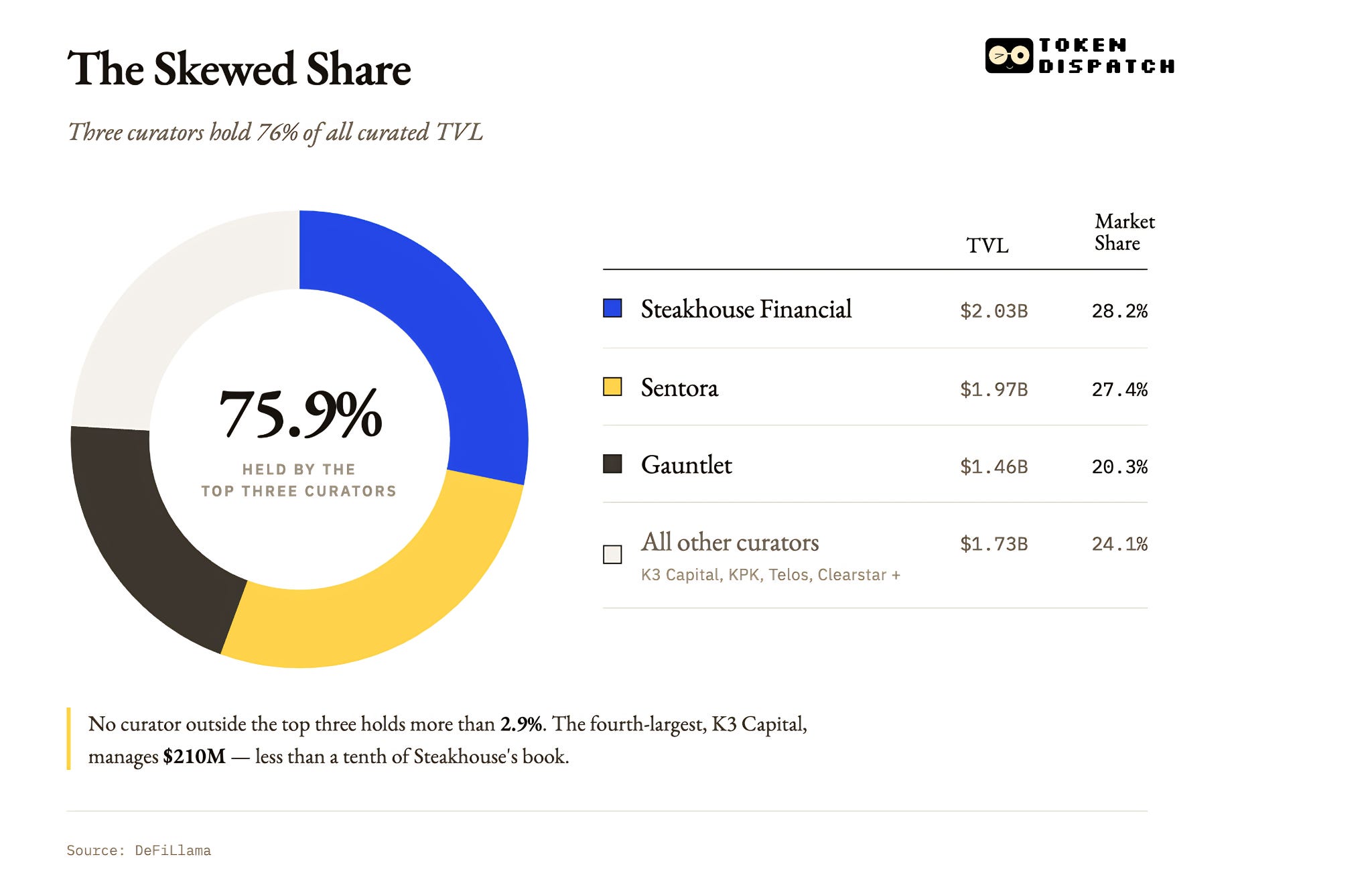
In an increasingly commoditising world, what’s rare is the most valuable. Judgement remains the most valued here, just as it is elsewhere. We have reflected similarly on countless occasions in our editorial calls at The Token Dispatch too: ‘What separates what we write from what our competitors do?’ ‘How are we writing a different story about the same half a dozen protocols, chains and projects?’ We come back to the same answer for all these questions: human judgement.
Consumers stop paying premiums for services offered by multiple sellers with minimal difference in quality. The premium is reserved for the judgement that’s rare and unique to one or two such sellers.
This is reflected in how managers of fundhouses and curators of these vaults get paid.
The top three curators generated over $12 million cumulatively in fees over 30 days, of which they retained only $880,000 (averaging 7.3% conversion) as revenue. This begs a simple question: Why would a firm managing a couple of billion in funds offer the vault for such low margins? The answer is where the real value is accruing in this ecosystem.
These vault providers charge almost nothing to run these vaults so they can become the embedded default inside platforms like Coinbase or Robinhood. Curators underbid each other to serve these platforms because once an app integrates its earn feature with a vault in its backend, letting them go to save a few basis points means re-integrating with a new partner, re-auditing their systems and re-underwriting their model. So, forgoing the fee on selling vaults as a product buys an expensive seat at the backend that is difficult to replace. Once this is achieved, there will be little resistance to paying for their credit judgment.
But there’s a problem here. Safe lending doesn’t reward the vaults that are fastest to integrate and offer the best price, but those who underwrite the best. We saw others who did this shut their shops.
In November 2025, a project called Stream Finance came apart. It all started when the company’s curators accepted xUSD as safe collateral across DeFi vaults. Except that it wasn’t. An outside manager running the strategy behind it lost about $93 million worth of assets, triggering a rapid sell-off and causing xUSD to lose its dollar peg. The stablecoin became worth less than a quarter of a dollar.
The isolated-market design did its job and stopped the damage from spreading to other vaults. But isolation only contains a bad decision and cannot undo the original mistake of accepting xUSD as safe collateral. That call had already been made, and money had already been lent out against it. So the loss was borne by the depositors and not the curators who had approved the collateral in the first place.
What happened with Stream Finance is the consequence of renting a risk engine with no credit desk attached. A vault is software that can only promise to isolate our risk. How our money is managed still needs to be promised by a human curator.
So, somebody has to be right about the borrower before the money leaves, and it’s this part where the utmost value currently accrues. This is reshaping how certain players do business in this space.
The Opportunity
Over the past three years, Qiro Finance went from tokenised marketplace to underwriter for hire to vault operator. It started as a marketplace, then realised the scarce input there was not deal flow but judgment. So, it put its judgment up for hire. It underwrote other platforms’ deals with its name on the report, in public, where a single bad call would have ended its business. Huma Finance, a payments network that has moved billions without a credit default, partnered with Qiro in January 2026 to underwrite up to $250 million in deals.
Take its public report on mGLOBAL, a token backed by a $1.1 billion fund run by Fasanara. Qiro’s review put the exposure right at the top, where it disclosed that the fund’s loan defaults had more than doubled since 2022, and the cost of protecting against currency swings was eating up nearly a fifth of what the fund earned.
This is precisely what a good credit desk is expected to do.
By July 2026, Qiro had underwritten more than $50 million across payment financing, trade finance and fintech lending with zero defaults, and it now runs its own vaults. But it lends only to borrowers it sources and judges itself. The vault software is the same commodity everyone else uses, but the work that goes behind it is where Qiro contrasts with its competitors.
Most players in the lending chain get paid whether or not the loan is recovered. A curator earns their cut on the deposits they gather. A ratings firm earns its buck for its opinion and walks away long before the loan matures. But Qiro’s fortunes are tied to the health of the loans it underwrites. If a loan is defaulted on, it impacts Qiro’s income in the same quarter. This model may not make much business sense. But the skin in the game Qiro has is what would make investors trust it to allocate their money.
The scale of Qiro’s business is still tiny, with $50 million underwritten so far against the roughly $9 billion parked in curated vaults. Running the underwriter and the lender under one roof also poses a problem, precisely the one that a credit desk is supposed to remove. Yet, Qiro has picked up the right fight by vying for a place where the value accrues.
Renting these curated vaults as yield engines is a great start. Especially for fintechs like neobanks, which can offer a savings rate today with no charter, no partner bank and no fund. Traditional finance was structurally never able to offer such an integration. But for curated vaults to become the perfect backend for your savings, offering a plug-and-play solution isn’t enough. A lot will depend on who is underwriting the risk behind the strategies that run through these vaults.
That’s it for today. I will be back with the next one.
Until next time, stay curious,
Prathik
Token Dispatch is a daily crypto newsletter handpicked and crafted with love by human bots. If you want to reach out to 170,000+ subscriber community of the Token Dispatch, you can explore the partnership opportunities with us 🙌
📩 Fill out this form to submit your details and book a meeting with us directly.
Disclaimer: This newsletter contains analysis and opinions of the author. Content is for informational purposes only, not financial advice. Trading crypto involves substantial risk - your capital is at risk. Do your own research.