


Hello,
In the last 10 weeks, Cloudflare built an entire internet stack to rewire commerce end-to-end for non-human players. The infrastructure of the San Francisco-headquartered company claims to power 1 in 5 web requests across the globe and 42% of the Fortune 500 companies. The same company that built its reputation by offering us, humans, a range of internet solutions like content delivery network services and cloud cybersecurity is now betting on an AI-dominated internet.
So much so that Cloudflare has rebranded its website to explicitly state that it is now building for an era where AI agents capture the majority of activity on the internet.
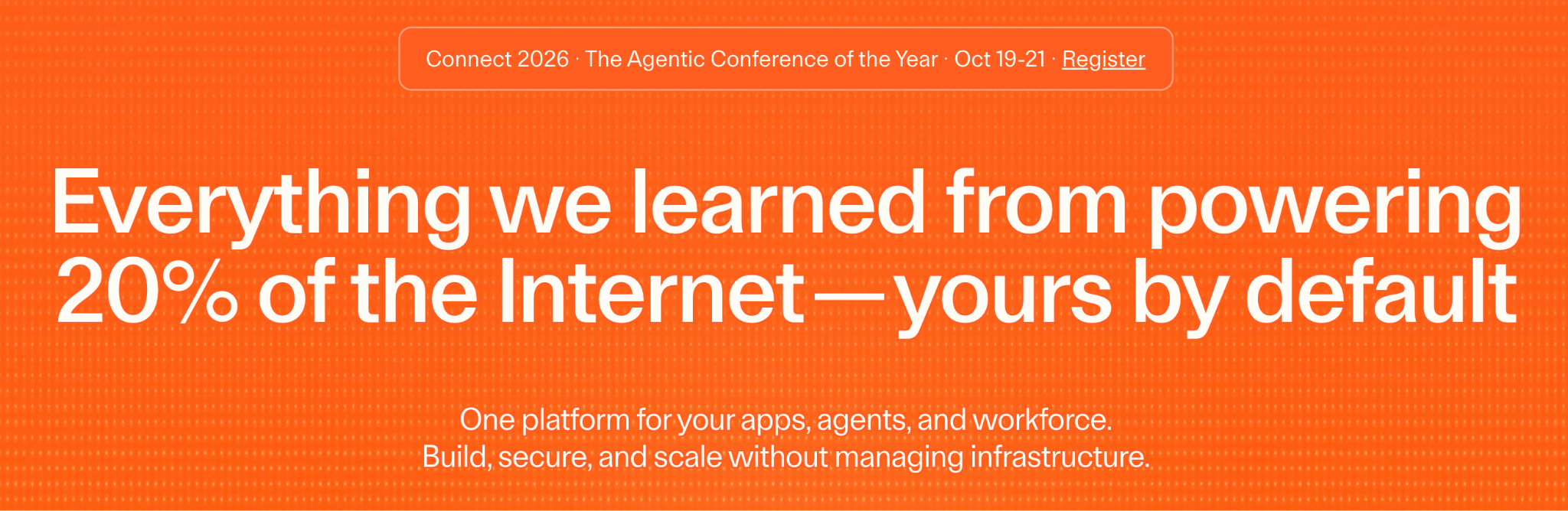
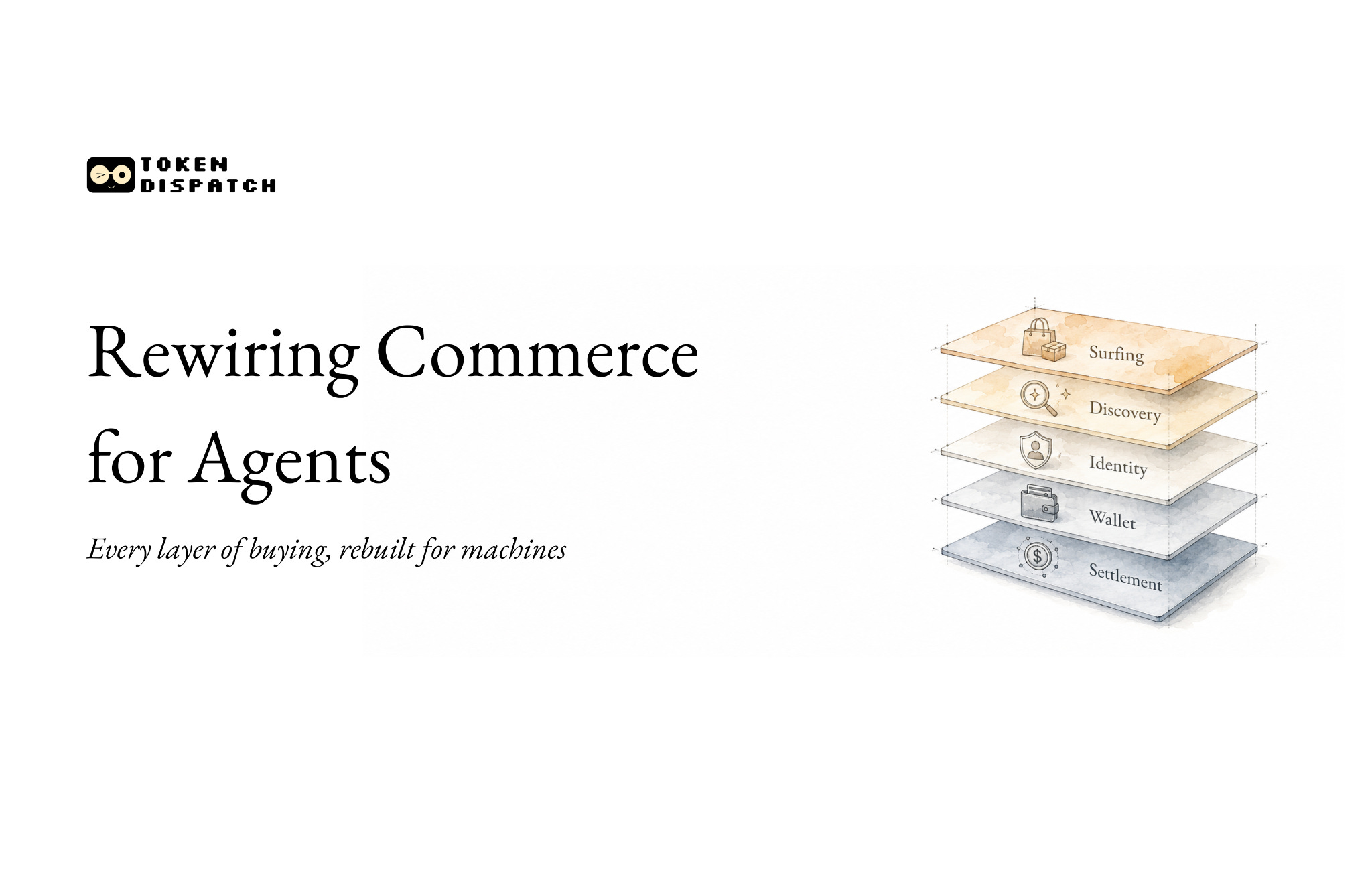
Since the start of July, the company has shipped a browser, a wallet and a storefront for machines specifically. This rewires every layer of the commerce stack, including surfing, identity, settlement, and holding money in a way that is far from being native to how humans do commerce and transact.
Cloudflare isn’t the first one to build for an agentic–first internet and commerce world. But its series of launches focusing on the agentic era calls for a closer look at how the entire journey of buying something is being taken apart and reassembled for machines.
In today’s piece, I will explain layer by layer who captures the value in this new stack as more companies rush to rebuild commerce for agents.

The Browser for Bots
To understand why AI agents need a different infrastructure than the current one, you need to first understand how they function.
An AI agent is just a piece of software that does a task for you. It could be something as simple as booking a flight or renewing your streaming platform subscription. To do these jobs, the agent needs to move around the web, prove its identity and pay for the services or products it shops for you. But the shopping journey of these machines is not similar to humans. They don’t open a flight booking website and stop scrolling at a fancy-looking ad or well-written copy. So internet infrastructure companies must rebuild each of those steps in the internet journey.
Last week, Cloudflare launched Kitesurf, a browser that they built specifically for AI agents. The interesting part about the browser is the features they stripped off an average browser that’s made for human users.
Normal browser builders spend enormous effort and time making a page pleasant for a human. They need to focus on fonts, colours, animations, where and how the little tabs stack, and the extensions you can install. Kitesurf drops all of it and keeps only the underlying information that a machine can read. AI doesn’t care about tabs or themes. All that matters to your bot is the cost of getting its query resolved and the speed at which it can find answers.
So, a browser built for agents rewires the surfing aspect. Such a browser lets the agents seamlessly surf the web for the services they need to buy or find for their masters. Then, we move to the buying aspect.
What Buying Entails
Let’s play back how we buy anything online.
We first discover it either through a search, an ad, or a shop we usually shop from. Sometimes we get persuaded to buy something we were not originally looking to buy. It could be a brand placement, a review, a discount, or a nicer-looking product on the shopping page. Then comes the difficult part of making a decision. Once we move ahead with the cart, we prove our human identity (to a machine, ironically) using a login or a captcha and use our saved cards or other methods to pay.
When we hand over this entire journey to an agent, a lot of steps become irrelevant, while some new ones take over.
An agent does none of the scrolling and discovering interesting products through ads or fancy landing pages like we humans do. Instead, it prefers to read through a clean, structured list of products and prices, pick a few that match the instructions it was given, and hand its master a shortlist of products that make the cut.
As humans, you could jump to page 2, 3 and so on of the Google search if you were not satisfied with the results on the first page. But the agent’s shortlist cuts all that crawling and gives you a shortlist that might be most relevant to your instructions. We have already started using this at scale. A survey of over 1,000 US consumers found that 57% of them leverage AI for product research at least weekly.
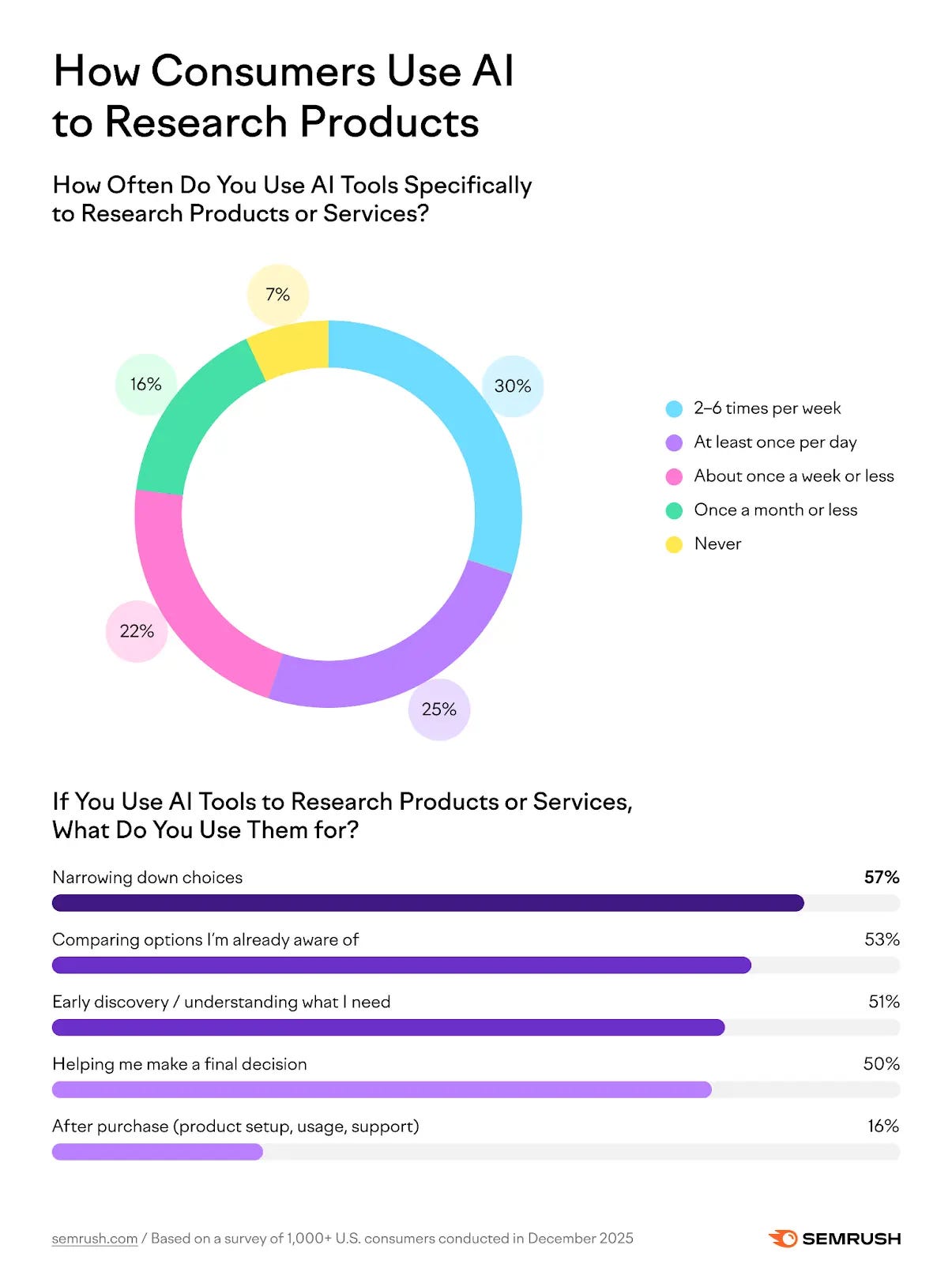
This shows that AI agents significantly cut the seller out of the shopper’s decision-influencing process. That influence and power now move to the agent’s shortlist. But who influences what the agent selects in its shortlist? It all depends on the format of the information that the agent reads before choosing the products, and a handful of companies are racing to control that format.
The Discovery War
In September 2025, OpenAI and Stripe launched Agentic Commerce Protocol (ACP), which now runs shopping inside ChatGPT. In this, a merchant shares its catalogue with OpenAI. When the buyer searches for their requirement through a prompt on OpenAI’s native chat interface, these catalogues surface and can be used to place an order and close the sale within the same chat window.
The shopper never visits the merchant’s website. All the discovery and purchase happen in the chat interface. To cut the noise of excess and irrelevant choices and drive buyers to shop for what they were looking for, OpenAI charges the merchants 4% of every order. It’s also a toll for putting the seller’s product in front of OpenAI’s distribution.
This 4% is what came back to bite OpenAI. The protocol never took off. Although Etsy went live on day one, only about 30 Shopify merchants out of the millions in its network had bothered to plug in even months after its launch. The blow made OpenAI retreat from its strategy by early 2026 and now reroutes shoppers back to the retailer’s site to finish the purchase, handing merchants back the control the original design took away.
Google and Shopify learned from this and joined hands for a contrasting bet.
Their Universal Commerce Protocol (UCP), launched in January 2026, let the merchant keep the catalogue on its own site from day one. The UCP neither plays an intermediate warehouse of catalogues, nor does it charge any commission to facilitate a sale. That’s because UCP isn’t a centralised marketplace like OpenAI and Stripe’s ACP. Instead, it chose to run an open, decentralised standard and make the communication layer entirely open.
Then, how does Google make money? Through ads and paid placements of products by retailers.
By April 2026, Amazon, Microsoft, Meta, Salesforce and even Stripe had joined Google’s UCP. Walmart, Target, Best Buy, Visa and Mastercard have also signed on.
Both models change the incumbent commerce model, which was built specifically for human-driven discovery. The human-centric model required merchants to come up with appealing advertisements and landing pages to win human attention. The new agent-driven commerce world needs merchants to satisfy a query that both shoppers and merchants will rarely see.
The Dying Layer
A huge share of commerce spending goes to persuasion through advertising, branding, and loyalty points. The whole craft of nudging an undecided human toward buying a product or service is a capital-intensive task. It could cost up to hundreds of billions of dollars a year. But the spending makes sense for humans because it depends on the assumption that the buyer can be moved. That assumption is based on proven science about human behaviour that has significant empirical backing.
On the contrary, an agent doesn’t feel emotional about an advertisement or a brand story. The only thing it cares about is the product specifications and the instructions it has been given.
So this layer gets deleted altogether in the commerce stack that’s being rewired for agents.
The new layer is already selling brands a way onto the agent’s shortlist, just the way search-optimisation firms once sold an inorganic climb up Google’s results pages. It’s just that the nudging is no longer aimed at a person, but is in the form of a paid listing or a discounted offer to grab the agent’s attention.
But what’s clear is that the profitable business of changing a human’s mind at the moment of purchase will cease to exist. There’s no more value left in this layer to capture.
Where Does the Value Accrue Next?
When an agent shows up to buy, the shop has a new problem. Who sent this thing? Is it a real assistant or a bot here to cause trouble? Is it allowed to spend this person’s money, and how much? A human has autonomy and identity. An agent is just software and a few lines of code that could be representing anyone. It is still representing a human (hopefully), but could be acting in bad faith. So somebody has to vouch for it, keep the list of trusted agents, and let shops check that identity at the first step.
That job is the most valuable layer in the stack. Think about why Visa is worth more than almost any bank. It does not lend money and barely moves it. Yet it facilitates the moment of trust. Every time a stranger’s card clears, Visa is the one certifying and differentiating bad actors from the good ones. Each time it does that, it takes a thin sliver of the transaction it facilitates.
The same Visa has already built a registry to vouch for these agents. This certification helps merchants trust the agent and let it spend.
Cloudflare is also chasing the value this layer generates. Its cloudflare.pay accounts give an agent an identifiable name. Cloudflare holds an account edge others don’t. It already has a distribution base accounting for a fifth of the global internet. That allows the company leverage to restrict agents that don’t verify themselves by inserting friction. It could become for agents what the domain name system (DNS) is for websites.
How This Evolves
Those watching this space will be most interested in a few key aspects. Will the agent identity become a whitelist that Visa or Cloudflare owns and charges for? Or will it remain an open standard that belongs to no one, like how Google and Mastercard are pushing?
Cloudflare holds the edge because of its presence across several layers at once. The company offers a browser the agent can surf with, the name it identifies the agents by, and the wallet it enables the agents to pay from. All of these sit on one network which already services 42% of the Fortune 500. Owning multiple layers across this stack lets Cloudflare charge a fee at each of them, while undercutting its competitors by offering a subsidised rate collectively for all its services.
But Cloudflare will face stiff competition from Google because of the loyalty and data bank it already possesses. Shopify integrates millions of merchants into Google’s standard, and Amazon, Walmart, Target and Best Buy collectively bring the retail might of merchants
While Cloudflare controls the infrastructure the agents travel through, Google holds an edge in hosting the merchant catalogues the agents shop from. An identity standard is only as strong as the merchants who honour it, and Google has the loyalty of those merchants here.
It will be a close fight to watch.
That’s it for today. I will be back with the next one.
Until next time, stay curious,
Prathik
Token Dispatch is a daily crypto newsletter handpicked and crafted with love by human bots. If you want to reach out to 170,000+ subscriber community of the Token Dispatch, you can explore the partnership opportunities with us 🙌
📩 Fill out this form to submit your details and book a meeting with us directly.
Disclaimer: This newsletter contains analysis and opinions of the author. Content is for informational purposes only, not financial advice. Trading crypto involves substantial risk - your capital is at risk. Do your own research.