


Hello,
Consider a software engineer in Pune who buys a few US shares through an app every month. The US market opens around his dinner time and closes well after midnight. A token of that same share, which trades around the clock, sounds like it was built for him.
That’s what tokenisation promised. Where you lived and what time it was would no longer matter in deciding what you could own. But now, the companies have a say. Over the last few weeks, dozens of them refused to let their shares trade as tokens on a new venue. The old gatekeepers were brokers and exchanges. The new one is the issuer.
But this is an odd arrangement. While shareholders own the company, it’s the company that is deciding where its shares trade. Management says it’s protecting investors. Maybe they are. But why is nobody asking the investors?
It’s nice to have caution. But the people with the most to gain have the least say. In today’s guest essay, Sebastien Davies, Partner at Primal Capital, digs into why so many companies said no, and what it would take for them to say yes.
On to Sebastien’s story,
Prathik

StablesReward: Your AI Agent Spends, You Earn
AI agents can surf the web, read reviews, and book hotels for you. All these tasks cost money. But what if these tasks could earn you back something?
StablesReward does just that. Once you connect your agent to an MCP endpoint, it gives your agent a menu of paid tools. Every call your agent pays for earns you miles or stocks. And this is in addition to the rewards you earn anyway on your own spending across 800+ merchants.

Every purchase pays you back. The best part is that you can choose how you’d like to be rewarded. Transfer miles to airlines and hotels, or let your stocks build a portfolio from the spend you were making anyway.
Launching soon. Free to join.
I started this piece around a different number. On October 23, OKXICE, the tokenised stock venue owned jointly by Intercontinental Exchange (ICE) and OKX, listed 22 companies that had objected to having their shares traded on it. 19 came from the 62 on its original roster. What interested me was the other 43. Under the SEC’s new exemption, a company that says nothing is treated the same as one that agrees, and I wanted to know what that default would make of their silence.
To the detriment of my blood pressure, 33 more companies from the original list appeared on the objection list over the next eleven days. The notice of November 3 lists 59 objectors. Checked against the October 4 roster, 52 (about 84%)come from the original 62, leaving 10 without a disclosed objection. All five of the large names I’d been watching are on it. JPMorgan and Nvidia appeared in late October, Amazon and Tesla on November 2, and Apple on November 3.
So the question changed. I set out to ask what silence would allow. The response made me ask why so many companies took the trouble to object, and what would have to change for them to decide differently.
What the SEC Built
The Innovation Exemption, Release 34-106402, issued September 17, lets a Tokenised Securities Venue run on-chain trading in tokenised US-listed stocks for five years without registering as an exchange. The token has to be the real thing. A broker-dealer holds one share per token, and the holder gets the same dividends, votes and claim on liquidation. Each of the 75 largest names is capped at 0.25% of the prior month’s average daily volume, one share in every four hundred that already trades.
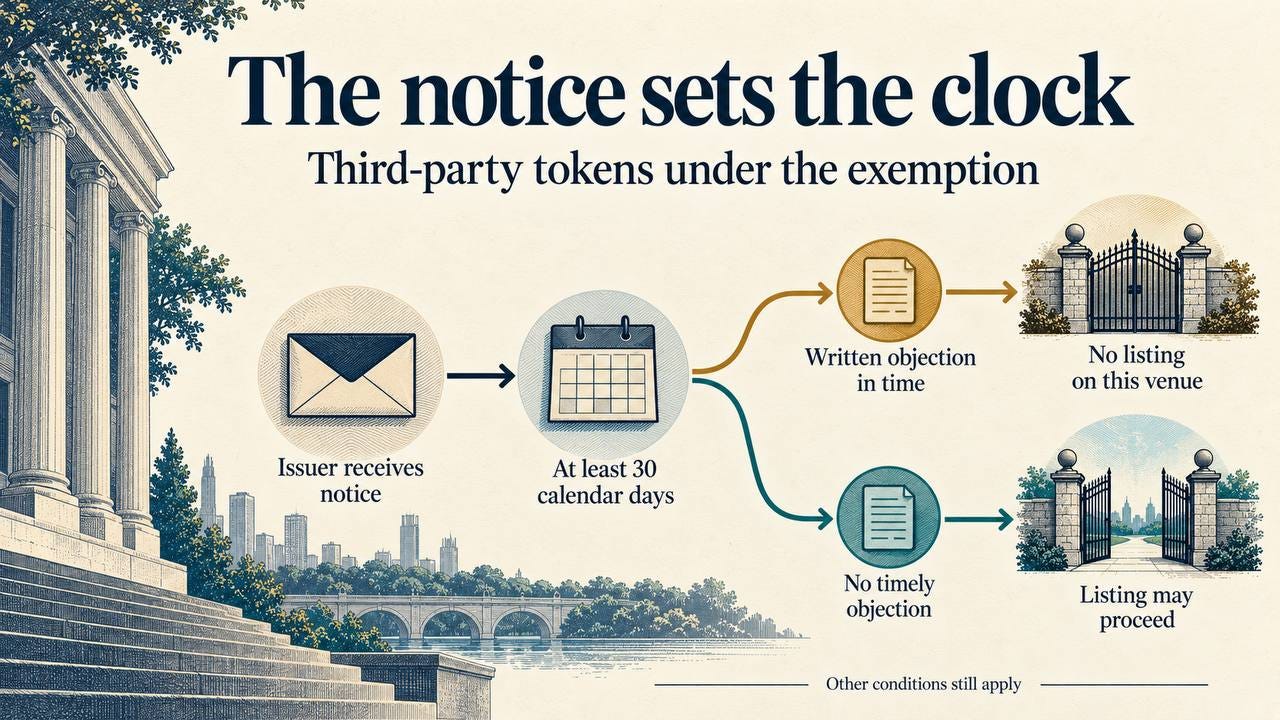
When a third party makes the token, the venue has to send the issuer written notice and wait at least 30 calendar days. A written objection inside that window keeps the token out of the venue. Without an objection, the venue can go ahead once the order’s other conditions are met. Erin Martin, a Morgan Lewis partner and former senior SEC lawyer, put it precisely to Fortune: “There’s not a proactive consent right. Rather, it is a reactive right to object.”
None of that has changed. Silence still lets a venue proceed. What’s striking is how few companies were willing to leave it there.
How the Count Moved
OKXICE plans round-the-clock trading in Uniswap pools on OKX’s XLayer chain, paired against USDC or USDG. Its October 4 notice proposed 63 tickers across 62 companies. The tally since, by notice date:
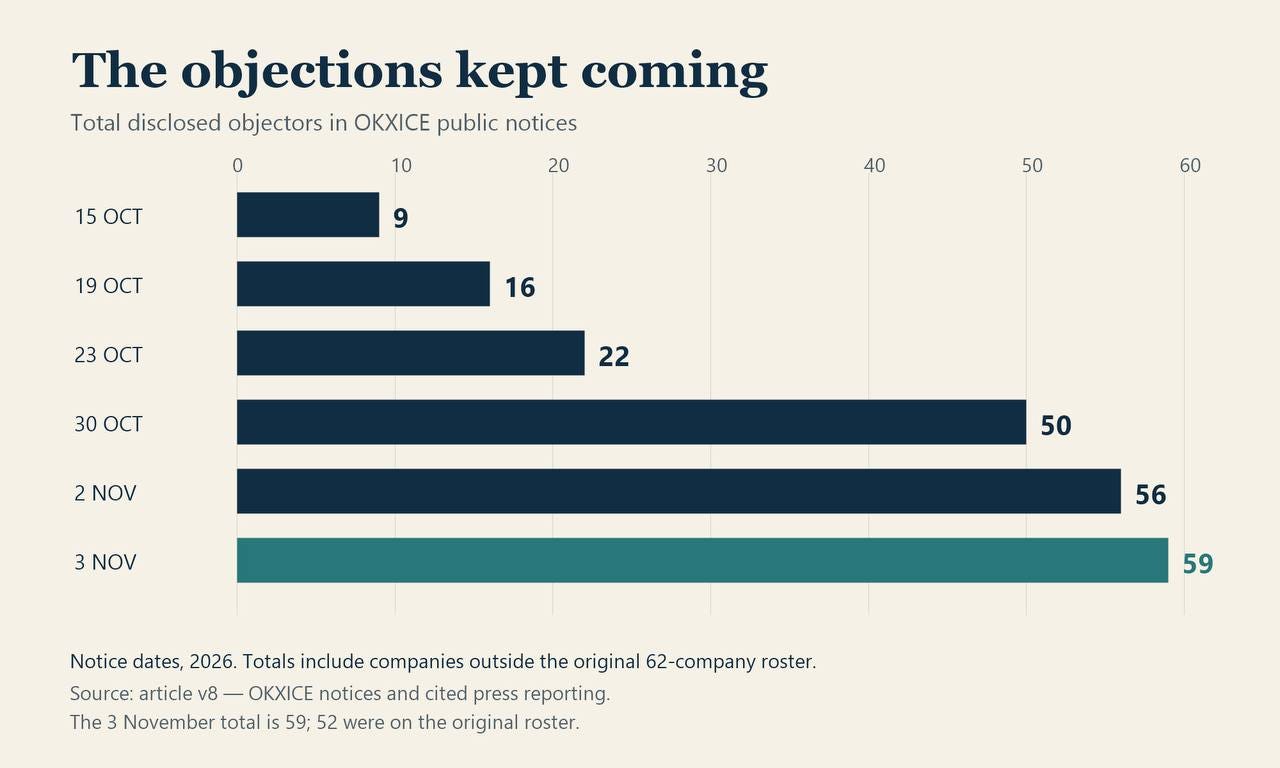
The ten without a disclosed objection are Strategy, Robinhood, Coinbase, Circle, Securitize, BitGo, Palantir, Super Micro Computer, ServiceNow and Boeing. Six of them run businesses built around crypto or tokenisation, and Securitize and BitGo have said they won’t object.
A missing objection doesn’t establish approval, an expired window or a decision to list. For issuers that received notice on October 4, the window closed on November 3, but each window runs from the date when a company received its notice, and those dates aren’t public. The venue then has up to five business days to publish an objection, so ones sent in time can still appear.
Why Object
One objector has said publicly why. A spokesperson for Applied Optoelectronics, a Texas-based maker of optical components, told Fortune on October 21 that the company doesn’t “see a clear benefit to AOI or our shareholders that justifies these uncertainties.”
AOI’s sentence speaks about the economics involved. An issuer can see the possible costs of an unfamiliar venue much more clearly than the benefits. The benefits are some extra liquidity, capped at one share in four hundred, and perhaps access for investors who’d rather hold on-chain, on a venue the company doesn’t control. The costs are easier to list.
Price transparency comes first. Nasdaq’s guidance to its listed companies notes that these venues don’t have to display best prices or report to the consolidated tape, and trade data can lag by up to ten minutes, which “effectively creates a shadow market for equity securities.” The SEC itself flagged that pool prices are “most likely based only on the ratio of the quantities of assets in that liquidity pool.” Trading hours make it worse. A pool that trades overnight prices the stock while the primary market is shut, including after results, and produces a number that the shareholders will see but the company can’t explain.
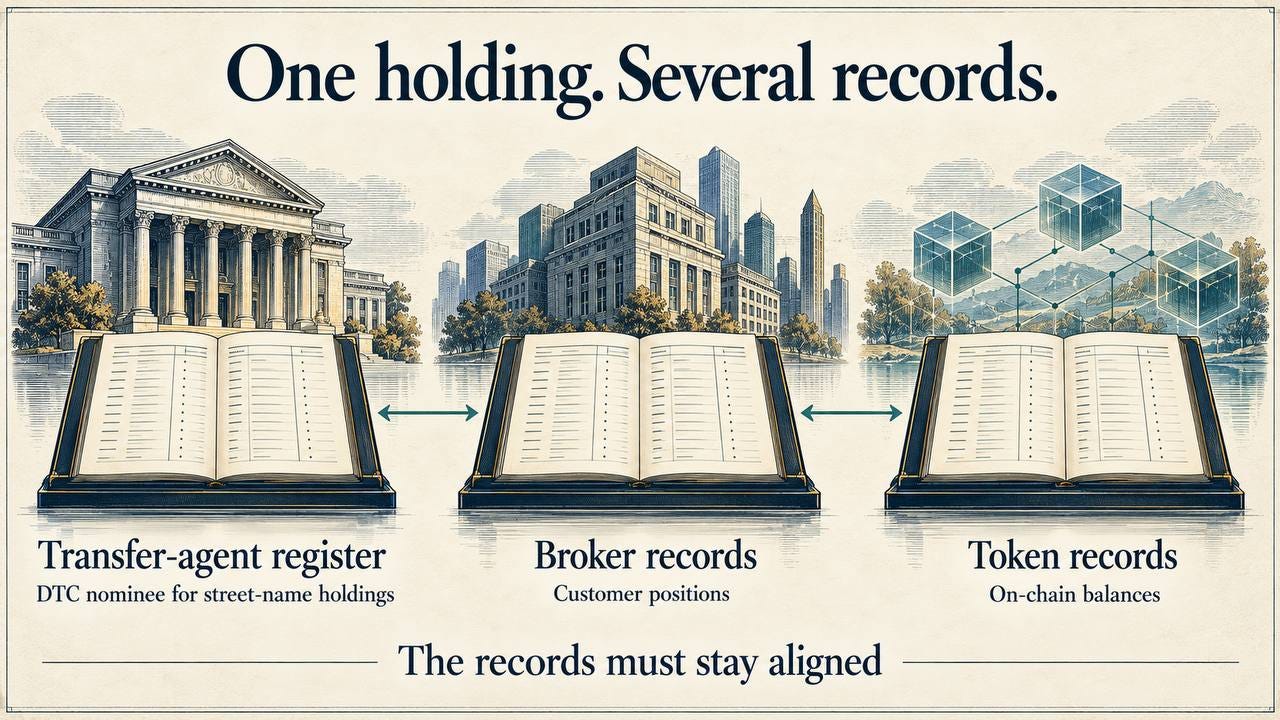
Then, come the ownership records. Joris Delanoue, who runs Fairmint, an SEC-registered transfer agent that keeps registers on-chain, said: “For equity securities, a blockchain isn’t the source of truth; the issuer-authorized shareholder register is.” Most US shareholders own through a broker, and the register shows DTC’s nominee as the holder. A token adds another record on top, and every one of them has to agree.
Last is investor confusion. Nasdaq’s rebuttal is that if investors get poor outcomes on a venue where the issuer let its stock trade, “investors may assign blame to the issuer.” Against all that, objecting costs a letter.
Some companies may be waiting for a working market. Andrew Cuomo, OKXICE’s co-chair, said he expects companies to hold back because they don’t want to be first and would rather see how it goes. Under a 30-day, one-venue-at-a-time process, waiting and refusing look identical from the outside.
Others may object to this venue or structure. OKX is an offshore crypto exchange with its own regulatory history, and the trading runs through automated pools paired against stablecoins. Some boards may not want their name next to that.
Most want control. A company can be happy to see its shares tokenised and still prefer to decide how, by whom, and on what terms. The order lets an issuer tokenise its own shares without the third-party notice. Payments incumbents made that choice with stablecoins: Mastercard bought BVNK, and Visa lets payout firms prefund transfers in USDC, integrating on their own terms and at their own pace.
The tally can’t tell us which of these applies to most issuers. 52 letters with one public reason is a count of decisions, and the reasons stay private.
Who Wants which Standard
Several parties arguing over the standards have tokenisation plans of their own. ICE warned in its 2025 10-K that “if we do not innovate, we risk being displaced or disintermediated,” naming tokenised securities. OKXICE is its answer, and a default where silence lets a listing proceed works in its favour. Nasdaq, which says it will opt its own shares out of these venues, formed a digital assets unit in the third quarter and bought $100 million of preferred stock in Kraken’s parent in September. Its investor protection concerns are legitimate, and it also has a commercial interest in where tokenised equities trade.
SIFMA, whose members are broker-dealers & asset managers, asked the Commission on October 19 to flip the default. A third-party token “should trade on a TSV only with the issuer’s affirmative consent,” it argues, because the order “treats an issuer’s silence as consent.” Goldman Sachs, an objector since October, is a member.
An opt-in would change what happens to issuers who never respond: any of the 10 that have neither objected nor said yes would stay off the list. It wouldn’t explain clearly why 52 companies took the affirmative step to object. On OKXICE’s roster, most issuers didn’t leave the decision to the default. How many of the remaining 10 ultimately decide is still unknown.
The Best Case
The company veto covers one structure: third-party tokens, backed one-for-one, on a US venue under this order. It doesn’t reach an offshore token or a product that gives price exposure without ownership. Of about $25.6 billion of tokenised equity trading on BNB Chain in the third quarter, almost all happened outside the SEC’s order. That’s turnover and doesn’t establish every product’s legal structure, but it gives a sense of scale. An objection might even push trading toward a wrapper the company knows less about. Regardless, under this exemption, on OKXICE’s original roster, most issuers objected in time.
Where this goes
I’m now focused on a more specific question. Will any company that said no to OKXICE say yes when it can choose the venue, the structure, or the terms?
A second route already exists. On October 29, Canton Strategic Holdings, a small Nasdaq-listed company, announced an agreement with TSV LLC and engaged Fairmint to tokenise its shares “as issuer-sponsored stock.” Of course, this doesn’t tell us whether an OKXICE objector would do the same, but it does change the test. The question is no longer whether any issuer will take the sponsored route, but whether one of the 52 does.
The other test is of a comparable venue. The exemption is built around permissioned AMM liquidity pools, so the fair comparison is another venue under the same order with different safeguards or reporting practices. A conventional order book would change the regulatory route as well as the venue. If the same issuers object again, the OKXICE-specific explanation weakens, though that alone wouldn’t say which other explanation is doing the work. If responses vary, that would be consistent with venue design or control mattering more than a general reluctance to tokenise.
What to Watch
I can’t wait to see the launch roster, which will show what OKXICE chose and was able to list. Sadly, we still won’t know why any name is absent. The pace at which this is all moving, none of the 10 silent companies should be assumed to trade.
I’m also watching the 52 as a cohort. The first to tokenise its own shares will have said yes on its own terms after saying no to OKXICE’s. Finally, a second venue under the same exemption that is sending third-party notice to the same companies might provide us with more intelligence as to how corporates are thinking about tokenising their equity.
The SEC Chairman Atkins and Commissioner Uyeda expect notice-and-comment rulemaking, and that’s where SIFMA’s opt-in gets written in or doesn’t. The standards will matter most for companies that never answer, and for venues with less visible rosters, where fewer issuers may notice the letter at all.
P.S.: This story was first published here.
P.P.S.: We will be featuring good writing and writers we love from time to time. If you have recommendations, send them our way.
Token Dispatch is a daily crypto newsletter handpicked and crafted with love by human bots. If you want to reach out to 165,000 subscriber community of the Token Dispatch, you can explore the partnership opportunities with us 🙌
📩 Fill out this form to submit your details and book a meeting with us directly.
Disclaimer: This newsletter contains analysis and opinions of the author. Content is for informational purposes only, not financial advice. Trading crypto involves substantial risk - your capital is at risk. Do your own research.
