


Hello,
Money that’s not liquid enough is as good as a souvenir. Electricity stored at the grid is of no use if it can’t be circulated.
Often when I read about the new kinds of money humans innovate, the first question I ask is: “Does this circulate enough to ensure it satisfies the basic utilities of money?” It must have a store of value, should compound, and be freely movable to allow transfer of value.
Money sitting in a bank account doesn’t benefit the masses - be it dollars or stablecoins. Liquidity that’s disconnected from its points of application is exclusionary by nature and defeats the fundamental idea of money.
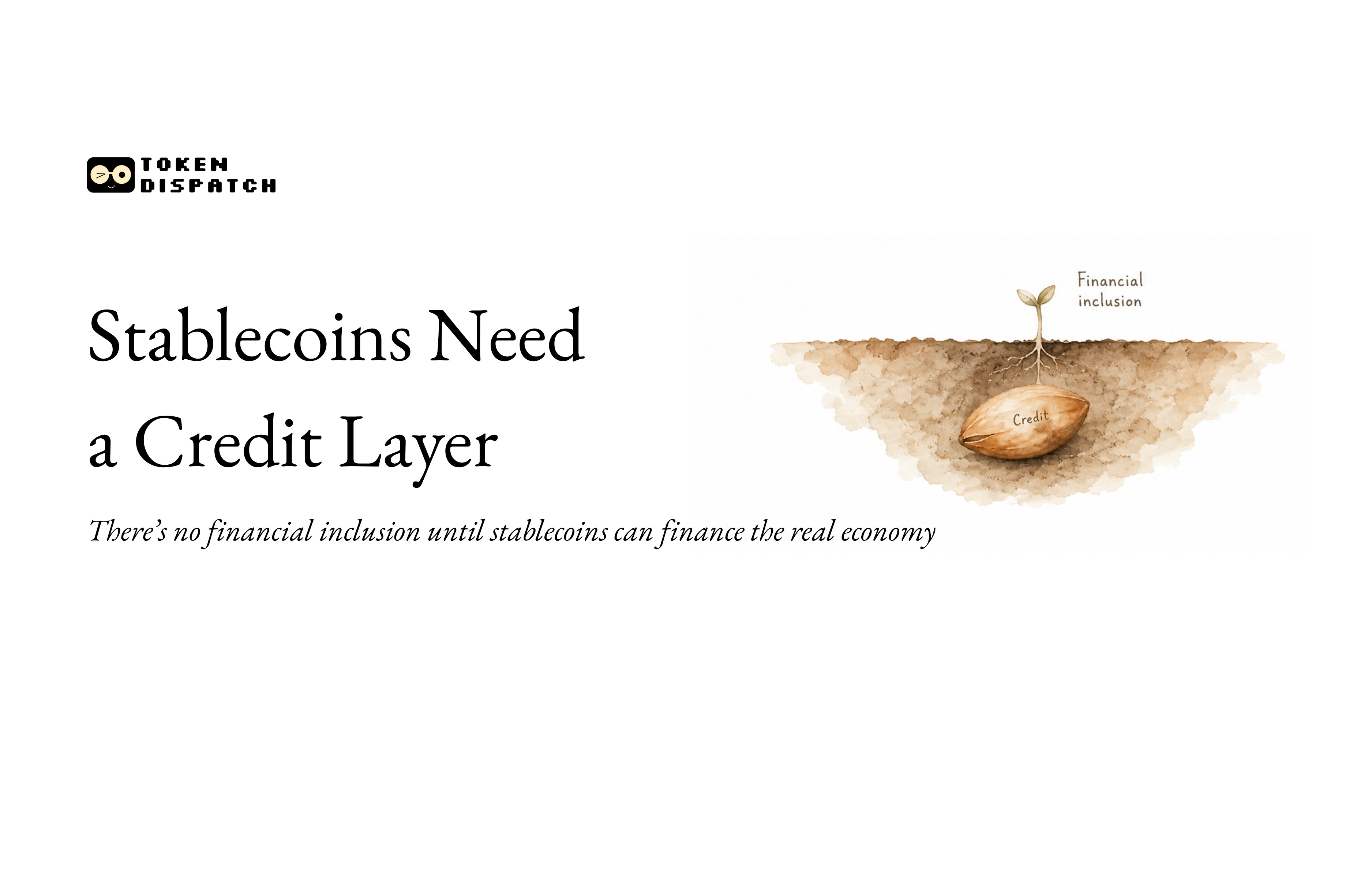
Circulation is key for any kind of money to be adopted by the masses, and credit is the perfect tool to help circulate money. Credit does to money what gridlines do to electricity. What makes the dollar the dollar is that an entire credit apparatus sits behind it, including banks, underwriters, and guarantee structures, that takes idle liquidity and routes it toward people who can put it to work.
Stablecoins have solved the movement problem, but it’s not yet a complete form of money.
Criptolawyer/Ana Ojeda, who leads institutional business development at Blend, writes in today’s guest essay about the role credit needs to play to make stablecoins support financial inclusion.
On to Ana’s story,
Prathik

Crypto Investing On Autopilot
You’ve probably had your brain fried tracking 50 things for the few tokens you handpicked from a pile of random. Crypto is not a joke. If anything, it is a sad place that robs people off their money. Glider builds on the opposite philosophy. It helps you pick a basket of assets and programmatically rotate it based on conditions you define.
One basket holds the Mag7 at equal weight.
Another mirrors congressional stock trades, the Pelosi Tracker.
Everything stays non-custodial. No gas fees either.
Today’s issue was sponsored by them, and it comes in the week they launched ATPs with Bitwise. More on their release on Bloomberg here. Explore how Glider combines RWAs and programmatic finance directly in its product here.

Let your strategy run itself at Glider.fi.
We have built faster settlement, cheaper cross-border payments, dollar-denominated accounts, crypto cards and increasingly efficient fiat ramps. These are meaningful achievements, particularly in emerging markets, where accessing a stable currency can already transform someone’s financial life.
But we have mostly solved how money moves. We have not solved who gets access to capital.
A worker may now receive part of her salary in USDC. A merchant can accept stablecoins from customers. A small business can preserve its treasury in dollars instead of watching its local currency depreciate. Then the merchant needs financing to purchase inventory, the worker needs to cover an emergency, or the business needs thirty days of working capital.
At that moment, the supposedly new financial system usually offers one answer: bring us more collateral than you want to borrow.
That is excellent collateralised liquidity. It is not financial inclusion.
I come from Venezuela, so I have never thought about stablecoins as an abstract crypto product. I think about them as protection against devaluation, access to dollars and a way for people and businesses to operate when the traditional financial system cannot serve them effectively.
But protection is only one part of finance. People do not only need a place to store money. They need to receive it, move it, earn on it and sometimes borrow against their future income rather than their existing wealth.
My thesis is that stablecoins will reach their full potential in emerging markets only when they become connected to a credible credit layer: one that combines productive accounts, local underwriting, regulated lending, business operating data, guarantees and institutional capital.
1. Overcollateralised lending solved a crypto problem
Overcollateralised lending was a rational response to the conditions in which DeFi emerged.
An open protocol does not automatically know a borrower’s identity, income, employment, repayment history or legal enforceability. Requiring liquid collateral made it possible to lend without relying on a conventional credit relationship.
That model works well for traders, market makers and treasury managers. It can be transparent, automated and highly efficient.
But someone who needs $100 because they do not have $100 cannot deposit $150 to borrow it. A small merchant seeking working capital usually cannot lock up more liquid capital than the inventory it wants to purchase. The people most likely to benefit from credit are precisely those least likely to possess excess collateral.
Real credit requires something more difficult than a liquidation engine. It requires an informed judgment about someone’s ability and willingness to repay.
That judgment may use payroll history, merchant sales, recurring cash flows, employment records, transaction behaviour, previous repayments, invoices or commercial relationships. It also requires servicing, collections, consumer protection and a party capable of absorbing losses when the judgment is wrong.
A blockchain can make the infrastructure surrounding credit more transparent and efficient. It cannot make credit risk disappear.
This is the central limitation of the stablecoin economy as it exists today. We have created global liquidity without creating a sufficiently sophisticated system for allocating that liquidity to the people and businesses that need it.
The encouraging part is that the different components of that system are beginning to appear.
2. Cashea: underwriting through local behaviour
One of the most instructive examples is Cashea in Venezuela.
Cashea is not a crypto lending protocol and does not offer unrestricted cash loans. It provides purchase lines that consumers can use across a broad merchant network. Users make an initial payment and complete the remainder in instalments.
What makes the model relevant is not simply the buy-now-pay-later format. It is the information generated through the commercial relationship.
Cashea can observe where someone shops, how regularly they repay and how their behaviour changes over time. Responsible repayment can increase purchase capacity, while the merchant network gives every credit decision a specific economic purpose.
This is often more useful for local underwriting than knowing that a wallet temporarily holds a token worth 150% of the requested loan.
Cashea demonstrates that creditworthiness can be constructed through real commercial activity, even where traditional credit bureaus and banking relationships remain incomplete. The merchant network is not merely a distribution channel. It becomes part of the underwriting system.
Its exact model will not be portable to every country because credit is deeply local. But the underlying principle matters: emerging-market underwriting will increasingly depend on real economic behaviour rather than crypto collateral alone.
The next challenge is connecting that local information with properly licensed lenders and deeper pools of capital.
3. Portola: distributing credit without turning every wallet into a bank
This is why one of the products that interests me most right now is Portola.
I recently met one of Portola’s founders in person, and the conversation stayed with me because the company is addressing one of the most complicated questions in embedded finance: how can a wallet or fintech offer credit without pretending that it should become a bank?
Portola connects platforms with regulated lenders while allowing the platform to preserve its user experience. The licensed lender still performs the underwriting, funds the loan and bears the credit risk. Portola coordinates the infrastructure around applications, offers, compliance, settlement and servicing.
That separation is important.
A wallet should not need to become a licensed lender simply because its users need credit. A fintech should not be forced to build loan origination, servicing and collections infrastructure from zero. At the same time, embedding a credit button cannot make regulatory responsibilities or credit losses disappear.
Portola’s current architecture is not yet a complete answer to emerging-market microcredit. Local markets may require alternative data, domestic lenders, local consumer-credit licenses and very different servicing practices.
But its model provides a compelling blueprint: keep the experience embedded while preserving clear responsibility for underwriting, compliance, capital and losses.
The next step is connecting that architecture with richer local signals. Payroll history, merchant revenue, recurring payments and transaction behaviour could help a regulated lender evaluate a borrower who may not have a conventional credit file.
Cashea demonstrates how local credit information can emerge. Portola shows how that information could eventually connect with regulated lending capacity.
4. Flex: credit inside the operating life of a business
For businesses, the same thesis appears in a different form.
A company does not experience payments, treasury, accounting and credit as separate theoretical markets. It experiences them as one continuous operating problem.
Revenue arrives today. Payroll is due tomorrow. A supplier needs to be paid in another country. Inventory must be purchased before the next sales cycle. An invoice will settle in thirty days, but the company needs liquidity now.
This is why Flex is another product that interests me. Flex combines business banking, stablecoins, payments, cards and private-credit products within one financial environment. Its financing products include working capital, revenue-based financing, business lines of credit and accounts-payable and accounts-receivable financing.
When revenue, supplier payments, receivables and expenses live inside the same platform, the financing experience can be connected with how the business actually operates.
Instead of asking a company to present a static snapshot of itself, the platform can understand the timing and movement of its cash flows. That context is particularly valuable for businesses whose financial reality does not fit neatly inside a conventional credit application.
Flex is not an emerging-market microcredit platform, and product availability depends on geography and eligibility. But it demonstrates what the eventual product should feel like: financing embedded into the financial operations of a business rather than offered as a disconnected loan.
Stablecoins make this model even more relevant for internationally operating companies. A business may receive revenue in one jurisdiction, pay suppliers in another and run payroll somewhere else. Stablecoin settlement can reduce the friction involved in moving that money, while embedded credit can finance the gaps between those activities.
Portola shows how platforms can connect with lenders. Flex demonstrates how credit can live inside the actual financial life of a business.
5. Cap: separating the borrower from the risk capital
The next question is who absorbs the risk when the borrower cannot provide sufficient collateral personally.
This is where Cap becomes relevant.
Cap separates its system into depositors, borrowers and external underwriters. Rather than requiring the borrower to provide all the collateral personally, another participant can supply financial coverage and earn a premium for assuming that risk.
In one example, Flow Traders accessed stablecoin credit through Cap, while Lombard BTC holders supplied the coverage.
This is institutional credit, not emerging-market microfinance. But the structural idea is powerful: the borrower and the provider of risk capital do not need to be the same person.
Applied to emerging markets, a similar guarantee layer could eventually involve local financial institutions, insurers, development-finance organisations, employers, merchant networks or specialised first-loss funds.
A merchant network might guarantee part of a credit portfolio because the financing increases sales. An employer might support salary-linked advances. An institutional investor might fund a first-loss pool because the transaction data is transparent and the risk-adjusted return is attractive.
This is not about making collateral disappear. Credit risk must sit somewhere.
The objective is to move the obligation to provide coverage away from the individual borrower and toward professional parties capable of evaluating, pricing and absorbing risk.
Cap’s architecture helps demonstrate how that separation could work.
6. Blend: making the underlying account productive
At Blend, where I lead institutional business development, I work on another part of this emerging system: the productive account and capital-access layer.
Before a fintech, payroll platform, wallet, or neobank can offer sophisticated savings or credit products, it needs infrastructure that keeps each user’s balance separate, applies controls, produces audit trails and connects the account with appropriate financial strategies.
Blend provides non-custodial, per-user accounts that let platforms offer governed access to stablecoin yield and institutional financial products under their own brands.
We are not trying to replace the local lender or decide whether someone in Brazil, Mexico or Venezuela should receive a loan. That decision belongs to properly licensed institutions with relevant local information.
Our role is to make the underlying account productive, controlled and interoperable.
The more I work on Blend, the more convinced I become that yield is not the endpoint. It is the first productive use of a digital financial account.
A stablecoin balance should not remain idle while the user waits to spend it. It should be able to access an appropriate return, remain available for payments and eventually become part of a broader financial relationship.
That relationship could include payroll, treasury, merchant payments and, once the necessary underwriting and lending infrastructure exists, credit.
This is why we are interested in working with teams across the entire emerging stack. Blend does not need to become Cashea, Portola, Flex or Cap. The more valuable opportunity is to make these specialised layers interoperable.
The future financial system will not be built by one company rebuilding accounts, payments, underwriting, guarantees, servicing and capital allocation internally. It will be built by connecting the best infrastructure at each layer while presenting the user with one coherent product.
7. How the pieces fit together
Once these components are placed together, the shape of the future product becomes much clearer.
A person receives salary or business revenue in a stablecoin account. They use that same account to pay merchants, suppliers, employees or contractors. The portion they do not need immediately can access an appropriate return rather than remaining idle.
Over time, the account develops a financial history based on verified income, transactions, commercial activity and repayment behaviour. That information can be evaluated by a local underwriting system and routed to a properly licensed lender.
A guarantee provider or first-loss investor can cover the portion of the risk the borrower cannot collateralise. Repayment can then be coordinated with future cash flows.
For a business, the same account could receive customer payments, run payroll, manage supplier bills, allocate treasury and provide working capital based on actual operating performance.
The user should not need to understand which company provides the account, which lender funds the loan, which underwriter supplies the guarantee or which infrastructure executes settlement.
They should experience one coherent financial relationship.
Cashea represents the local behavioural context. Portola represents the connection with regulated lenders. Flex represents the business operating and working-capital experience. Cap represents guarantees and professional risk capital. Blend represents the productive account and access infrastructure underneath the user’s balance.
These companies do not compete to solve the same problem. They are potential components of the same architecture.
8. Credit remains local, even when capital becomes global
None of this eliminates regulation.
Credit is considerably more local than stablecoin settlement. Consumer disclosures, affordability assessments, interest-rate restrictions, data privacy, licensing, collections and credit reporting vary significantly by jurisdiction.
Stablecoins may reduce settlement costs, but they do not remove these obligations. If anything, embedded credit makes it more important to define responsibilities clearly.
The account provider does not need to become the lender. The lender does not need to build its own stablecoin infrastructure. The distribution platform should not silently assume the underwriting risk. The guarantor does not need to control the user relationship.
But every participant must know what it is responsible for.
This is why I do not believe there will be one global smart contract offering identical unsecured loans everywhere. Capital may become increasingly global, but underwriting, regulation and enforcement will remain connected to local realities.
A lender in Colombia may understand merchant cash flows that a global protocol cannot evaluate. A payroll company in Mexico may understand income stability better than a foreign credit bureau. A merchant network in Venezuela may observe repayment behaviour invisible to the traditional banking system.
The opportunity is to connect global stablecoin liquidity with institutions that understand these local realities.
9. The real stablecoin killer product
The stablecoin killer product for emerging markets is not simply a better way to buy USDC.
It is a financial operating account where a user can receive money, preserve its value, spend it, generate an appropriate return and gradually access credit based on real economic activity.
Giving someone access to digital dollars protects their purchasing power. Giving them a card makes those dollars spendable. Giving them yield makes their savings productive. Responsible access to credit lets them build.
It allows a merchant to purchase inventory before demand arrives. It allows a contractor to buy better equipment. It allows a family to manage an emergency without selling productive assets. It allows a business to convert future cash flows into working capital.
This is why I no longer believe the central question is whether stablecoins can replace bank transfers.
The real question is whether stablecoin infrastructure can support a complete financial relationship.
My thesis is that it can, but only if we stop treating payments, yield, underwriting, guarantees and credit distribution as separate industries.
The next financial system will be assembled from complementary layers: local behavioural data, regulated lenders, embedded business finance, institutional risk capital, productive accounts and compliant settlement infrastructure.
Payments made money move. Yield makes it productive. Credit is what can turn it into an economy.
That’s it for today.
P.S.: This piece was originally published here.
P.P.S.: We will be featuring good writing and writers we love from time to time. If you have recommendations, send them our way.
Token Dispatch is a daily crypto newsletter handpicked and crafted with love by human bots. If you want to reach out to 165,000 subscriber community of the Token Dispatch, you can explore the partnership opportunities with us 🙌
📩 Fill out this form to submit your details and book a meeting with us directly.
Disclaimer: This newsletter contains analysis and opinions of the author. Content is for informational purposes only, not financial advice. Trading crypto involves substantial risk - your capital is at risk. Do your own research.