


In early October, a memecoin on Ethereum called Claus swapped out part of its brain.
Claus splits its trading fees between buybacks, burns, liquidity and rewards for NFT holders.
This was a coin that had already given the weather a say in its finances. Claus divides trading fees between buybacks, burns, liquidity and rewards for NFT holders. For a time, signed weather reports from London Heathrow helped determine how much went towards destroying tokens and how much went back into the pool to support trading. Rain favoured burns. Dry weather favoured liquidity.
If the reports are not arriving, the allocation returns to an equal split.


The weather experiment was one of several functions attached to its trading pool. On 6 October, the project reported removing an arbitrage function while keeping the token address, pool and other features in place. This way, the holders did not have to exchange their tokens for a replacement.
This happened because the Uniswap v4 pool uses an upgradeable hook.
A hook is a smart contract that adds instructions around trading. Other developers use hooks to adjust fees or put liquidity to additional use. This lets people build different kinds of markets inside an existing exchange, without having to launch a DEX and persuade everyone to move there.
So by October 8, if you checked Uniswap’s public hook registry, the contract running all the fee stuff for Claus was now pointing at this new piece of code called FeePrivacyHook instead of the old FeeWeatherHook.
The team says that the coin is its own agent with the token as its body and an upgradeable Uniswap v4 hook as its mind. A token’s rules were always written once into the contract, and every exchange treated it that way forever.
Hooks pull those rules out of the token and stick them in the market where it trades. Sometimes they even let someone rewrite the rules later.
An industry is forming around this, and that opens the door to a bunch of interesting products and also some fresh ways to lose money.

StablesReward: Your AI Agent Spends, You Earn
AI agents can surf the web, read reviews, and book hotels for you. All these tasks cost money. But what if these tasks could earn you back something?
StablesReward does just that. Once you connect your agent to an MCP endpoint, it gives your agent a menu of paid tools. Every call your agent pays for earns you miles or stocks. And this is in addition to the rewards you earn anyway on your own spending across 800+ merchants.
Every purchase pays you back. The best part is that you can choose how you’d like to be rewarded. Transfer miles to airlines and hotels, or let your stocks build a portfolio from the spend you were making anyway.
Launching soon. Free to join.
What are the hooks?
If ETH costs $2,000 in one pool and $2,020 in another. A trading bot can buy from the cheaper pool and sell into the more expensive one, keeping whatever profit remains after fees and gas as arbitrage. Those trades help bring the two prices closer together. Usually, the bot keeps the profit while the pools earn trading fees.
A normal liquidity pool already has rules for calculating trades and charging fees. But a developer might want it to capture some of that arbitrage profit for its users. A hook is a separate smart contract that runs extra instructions at specific points during a trade. Some hooks use those instructions to check for a price gap after a swap and execute profitable trades to close it, all within the same transaction. They can then share the captured profit with liquidity providers, the trader and the project running the hook.
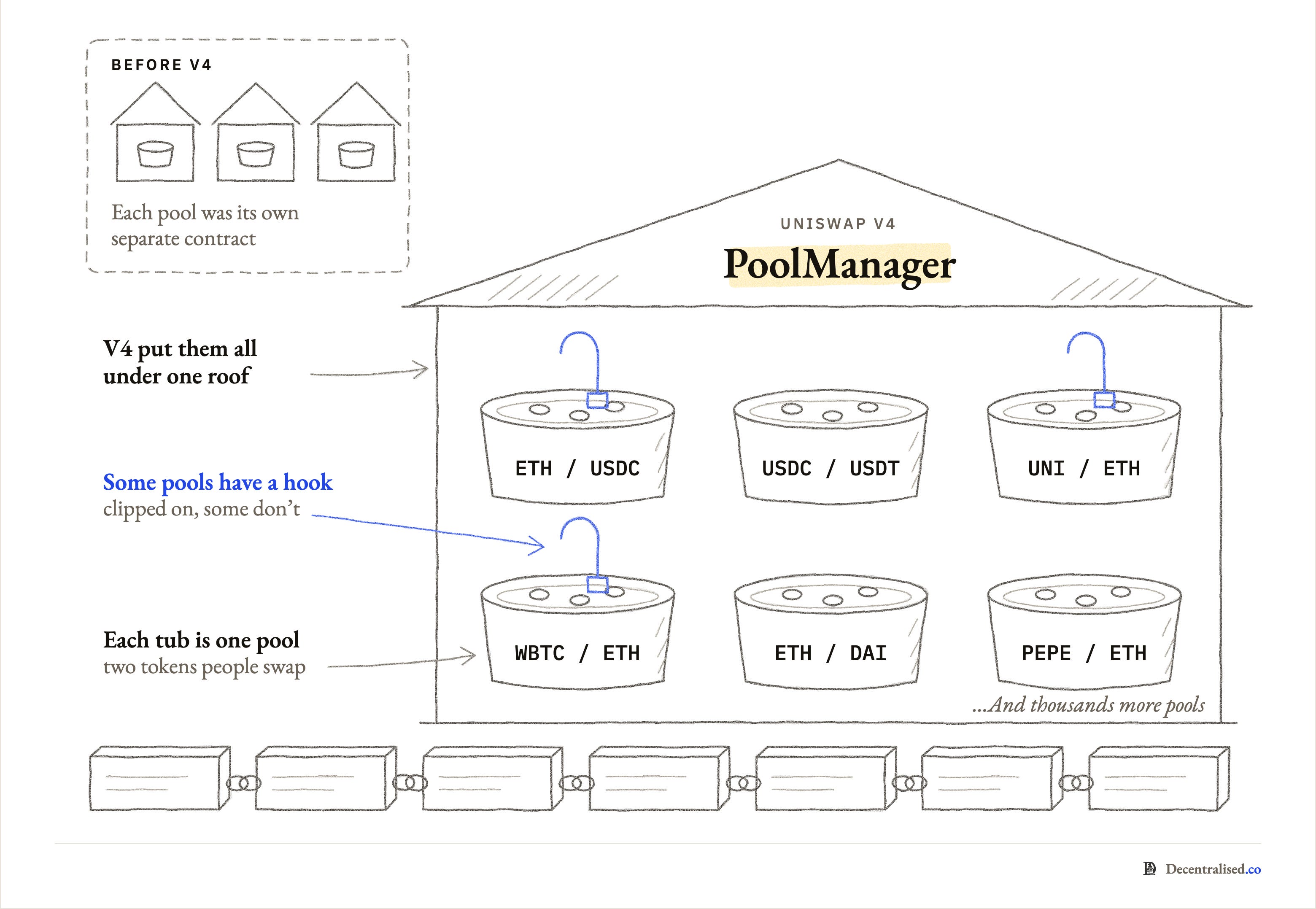
In Uniswap v4, a shared contract called the PoolManager handles swaps and tracks each pool’s balances. Every v4 pool on the same chain uses that PoolManager, but each pool still has its own liquidity and settings.
If you swap ETH for CLAUS, the PoolManager processes your trade using the ETH/CLAUS pool. If that pool has a hook, it also checks when the hook is supposed to run.
A hook can contain a function called beforeSwap. That means “run these instructions before processing the trade”. For example, it could calculate the fee for your swap or check whether you are allowed to trade. Another function, afterSwap, means “run these instructions after processing the trade”. It might trigger a buyback or record the updated price. A hook can use either function, both, or other functions connected to adding and removing liquidity.
These instructions do not have to change every time. A hook could follow the same rule for years, such as allocating a fixed share of fees to rewards.
A pool can also work without a hook. In that case, the PoolManager processes trades using v4’s standard pool behaviour. Hooks are there for developers who want to customise it.
The complication comes when a developer wants to replace the instructions later. When the pool is created, its settings include the hook contract’s address. That is how the PoolManager knows which contract to call. Uniswap v4 makes that address a permanent part of the pool’s identity. Deploying a different hook at a new address does not reconnect the existing pool to it.
Without an upgrade mechanism, using that new hook would mean creating another pool and moving liquidity into it.
Claus uses an upgradeable setup to avoid that. Its hook has two parts. One contract keeps the permanent address that the pool calls. A second contract contains the instructions that the first contract runs. The first contract is called a proxy.
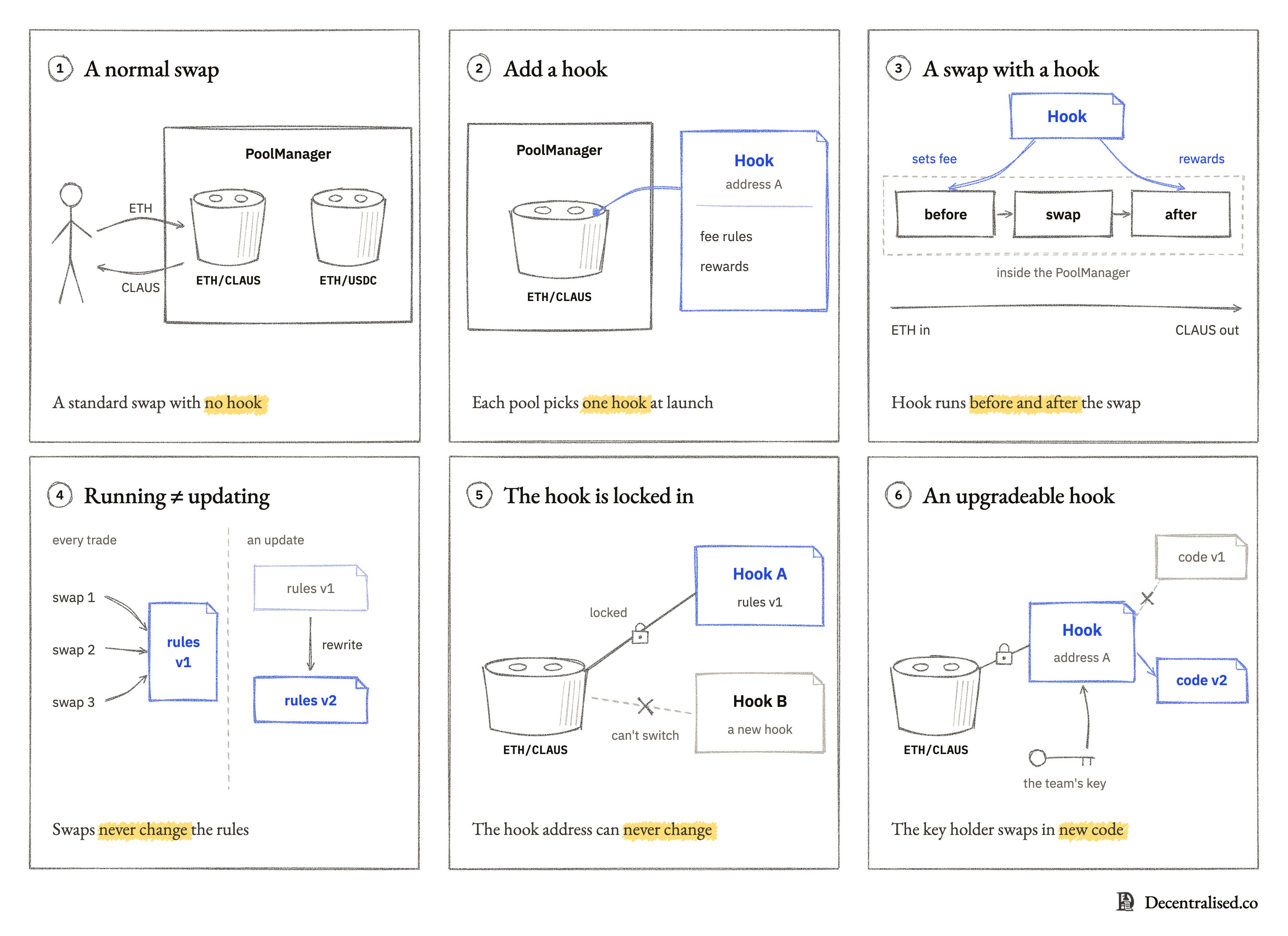
When Claus’s authorised controller wants to change the rules, they deploy a new version of the instructions and tell the proxy to use that version. The pool continues calling the same hook address, but the hook now runs different code.
That is how an existing pool can gain new behaviour without making holders move to a new token. Whoever controls the upgrade has power over how that pool behaves, which is part of what users trust.
Things that were harder before
Before hooks, developers could already make tokens behave differently or do unusual things. The difficulty was getting those features to work with the rest of DeFi.
The first was to write the rules into the token itself. On Ethereum, that gave us “tax tokens,” ERC-20s which deduct a charge when tokens move between addresses. If you send 100 tokens to pay for a swap but the token deducts two along the way, only 98 reach the pool. The swap can fail because the exchange’s contract expects the full 100.
Uniswap’s v3 update says these tokens do not work with its standard router contracts. Developers need a workaround, such as a wrapper or a customised router.The tax raises money for rewards, but it also makes the token harder to trade because some exchanges cannot handle that deduction.
Developers could also build separate contracts around a pool, or modify an exchange’s code and deploy their own version. But the amount of work to build that infrastructure is bigger than the feature itself.
Hooks give developers a place to put rules that belong specifically to trading. It made it possible to:
Fund buybacks or rewards from trades without taxing ordinary transfers between wallets.
Adjust trading fees automatically, for example when prices become more volatile.
Share captured arbitrage profits with traders and liquidity providers.
Check who can trade, allowing a pool to accept only approved wallets.
Connect trading to lending, so liquidity can earn interest when it is not needed for swaps.
Build these features inside an existing exchange, instead of launching and maintaining a separate DEX.
Hooks also creates room for businesses whose main product is the behaviour of the pool.
On 14 October, Uniswap introduced VolatilePair, a hook that recalculates separate fees for buying and selling, starting with ETH/USDC on Ethereum. It uses recent price movements to decide how to charge each side. According to the announcement, StablePair, its earlier hook for stable pairs, had handled $3.1 billion in four weeks.
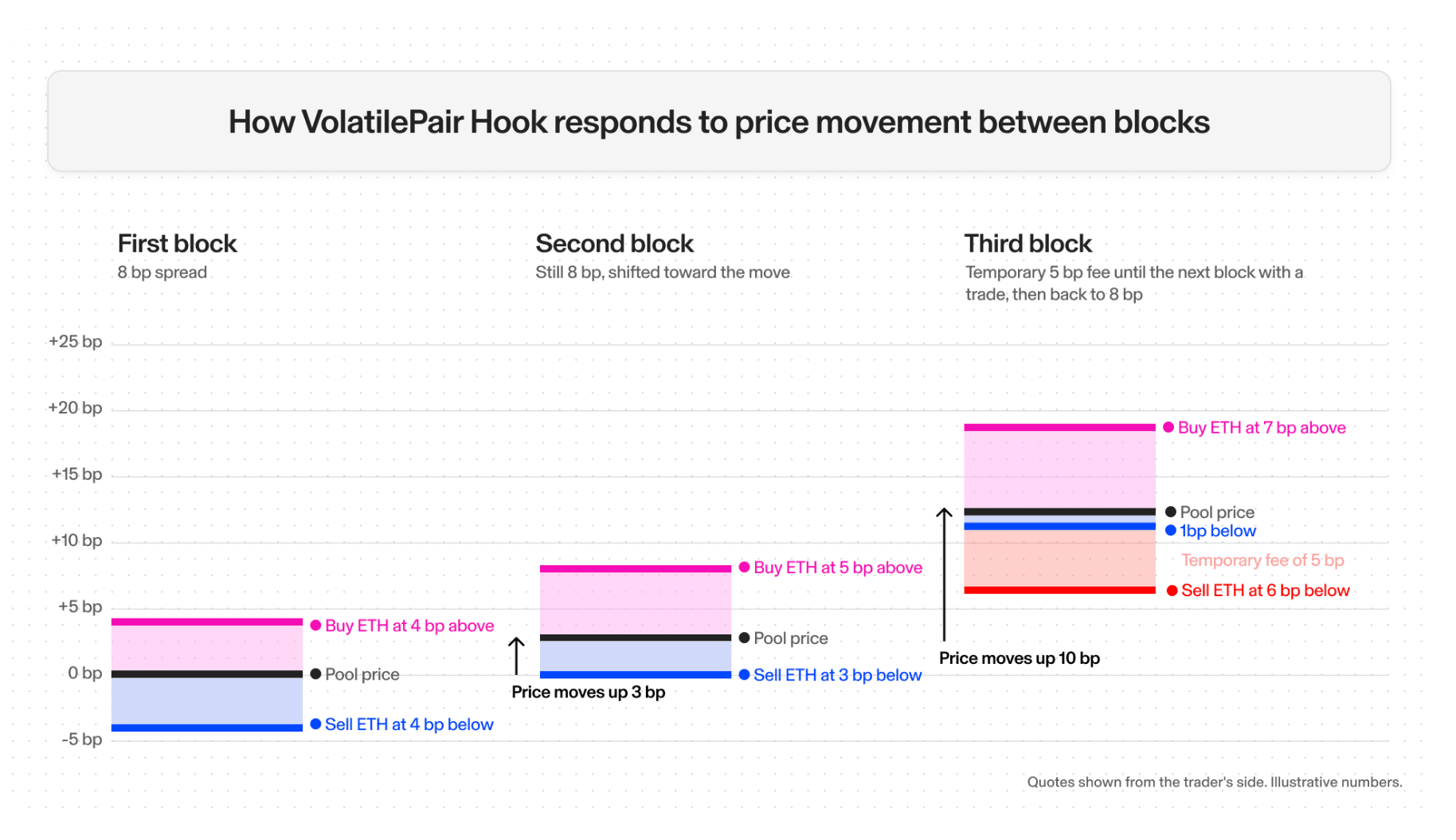
Other teams are adapting fees to the assets being traded.
Fables, a DEX on Robinhood Chain, is taking the first approach. It builds markets for assets including tokenised stocks, using hooks to adjust fees based on signals such as time and volatility. A stock token can keep trading while its underlying market is closed, when reliable prices and opportunities to hedge may be harder to find.
The argument for a changing fee is that supplying liquidity at those times is a different job from supplying it during a busy trading session.
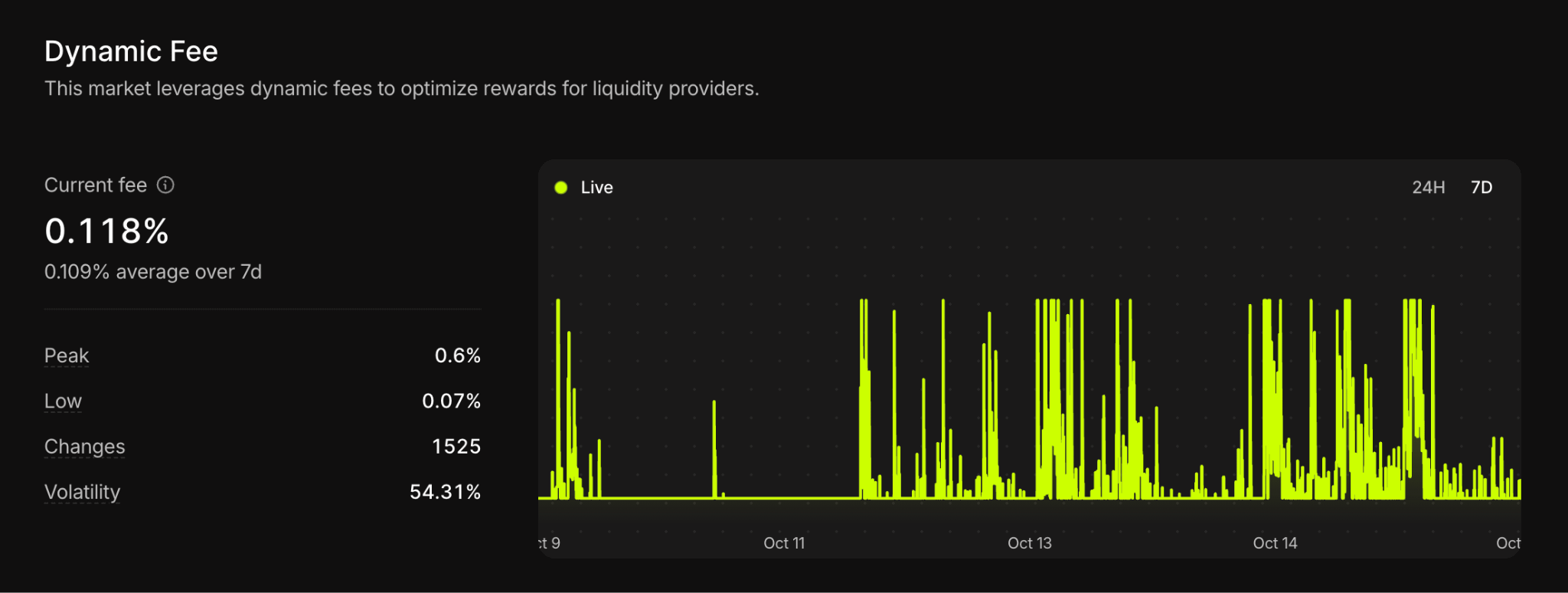
Fables adjusts fees around stock-market hours. But a tokenised fund may only allow approved investors to hold it.
Uniswap Labs introduced Permissioned Pools in July, with Superstate, Securitize and Dowgo among its launch partners. The design uses hooks to check whether a wallet is allowed to trade or provide liquidity.
Its DualPool hook lends out a market maker’s idle tokens until a swap needs them, and Spark moved $150 million of stablecoins to v4 to use it. Its auction hook sells a new token over time and then opens a pool at the price buyers settled on, which is how Aztec raised about $59 million from more than 17,000 bidders.
And people are using it. v4 is doing $39.7 billion in volume over the last 30 days, about half of all Uniswap trading, and taking 64% of Uniswap’s fees. A lot of that comes from Robinhood Chain. When Bitquery counted pools there in early September, only about a third of v4 pools had a hook, but those pools handled 74.5% of the trades.
The Ethereum side
If hooks are a new place to keep a token’s rules, the business is in selling those rules ready-made. That’s Programmable. It calls itself open launch-model infrastructure for Uniswap v4, which is a mouthful for a toolkit that launches tokens with their rules already set up, on Ethereum and Robinhood Chain. If you pick its Classic launch and you get a token with buy and sell fees you set and an ETH pool that’s locked forever.
If that sounds like a tax token to me and it pretty much is one, except the fee now lives on the pool where routers can see it coming. The Custom launch, done through an API, is for teams that want their own hook setup. Programmable’s default for new custom launches on Robinhood Chain sends a 0.2% fee to a published recipient, and its README is upfront that the contracts haven’t had an outside audit or a public security contest.
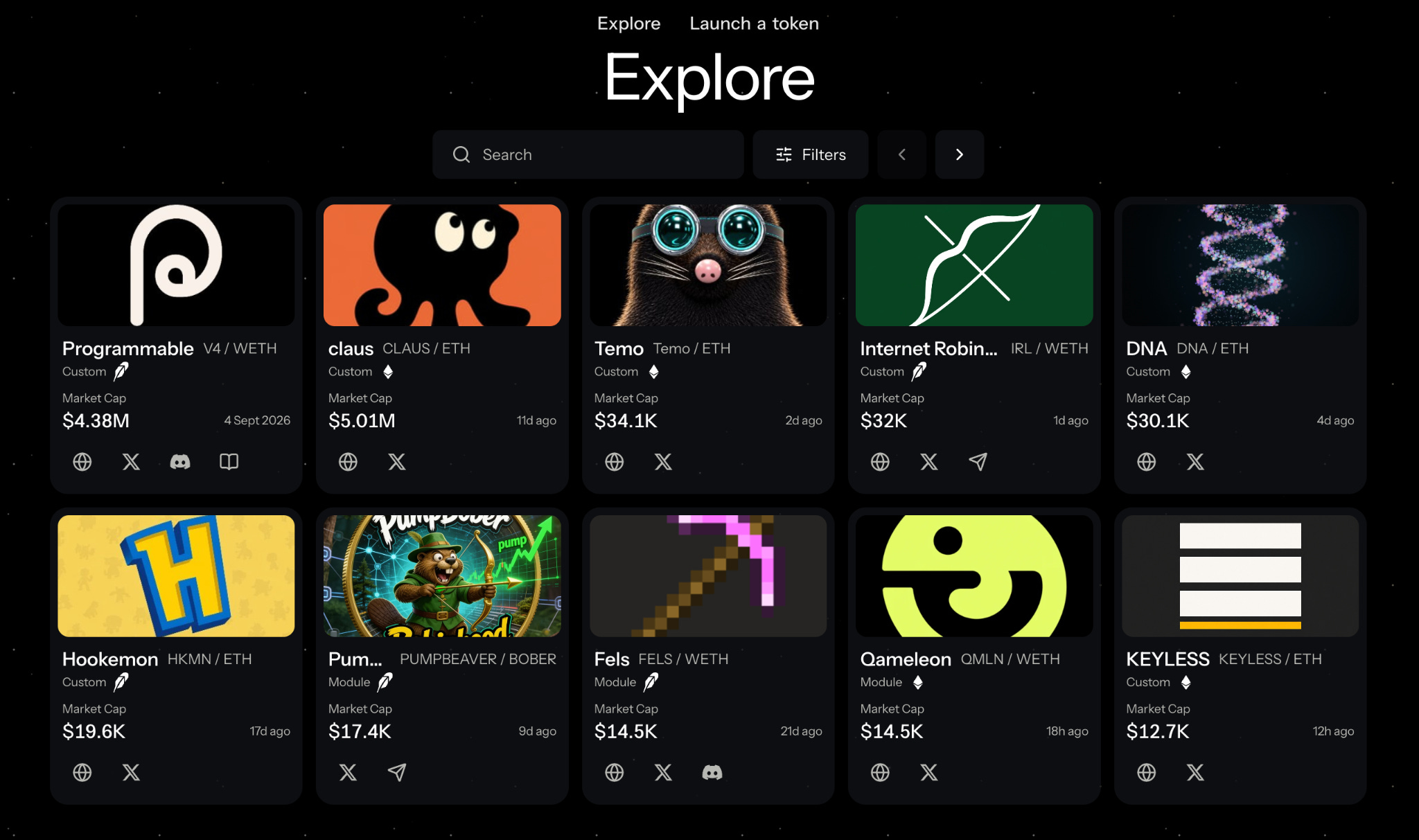
Claus launched through Programmable. Buybacks, NFT rewards and weather-based allocations can all become parts of the experience around trading one token. Claus can change what happens to trading fees without launching a new token. But holders need to watch those changes, because the rules they agreed to when they bought may change later.
Hookr is a similar kit on Robinhood Chain, with 22 “Hook Blocks” a creator can tick, like anti-sniping or auto-burns. One block, from a startup called What The Hook, catches price gaps between a token’s pools before the bots do and shares the profit with traders and liquidity providers. Hookr includes What the Hook’s service as an option in its token-launch toolkit.
For third-party pools integrating WTH directly, its published default gives 45% to LPs and 5% to the trader, while the treasury receives 40% and a referral recipient gets 10% - these are shares of captured profit. What The Hook, the only one of the kits that shares its numbers, has distributed about $68,000 in total, mostly to its own treasury.
The Solana Side
Uniswap’s protocol doesn’t run on Solana, and trading there is split across separate exchanges like Raydium, Orca and Meteora. With no single PoolManager to attach a hook to, Solana puts the hook inside the token itself.
Its newer token standard, Token-2022, lets a creator attach a transfer hook. This is a small program that runs every time the token moves. That covers buys and sells, and also transfers. This is called a transfer hook. It can check rules, such as whether the recipient is approved to hold the token, and stop the transfer if those rules are not met.
Hooked is a Solana launchpad where every token comes with one of these transfer hooks. Creators pick from 39 ready-made rules, like Hot potato or one that makes buyers wait 15 minutes before they can sell, or ask an AI builder to write a custom one. Each rule comes with an easy English reading, and some tokens let the creator, or a holder vote, rewrite the rules later. Every trade pays a 1% fee, and most of it buys back and burns Hooked’s own token.


The catch is that Raydium won’t create pools for transfer-hook tokens unless an admin approves them. Meteora takes them on its bonding curve, the starter price formula new tokens trade on. But it strips the hook off once a token graduates to its main pools. Hooked’s workaround is to keep tokens on the curve forever, so the rule never switches off.
On Uniswap v4, the extra rules belong to a pool.
The same token can trade in a pool with a hook and another without one. You can choose where to trade, or let a router choose for you.
Solana’s transfer hooks work differently. Their rules belong to the token and apply whenever it moves, including transfers between wallets. In both cases, the surrounding businesses still matter. Routers decide which pools to route trades through. Exchanges decide which token features they will accommodate.
Developers have more ways to design a market, but their choices affect where that market can find users and liquidity.
What upgradeable rules could change
I think the upgradeable part matters more than the hook itself. A fixed hook is a better tax token. That makes the market around a token behave a little more like an app that receives updates.
Until now, fixing a token meant migrating it. The team launches a new contract, asks every holder to swap, begs exchanges to relist and watches liquidity split between the old version and the new one. When Polygon replaced MATIC with POL in September 2024, every holder had to convert one for one, and exchanges had to run the switch for their users.
In these cases, some holders always get left behind. An upgradeable hook lets a project change what its token does without that exodus, and that changes who can afford to experiment.
The most useful home for this may be far from memecoins. I am thinking, the tokenised stocks because Real-world assets come with trading rules that keep moving. A fund might expand to investors in another country and need a different eligibility check. An upgradeable hook could accommodate that change while keeping the existing pool. It would not rewrite the investor’s legal rights or remove restrictions in the token contract, but it could help the trading venue keep up. For a market meant to operate for years, that seems more useful than permanently committing to every decision made at launch.
A fund might need to update its trading rules, while a memecoin community might want rules its creator cannot touch. Both have good reasons for their choice. With an upgradeable hook, I’d want to know exactly what the person controlling it can change. Being allowed to update who qualifies to trade is one thing. Being able to change fees or redirect rewards gives them much more control over the people using that pool.
I’d want time to review an update before it affects my money, and a chance to withdraw if I disagree. A project can build that notice period into its contracts and restrict what its developers can change. Giving up upgrade powers altogether would prevent later revisions, including fixes users might want. These are terms I’d check before depositing, alongside the fees and expected returns.
Claus calls its hook its mind. A team could let an AI agent update that hook as trading conditions change. For example, the agent could adjust fees within limits the team sets and explain each change. I can see the appeal of letting software handle those adjustments. But I would want to know who can set its limit and also stop it if it makes a bad decision.
Money has always had opinions.
In 1932, during the Great Depression, the Austrian town of Wörgl introduced its own local money. To keep a note valid, whoever held it at the end of each month had to buy a stamp costing 1% of its face value. Who would want money that was shrinking? That gave people a reason to spend the notes rather than keep them.
The town used the scheme to fund public works and accepted the notes for taxes, including overdue payments. The experiment ended in 1933 once Austria’s central bank intervened.
In that world, the money opinions belonged to governments, and you couldn’t see them. Governments still set rules that shape how people use money. Crypto gives developers their own means of making such choices for individual tokens and markets, with buyers able to select among arrangements that serve different purposes.
Choosing a token is you deciding whether that arrangement works for you.
Token Dispatch is a daily crypto newsletter handpicked and crafted with love by human bots. If you want to reach out to 165,000 subscriber community of the Token Dispatch, you can explore the partnership opportunities with us 🙌
📩 Fill out this form to submit your details and book a meeting with us directly.
Disclaimer: This newsletter contains analysis and opinions of the author. Content is for informational purposes only, not financial advice. Trading crypto involves substantial risk - your capital is at risk. Do your own research.