


Alex Atallah, a developer in 2017, thought the crypto industry didn’t have a great storefront. He wanted to solve it and capture the value, so he built OpenSea. An aggregator to trade unique digital collectables, the darling of the 2020 NFT hype era.
When the bad times hit, Atallah didn’t waste time grieving. The open-source AI boom started, and Atallah again saw the fragmentation problem he tried to solve before. AI was experiencing a Cambrian explosion of raw supply. Developers were drowning in fragmented APIs and disparate billing systems. Now was the perfect time to introduce a storefront.
So Atallah built OpenRouter and called it the “Stripe for AI.” Stripe gave software builders a single API and a consolidated bill for all their payment processing. OpenRouter did the same for AI models, which explains the ' Stripe for AI’ label.
I don’t believe in manifestation, so let’s call this a self-fulfilling prophecy, but Stripe is now buying it for more than $7 billion.
OpenRouter closed a $113 million Series B in May at a $1.3 billion valuation. With the Stripe deal, that number is now 5x.
Today, I’m looking at what Stripe bought and why the real money is made at the interface.


What does OpenRouter do?
Normally, if a company wants to use AI models from OpenAI, Anthropic, and Google, it has to set up separate accounts and write unique code for each. With OpenRouter, developers and companies can plug its single API into their software to access all of them at once. When an application sends a request, OpenRouter automatically forwards it to whichever of its 500 supported AI models offers the lowest cost, the fastest response time, the best data privacy, or is actively available.
Proven to work well with the volume having spiked five times in six months, the platform now routes 25 trillion tokens a week for its eight million users.
OpenRouter charges developers raw model prices and takes a 5.5% fee on card payments and 5% on crypto. In March 2026, research firm Sacra estimated this generated $50 million in annualised revenue from $900 million in gross spend. Because traffic has only accelerated since, Stripe ended up paying a premium multiple of 50x to 140x revenue to bring those numbers in-house.
But Stripe can also afford to do that with its deep pockets. The payments giant reported $6.8 billion in revenue last year with $3.2 billion in cash, earning a $159 billion valuation in a February tender offer. According to the 2025 annual letter, the total volume is $1.9 trillion, up 34%, and accounts for about 1.6% of global GDP. Patrick and John Collison wrote that Stripe now powers over 5 million businesses, “including all of the top AI companies,” and the letter names ChatGPT, Claude, Cursor, Replit and Vercel. Stripe has not published a revenue figure or broken out what share comes from AI.

Stripe has built a solid stack by acquiring all the components needed to enable AI agents to spend money.
For underlying infrastructure, they bought Bridge, the stablecoin infrastructure company, for $1.1 billion. AI agents need a place to store and manage their funds, so the company bought Privy, the wallet provider, for an undisclosed amount.
Next is Metronome, a billing platform that tracks how much computer power is used. Heavyweights like OpenAI, Anthropic, and Nvidia already use it to calculate usage. It was bought for about $1 billion in December 2025.
Stripe then launched Tempo, the payments chain incubated with Paradigm, which went live in March with a Machine Payments Protocol letting software pay for services without needing human approval. Stripe then shipped the x402 protocol, enabling AI agents to buy computing power with crypto.
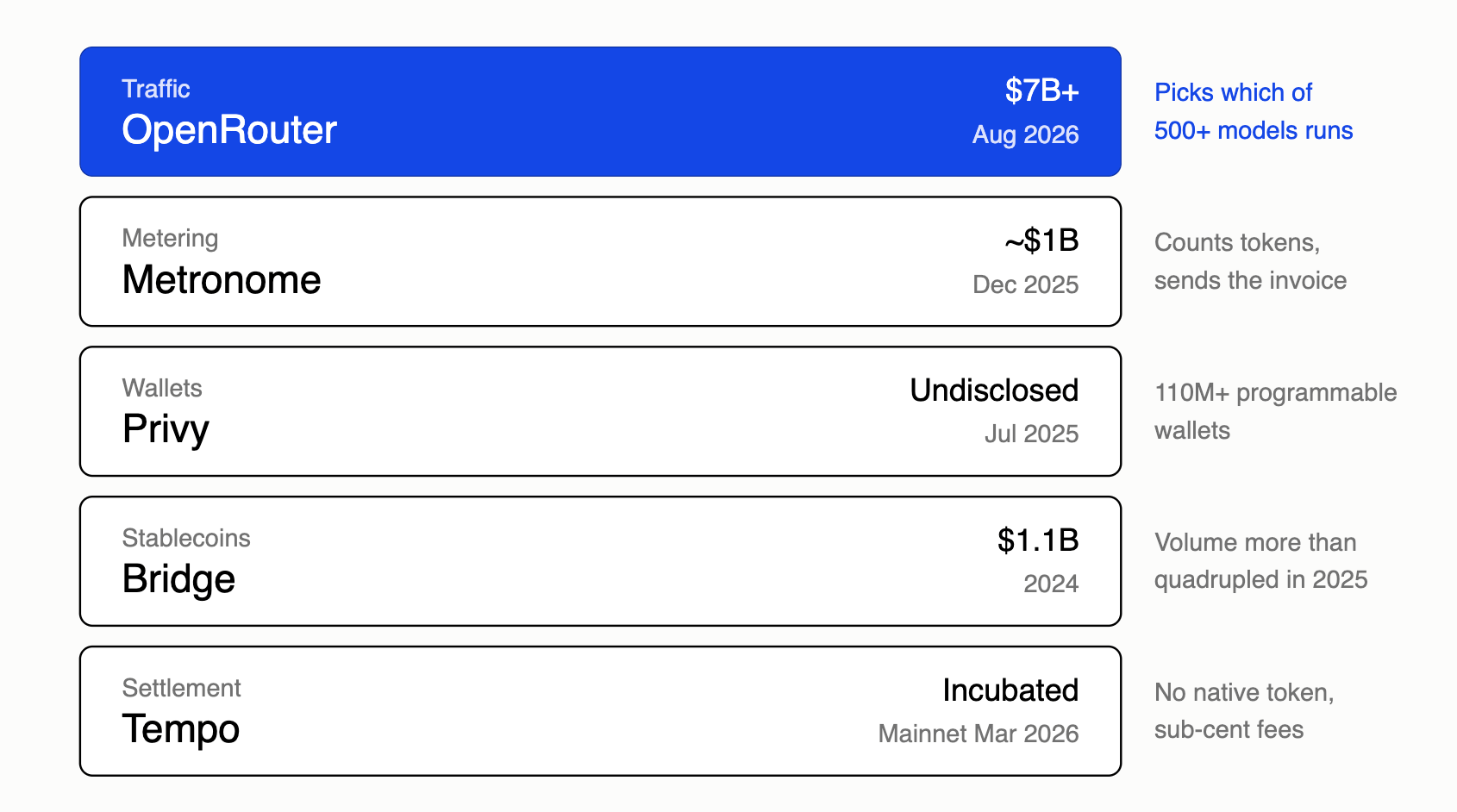
But it wanted to see where the requests were going or decide which model got the job, a question now answered by the OpenRouter acquisition.
Since December, Stripe’s CEO Patrick Collison has been saying that the AI industry is moving away from flat monthly subscriptions toward pay-as-you-go pricing, where users pay only for what they consume. Stripe already had the backend system that tracks and bills that usage. This new deal now gives the company control over the storefront where developers access the models, too.


Settling digital transactions is a commercial dead end. Crypto can move it, settle it, but where is the money?
The underlying tech handles the real work at a massive cost, but the user-facing app captures the profit.
Verizon and AT&T spend billions digging trenches and building 5G cell towers so data can move smoothly. But they are essentially running a low-margin utility. The money is always captured at the interface. In this case, Apple sells the smartphone that uses the network, and Meta collects the ad revenue from the apps running on it.
This happens everywhere. Circle, for instance, makes 94% of its money parking customer deposits in Treasuries. Even though its routing protocol handles 60% of cross-chain USDC volume, it generates almost zero direct revenue because third parties own the settlement blockchains. Arc (mainnet launches on September 16) is Circle’s push to move up the stack and finally monetise the interface by not giving away all the transaction fees. Just moving and settling won't get you very far, unless it becomes a monopoly. Visa and Mastercard just move and settle data, but they make billions because they operate a closed system. Unlike a public crypto blockchain or the open internet, Visa is a private network. If a merchant wants to accept a card, they have to use this infrastructure and pay a 2% to 3% fee on every swipe.
The numbers for AI payments look big, but they don’t mean much. The x402 protocol has processed over 153+ million transactions since May 2025, with a lifetime volume of $40 million. This is an average transfer size of 26 cents. Even on cheap networks (like Base or Solana), paying a fraction of a cent in gas to send a 26-cent payment is not economical. In Web-3, 153 million micro-transactions are the classic signature of “Sybil farming” (users programming bots to send pennies back and forth to inflate network stats and qualify for future token airdrops) or developers just running load-test scripts in a loop.
Compare that to OpenRouter, which moves $900 million a year and retains 5%. The underlying payment networks do way more work but move much less money, all for tiny fractions of a cent.
Even specialised chains like Tempo launched without a native token. That means they deliberately gave up the massive, speculative revenue that usually comes with running a crypto network. They made that trade-off so their corporate clients could finally get safe, predictable fees
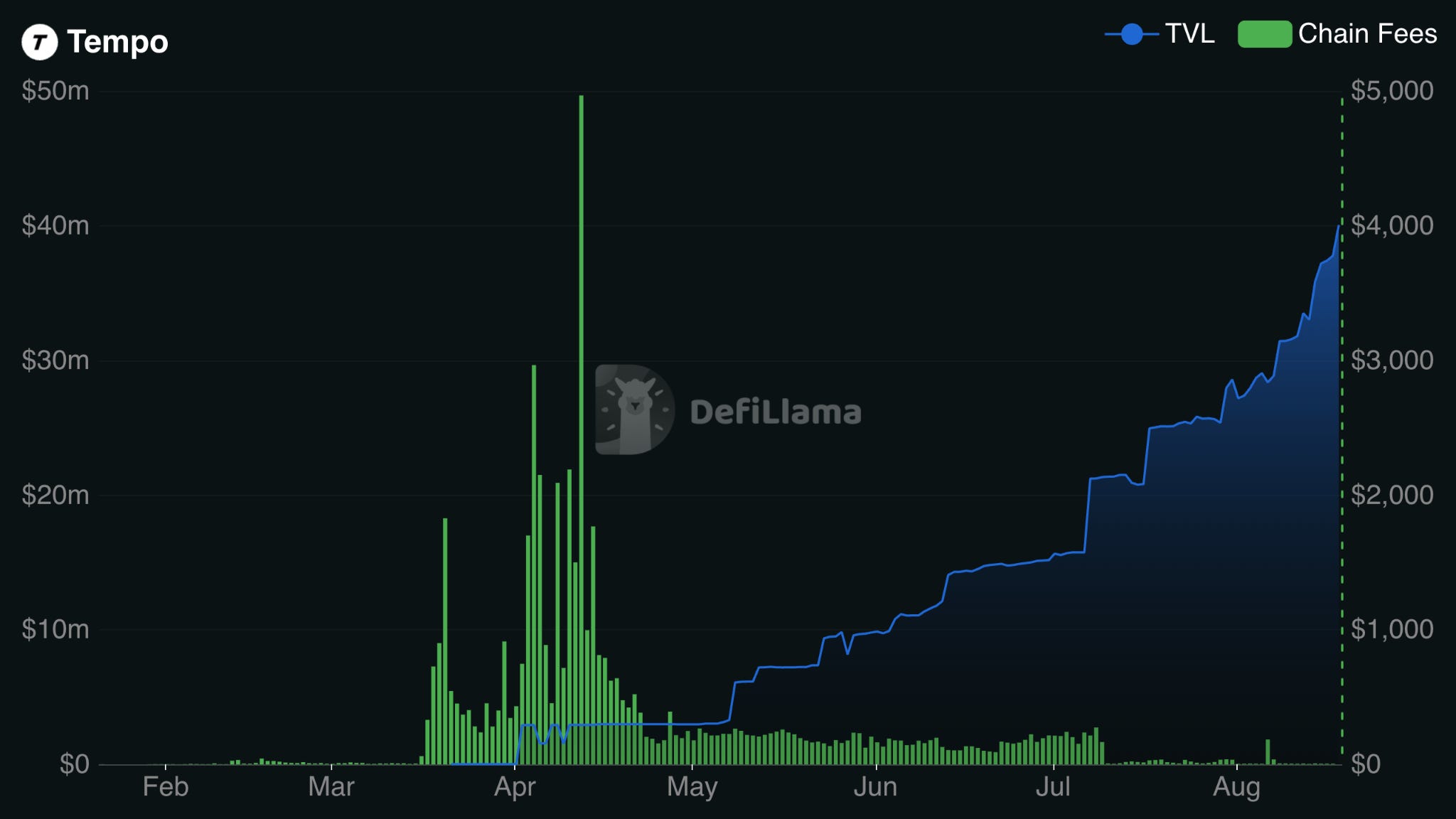
Although Stripe’s founders wanted to build infrastructure capable of processing millions of transactions per second, Tempo’s current utilisation is extremely low. Since going live in March, the network has averaged under one transaction per second. While load tests confirm capacity exceeds 18,000 transactions per second, real-world activity generated just $5.34 in daily fees and around $620 over 30 days. The chain holds $40 million in total value locked, but the settlement volume produces a very low economic return.
The platform talking directly to the customer is the one that gets rich. Crypto was supposed to win here by bundling AI models together and using token discounts to offer unbeatable prices. But that plan is failing. Crypto protocols might have access to cheap compute power, but centralised companies are the ones actually controlling the users and taking the profit.
Chutes, a decentralised network that rents out cheap AI computer power built on Bittensor, has processed 9.1 trillion tokens across 400,000 users. During its highest volume days in late May and early June, Chutes pushed nearly 22 billion tokens per day through the OpenRouter interface. But they depend on OpenRouter for up to a quarter of their daily volume. io.net, pushing 4 billion tokens a day, uses the same centralised platform for distribution.
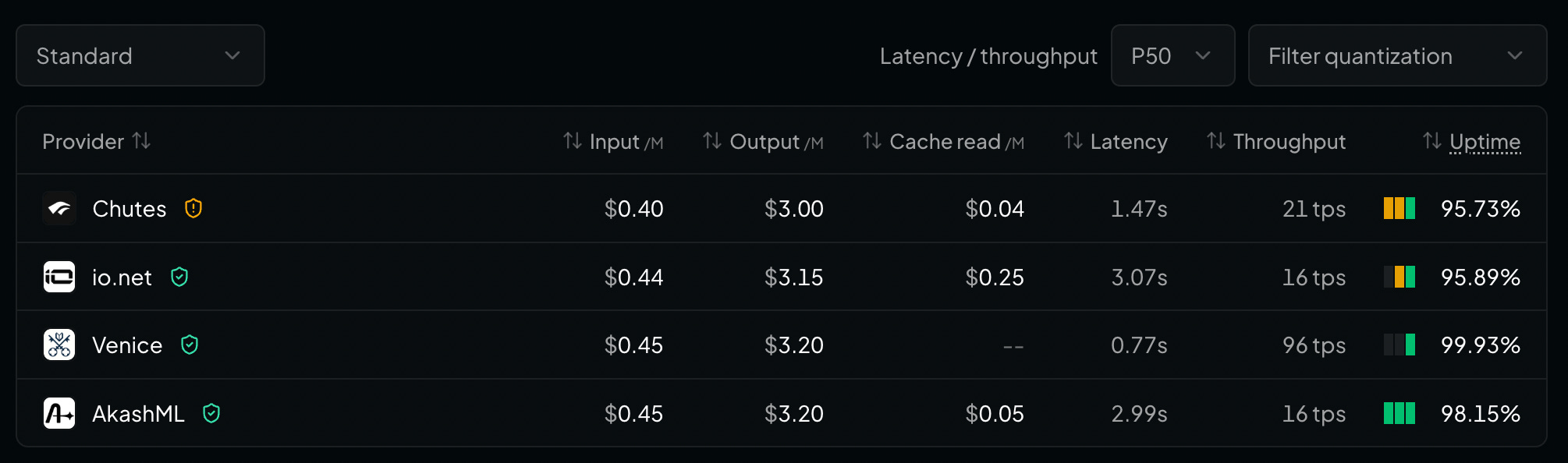
Decentralised networks like Chutes can easily undercut Amazon and Google because they don’t have to pay for expensive data centres or corporate staff. Instead, they let independent computer owners supply the hardware, paying them in crypto rewards. Because their overhead is so low, they can sell AI computing power way cheaper than big tech. The weakness is trust, which is the entire value of the interface layer.
Quality control is a massive headache for OpenRouter. When you call an AI model, OpenRouter routes your request to the cheapest available independent server. But not all servers are the same; some use weaker hardware or tamper with the model to save money. In fact, a recent survey of 42 servers found that nearly a third completely hid their data settings. To fix this, OpenRouter is launching a “verified” tier for trusted providers. For crypto networks, this problem is even worse. Malicious nodes have an economic incentive to run downgraded models to maximise profit margins.
While projects like DGrid and Bittensor are developing theoretical models to detect output degradation, real-time verification at scale remains an unsolved problem.
Uptime is another operational hurdle. Because they don’t have massive, flexible server systems like big tech companies, networks like Chutes can crash during heavy traffic spikes. To maintain reliability, developers rely on centralised aggregators as a fallback, effectively paying the toll they intended to avoid.
On the money side of this, reported revenue figures differ from economic demand. Bittensor claimed $43 million in first-quarter subnet revenue, but independent analysis found a maximum of $15 million in verified external usage, with Chutes bringing in less than $2.5 million. Chutes gets handed about $54,000 every single day in freshly printed crypto tokens. They are being kept alive by crypto inflation, not because real people are lining up to use their service.
DGrid operates an OpenAI-compatible gateway that routes to more than 200 models, settles payments via the x402 standard, and audits outputs through its “Proof of Quality” mechanism. The platform reported $20 million in revenue across its first six months from over 13,000 users ahead of a planned DGAI token launch. That figure, however, came from selling $1,580 lifetime membership passes that grant future token allocations, making it a disguised token presale rather than recurring API consumption.
To see that decentralised networks can handle real traffic, look at Dippy. This massive AI character app, which has 8.6 million users, ditched traditional cloud providers and moved its entire operation to Bittensor’s Targon network. While the financial revenue numbers are tough to completely verify on-chain, it’s a huge win. It proves everyday consumer apps can rely on decentralised tech to work.
When a company is independent, it routes your traffic fairly. But when a corporation like Stripe owns the front door, conflicts of interest kick in. Stripe has its own payment tools, wallets, and blockchains to sell, giving it a clear incentive to push their own rails over competitors.
Crypto’s biggest selling point is that nobody owns it. A decentralised system can’t be bought out by a corporation, and no one can change the rules behind closed doors to favour their own apps. Stripe can build great software, but it can never offer truly neutral, un-rigged plumbing.
The interface thesis makes total sense too. I just don’t think crypto is anywhere close to owning it.
What Stripe did was put a public price tag on standing in the middle. They are reportedly paying $7 billion for roughly $50 million of revenue, because standing between eight million developers and ~500 AI models is a great business. If you are building an open-source router, you can now wave that valuation at venture capitalists.
Obviously, the trade gets awkward. Up until now, decentralised compute networks have grown by plugging into OpenRouter and letting it handle the annoying work of finding customers. Now, that front door belongs to Stripe, a company with every commercial reason to favour traffic that touches its own products. If you picked OpenRouter because it was neutral (say, you wanted to route queries to cheap Chinese models without corporate interference), you are probably getting nervous.
A router nobody owns is a router one can’t bias. The problem is that to sell it, you need to prove what code the miners ran, offer uptime that doesn’t rely on a centralised backup, and make money that doesn’t vanish the moment token subsidies end. We are not there yet. So clap clap, good for Alex Atallah.
Token Dispatch is a daily crypto newsletter handpicked and crafted with love by human bots. If you want to reach out to 170,000+ subscriber community of the Token Dispatch, you can explore the partnership opportunities with us 🙌
📩 Fill out this form to submit your details and book a meeting with us directly.
Disclaimer: This newsletter contains analysis and opinions of the author. Content is for informational purposes only, not financial advice. Trading crypto involves substantial risk - your capital is at risk. Do your own research.