


In 1996, Purdue Pharma sent 671 salespeople across America, telling doctors OxyContin was different—time-released and safer. The addiction risk was less than 1%. They had a study. Doctors believed them. Patients believed the doctors. By 2001, OxyContin was generating about $1.5 billion a year. The study, it later emerged, was not great.
1By 2017, 47,000 Americans were dying annually from opioid overdoses. By then, the Sackler family, which owned Purdue, had invested in addiction-treatment companies. You have to admire the completeness: creating the disease, monetising the cure, and keeping it in the family.
McKinsey advised Purdue on how to “turbocharge”(their exact word) OxyContin sales. Then, when the crisis had a name, a body count, and a congressional hearing, McKinsey pivoted to advising governments on opioid response. This gave them two clients on opposite sides of the same disaster, billing by the hour throughout.
We have seen this pattern before in business history. Does it have a name? It is not quite disaster capitalism, that is, about profiting from crises you did not create. This is more specific: build the problem, sell the solution, ideally while publicly expressing concern about the problem. The concerned expression is important because it shows you understand the severity of the situation, which makes sense, because you built it.
Facebook did this. So did the rating agencies before 2008. So did tobacco companies when they pivoted to nicotine patches. But all of them had the decency to keep some distance between the problem and the solution—different subsidiaries, spokespeople, and plausible deniability.
Sam Altman did not bother with the distance. I’m not sure what to feel about that.

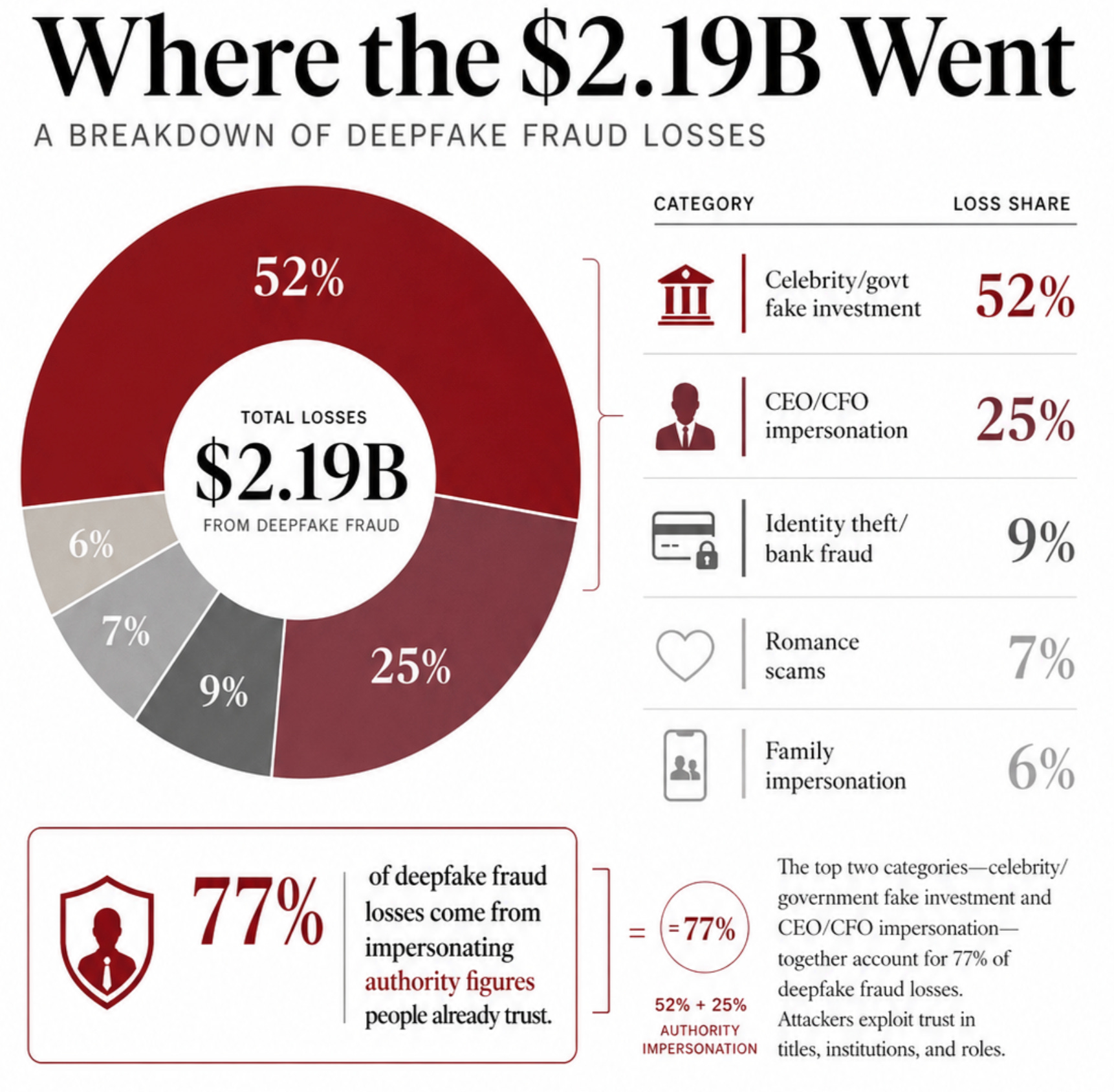
Altman co-founded OpenAI in 2015. OpenAI built the models that made deepfakes cheap, synthetic identities indistinguishable from human ones, and bot armies scalable to any size. The downstream effects are no longer hypothetical: $2.19 billion in cumulative global deepfake fraud losses to date, including $1.65 billion in 2025 alone. In January 2024, a finance employee at Arup’s Hong Kong office was invited to a video conference with the CFO and several senior executives. He watched them speak, followed their instructions, and made fifteen wire transfers. Every person on that call was a deepfake. The total loss was $25.6 million. Forty-three per cent of finance professionals targeted by deepfake scams fall for them. Eighty-seven per cent say they would act on a CEO payment request without additional verification. Only 0.1% of people can correctly identify deepfake content in controlled tests.
In various interviews over the years, Altman has said this is exactly why proof of personhood is necessary. That AI-generated content has made human verification urgent. He is correct that the internet needs a new identity layer, and he is also the reason it is necessary.
He also co-founded Tools for Humanity, which sells the iris scanner.
You stare into the lens, it converts your iris pattern into a cryptographic hash, deletes the raw image (they promise), and issues you a World ID. Zero-knowledge proofs mean you can prove you are human without revealing which human. As of April 2026, 18 million people across 160 countries have done this. The technology is legitimately impressive: a false-match rate of 4.1 × 10⁻⁸, meaning it can distinguish among billions of people with near-perfect accuracy.
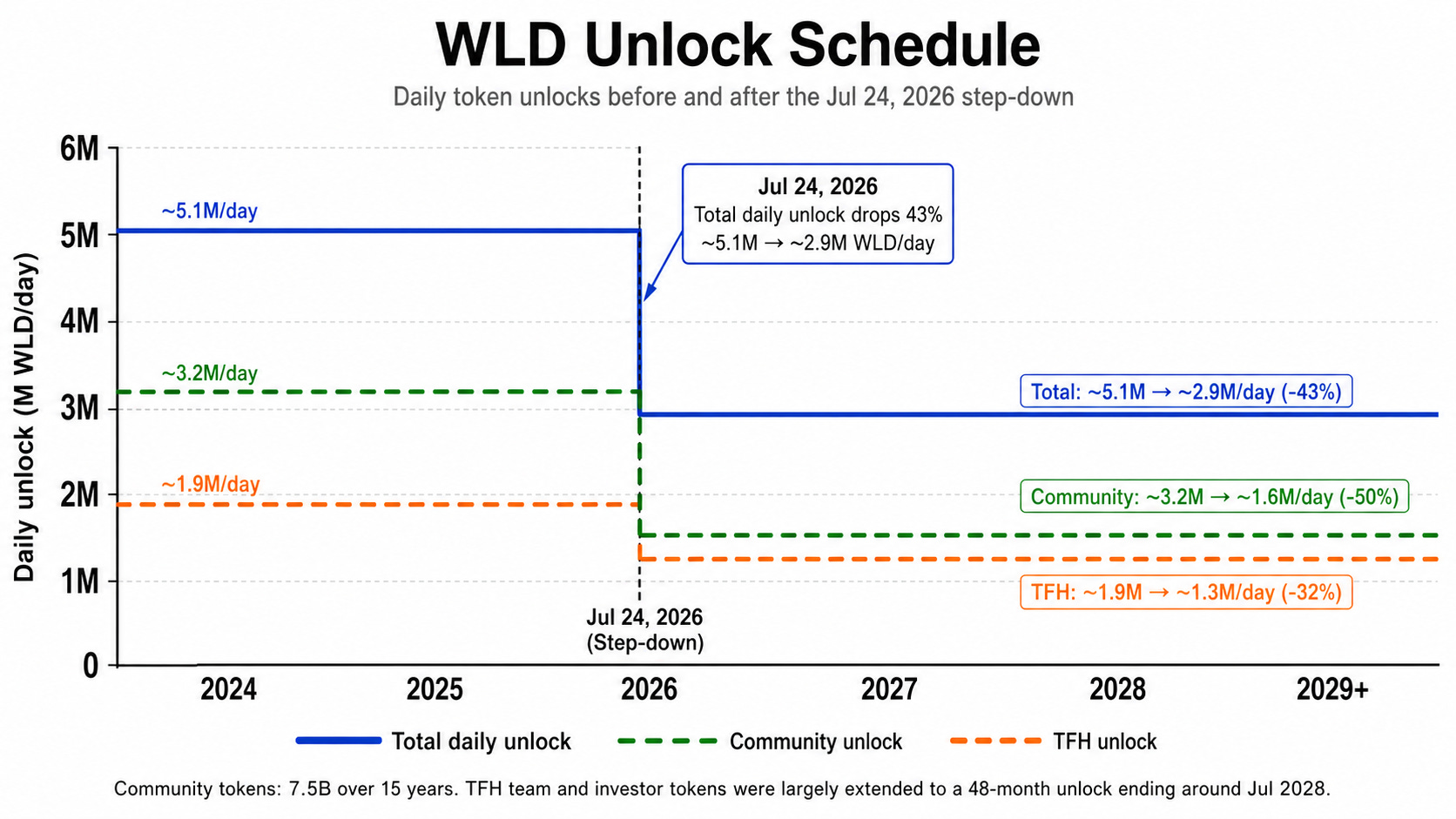
Regarding tokenomics, you get WLD tokens as payment after scanning your iris. Seventy-five percent of all 10 billion WLD tokens go to the community, which is the people scanning their irises. Only 25% goes to investors and the team. But then that 75% community allocation unlocks slowly over 15 years. A little bit is released every month for 15 years. The investor allocation, after a 12-month waiting period, started unlocking immediately.
So in the period when WLD was most valuable, insiders held roughly 60% of what was actually available to trade. The community held about 40% of the circulating supply despite supposedly getting 75% of the total.
WLD hit $11.74 in March 2024. Today it’s $0.253, down 97.5% from the peak.
A person in Nairobi who scanned their iris in 2023 receives roughly 40 WLD per month over 12 months. At the peak price, that was worth around $470. Today it’s worth $10.56.
The a16z partner, Andreessen Horowitz, one of Silicon Valley’s most powerful VC firms, got in at seed valuations years before launch. They had four years to manage their position and exit at the right time. Meanwhile, the person in Nairobi got $10.56. And cannot get their iris data back. If you look at it this way, one side has liquidity options, and the other has a permanent biometric record and no exit.
So when they say there is an iris scanner in a Gap store, the same place you go when you need chinos urgently and have somehow run out of opinions about your own clothes, you will stand in front of a biometric device between the sales rack and the fitting rooms, and it will feel completely normal, because everything feels normal there. Tinder, Zoom, and DocuSign have all integrated World ID. There are 1,500 active Orbs deployed across 23 countries. At what level of integration does opting out become functionally impossible? We don’t have an answer for that. Do we?
Kenya, the Philippines, Colombia, Thailand, India, Indonesia, and Hong Kong have all banned it or heavily restricted it. Germany is still investigating under GDPR.
Kenya’s objection was that offering tokens worth meaningful money to people living on very little is not free consent. Again, we have no answer.
A $10.56 grant in Ohio is still $10.56 in a country with a GDP per capita under $2,000. The people who designed the grant live in San Francisco. Altman’s The World has never published a clean country-level breakdown of scan numbers; isn’t that an interesting omission for a project that talks extensively about transparency? The partial data available shows early-adopter concentration in Argentina, Kenya, Colombia, and Indonesia, markets where the token was worth scanning for, and the biometric was the price of entry.
The crypto community spent a decade building exactly the infrastructure you would use to solve this problem without centralising it: W3C Decentralised Identifiers, Verifiable Credentials, the full self-sovereign identity stack. The founding argument was that you own your identity and no central authority controls it. This was a moral position, a response built explicitly against the kind of centralised identity infrastructure that World ID has now become. The silence that followed World ID’s rise does not have one clear explanation. Some of it is financial. WLD token holders have upside in World ID succeeding, and it is difficult to object loudly to something you are long on. Some of it is exhaustion; the SSI (Self-Sovereign Identity) community spent years building something technically correct and practically unusable, and when World ID showed up with a product and eighteen million verified users, the people who should have objected did not have a counter-product to point to. And some of it is just a technical concession. The ZK proof architecture does provide a real privacy guarantee, and a meaningful part of the community looked at the design and decided this was an acceptable trade-off rather than a betrayal. Vitalik Buterin has been the exception, writing thoughtfully about the risks of one-ID-per-person systems and the value of competing overlapping approaches, but his argument, however correct, has not produced anything resembling a counter-movement. All philosophies and no products yet.
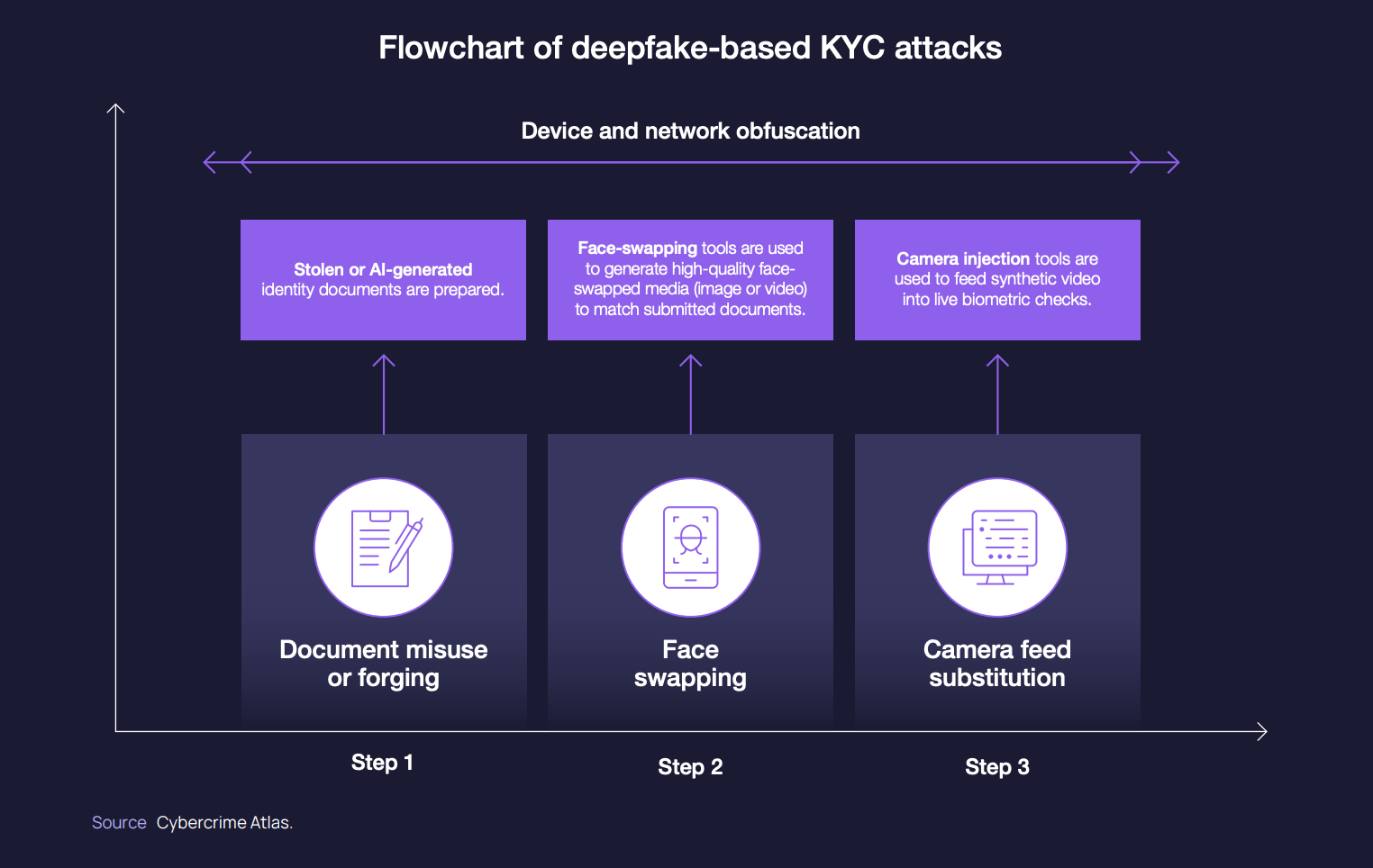
The World Economic Forum published a 2026 report, co-authored with Mastercard, Banco Santander, and Group-IB, that tested 17 face-swapping tools and 8 camera-injection tools against standard KYC biometric checks. Most of them passed. A deepfake image that bypasses identity verification costs $5. A synthetic identity sells for $15. The arms race is not going to stop because Sam Altman built a nicer orb. And if the orb’s database is ever breached, every compromise in it is permanent. The cryptographic hash that remains after your scan cannot currently be reverse-engineered back to your iris, but in five or ten years, as capabilities improve, what becomes derivable from it is something your iris hash cannot opt out of. The risk of a subpoena is that companies comply with government requests when the alternative is operating illegally. The acquisition risk is that Tools for Humanity has venture-backed investors who will eventually want liquidity, and the acquirer’s intentions are not contractually required to match the founders’. An e-commerce inventory company, Eightco Holdings, announced a $250 million purchase of Worldcoin in September 2025. Their stock went from $1.45 to $45.08 in a single day. If someone has already decided that verified human identities are a treasury asset worth accumulating, that appetite is not going away.
OpenAI and Tools for Humanity exist in a feedback loop. The more convincing OpenAI’s models become, the more necessary World ID appears. Altman has simultaneous financial incentives to worsen the deepfake problem and increase the value of the biometric solution, and these are not compound interests. The concerned expression, remember, is important. It signals that you understand the severity of the situation. Nobody understands the severity of the situation quite like the person running both sides of it.
None of this appears anywhere as a policy decision, we have to wait for it to just emerge from the roadmap, quarter by quarter, which is a much cleaner way to make a political choice without ever having to defend it as one. By the time enough people start treating it that way, there will be 180 million irises in the database.
The Sacklers, at least, had the courtesy to keep the whole thing within the family. Altman, to his credit, has upgraded the model for the internet age with broader distribution, cleaner branding, and just enough tokens to make the trade feel like a gift, right up until you remember that one side of it can be sold, and the other is, well… you.

Token Dispatch is a daily crypto newsletter handpicked and crafted with love by human bots. If you want to reach out to 200,000+ subscriber community of the Token Dispatch, you can explore the partnership opportunities with us 🙌
📩 Fill out this form to submit your details and book a meeting with us directly.
Disclaimer: This newsletter contains analysis and opinions of the author. Content is for informational purposes only, not financial advice. Trading crypto involves substantial risk - your capital is at risk. Do your own research.