


There is a version of this story where Optimism wins.
In that version, the OP Stack becomes the default infrastructure for Ethereum scaling, dozens of well-capitalised chains join the Superchain, revenue flows back into the Collective, interoperability ships, and the whole thing compounds into something that looks, from a distance, like a new kind of internet. Not owned by anyone. Governed by everyone. Self-sustaining.
That version was not crazy. For a while, it looked like the one that was actually happening.
The problem is that everything Optimism did to make that vision possible also made it impossible to protect.
The OP Stack was released under an MIT license. This matters more than almost any other decision Optimism made, so it’s worth being precise about what it means. MIT is the most permissive open-source license in common use. Anyone can take the code, build on it, modify it, commercialise it, or fork it entirely. No royalties, revenue share or obligation of any kind. You don’t even have to say thank you.
Optimism made this choice deliberately. The logic was simple: if you want to become the default framework, you remove every possible reason not to adopt you. You make the cost of entry zero. You make the license uncontroversial. You make it so that any team, any company, any exchange with a developer budget can spin up an OP Stack chain without asking permission or signing anything.
It worked. By mid-2025, the OP Stack was processing 69.9% of all L2 transaction fees. Thirty-four chains were live on the mainnet. Coinbase was on it. Uniswap was on it. Kraken was on it. Sony was on it. Worldcoin was on it. When people talked about Ethereum scaling, they were usually talking about something built on Optimism’s code.
Optimism had won the standards war.
And then, the biggest chain it had ever helped build decided it no longer needed the arrangement.

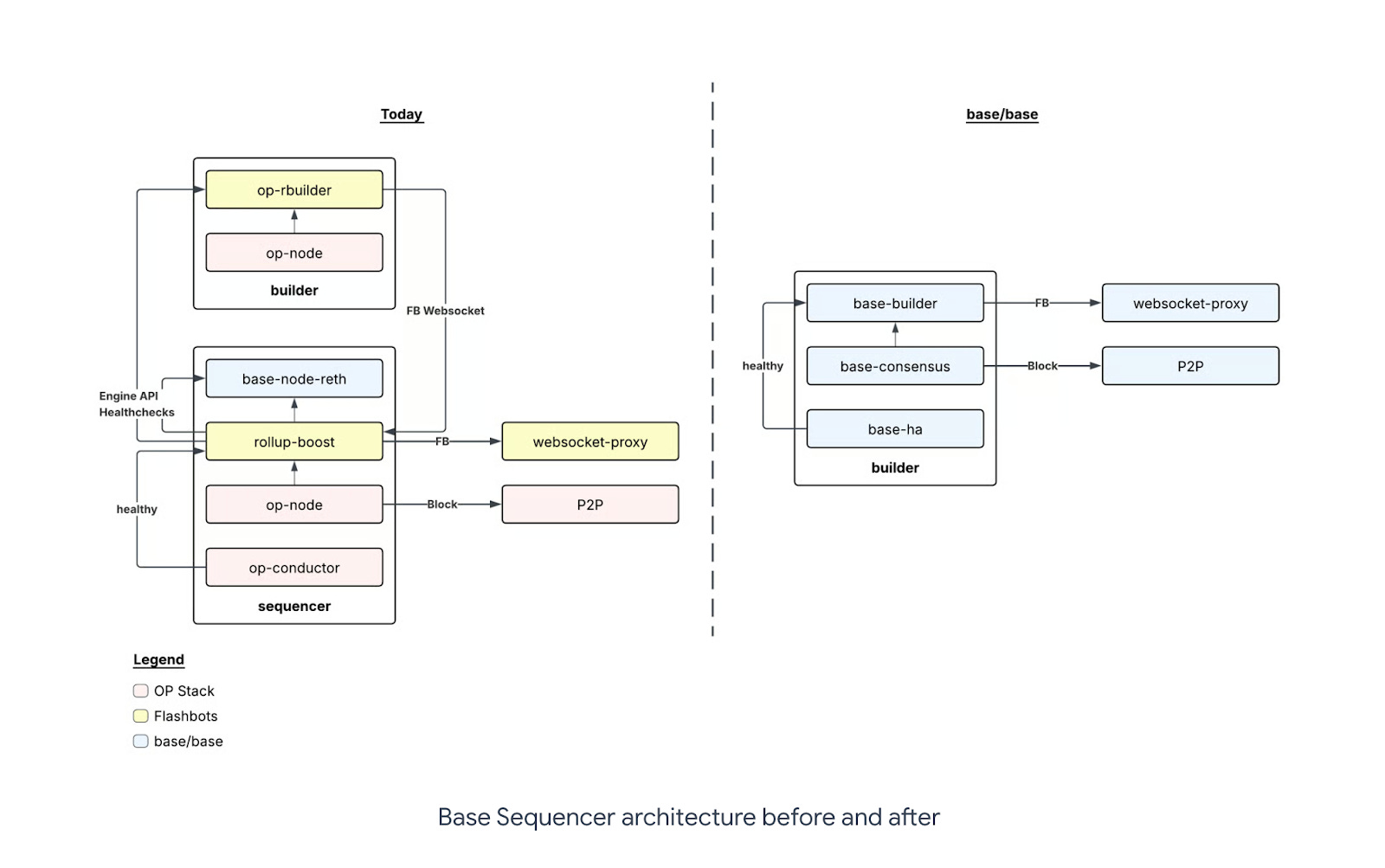
On February 18, 2026, Coinbase published a blog post titled which was written in the careful, collegial language that companies use when they want to announce something significant without making it sound significant. Base would consolidate its codebase. It would accelerate development cycles. It would reduce coordination overhead. Gratitude was expressed. The partnership was celebrated.
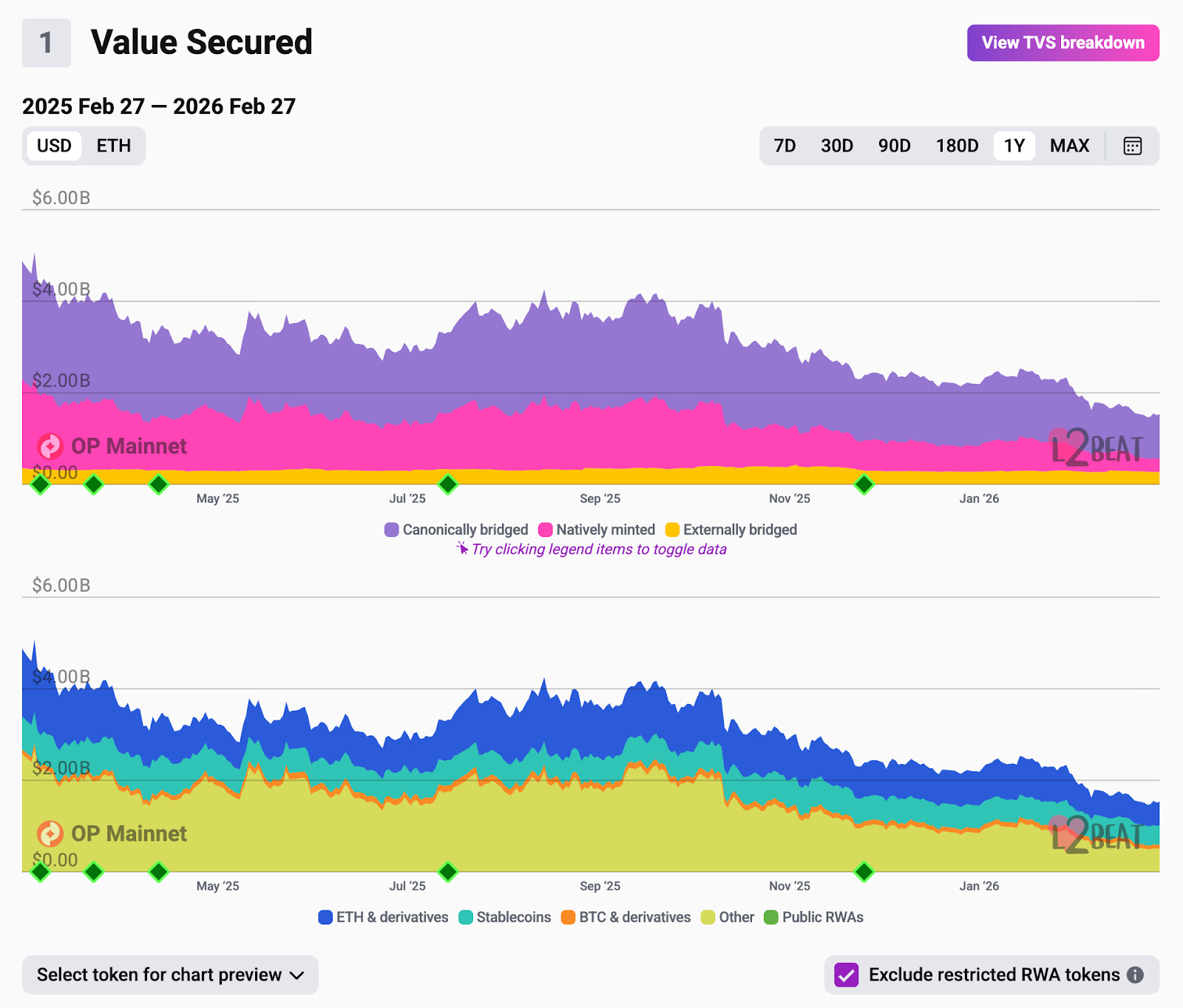
OP dropped 28% in 48 hours. Sell volume surged by 157%. Within days the token was down 89.8% over the prior year, sitting at $0.12 at the time of writing, against a March 2024 peak of $4.85. OP Labs CEO Jing Wang wrote on X: “This is a hit to near-term on-chain revenues.”
To understand why, you need to understand what the Superchain was actually selling.
The OP Stack was free. The license made that permanent and irrevocable. So why would any chain share revenue with the Optimism Collective? The answer Optimism gave was interoperability. Join the Superchain and your chain won’t just be a chain. It will be part of a unified network where liquidity and users move freely across all member chains, and where building on one chain means building on all of them, where the whole becomes worth more than the sum of its parts.
That was the value proposition. Pay 2.5% of gross revenue or 15% of net profit, and in return you get access to something no single chain can build alone.
The interoperability never shipped.
Optimism had targeted early 2025 for native interoperability on the mainnet. It didn’t arrive. One longtime governance delegate says: “That unfortunately has not materialised despite years of technical work.”
Members were paying the tax. The product it was supposed to fund remained theoretical. What the Superchain offered in practice was shared branding, shared governance overhead, and a revenue obligation. The thing that made the revenue obligation worth paying was always just around the corner. Meanwhile, Base kept growing.
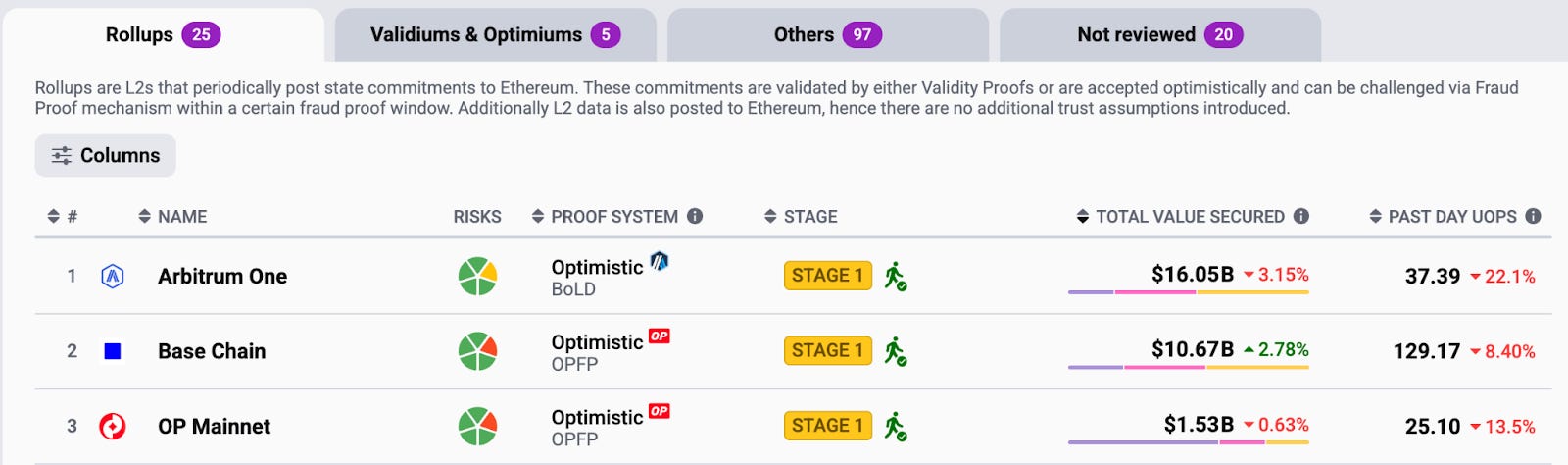
By January 2026, Base was generating 96.5% of all gas fees flowing into the Optimism Collective. Nearly all of it. Base processed roughly four times more transactions than OP Mainnet, generated about 144 times more DEX volume, and produced 80 times more gas fees than Optimism’s own chain. Of the roughly 14,000 ETH the Collective had received over the entire lifetime of the partnership, Base had contributed 8,387 ETH, and its share of monthly revenue had been climbing steadily toward total.
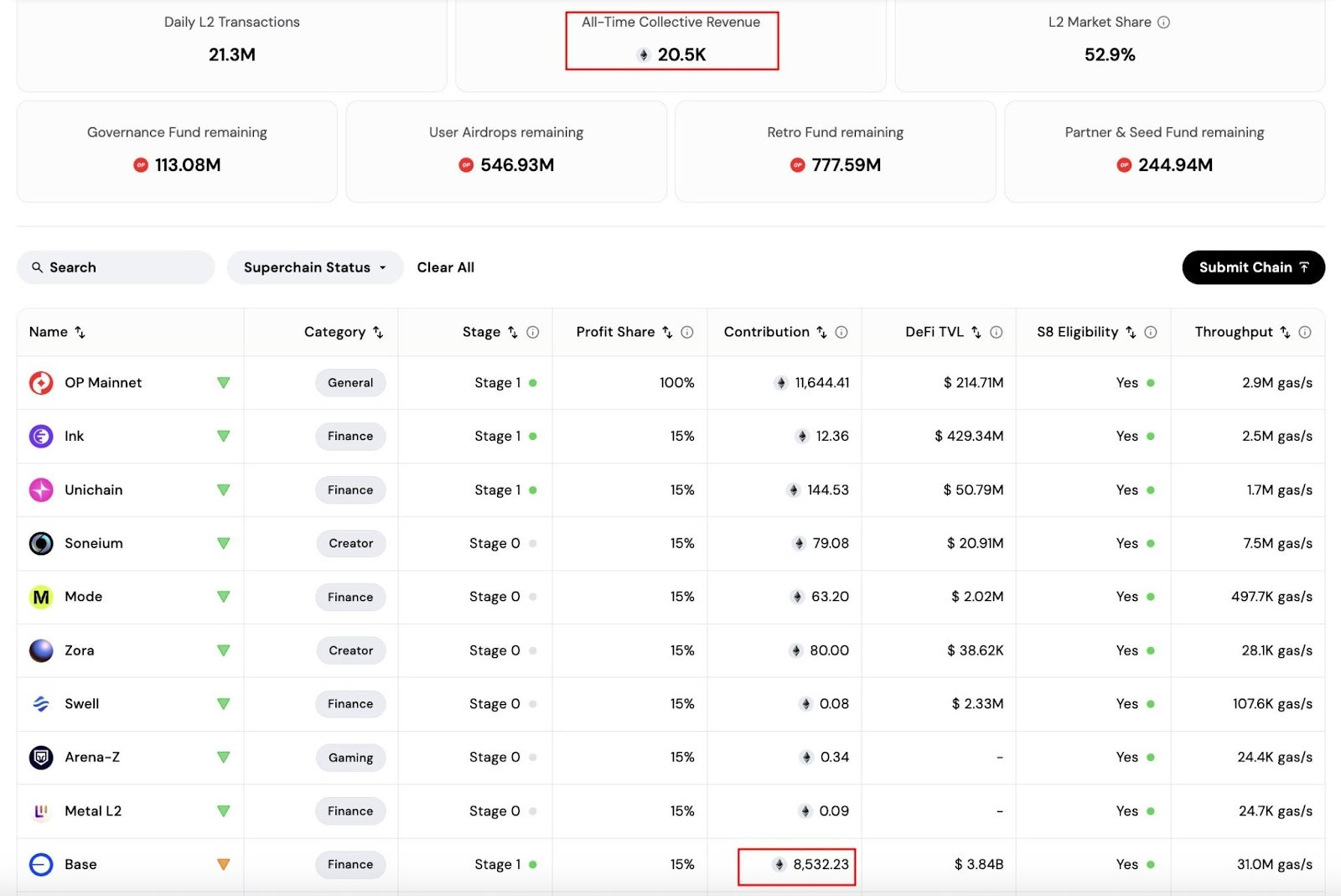
The other 33 Superchain members were present but economically marginal. In the first half of 2025, World Chain, the second most active member, accounted for 11.5% of Superchain computation. OP Mainnet itself was at 11.4%. Ink, Soneium, and Unichain together were under 13%.
The Superchain had become, in everything but name, a one-chain operation. The federation was real on paper. The economics were Base.
At some point, the strongest participant in any collective asks the obvious question: What am I actually getting from this?
There is a version of this dynamic that plays out in almost every open-source success story. MongoDB built a widely adopted database, released it openly, and watched Amazon Web Services build a profitable managed service on top of it without paying MongoDB anything. AWS had the distribution. MongoDB had built the standard. The value went to the entity that controlled the users, not the entity that wrote the code. MongoDB eventually changed its license. AWS forked it into OpenSearch.
Elastic went through the same cycle. Redis too. The specifics differ, but the structure is identical every time. The infrastructure creator builds the standard, a large player with distribution adopts it, the large player captures the value, and the large player eventually internalises the stack and leaves. The open license that drove adoption is the same open license that makes the exit costless.
Optimism is the crypto version of this story.
Arbitrum watched this dynamic and made a different call. Orbit chains, Arbitrum’s equivalent of the Superchain, operate under Business Source licensing. There is a contractual basis for revenue sharing, not a voluntary one. When your largest partner can leave without legal consequence, the federation depends entirely on whether staying serves their interests. Arbitrum decided not to build on that assumption.
Base’s stated reasons for leaving were technical. A unified codebase would mean faster development, targeting six major upgrades per year instead of three. Independent control of its Security Council would mean no external entity could slow or block network decisions. Reduced dependencies would mean Base could respond to Ethereum’s own upgrade cadence without waiting on governance processes it didn’t control.
Coordinating across multiple codebases is genuinely slower than owning your own stack.
But there is another reason that requires no reading between the lines. JP Morgan estimated that a Base token could unlock roughly $34 billion in equity value for Coinbase and raised their price target on the stock to $404. A Base token with credible value capture is structurally difficult to design while Base is sending 15% of net revenue to a separate protocol’s collective. Leaving the Superchain is a prerequisite, not a side effect. Both motivations point in the same direction. Base followed them there.
What Optimism is left with is not nothing, but it requires honesty about what changed.
OP Mainnet holds $1.5 billion in TVL. On the same day Base announced its departure, ether.fi said it would migrate its on-chain credit card product to OP Mainnet, bringing 70,000 active cards, 300,000 accounts, and over $160 million in TVL. The Collective had approved a buyback program directing 50% of sequencer revenue to monthly OP purchases just weeks earlier.
The ether.fi partnership gives OP Mainnet a clearer use case in consumer payments. But EtherFi’s annualised fee contribution is roughly $13 million. Base earned approximately $55 million in profit in 2025 alone. The buyback program was designed around a revenue base that no longer exists in the same form. Investor and contributor token unlocks continue at roughly $32 million per month regardless.
The pivot toward enterprise services is probably the right move. OP Labs has raised over $175 million, has serious engineering talent, and there is genuine demand for managed OP Stack deployments from institutions that want to launch chains without building the internal capacity to maintain them. Jing Wang’s framing of it as “Databricks for blockchain infrastructure” is a reasonable analogy. It is a services business. It can work.
But a services business is different from a network that generates compounding protocol revenue through federation. The OP token was priced for the latter. The market understood that before the blog post was twelve hours old.
Let’s zoom out. What happened on February 18 is less about Optimism.
More than 50 Layer 2 networks competed for users and liquidity through most of 2024. By late 2025, three of them, Base, Arbitrum, and Optimism, were processing nearly 90% of all L2 transactions, with Base alone above 60%. Smaller rollups had seen activity fall 61% since June. The Dencun upgrade’s 90% fee reduction compressed margins across the board. Base was the only L2 that turned a profit in 2025.
The chains that survived and the chains that will define this layer for the next several years are not necessarily the most technically sophisticated. They are the ones with a structural reason why users stay. Exchange-backed chains, Base, Ink, and Mantle, have distribution built into their parent company’s existing user base. Every Coinbase customer who wants to go on-chain is one tap away from Base. DeFi-native chains like Arbitrum and Hyperliquid hold position through liquidity depth that is expensive to rebuild elsewhere.
Technology is the part that can be forked. The OP Stack proved that better than anything. What cannot be forked is the relationship between Coinbase and its 100 million users or the $10 billion in open interest sitting on Arbitrum. That is where the durable value lives, and it has very little to do with which license you chose for your codebase.
Optimism’s decision to release the OP Stack under a permissive open license was the right call. It produced the widest adoption any L2 framework has seen. It made Optimism the infrastructure standard for an entire generation of Ethereum scaling. Without that decision, Base might have been built on something else, or not at all.
But the same decision that made all of that possible also made the exit costless. When Base grew large enough to have its own users, its own token roadmap, and its own reasons to seek full sovereignty over its infrastructure, there was nothing in the license and not enough in the interoperability promise to give it a reason to stay.
Optimism won the standard war. The standard just didn’t come with a mechanism to capture any of the value it created.
At $0.12, the token is the market’s answer to what that’s worth.

Token Dispatch is a daily crypto newsletter handpicked and crafted with love by human bots. If you want to reach out to 200,000+ subscriber community of the Token Dispatch, you can explore the partnership opportunities with us 🙌
📩 Fill out this form to submit your details and book a meeting with us directly.
Disclaimer: This newsletter contains analysis and opinions of the author. Content is for informational purposes only, not financial advice. Trading crypto involves substantial risk - your capital is at risk. Do your own research.