


Hello,
Every once in a while, someone notices that some currency is paying 8% while the dollar is paying 4%, and asks why not just hold the 8% one and pocket the difference. It sounds like free money, or arbitrage - if you will. That’s how carry trade works. But it isn’t that simple. Although the spread appears practical to pocket, the financing cost, including borrowing, hedging, and moving such money, may often eat away at the spread. Mature players in the markets have known this for a century. The high yield and the cost of using it move together in a way that almost entirely closes the gap you were chasing.
The same logic is being applied to tokenised Treasury bills in DeFi right now. People question why the funds are sitting passively in DeFi and not being used to earn more yield. There’s a fundamental problem in that thinking.
The market often focuses on the 3% to 4% yield sitting safely on-chain. But a yield does not become useful simply because it has been tokenised. To loop the asset, a trader must borrow stablecoins against it. And often, the cost of that borrowing can be equal to or higher than the Treasury yield itself. Once the spread turns negative, leverage works against you. The asset may still be a perfectly sensible investment to hold, but there is little economic reason to use it inside DeFi.
That’s why $35 billion can sit on-chain doing nothing, and yet none of it is a missed opportunity.
Alessandro, who builds the tooling to move assets into these on-chain vaults at Li.Fi, sees this problem from the inside. In today’s guest essay, he takes the idle-90% figure everyone obsesses over and walks through the actual economics around why the money sitting still isn’t stuck or locked out.
On to Alessandro’s story,
Prathik


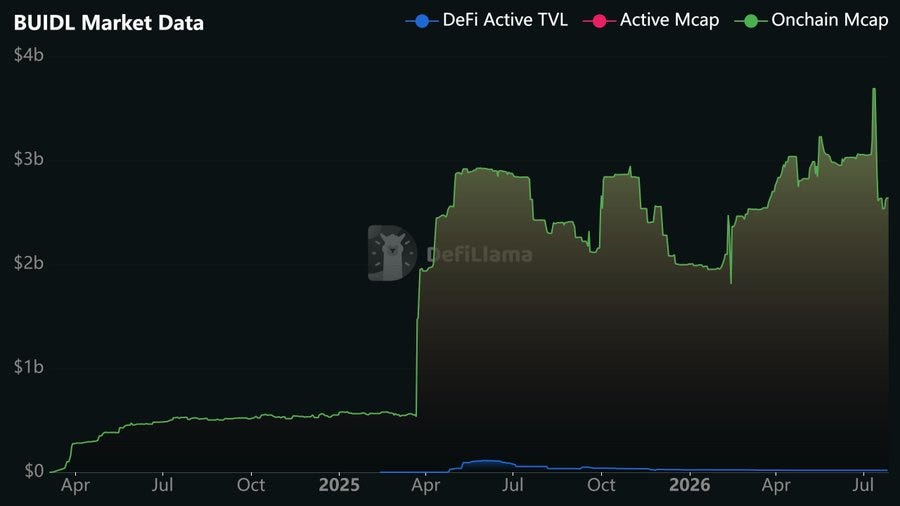
BlackRock’s BUIDL holds $2.6 billion of tokenised Treasuries. Less than 1% of it sits anywhere DeFi can touch. Zoom out and the picture is the same. Tokenised real-world assets crossed $35 billion in July, an all-time high, while open DeFi lending puts to work about $2.5 billion. Treasuries and money market funds, the largest slice of the market, show 5.5% utilisation. Tokenised stocks are at 2.9%. The rest sits in wallets doing nothing.
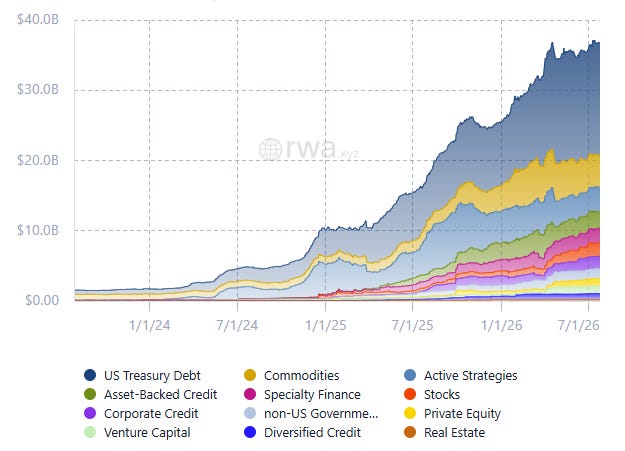
Measured by issuance, institutions have arrived. Larry Fink has told investors that every stock, bond and fund can eventually live on-chain, and BlackRock, J.P. Morgan, Apollo, Janus Henderson and Circle all have tokenised funds on public networks today.
However, measured by usage, almost nothing has happened.
Ask why, and you get the same three answers: KYC restrictions, slow redemptions, transfer-restricted tokens. While true, they describe the fence, not the reason so few people try to climb it. The better answer might be an economic one. For tokenised Treasuries in particular, there is currently no levered trade. The 90% that sits idle is not stuck. It is capital making the rational choice. And part of the answer, which we will get to, is that the yield already reaches users through a different door.
The Carry Theorem
Start with what DeFi would actually do with a yield-bearing token. The native move is looping. You deposit the asset as collateral, borrow stablecoins against it, buy more of the asset, and repeat. At every given LTV, the maximum exposure is 1/(1-LTV), so an 80% LTV gives you 5x. This is how stETH grew, how Ethena’s USDe reached more than $14 billion at its peak, and how every yield asset in DeFi gets levered.
The net return of a loop is the asset yield plus (leverage minus one) times the spread between asset yield and borrow cost. In plain terms, leverage multiplies the spread, not the yield. Everything depends on that spread.
Here is the problem for Treasuries. A tokenised T-bill pays the “risk-free” dollar rate. The person lending you stablecoins on Aave can reach that yield too, directly by clearing the token issuer’s KYC, or through a plain brokerage account. So, they face a choice: lend stables to you, or buy T-bills. Reaching the bill has a cost: clearing KYC, minimums, moving money off-chain, so lenders will tolerate earning a bit less than the bill. However, when Aave’s lending rate sinks too far below the bill, they pick the bill and stop adding deposits. The borrowing rate is always higher than what lenders earn, because the protocol takes a spread in between. Put those two together, and the bill yield ends up inside Aave’s spread: above what lenders earn, below what you pay to finance it by borrowing stables.
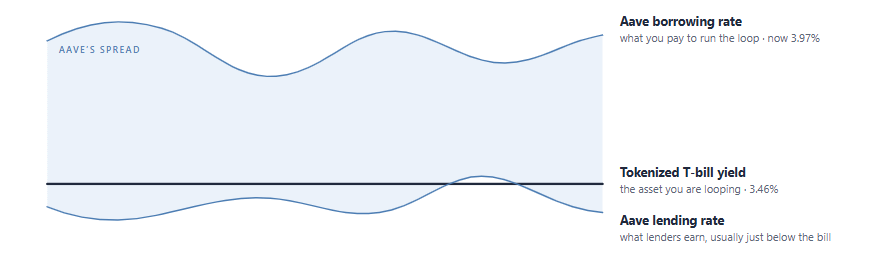
Your financing cost ends up above the bill rate for long stretches. The asset you want to loop pays that same bill rate. You are financing the risk-free rate at the risk-free rate, or worse.
In 2024, Aave v3 USDC borrow averaged 9.0% while bills paid about 5.3%. In 2025, it averaged 5.8%. As of mid-July 2026, borrow sits at 3.97% against a tokenised Treasury average yield of 3.46%. Run the loop today at 80% LTV and five turns: 3.46 + 4 x (3.46 - 3.97) = 1.42%. Leverage points down. You would earn less than if you simply held the token unlevered.
The squeeze is not airtight. As I write, Aave’s USDT borrow rate sits a few tenths below the bill yield, and roughly $700 million of leverage against RWAs has formed across Aave, Morpho and Kamino. But look at when the spread flips. On-chain dollar rates only fall below TradFi rates when demand for crypto leverage collapses, so T-bill collateral activates exactly when nobody wants dollar leverage. And a spread hovering around zero, after collateral haircuts, fees and rate volatility, still never pays at size.
An economic working paper (Barbon, Barthélemy and Nguyen, 2023) found that stablecoin lending rates are driven mostly by crypto demand and reconnect with conventional rates only slowly, through exactly this arbitrage channel. That slow reconnection is the 2024 premium visible in the numbers above. A Keyrock and Securitize report showed that tokenised Treasuries out-yielded DeFi’s benchmark stablecoin lending rate on 98% of days in Q1 2026, with 3.6 times lower volatility. Read that carefully. The tokenised T-bill is a better hold than lending on Aave, and simultaneously impossible to lever. The bill pays more than Aave lenders earn and less than Aave borrowers pay.
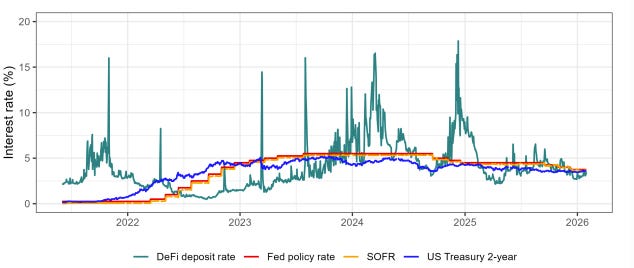
So the idle 90% is not waiting for a better front-end. It is capital declining a negative-carry trade.
Utilisation Follows Carry
If the carry explanation is right, it should predict which RWA categories DeFi actually uses. It does, across all three classes.
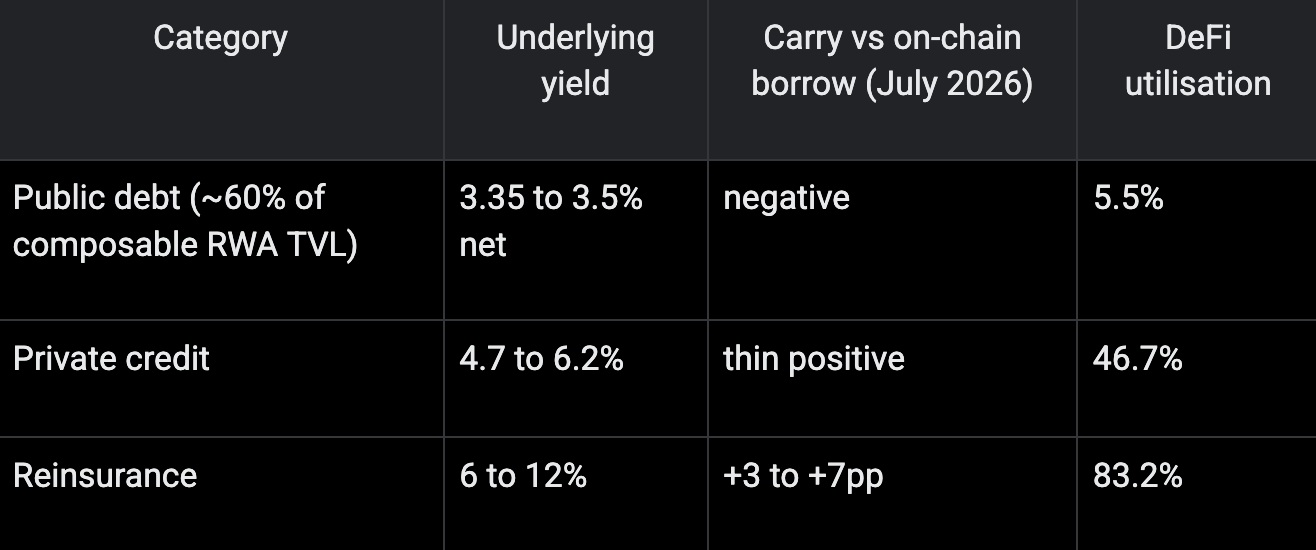
Private credit yielded 8 to 10% when most of these integrations were built, so the deployed capital arrived when the carry was wide.
The obvious objection is that carry and transferability are tangled together, since the high-yield categories happen to be freely transferable tokens while Treasuries are dominated by whitelisted ones. Class-level data can’t separate the two. But specific comparisons where transferability and carry pull in opposite directions can separate them, and those comparisons are unambiguous. Apollo’s ACRED is a transfer-restricted, qualified-purchaser-only tokenised credit fund yielding around 8 to 9%. It became the flagship DeFi looping asset last year. Securitize built a wrapper, Gauntlet automated the strategy, and KYC-gated markets appeared on EVM chains and Solana to capture the spread. Meanwhile, Ondo’s USDY is freely transferable, holds over a billion dollars, and has essentially no leverage footprint. Its carry is negative.
Restrictions are a fixed cost. Wide carry pays the cost. Negative carry means there is nothing to pay for it with. Better access tooling shrinks the cost, but it cannot create the spread.
Three honesty notes on Table 1. First, the 46.7% private credit figure excludes Figure’s HELOC book, which is tokenised but not composable; include it and utilisation drops to roughly 12 to 15%. Second, the largest ‘private credit’ asset in DeFi is Maple’s syrupUSDC, which is overcollateralised lending to crypto trading firms, so real-world credit in DeFi is smaller than the headline suggests. Third, the reinsurance row is two protocols designed as DeFi-native products from day one, so read it as directional rather than statistical. One scoping choice matters too: these figures count open, permissionless lending. Looser definitions that count every RWA deposit in any DeFi protocol reach about $7.4 billion for Q2 2026, up 200% in a year. The level moves with the definition. The ranking across asset classes, which is where the story lives, does not.
TradFi Leverages the Same Asset at 50x
Here is where it gets interesting, because the no-demand story is wrong in one specific way. Demand for levered Treasuries is enormous. It just lives somewhere else with better infrastructure.
In TradFi, fixed income stands on three legs: financing, rate hedging, and shorting. DeFi has built none of the three in a permissionless form.
Financing. The US repo market carries ~$12.6 trillion in outstanding exposure. Overnight general collateral repo currently runs 16 to 29 basis points below the 3-month bill yield, so right now TradFi finances the risk-free asset below its own yield. That sign flips with the rate cycle. The structural part never flips: financing in trillion-dollar size, at haircuts near zero, meaning lenders demand almost no extra collateral at a rate that hugs the risk-free curve. DeFi has never had any of the three. That deep, nearly frictionless financing is why the basis trade can exist at all. Hedge funds ran about $830 billion of these positions as of late 2025, long cash Treasuries against short futures, at 50 to 70x leverage on the futures leg. DeFi’s version of financing is variable-rate, priced above the asset yield, and capped at 80 to 92% LTV for a maximum of 5 to 12.5x, with no term structure and no netting.
Rate hedging. Outstanding interest-rate derivatives total roughly $668 trillion. This is the machinery that lets insurers and pensions run fixed-income books against liabilities that stretch decades longer than the bonds they can buy. UK pension funds at their peak hedged about £1.4 trillion of liabilities through strategies built on swaps and repo. DeFi’s equivalent is a graveyard. Element, Yield Protocol, Sense and Voltz were a whole generation of on-chain rate protocols, and all of them wound down. Pendle survives, and its Boros venue for funding-rate swaps has done $18 billion of cumulative notional in eleven months. That is real, but still tiny. Boros open interest peaked above $250 million, about 0.17% of the roughly $150 billion sitting in funding-rate positions on an average day.
Shorting. Securities lending has $4.4 trillion on loan and produced a record $9.1 billion of revenue in the first half of 2026. There is no native on-chain mechanism to short a tokenised Treasury. No shorting means no two-sided price discovery and no special markets.
Duration. The quieter structural problem sits underneath all three. DeFi liquidation assumes the collateral can be sold within the same transaction. Tokenised funds redeem on a cycle; next-day for some funds, quarterly for others. A liquidator who seizes that collateral cannot sell it in the same transaction. Someone has to hold the position until the fund pays out. You can see protocols contorting around this in production. Every serious RWA collateral listing since 2025 has gone to isolated or permissioned venues rather than the main pools. Morpho hosts them in isolated markets, Kamino keeps them in their own markets, and Aave built Horizon as a separate permissioned instance rather than touching its core pool.
Strip those legs from any market, and the rational position size is close to zero. TradFi investors are not avoiding on-chain Treasuries out of ignorance. They are declining to trade a market with no repo desk, no swaps desk and no borrow desk.
The On-chain Buyer and Cashflows
Even if the infrastructure existed, there would still be a demand-side problem, because the people actually trading on-chain today don’t want cashflows. They want price exposure with leverage.
The cleanest evidence is tokenised stocks. Spot tokenised equities on Solana, which handles 96% of all tokenised stock trading, did $4.84 billion in volume in the entire second quarter of 2026. Hyperliquid’s HIP-3 builder markets, led by equity perps, did about $62 billion in May alone, and by mid-July, these markets were roughly half of all Hyperliquid perp volume, up from 2% in January. That is a revealed preference of nearly 40 to 1 for synthetic price exposure over owning the tokenised asset.
Dividends make the same point from the other side. None of the three major tokenised stock issuers pays dividends out as an on-chain cashflow. xStocks rebases dividends into your balance, Ondo Global Markets accrues total return into the token, and Robinhood’s stock tokens are legally derivatives, with the newer on-chain versions structured as debt instruments that pay dividends as dollar credits inside the app. There is nothing for a DeFi protocol to compose with. The main lending venue that accepts tokenised stocks as collateral, Kamino on Solana, holds roughly $20 to 30 million against them. All tokenised stocks in DeFi combined: $78 million.
Pendle, DeFi’s fixed-rate venue, tells the same story with better resolution. The rails demonstrably work. Pendle settled $58 billion in fixed yield in 2025, and its principal tokens are functionally zero-coupon bonds. But the demand that used those rails was leveraged, points-subsidised Ethena carry, and when that spread died in September 2025, Pendle’s TVL fell 92%. RWA underlyings on Pendle reached all of $151 million, about half a percentage point of the tokenised RWA market. Tokenised Treasuries don’t need a yield-splitting venue. They need a repo market that doesn’t exist.
The Yield Travels Better than the Asset
There is one more twist, and it changes how you should read the headline number. The T-bill yield is already flowing through DeFi at scale. It just doesn’t travel as the fund token.
Look at who actually holds the big tokenised Treasury products. Ethena’s USDtb stablecoin keeps over 90% of its reserves in BUIDL. Ondo’s OUSG is reported to be BUIDL’s largest single holder. Sky (ex-MakerDAO) allocated $2.4 billion of its reserves into BUIDL, Superstate and Centrifuge funds through Spark, and another billion into Janus Henderson’s CLO fund through Grove. Circle’s USYC, which overtook BUIDL in March 2026 and now sits at $2.9 billion as the largest tokenised Treasury product, grew almost entirely as off-exchange margin collateral for Binance institutional clients. BUIDL itself has been accepted as derivatives margin on Crypto.com and Deribit since June 2025.
Every name on the above list is a wrapper, a DAO treasury, or an exchange collateral program. Not one of those use cases shows up as “DeFi utilisation” of the underlying token, yet the yield reaches users anyway, through sUSDS ($6.2 billion earning the Sky Savings Rate), through USDY at around 3.5%, and through USDtb rewards. Yield-bearing stablecoins drove more than half of net stablecoin supply growth in Q1 2026.
This is not a failure mode. It is how money has always been structured. Reserves sit still while claims on them circulate. Tokenised Treasuries are settling into the same role: the reserve layer of onchain dollars, and reserve layers do not circulate. This means utilisation was partly the wrong metric from the start. It measures whether the base moves, when the whole point of a base is to hold still while everything above it moves.
Regulation is actively pumping this structure. The GENIUS Act, signed in July 2025, prohibits payment stablecoin issuers from paying any form of yield. So the issuer cannot legally pay the T-bill return to its own holders, and the yield migrates into wrapper tokens and rewards paid through affiliated entities. Regulators are already moving on the rewards door (the OCC proposed in February 2026 to treat coordinated issuer and affiliate rewards as presumptively prohibited), which leaves the wrapper as the structure regulation durably favours. The 90% idle statistic partly measures the wrong layer: the yield composes, the asset doesn’t.
Will It Change?
Two sides are attacking this problem from opposite directions, and they disagree about what the problem is.
The first one is institutional and rebuilds the missing TradFi legs on-chain in permissioned form. Tokenised repo already runs at scale inside banks. Broadridge’s distributed ledger repo platform processed $7.5 trillion in June 2026 alone, and JPMorgan’s Kinexys has processed roughly $3 trillion of tokenised repo since its 2020 launch. Closer to DeFi, Grove’s Basin facility offers up to $1 billion a day of instant liquidity against BUIDL and JTRSY redemptions, which is functionally an on-demand repo window for tokenised funds. Aave’s Horizon holds about $255 million. On the access side, before capital enters the vault, Plume’s Nest Vaults fold compliance into the transaction itself: instead of a static wallet allowlist, a signed policy attestation checks eligibility the moment capital enters a vault, making compliant access far easier to compose with. The infrastructure is arriving. It is arriving wearing a suit.
The second side is crypto-native and changes what gets tokenised. A tokenised T-bill is a worse product than the brokerage version, as it delivers the same asset with extra smart contract risk, extra fees, and a buyer base that never asked for it. Plume’s answer is not to choose between the two sides, but to connect them: use institutional-grade vault and compliance infrastructure to distribute assets whose yield can actually clear the on-chain financing floor. nOPAL is the clearest example. The Plume Nest vault behind it allocates mainly to BlackOpal’s short-dated credit-card receivables strategy, holding roughly $35 million in TVL at an 11.8% trailing 30-day APY. The Morpho market financing nOPAL collateral currently charges roughly 4.9%, with about $814,000 borrowed against it, a positive gross carry before fees, haircuts and rate movement. Plume, in other words, is side-one plumbing carrying a side-two asset. While both agree the trade has to earn a positive spread, Plume’s model is to work both sides of it.
My watchlist for when the idle 90% actually moves:
Someone offers permissionless dollar financing below the bill yield against tokenised Treasury collateral. That is the on-chain repo moment.
A liquid rate market emerges for RWA yields, so duration can be hedged rather than just held.
A borrowing mechanism makes tokenised funds shortable.
Async redemption standards make slow-to-redeem collateral possible to liquidate without 35-day windows.
Financing has permissioned prototypes today, and the async-redemption standard is live and spreading. Rates and shorting have nothing yet.
At LI.FI I work on Composer, the orchestration engine behind our DeFi and RWA Earn product. It handles the access leg of this problem, moving any token on any chain into a KYC-gated RWA vault in one flow with the compliance check included. Access decides who can get into an asset. Carry decides whether there is a trade once they hold it, and no router can fix a negative spread.
Today’s idle 90% is a carry problem. But look at what happened with ACRED. The moment carry turned wide, wrappers, KYC’d markets and automated strategies showed up within months, because restrictions are a fixed cost and someone has to make that cost cheap to pay. When the spread flips, the binding constraint moves back to access.

The tokenisation thesis was that putting assets on-chain makes them more useful. For an investor with a brokerage account, that is not yet true, because a tokenised T-bill today carries more risk than its off-chain twin and can do less. The capital that already lives on-chain has voted for a different form. Until the financing floor breaks, the rational trade is the one the market is already making. Hold the wrapper, collect the yield, and leave the fund token alone.
And the issuers seem to know this. The fees earned on a few billion dollars of assets barely register at firms that manage trillions. So, these funds are loss leaders, sold rather than bought. It’s the price of being in position before the market structure arrives. Today’s demand was never the point.
That’s all for today.
Until next time,
Alessandro
P.S.: This piece was originally published here.
P.P.S.: We will be featuring good writing and writers we love from time to time. If you have recommendations, send them our way.
Token Dispatch is a daily crypto newsletter handpicked and crafted with love by human bots. If you want to reach out to 170,000 subscriber community of the Token Dispatch, you can explore the partnership opportunities with us 🙌
📩 Fill out this form to submit your details and book a meeting with us directly.
Disclaimer: This newsletter contains analysis and opinions of the author. Content is for informational purposes only, not financial advice. Trading crypto involves substantial risk - your capital is at risk. Do your own research.
