


Hello,
Money’s utility depends on its mobility. Consider paying a friend who keeps their money in another bank. Behind the banking app interface, the two banks settle with each other, and the money remains worth the same in both banks.
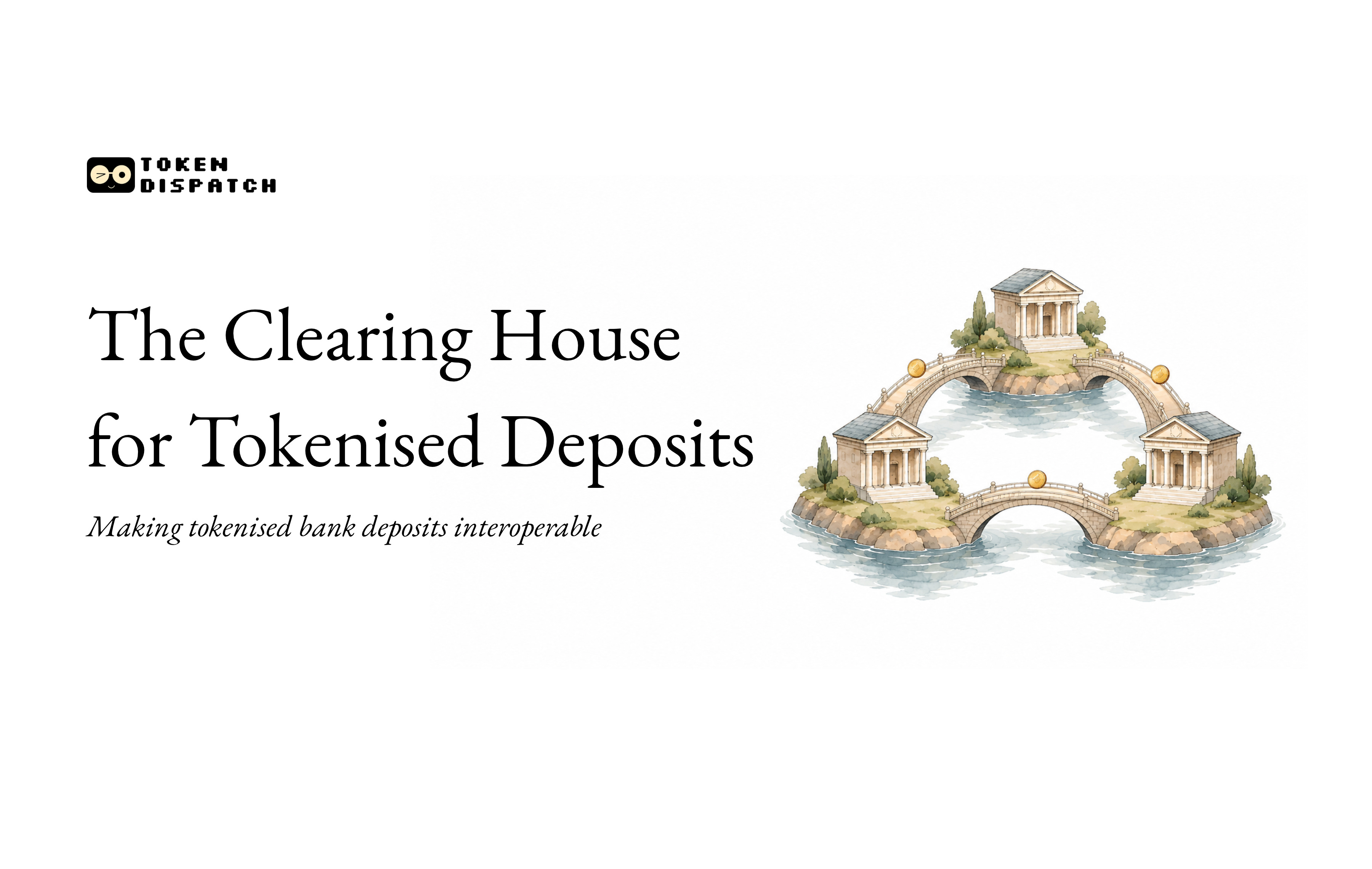
Banks have spent the last few years rebuilding deposits for a world that never shuts. Enter tokenised deposits. JP Morgan, Citigroup, and HSBC all have tokenised deposit services. These tokenised deposits move at any hour and are programmable. But they work within the specific banking ecosystem.
A tokenised deposit is a claim on the bank that issued it, and other banks’ ledgers can’t use it. Although tokenised deposits are programmable, the hard part is connecting them across banking ecosystems.
In today’s story, I explain why the value accrues in making tokenised deposits travel across banks.
On to the story…

StablesReward: Your AI Agent Spends, You Earn
AI agents can surf the web, read reviews, and book hotels for you. All these tasks cost money. But what if these tasks could earn you back something?
StablesReward does just that. Once you connect your agent to an MCP endpoint, it gives your agent a menu of paid tools. Every call your agent pays for earns you miles or stocks. And this is in addition to the rewards you earn anyway on your own spending across 800+ merchants.

Every purchase pays you back. The best part is that you can choose how you’d like to be rewarded. Transfer miles to airlines and hotels, or let your stocks build a portfolio from the spend you were making anyway.
Launching soon. Free to join.
The Porters Are Back
On September 24, seven British banks closed two remortgages in a way no British bank had before. The borrower’s money remained locked in their account, kept earning interest, and was released the moment the deal was done. Nobody had to wait for funds to clear.
The seven banks, including Barclays, HSBC, Lloyds, and NatWest, collaborated with one shared platform. UK Finance, the industry body, commissioned it from Quant, a London software firm. Without the shared platform, every bank’s token remains siloed.
The Bank for International Settlements (BIS) said as much in September. Without interoperability, a tokenised deposit can’t cross a bank’s “KYC boundary”. So, my bank’s token means nothing to another bank’s ledger because the latter has never vetted the former or agreed to hold a claim on the same.
This is the biggest bottleneck to what tokenisation promises. A tokenised bond or fund only settles when the asset and the cash swap at the same instant. On one of the largest live tokenised repo platforms, the securities are on-chain, and the cash still moves on old rails. Tokenised Treasury funds have grown to roughly $14.5 billion, yet most of that money still settles the old way.
It’s not a dead end. Finance has solved this problem before. In the early 1850s, New York’s banks settled with each other by sending porters around the city with cheques, each bank to every other bank, every day. The more banks opened, the worse it got. In 1853, they set up a clearing house that did a single settlement daily of all the cheques due. That institution is today’s The Clearing House, owned by about 25 of America’s largest banks, and it runs CHIPS and RTP, two of the country’s core payment systems.
Today, the problem is that separate tokenised deposits across banks need to align with central bank money on a Sunday.
To solve this, the banks are agreeing on a shared, common layer where the settlement of tokenised deposits issued by different banks takes place. On September 24, The Clearing House picked Quant, after a competitive process, to run the orchestration layer of its On-Chain Money network. It opens to banks in the first half of 2027.
A Once-in-a-Generation Opportunity
Clearing layers are close to natural monopolies. Once a country’s banks agree on a rulebook and a settlement venue, it stays that way for decades. When The Clearing House launched the Real-Time Payments (RTP) network in 2017, it was billed as the first new core payments system in the US in more than 40 years. That’s how this line of business works. When the window for such a stack opens and the seat is captured, the window is shut for a generation.
In 2016, after a competitive tender, The Clearing House hired Vocalink, a British company owned by UK banks, to build RTP. Vocalink had already built Britain’s Faster Payments. RTP now moves around $7 billion a day. A decade later, The Clearing House ran another tender and picked another London builder.
What’s different now is how many such seats of value accrual are opening at once. Tokenised money forced every major banking system to answer the same question within the same 18 months.
Quant has taken the two biggest domestic contracts awarded so far, America’s and Britain’s, on the same day.
Swift chose to build its own shared ledger. Seventeen banks are piloting it, and Swift expects at least 19 across five currencies by the end of 2026. Chainlink, IBM, ACI, and Oracle are all competing to plug banks into it. America’s regional banks started the Cari Network, built on ZKsync. The European Central Bank chose not to hire a private orchestrator at all. Its Pontes link, live since September 21, settles tokenised assets directly in central bank money.
So what is the seat actually worth? The liquidity.
CHIPS, The Clearing House’s large-value system, moved just over $2 trillion a day in 2025. Because it nets payments against each other, banks settled that with about $96 billion of funding instead of an estimated $442 billion. The Clearing House puts the savings at $5.5 billion a year. That is what a good clearing layer does. It lets the system run on a fraction of the cash it would otherwise need.
Now compare where tokenised deposits are today. JPMorgan’s Kinexys, the largest bank token network, averages about $7 billion a day. That’s roughly 0.3% of CHIPS, and it only works between JPMorgan’s own clients. The leader in tokenised deposits is a siloed garden.
That gap is the opportunity. No single bank can close it alone, however large it is. Only a shared layer can.
Who Captures the Value?
This layer will create enormous value. It’s how bank-owned infrastructure has always worked. The $5.5 billion CHIPS saves every year goes to its member banks. The Clearing House is owned by the banks that use it, and it prices like it.
Vocalink is a good example of how owners collect rent while the builders get paid. It built Britain’s Faster Payments and America’s RTP, two systems that now carry trillions. In 2016, Mastercard paid about £700 million for 92.4% of it, on revenue of £182 million. The prize went to the British banks that owned Vocalink. For the builder, that’s a superb outcome. But for the system it had built, it didn’t mean much.
The Quant Network operates inside the shared tokenised-money infrastructure of the world’s two largest financial centres. If it executes, it becomes a very valuable company. The banks that convene these networks will still capture far more.
So the real winners are the conveners of the ecosystem, like The Clearing House, UK Finance, and Swift. Those who control the rulebook of who gets in, on what terms, and at what cost capture the utmost value.
Close behind are the banks that join early, and that includes the small ones. America has 4,238 FDIC-insured banks, and 90% of them are community banks that will never run their own blockchain. Quant’s offer to issue tokenised deposits on their behalf, through The Clearing House, is the strongest case for a shared utility over a JPMorgan-only world. Without it, tokenised money becomes a big-bank privilege.
The risk is that banks solve fragmentation inside each club and recreate it between clubs. In America alone, there is The Clearing House network, Cari, Kinexys, and a 21-firm bank stablecoin planned for 2027. Further proof of the tokenised deposits ecosystem being a siloed garden is the fact that Huntington and KeyBank sit in both Cari and The Clearing House.
When the banks own the translator, the translator becomes a utility, and utilities don’t get to keep the toll. Enabling interoperability is where the value accrues, and where the players will crowd.
Although interoperability sounds like a technical word, it is more than that. It is the difference between a gift card and money. The former works only where it was issued. Money works everywhere because everyone accepts it at its face value. Banks spent a century making sure a dollar at one bank is valued as a dollar at every other. Central bankers call this the singleness of money. Tokenised deposits, as they exist today, break that perception. Interoperability puts it back.
Enabling it is not difficult. Ledgers can already talk to each other. The hard part is to figure out whose tokens a bank will accept, under which rulebook, and where final settlement happens. Britain answers through central bank reserves. The ECB built its own link. In America, The Clearing House is writing the rulebook, and Quant is building the switchboard.
A few things change if the industry gets this right.
First, money stops being a servant of time. A payment sent on Friday evening can sit idle until Monday because the settlement systems behind it close. Treasurers hold cash buffers to cover those dead hours. Bank money that settles across banks at any hour puts the cash back to work.
Second, tokenised assets finally get a till. The $14.5 billion in tokenised Treasury funds, and the repo and bond markets behind them, can settle against cash on the same rails at the same instant. The gap where one side has delivered and the other hasn’t paid disappears. That is the part of tokenisation institutions care about most, and it has been missing its cash leg all along.
Three, size stops being the moat. JPMorgan can run a token network for its own clients because it is JPMorgan. A community bank can’t do that. A shared layer gives the small banks that make up 90% of the system the same capability as the largest, on the same day.
The bigger shift is competitive. Stablecoins won their first decade by arguing that a dollar should be able to move around the clock between anyone. Interoperable tokenised deposits take that argument away while keeping deposit insurance, interest, and lending intact.
Within a decade, nobody will say “tokenised deposit”. It will just be a deposit, the same way nobody says “electronic payment” anymore. Customers will never see the clearing layer. That invisibility is exactly why it’s worth so much.
That’s it for today. I will be back with the next one.
Until next time, stay curious,
Prathik
Token Dispatch is a daily crypto newsletter handpicked and crafted with love by human bots. If you want to reach out to 165,000+ subscriber community of the Token Dispatch, you can explore the partnership opportunities with us 🙌
📩 Fill out this form to submit your details and book a meeting with us directly.
Disclaimer: This newsletter contains analysis and opinions of the author. Content is for informational purposes only, not financial advice. Trading crypto involves substantial risk - your capital is at risk. Do your own research.