


In Bhutan, the government sits inside a fortress. Literally, though.
Each of the twenty districts is run out of a dzong, a whitewashed fort with sloping walls and a monastery in the courtyard, usually planted on high ground above a river. Many are three centuries old. They were built to be hard to reach, because they were built to survive sieges.
Which worked beautifully when the job was defence.
Bhutan has around 786,000 people scattered across a very steep country. Roughly eight in ten work the land. Roads follow ridges instead of cutting through them, so two villages facing each other across a valley can be half a day apart. To get a document, you went down the mountain and up to the fort, and you waited, and you carried photocopies of everything you owned. Forget one paper, and you came back another day. The cost to the citizen is the day of farm work they lost.
In October 2023, Bhutan switched on the National Digital Identity (NDI), built to delete the whole tiring process the people went through. Two weeks ago, Bhutan started exporting it. We need to understand if the success belongs to the tech, or to Bhutan’s society.

The National Digital Identity puts your credentials in an app, locked with your face or your fingerprint. The records are on citizens’ phones, without a central vault holding everyone’s records. The state can confirm a credential is real without keeping a copy of it. A highly practical use case of zero-knowledge proof.
Say a service needs to know you’re over eighteen. The old way, you hand over a card carrying your birth date, your address, your ID number and your face, all of it, to settle one small fact. The NDI lets you prove the fact alone. Yes, over eighteen. You prove that is true without showing the file it came from.
Bhutan moved rails three times. It started on Hyperledger Indy, a closed ledger, the cautious institutional pick. In August 2024, it moved to Polygon for speed.
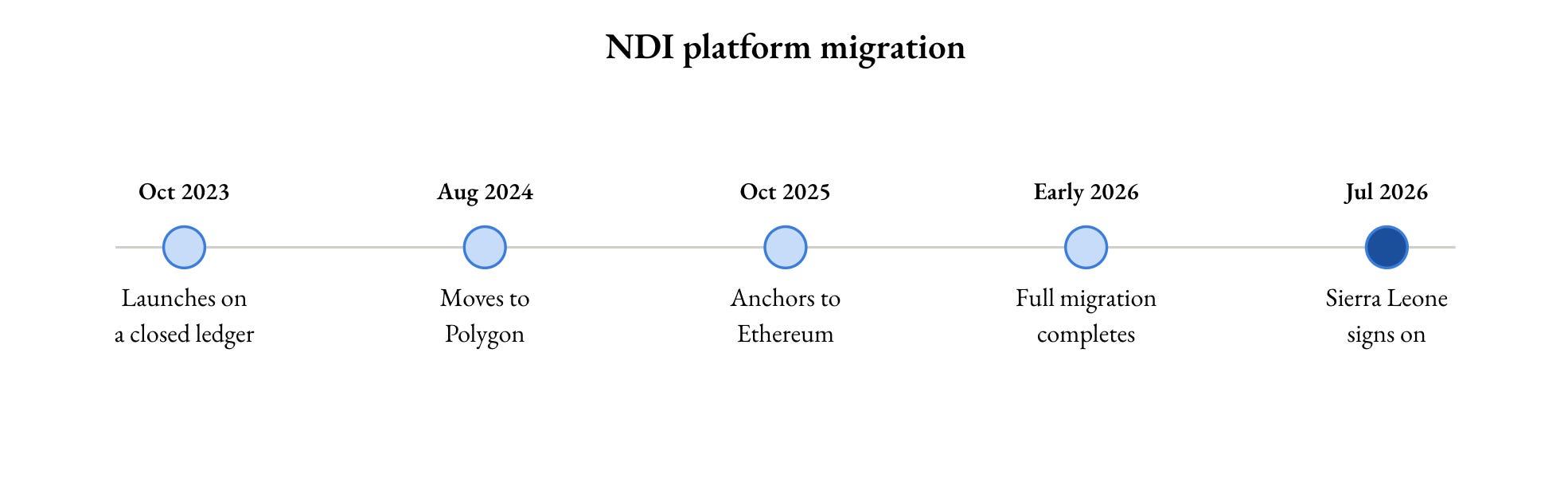
In October 2025, with Vitalik Buterin and the Ethereum Foundation’s president standing in the room, Bhutan anchored the system to Ethereum itself. First country on earth to put a live national identity system on a public chain, with full migration due this year.

Zero personal details are stored on-chain; it acts purely as a cryptographic ledger verifying that a credential remains valid and unaltered. The chain is a notary that no ministry can rewrite, including Bhutan’s own. The GovTech secretary’s reasoning was that Ethereum is spread across so many machines worldwide that it’s very hard to knock over. Bhutan selected a widely distributed public network to ensure its identity system stays online even if foreign infrastructure crashes. Because if a small nation like Bhutan relied on infrastructure controlled by a superpower (like US-based AWS or Google servers) and those servers suffered an outage, cyberattack, or political sanction, Bhutan would be left completely helpless. Since they cannot fix another country’s or company’s servers, they would just have to wait in the dark.
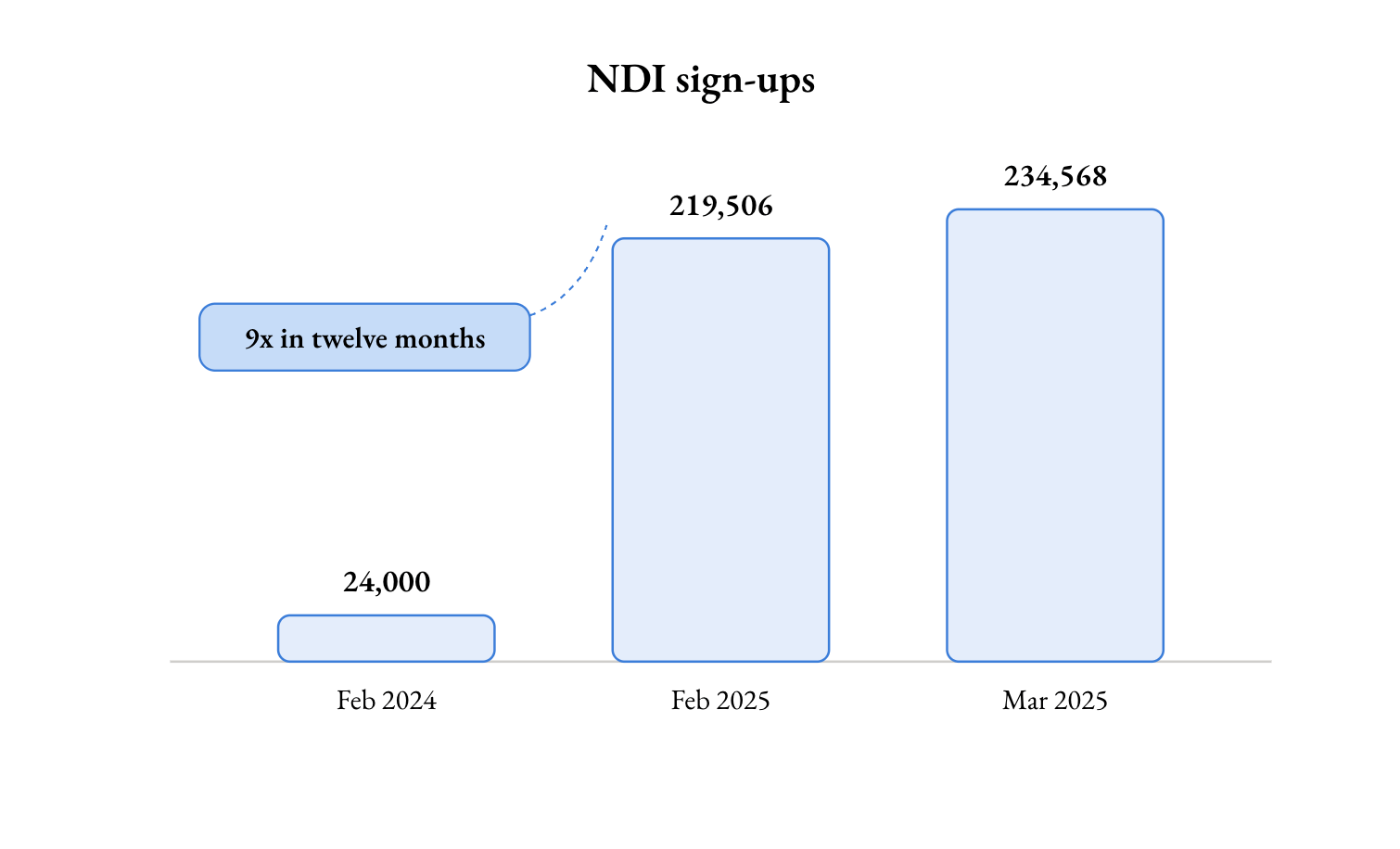
In February 2024, four months after launch, about 24,000 people had signed up. A year later, that was 219,506 registered users, out of 280,757 attempts, so not everyone who tried got through.
By the end of March 2025, the count of foundational IDs issued reached 234,568, covering citizens and foreign workers. A ninefold jump in twelve months, and it’s also roughly three in ten people. There’s been no official update published since, though the system has kept adding pieces.
On March 13, 2026, the Bhutanese Ministry of Foreign Affairs and External Trade, in collaboration with the GovTech Agency, issued an official press release announcing the integration of the Bhutan NDI wallet and eKYC with the national passport system. This means citizens no longer need to fill out physical forms or scan documents when applying for a passport. Instead, they can log into the G2C (Government to Citizen) website, scan a QR code using their NDI app, and their verified details, photograph, and e-signature are instantly synced to the passport office.
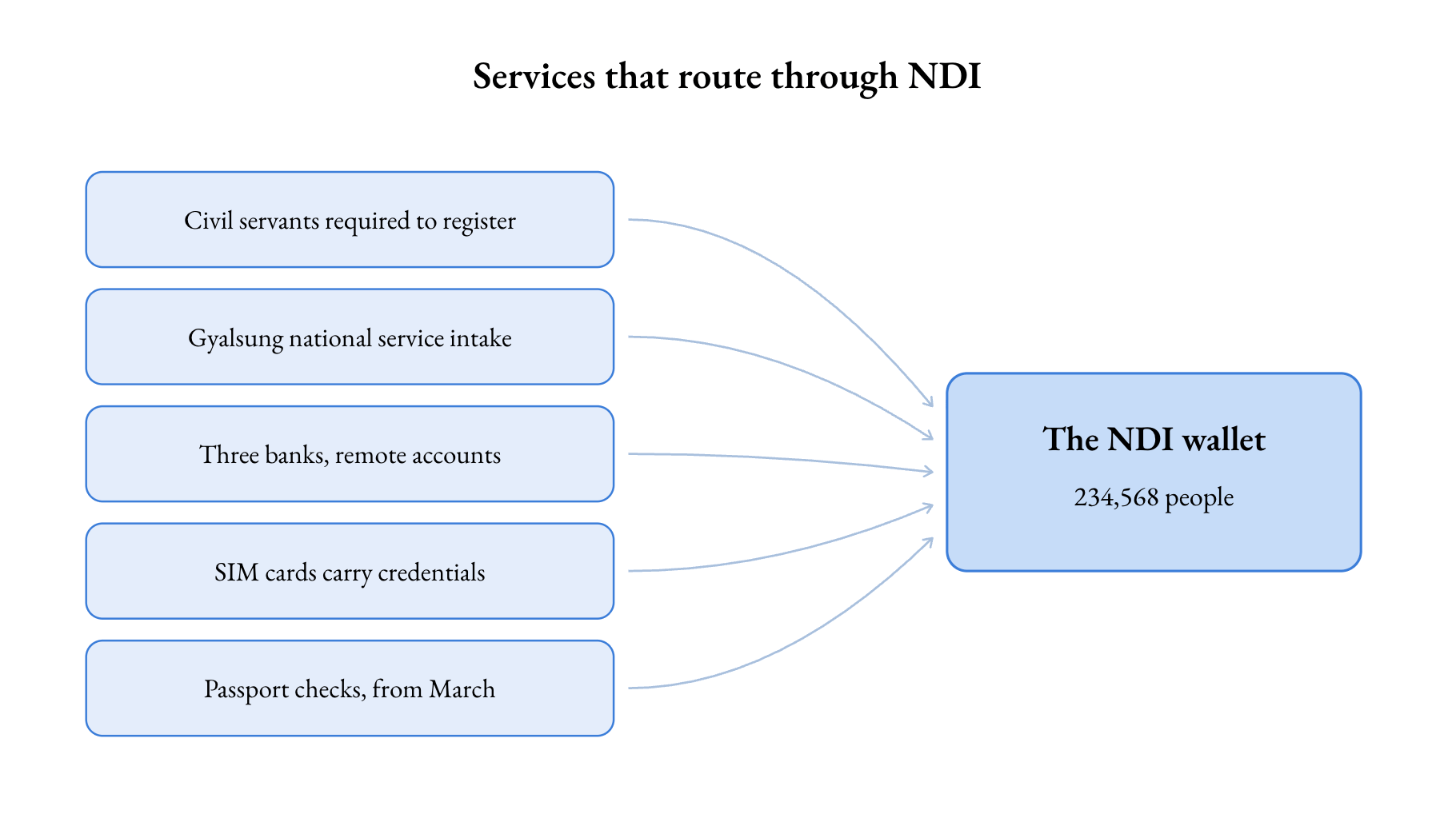
How did the 3 out of 10 that signed up get there? They got there because things people already had to do were routed through the app. Civil servants were required to register. Enrolment for Gyalsung, the national service programme every young Bhutanese goes through, runs on it. Three of the country’s banks, BOB, BNB and BDBL, wired it into remote account opening, so you can open an account without the trip to the branch. Telecom SIMs carry verifiable credentials. Passports followed.
High trust is what let Bhutan try. Ordinary usefulness, plus a few mandates, is what moved people. They might have downloaded it because the bank won’t open the account otherwise, and because the alternative is climbing up the fort.
But then, plenty of governments issue mandates. Very few get obeyed without a fight.
That’s where I get to romanticise this whole thing. Bhutan measures itself by Gross National Happiness, an idea its fourth king put forward in the 1970s that the constitution now instructs the state to pursue. Easy to file that under the tourism brochure that we all see and get excited. In practice it works as a test that proposals have to pass, and the test is whether the thing improves how people live, not only what it earns. A digital ID that saves a farmer two days of walking clears that bar without question.
The country also has a strange history with power. The monarchy handed authority to an elected parliament in 2008, and the king spent years persuading a reluctant public to take it. Because the monarchy willingly surrendered its power to the people, the Bhutanese public does not have an ingrained fear of an oppressive government. They do not automatically suspect that state tech initiatives are secret surveillance plots designed to track them.
When that state introduces a digital ID and promises it is actually better for privacy than a physical ID card (since you only share the necessary data, not the whole card), the public takes them at their word. The NDI Act passed both houses unanimously.
The same sovereign fund that built the identity system, Druk Holding and Investments, has been mining Bitcoin with surplus hydropower since around 2019. Holdings peaked near 13,000 BTC in late 2024 and have since been sold down to somewhere around 3,100, with hundreds of millions moving out to wallets nobody has identified. In May, the fund’s chief executive said he did not recall selling any. On-chain trackers say otherwise. A citizen-controlled identity system and an opaque treasury at the same time. After all, it’s a small state making bets, some of them as murky as anyone else’s.
Compare it with the United States, which for the last twenty years has been trying to standardise a driver’s licence.
REAL ID went into a wartime spending bill in 2005. It was a law requiring higher-security driver’s licenses to board domestic flights or enter federal buildings. Twenty-five states passed statutes or resolutions rejecting it. Fifteen wrote laws forbidding their own officials to comply. The opposition coalition ran from the ACLU (American Civil Liberties Union) to Gun Owners of America, groups that agree on nothing else, and they held for two decades. Enforcement finally came into force in 2025. Basically, the country took twenty years to settle the format of a card everybody already carries.
Because there’s a belief most Americans hold without being taught it. A government that can identify you reliably will eventually use that against you.
Barry Goldwater said it in 1974, warning that a universal identifier would leave a trail behind a person for life, ready to be reassembled and used to press on them. That instinct comes from a country with a long memory of files kept on the wrong people.
In fact, in America, proving who you are is an industry. Credit bureaus, verification vendors, background checkers, brokers reselling the fragments. When we talked about the paperwork in Bhutan, it was the effort and the time they lost on it that made it a problem. In this case, it’s the product itself.
So the same thing looks like a bridge over a mountain in Thimphu and as the first page of a dossier in Washington.
On July 5 this year, Sierra Leone’s technology ministry signed an agreement with Bhutan NDI and the SIGN Foundation to build the same kind of system there.
Bhutan is sharing its battle-tested, open-source digital wallet architecture, prioritising the training of Sierra Leonean developers so the country can manage its own W3C-standard system instead of paying perpetual vendor fees.
Sierra Leone has almost none of Bhutan’s advantages. It’s far bigger, far poorer, with a civil war inside living memory, and a long public record of corruption. If the theory is that only small, stable, high-trust countries can pull this off, Sierra Leone is the case that tests it. If it works there, the theory was wrong, and the useful ingredient was not Bhutanese serenity. The true formula came down to open tech standards, targeted state mandates, and a government with everything to gain by lowering bureaucratic hurdles — if it works.
The dominant narrative around this technology is still the one that promises escape; dodge the state, route around the rules. Bhutan used it to run the other way and make the state easier to reach, and it’s now sharing that with whoever wants it, while its own rollout is still in progress.
The result is mundane, people don’t NEED to climb the mountains too much.

Token Dispatch is a daily crypto newsletter handpicked and crafted with love by human bots. If you want to reach out to 200,000+ subscriber community of the Token Dispatch, you can explore the partnership opportunities with us 🙌
📩 Fill out this form to submit your details and book a meeting with us directly.
Disclaimer: This newsletter contains analysis and opinions of the author. Content is for informational purposes only, not financial advice. Trading crypto involves substantial risk - your capital is at risk. Do your own research.