


American companies hired consultants to slow their money in the 1970s.
It was called remote disbursement. To stall a payment, a New Jersey buyer would issue a cheque from an obscure bank thousands of miles away in Montana.
By adding physical distance and extra handoffs between banks, the cheque took days to clear. With interest rates soaring past 10%, keeping that cash in your account for just a few extra days yielded free profit.
There were consultants who did nothing except maintain maps of which small-town banks took the longest to clear. It was the volume that made it work. Americans wrote 8 billion checks in 1970 and 16 billion in 1980. The Federal Reserve float, the money that exists for a moment in two places at once because a cheque has been credited and not yet collected, averaged about $3 billion a day in 1972. It more than doubled between 1975 and 1978.
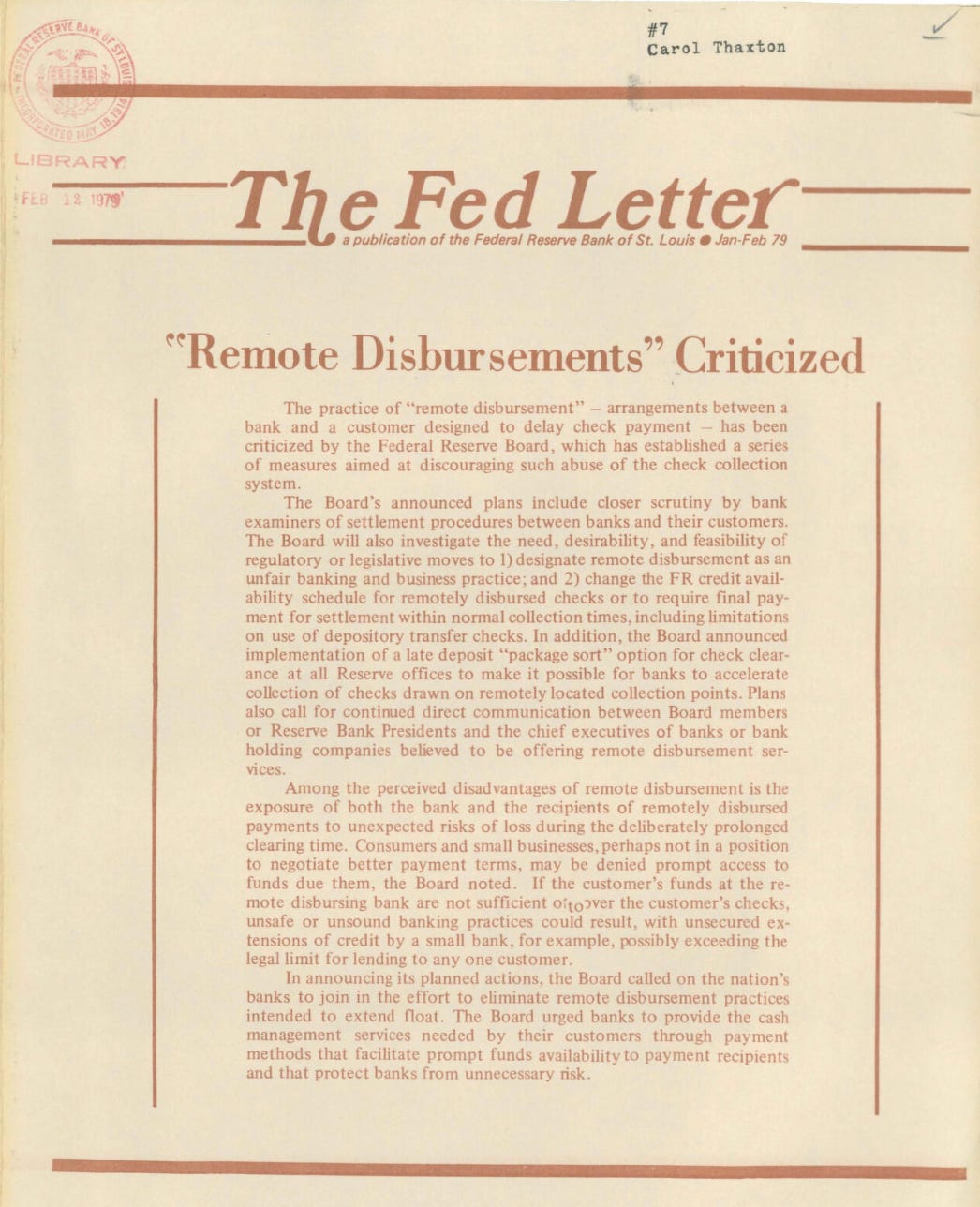
The Fed was furious. It published a report on remote disbursement in February 1979, then a policy statement telling banks to stop helping. The Monetary Control Act of 1980 called for the practice to be eliminated. Check 21 finished it two decades later. Most cheques now clear in one business day and the Fed processes every one of them in a single building in Atlanta. That was the end of it.

Siemens employs more than 12,000 people across 80-odd countries in a division called Global Business Services, processing invoices and running payroll and reconciling statements. Airbus started one in Lisbon in July 2021 and now has more than 1000 people in Portugal across that centre and its industrial unit. Goldman Sachs, the entire firm, employs 47,400.
Then in September 2024, the same Siemens issued a €300 million bond that settled in minutes with blockchain.
Today I want to show you what connects those two facts. On to the story…

Start with the bond, since it’s the easiest
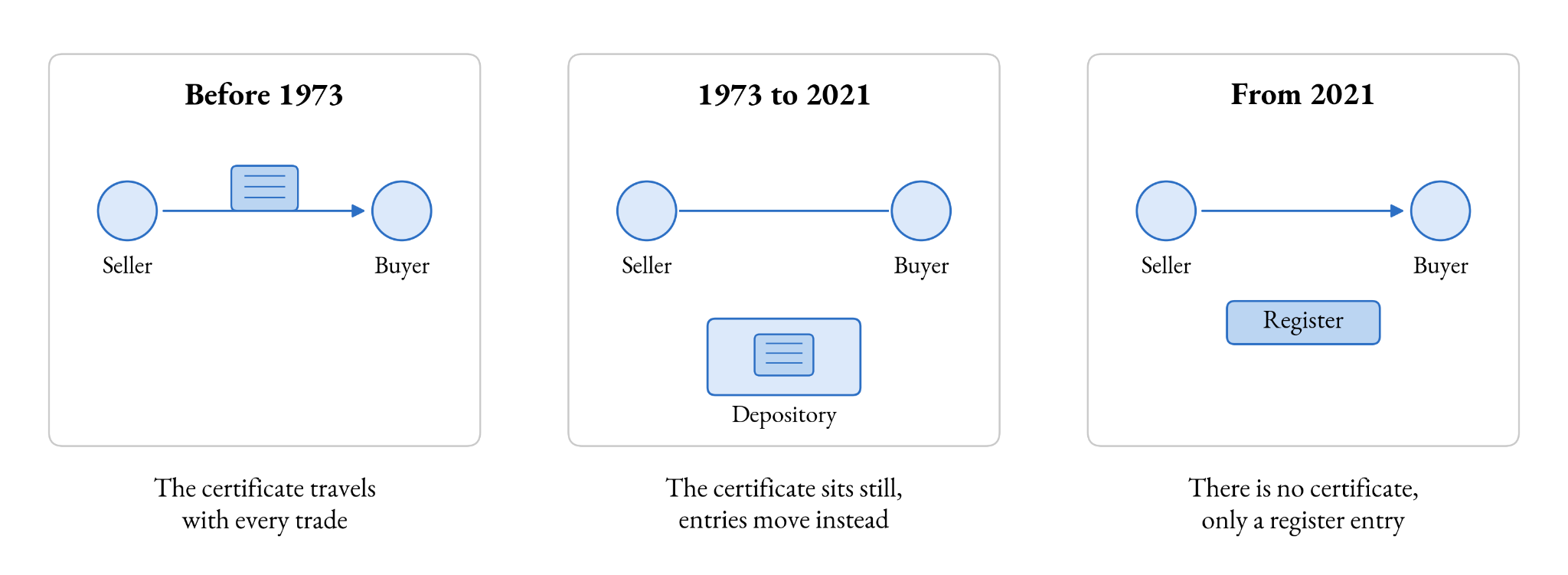
Siemens issued €60 million on Polygon in February 2023, waiting two days for the trade to settle. 18 months later, it returned with €300 million, swapping a public crypto network for SWIAT. Built by a consortium of European banks, SWIAT is a closed ledger designed specifically to play by institutional rules. That regulatory alignment allowed it to connect to the Bundesbank’s Trigger Solution, settling the entire €300 million automatically, in minutes, in central bank money.
Investors subscribed directly and could see their register entry the moment settlement completed. Peter Rathgeb, the corporate treasurer, ran both issues, and the second one removed nearly all the settlement risk from every party in the deal.
Normally, an institution like Clearstream (a massive Central Securities Depository) has to sit in the middle just to handle the certificate. Nobody’s job at Clearstream is safe or unsafe because of one German bond.
Secondly, the payroll department
Deel runs payroll for more than 40,000 businesses and 1.5 million workers across 150-plus countries, processing over $22 billion a year. Since January 2026, a company can fund its entire global payroll straight from a stablecoin treasury. In June 2026, Deel launched its own dollar-backed digital balance called DLUSD.
What leaves the employer’s side? Trapped liquidity in foreign bank accounts. Emergency troubleshooting for failed wires. Intermediary FX conversion fees. Manual account reconciliations.
What leaves the worker’s side? In Argentina, Turkey and Ukraine, a salary paid in local currency can lose 20 to 40% of its value inside a year. In 2025, 85% of Deel’s Argentine contractors chose to be paid in dollars. In June, the company gave them a dollar balance to hold inside the app they already use, built on Bridge and Privy and Tempo, with rewards on idle funds. In May, it started paying full-time employees in stablecoins on Polygon in the US and Eurozone, at 10 to 25% of net salary after tax.
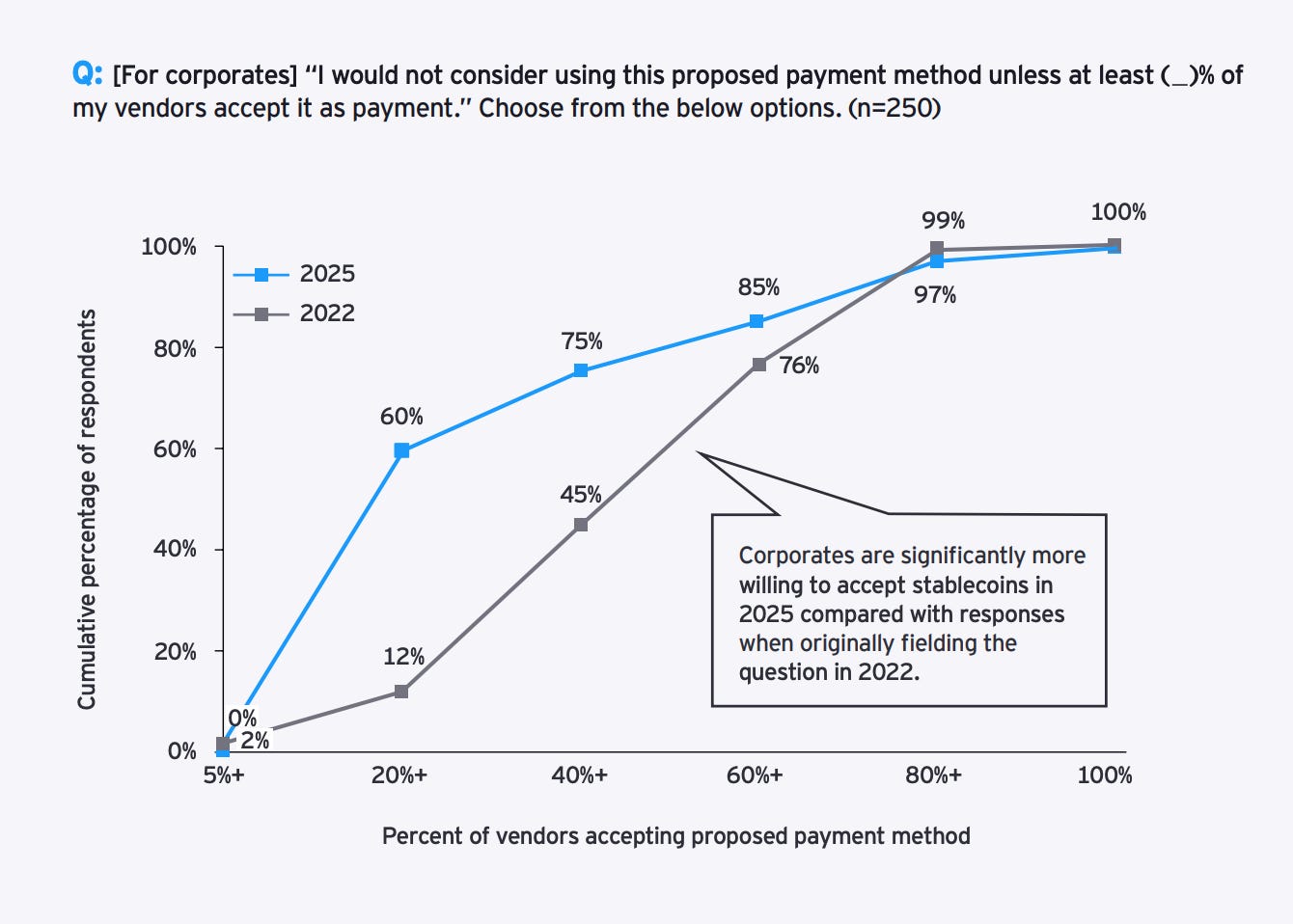
From a treasury perspective, stablecoin utility is now backed by hard data. According to an EY-Parthenon survey of 350 executives, 13% of firms have already adopted stablecoins. Of those, 41% have realised cost reductions greater than 10% in cross-border B2B payments. This efficiency reclaims $5 million on a $50 million transfer program. This is capital previously lost to fixed operational costs. Looking ahead, 54% of surveyed non-users intend to adopt this infrastructure within a year.
Real end-user stablecoin payments hit roughly $390 billion a year by February 2026, double 2024, and about 60% of it is now B2B rather than trading. Hyundai Card settled a cross-border corporate payment in seven minutes. Visa is running a $7 billion annualised settlement rate across nine chains, up 50% in a quarter. None of these is crypto companies experimenting at the edges.
Businesses are using stablecoins to solve the mechanical problems of slow cross-border settlement and trapped capital discussed earlier.
Third one, the biggest, least discussed - Collateral
JPMorgan’s Kinexys runs about $5 billion a day and has cleared $3 trillion in total, with its intraday repo alone passing $1.75 trillion. BlackRock has posted tokenised money market funds to Barclays as derivatives collateral. Broadridge moves $354 billion a day. CME is building the same thing with Google Cloud, aimed at a $15 trillion collateral market.
I want to explain why collateral is the one to watch if you’re building.
A hedge fund holds a position it doesn’t want to sell and wants to borrow against it. Neither side trusts the other, so the collateral goes to a triparty agent who sits in the middle and holds it. Somebody negotiates the agent’s contract first. Then the asset travels for days, and fees stack.
Semi Liquid secures the collateral in place and changes what the borrower can do with it. Freeze in place, adjust the spending conditions, skip the transfer. Just like Kinexys, it’s going at the same $15 trillion. Look now at the jobs that survive the introduction of software; the logistical aspect of moving the collateral disappears, and what remains are only the difficult human judgments involved in assessing the value of the asset and making the late-night default calls. Which is the line I’d hand to anyone deciding where to point a budget.
Which means technology is not eliminating the cost of misjudging a counterparty. This explains why some of these projects lived and the rest died.
Between 2018 and 2020, big companies including HSBC, Maersk, and BNP Paribas launched four trade-finance blockchain networks. None survived past 2023.
June 2022 - we.trade went bankrupt.
November 2022 - Maersk and IBM shut down TradeLens.
Early 2023 - Marco Polo shut down, $4.6 million in debt.
November 2023 - Contour closed after averaging only 60 to 70 trades a month (later acquired by XDC Network).
Faster digital letters of credit improved document speed, leaving the core cost of credit underwriting untouched.
Komgo is the only survivor of the group. It got there by dropping the blockchain. Launched in 2018 by major banks, it originally offered both a digital letter of credit and a document workflow tool. The credit product died; the paperwork product continued. While competitors collapsed trying to digitise trust, Komgo survived by pivoting strictly to mechanical plumbing.
Tether proves what happens when a financial company refuses to judge counterparties. By operating strictly as a mechanical conduit, taking dollars, holding Treasuries, and issuing tokens while exchanges handle the actual customers, it removes the operational cost of human trust. This perfectly automated asset-moving model allowed a 300-person team to clear $10.09 billion in profit in 2025. Generating $33.6 million per employee, Tether massively outperforms traditional risk-managing banks like JPMorgan and Goldman Sachs.
Then it stepped into credit. Its secured loans went from $14.60 billion on September 30 to $17.04 billion on December 31, almost $7 billion added in six months. Protected by a $6.34 billion safety net, though the borrowers are kept secret.
The second Tether started lending money, it had to hire humans to evaluate collateral and make late-night margin calls.
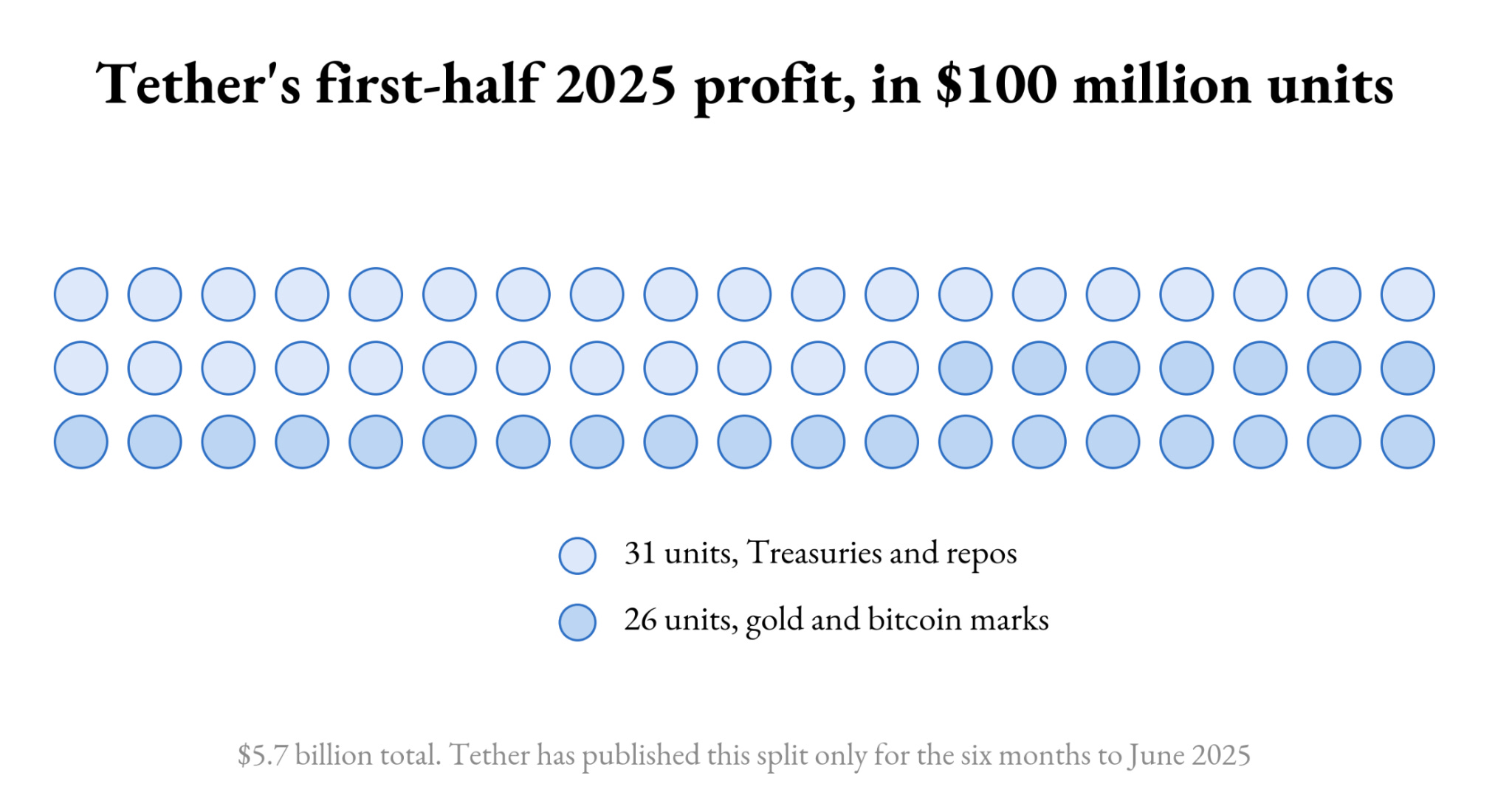
Two details heavily distort Tether’s profitability. First, nearly half of its profit came simply from the surging prices of its massive gold and Bitcoin reserves. Second, it pays zero interest on the billions of dollars of tokens it has issued. If a traditional bank held that much customer cash, it would owe billions in interest payouts every single year.
Circle shows the same boundary from the other side. It booked $1.4 billion in distribution costs tied to Coinbase in 2025, up from $924.5 million, per its 10-K. That’s 51% of its $2.7 billion revenue going to a company that neither issues USDC nor manages the reserves. Coinbase runs the onboarding, the KYC queue, the fraud team. Verifying a customer’s identity still requires human judgment. Circle keeps its headcount low by outsourcing this process entirely, turning what should be an internal payroll expense into an external contract line.
So, where to build.
Enterprise blockchain and stablecoin technology solve three operational problems. It automates the movement of cash, collateral, and certificates. It frees up idle capital trapped in payroll floats and escrows. And it removes cross-border friction in Latin America, Africa, and Southeast Asia, the exact use case driving the 10% cost reductions reported by executives.
Corporate issuance, which almost nobody is working on. Germany’s eWpG made Siemens possible. Total eWpG digital securities issuance was around €236 million by June 2024, with KfW adding €150 million across two deals. That’s nothing against the European corporate bond market.
Treasurers used to profit from delayed settlements. When the float died, they shifted to managing pre-funded accounts. Now, tokenisation has vaporised that too.

Token Dispatch is a daily crypto newsletter handpicked and crafted with love by human bots. If you want to reach out to 200,000+ subscriber community of the Token Dispatch, you can explore the partnership opportunities with us 🙌
📩 Fill out this form to submit your details and book a meeting with us directly.
Disclaimer: This newsletter contains analysis and opinions of the author. Content is for informational purposes only, not financial advice. Trading crypto involves substantial risk - your capital is at risk. Do your own research.