


Build something great and slow, and the money shows up late. Build something loud and hollow, and the money can’t wait. That’s one big rule of markets, which appears across the centuries in tulips, dot-coms, canal shares and even NFTs.
AI is believed to be the next big bubble. A bubble is when people throw wild leverage at it, build their entire business on a house of cards, ignoring the flaw in their system, and then it fails; they get to blame the bubble.
I looked at Bittensor, which pays people to make AI (good thinking, love the thought behind it). The system is split up into a hundred or so little ecosystems called subnets. You build something, it gets scored, and you get paid instantly in a crypto token called TAO.
Full disclosure before we start. I have a defect. I can’t look at anything shiny without going straight for the crack in it.
Someone shows me a miracle; my first thought is, who’s footing the bill? I’m working on it. Sorry in advance. But most times, I would love to be proved wrong.
So dock me a few points for temperament, then keep reading. Because Wall Street is racing to wrap in an ETF, Bitwise and Grayscale have filed for a Bittensor ETF with the SEC. The crack this time is just right there for you to see.

Bittensor tries to build AI the way Bitcoin builds security. Pay people in tokens to compete, let the competition sort the good from the junk. The network is cut into about 128 subnets, and each one is a small market for a single job such as inference, training models or scraping data.
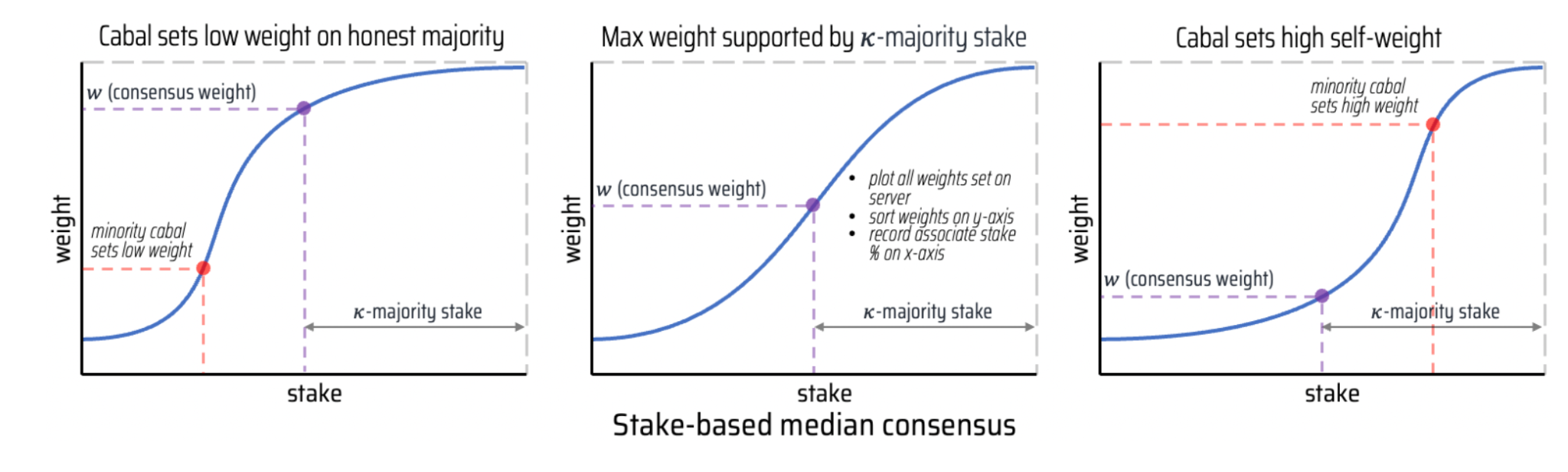
Miners do the work, validators grade it. TAO pays Miners based on the quality determined by the validators. Validators are paid based on how closely their grading matches the other validators’ grading, weighted by stake. So a validator earns by scoring in line with the pack, not by being right in some absolute sense.
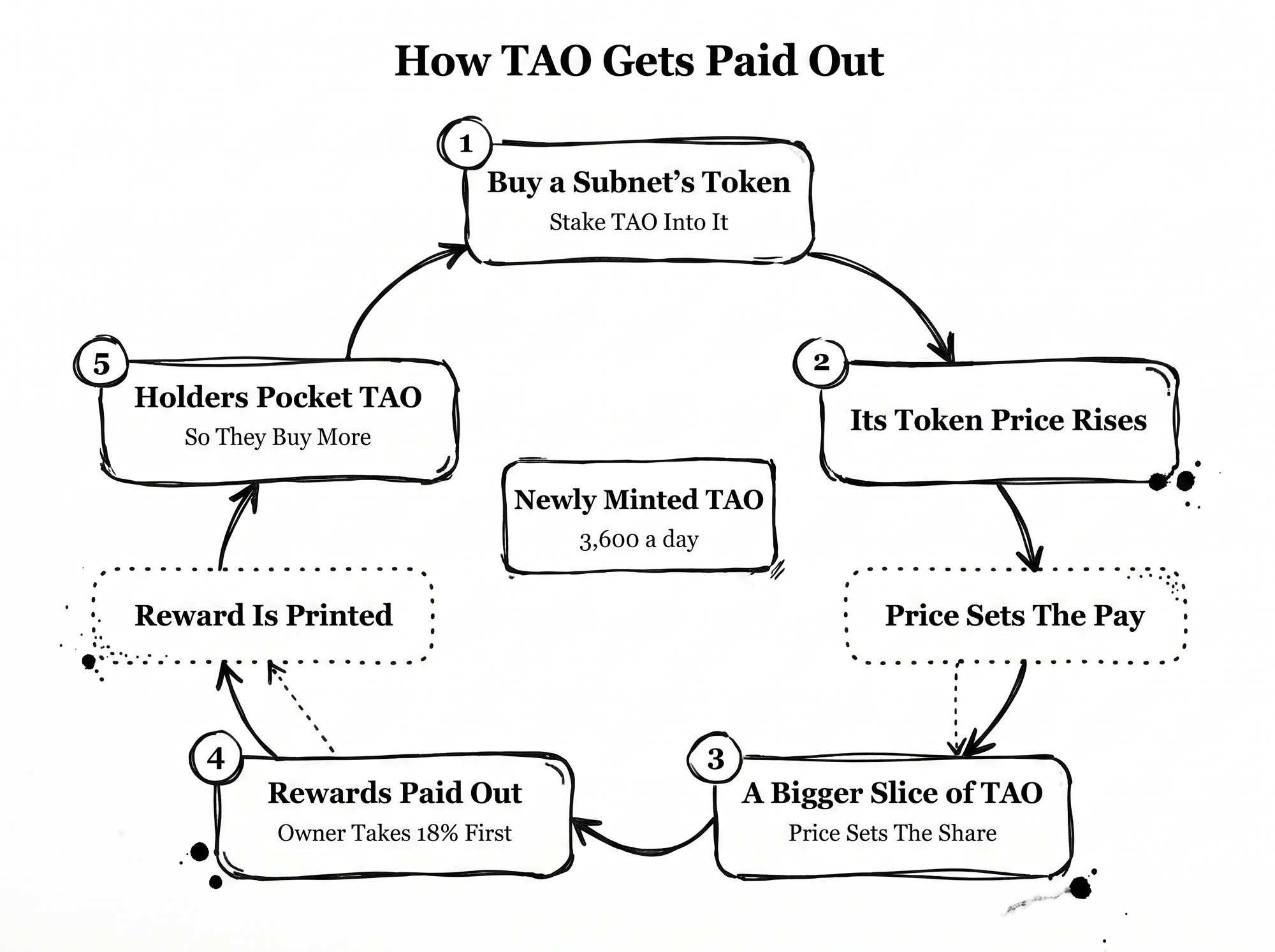
How much TAO each subnet gets is set by the subnet’s alpha token price, not by quality at all. Also, the subnet owner skims a fixed 18% off the top before anyone else is paid.
TAO is a roughly $2 billion token, with about $690 million of it staked into the subnets, the pools that decide which AI work gets funded.
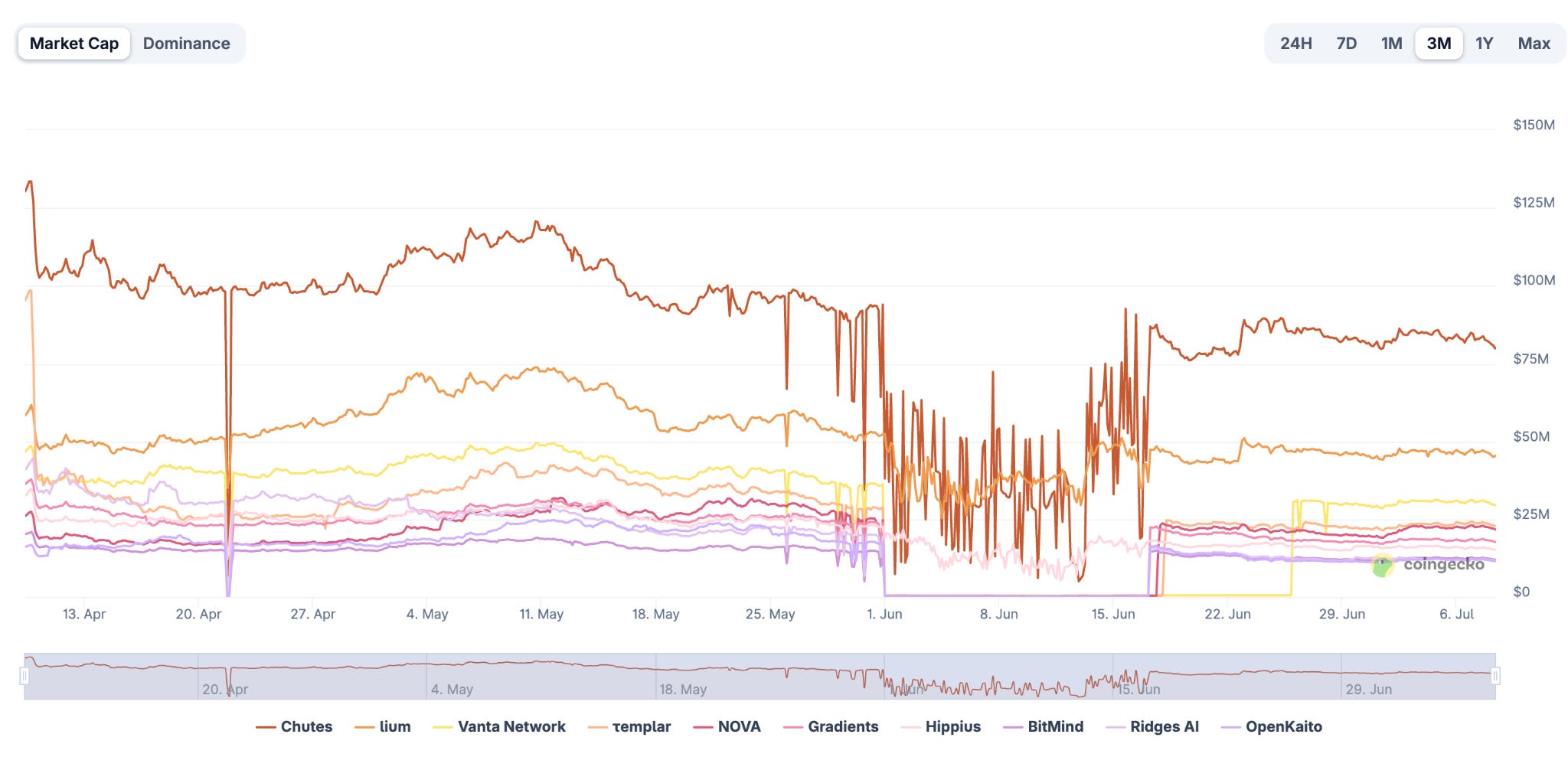
To make things more complicated or awesome (depending on the way you look at it), every subnet has its own token. It’s called alpha. When you invest your TAO in a subnet, you are buying its specific token and pushing up its price. That price determines how much of the new TAO a subnet gets compared to the others. And it’s the price averaged over time, not the price right this second.
So one quick pump won’t get you a bigger cut. You have to keep the price up, and that means you have to keep buying.
As always, cracked markets run on loops. Buying alpha drives up the price, which increases that subnet’s share of new TAO. That TAO goes straight to the people already holding the alpha, giving them cash to buy more. Money coming in makes the number go up, and the number going up pulls more money in. The only brake is that the network constantly prints fresh alpha, forcing miners and validators to sell it to cash out, which drags the price down. A subnet only stays funded if new buyers keep arriving to absorb that supply. Which is on purpose, and how the system is designed to work.
Now the good thing about this is that, because each subnet carries its own token, you can bet on a single slice of AI by itself. Buy the inference subnet and skip the training one, or vice versa. Capital gets to pick a lane inside the machine, which no stock market lets you do.
The chain can only see tokens moving, rather than AI being used.
There’s no clean tally of who really paid for what. The price is free to drift wherever the money leans. A stock can’t do that. Markets usually price real value, sure. Nvidia’s price has real sales sitting under it, sales you can look up. A subnet’s price has nothing under it but the buying. So when money coming in is the only thing you can measure, money coming in is the whole price.
Validators are supposed to score miners honestly. The system that runs it, Yuma Consensus, does fight cheating. It clips scores that stray too far from the pack, so a validator who over-rates a friend earns nothing for the excess. Good design. But the anti-collusion math holds only while the cheaters control less than half the validator stake in a subnet. Past that line, a validator and a miner can agree to swap high scores for a cut of the TAO, and the chain pays them for it. There’s another leak too, weight-copying, where a validator skips the grading entirely and copies everyone else’s scores off the public ledger, collecting rewards for doing nothing. The patch for that, commit-reveal, seals the scores in an envelope for a while so there’s nothing to copy. It only works where miner quality keeps shifting fast enough that stale scores go wrong. Where the work is steady, the copying pays again.
Now take that cheating threshold and look at who holds the power. One team, Rayon Labs, runs three of the top subnets that together take roughly a quarter of all the TAO the chain prints each day. Around two-thirds of TAO sits staked, plenty of it in a few hands. You can stand in either of two places here.
Stand in one spot, and Bittensor is a market doing its job. Instead of a closed-door committee deciding which AI deserves money, thousands of people bet openly on which kind of intelligence will matter, and funding flows toward their bets. Money leaning toward a thing is often the first sign the thing is promising.
Stand in the other spot, and a price means something only when it’s tied to the world outside it. A customer. A sale you can point to.
Doesn’t the tie look loose? Bittensor’s top earner is paid far more in printed tokens than it takes from real customers, and the people who can turn the rewards on and off are still a small core, close enough that when the founder switched emissions and sold token piles mid-fight this spring, the network’s largest operator, Covenant AI, packed up and left.
Early mistakes are swiftly made and then swiftly corrected; this token already bears the benefit of a hard fork to right a wrong. On Optimism, crypto-native venture capital got so frustrated with the endless rounds of fundraising designed to anticipate future developments that they instituted a form of retroactive funding. Payment is made for what has proven valuable, rather than a speculative bet on what might be. Rewards are given after verifying that the work has delivered on its promise, rather than as an a priori subsidy for a token’s promise. Both Gitcoin and Filecoin have experimented with different genres of this idea.
Bittensor’s entire wobble is a result of rewarding in the currency in which value is realised rather than the much more reliable double-spending of the underlying proof.
The network has changed how it decides a subnet’s pay twice a year. First, it went by the token’s price. Then, from November, by net staking flow, the money moving in minus the money moving out. In June, it switched back to price after the flow method ran into its own problems. Both were just stand-ins for the thing no one can measure, which is whether anyone actually used the AI.
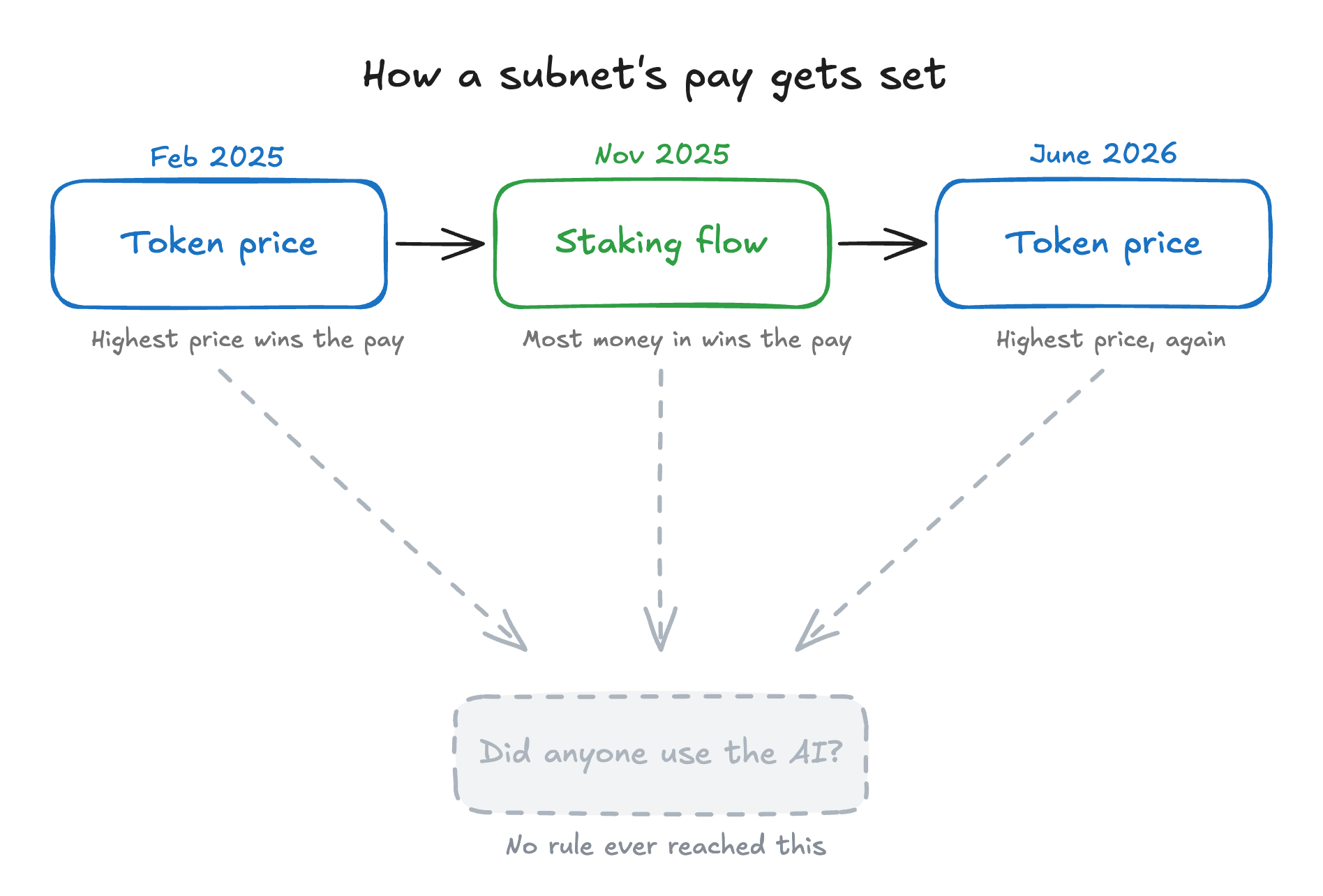
A network willing to destabilise its very existence by uprooting its own fundamental law twice in a short span is arguably more dynamic in its capacity for change than most. That said, the sobering reality of this hard fork is that the three sets of criteria all failed to take into account a single vital metric - the willingness of any one individual, outside of the subnets, to pay for the work being done by others. By rewarding one group for bringing in money, they are all trying to let money follow money, rather than value follow demand.
Even financial waste builds infrastructure. Just like the dot-com bubble created the fibre optic backbone of the modern internet world, the Bittensor bubble is creating computer silicon and AI training runs that can possibly outlive the hype.
And the prize for this particular investment has enormous value because it involves distributed AI. The way to beat chip monopolies is to create open-source alternatives, as Linux did for operating systems and Wikipedia did for encyclopedias. This same kind of disruptive innovation is happening right now on this network. The Covexus team trained a model on 70 different devices that exceeded Meta’s Llama-2 and received praise from Nvidia’s CEO, but it gets buried under the din of tokens.

That’s also why the ETF is more than a harbinger. Grayscale and Bitwise both anticipate the answer from the SEC later this year, around August. If approved, they would slip a defective machine into the middle of America’s retirement funds. That does represent risk to any observer who wants to buy in blindly, but it also represents two things you want to see in a nascent ecosystem. Infusion of real money and exposure to daylight. Few things are more efficient at accelerating a network’s incentives than a regulator giving its blessing and millions of new shareholders watching every payout unfold under a prismatic lens. With this last note, note that the scrutiny that comes with the territory is what ultimately makes it grow up.
I, with my newfound optimism, would say you should keep a close eye on the right stuff. The plumbing is still young and leaky, and it will be tightened, as with all young, leaky systems. The promise underlying it all is what I want to highlight. Open, multi-participant, and nonproprietary AI, as opposed to the walled gardens of the major cloud providers that happen to own the largest server farms in the world.
We spent this whole piece describing weaknesses, but the reason we did that is that the object is so worthwhile that improving it should be a priority. That’s why you should hope that subnets will eventually be able to support themselves outside the patronage of the foundation, if and when that happens. That would be a crucial statement that the most powerful technology of our age does not have to be controlled by the fewest possible entities.
It would be worth waiting for.

Token Dispatch is a daily crypto newsletter handpicked and crafted with love by human bots. If you want to reach out to 200,000+ subscriber community of the Token Dispatch, you can explore the partnership opportunities with us 🙌
📩 Fill out this form to submit your details and book a meeting with us directly.
Disclaimer: This newsletter contains analysis and opinions of the author. Content is for informational purposes only, not financial advice. Trading crypto involves substantial risk - your capital is at risk. Do your own research.