


“The world’s $2.5 trillion trade financing gap is not a credit problem. It is a cost-of-underwriting and information-asymmetry problem.”
Hello,
Banks are great at lending money to people who don’t need it as badly as others.
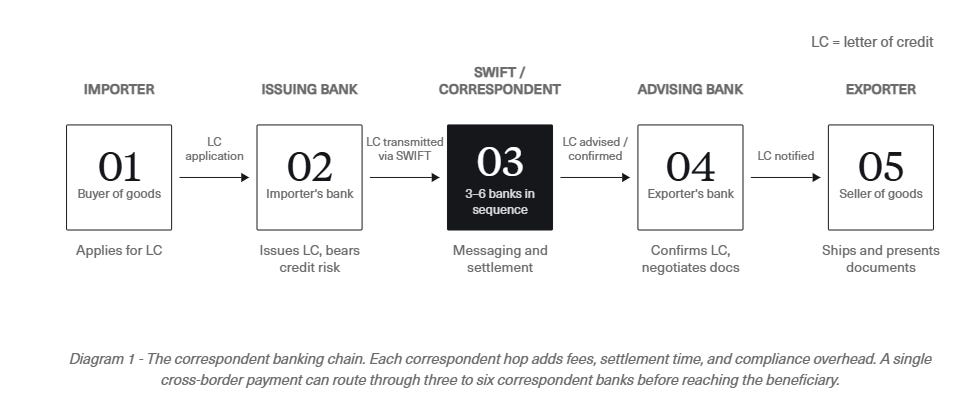
That’s not foul play, but business economics. Checking whether someone is trustworthy costs roughly the same in money and effort whether they’re shipping $40,000 worth of cashews or $40 million of semiconductors. Both still have to follow similar paperwork and compliance procedures. The transactions will have to go through the same network of three to six banks. This gives banks the benefit of achieving economies of scale if they prefer higher-order values to small-value ones.
This is the single most important incentive for banks to turn down small exporters that are yet to build their credibility. That’s probably why small and medium exporters have a 50% rejection rate, roughly seven times that of multinationals.
The asymmetry in the trade financing gap is not only based on enterprise size but also on geography. Asia-Pacific alone accounts for 40% of the world’s $2.5 trillion trade financing gap.
The system is broken for a specific set of people in certain areas. When exclusion structurally affects certain stakeholders, it makes it easier to map the problem and find a solution.
In global trade financing, one of the biggest problems is duplication. Every trade forces four or five institutions to verify the same facts, like who shipped what, to whom, against which invoice. Each institution records these details in its respective systems and charges for doing so. The cost of trust is incurred repeatedly, making it more difficult for small and medium exporters to absorb it.
Blockchains can solve this by moving stablecoins across a shared ledger in minutes, rather than routing fiat currency through multiple correspondent banks over three to five days. This is where blockchains can improve inclusion in trade financing by specifically making the entire proposition viable for global traders who are often ignored at the periphery.
Today’s guest essay is an investment thesis from 1kx, an investment firm that focuses on decentralised finance and stablecoin payments. In this thesis, Nichanan Kesonpat - Research Principal at 1kx - maps out how on-chain trade financing unfolds layer by layer and where value accrues for the industry to capture.
P.S. This thesis was originally published by 1kx here.
We will be featuring good writing and writers we love from time to time. If you have recommendations, send them our way.

Token Dispatch is a daily crypto newsletter handpicked and crafted with love by human bots. If you want to reach out to 170,000 subscriber community of the Token Dispatch, you can explore the partnership opportunities with us 🙌
📩 Fill out this form to submit your details and book a meeting with us directly.
Disclaimer: This newsletter contains analysis and opinions of the author. Content is for informational purposes only, not financial advice. Trading crypto involves substantial risk - your capital is at risk. Do your own research.