


Hello
Welcome to Edition 8 of The Reading List — your fortnightly antidote to the noise. We moved our reading list edition to Saturday last fortnight and are sticking with it this time as well.
For those here for the first time, every two weeks I share my favourite literature on crypto, finance, technology, culture, and beyond. I also share what I’m watching and reading this fortnight, beyond the world of crypto and finance.
The Fortnight That Was
The conflict in the Strait of Hormuz is far from over. The celebrations following U.S. President Donald Trump’s announcement of ‘Project Freedom’ were cut short last week, after he paused the plan that involved the U.S. military guiding stranded merchant ships through the Strait.
Although conversations around ceasefires have advanced considerably in the past fortnight, they remain on fragile sheets of paper, with recurring violations reported from both sides.
The U.S. and Iran are still talking through proposals for an interim deal. Iran has accused the U.S. of breaching the ceasefire, while the U.S. says it acted after Iranian attacks on naval assets in the Strait. So, the direction is not clear yet.
But markets didn’t seem too bothered with all this, or perhaps they had already priced in the conflict and corrected quite a bit.
In the past fortnight, both Bitcoin and equities inched over 2% higher. Oil remained elevated and volatile due to ongoing activity in the Strait of Hormuz, through which a fifth of global oil consumption passes. Gold and silver stayed weak despite the geopolitical backdrop, both ending lower over the fortnight.
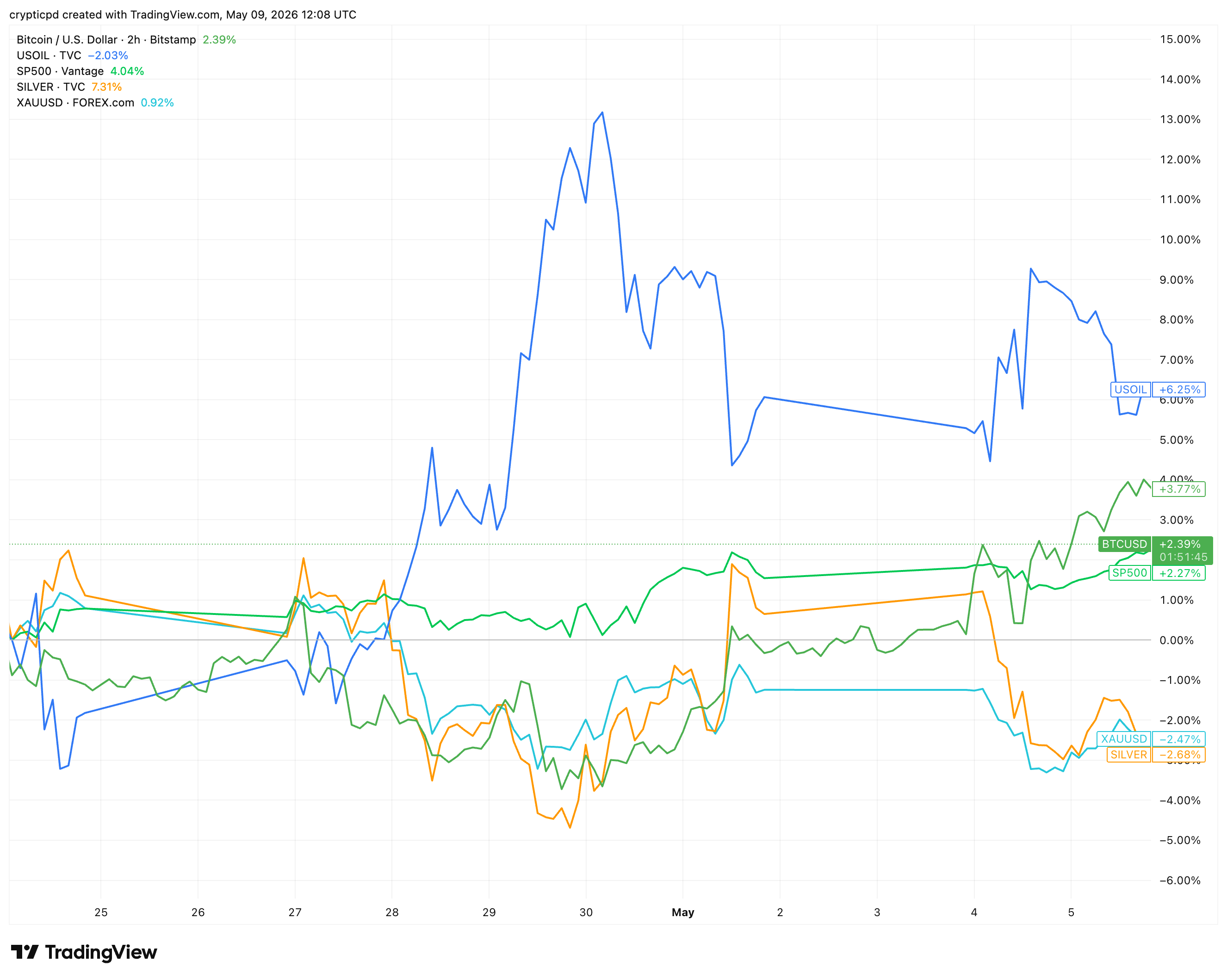
BTC holders had their reasons to cheer as it crossed the $80,000 mark for the first time in three months last fortnight. Since the war began, BTC price has shot up 20% while crude oil is up ~53%. On Friday, the S&P 500 closed at a record high above 7,400 points for the first time ever. A robust earnings week from Amazon, Alphabet and Meta, three of the Magnificent 7, drove up the equities. Although the crisis in Iran is far from over, the markets appear to have stopped panicking.
As always, none of this stopped the crypto ecosystem from having enough activity to talk about.
At Token Dispatch, we spent the fortnight looking at the parts of crypto that are trying to become less fragile, less cyclical, and more useful.
We started with Galaxy’s De-Correlation Test, in which I explained how Galaxy Digital’s operating businesses are beginning to decouple from pure crypto price cycles. Its digital assets segment stayed roughly stable even as crypto prices fell sharply, while Helios gives it a shot at building earnings from AI infrastructure without relying excessively on token exposure.
In The Art of Professional Stalling, Thejaswini explored how the Clarity Act is caught between lobbying, yield restrictions, and political delays, even as the product continues to grow without waiting for permission.
Then, I explored what makes BTC miners’ pivots into AI infrastructure and HPC perfectly timed. In Miners’ New Lease of Life, I discuss how Bitcoin miners can convert power and land into data centre value.
In “Is Ethena Making Money?“, Thejaswini traced how USDe’s economics depend on funding rates, collateral returns, and the behaviour of yield-seeking capital.
Vaidik wrote Crypto’s K-Shaped Thesis, arguing that crypto’s infrastructure is working well even when many liquid tokens are not. The industry is becoming more useful to exchanges, payment companies, banks, and traders than to the token holders who funded the dream.
I then looked at Can PMs Win the Perps Race?, after Kalshi and Polymarket moved toward perps while Hyperliquid moved toward event contracts. Everyone wants to become the everything exchange; the harder question is who already owns liquidity, leverage, and user habit.
Then, in Japan Just Put Its $9T Bond Market On-chain, Vaidik explained why tokenisation becomes serious when it touches collateral plumbing. Japan’s JGB experiment with Canton is a reminder that the boring back office may be where blockchain gets its most institutional use case.
We are working on more interesting stories in the days to come. But until then, this reading list will keep you in good company for the weekend.
Regulation & Policy
Polymarket’s Shaky U.S. Homecoming: The Information reports that Polymarket’s U.S. comeback has been slowed by executive churn, infrastructure delays, and questions around its nominal U.S. CEO.
The New Boogeyman: Molly White tracks the escalating crypto-politics circus around World Liberty Financial, Justin Sun, Trump-linked crypto interests, and pro-crypto lobbying.
Everyone’s a Loser: A commentary on the WSJ’s Polymarket profitability story, asking whether prediction markets are harsh or simply behave like most professionalised trading venues.
Crypto & Tech
Finance’s Digital Transformation, Finally: a16z crypto argues that blockchains are finally pushing finance through the kind of software-native transformation other industries saw decades ago.
Why Coinbase Wins in an AI-Native Finance World: Artemis makes the bull case that Coinbase is being mispriced as an exchange, while its upside may come from USDC, Base, x402, and agentic payments.
How On-Chain Infra Helps the Application Layer: A thread on how Polymarket and Hyperliquid are winning across the services they provide by optimising the underlying blockchain technology.
Hyperliquid Q1 2026 Report: Hyperliquid Research Collective’s Q1 report tracks the venue’s financial performance, ecosystem progress, and its push toward becoming a broader “house of all finance.”
State of Tokenisation Q1 2026: Pantera’s report maps a $320.6B tokenisation market across 593 assets and shows how the RWA stack is becoming a measurable institutional category.
The Six Layers of Stablecoin Payment Infrastructure: Paxos breaks stablecoin payments into licensing, onboarding, custody, funding, payout, and conversion.
Why Stripe Built Its Own Chain: Decentralised.co explains Stripe’s crypto acquisitions as a move to own more layers of the cross-border payments stack rather than merely process card transactions.
The Truth About Onchain Yield: Kelly Ye’s piece asks the question investors should ask before chasing DeFi yield: where does the return actually come from, and what risk is being hidden?
The State of Stablecoin Infrastructure Q2 2026: Verda’s interactive stablecoin map tracks 3,873 companies across stablecoin issuance, payments, ramps, agentic payments, RWAs, wallets, and compliance.
Finance & Economy
By the Time It IPOs, You’ve Missed It: A sharp private-markets opener on how the economic life of major companies now happens before public investors ever see an S-1.
Banking Beyond the Law: Aeon explores hawala-style underground banking networks and why informal trust-based money systems keep outpacing state-controlled finance.
Spending Money for Maximum Return: A practical essay arguing that the best use of money is not more stuff, but buying back time, energy, attention, and optionality.
Young Indonesians on the Debt Treadmill: A consumer-finance story on how young Indonesians are getting trapped by easy credit, pay-later products, and debt rollovers.
The Great $110 Trillion Wealth Transfer Won’t Happen Any Time Soon: WSJ argues the much-hyped boomer wealth transfer will be slower and messier than expected because older Americans are living longer, spending more, and often passing wealth first to spouses.
Sell the Electricity No One Is Using: Matt Levine explains energy efficiency as a financial product and how selling saved electricity rather than adding more supply.
Scarce Assets: Packy McCormick argues that abundance in technology and capital will make genuinely scarce assets, like teams, brands, art, land, and status, even more valuable.
The Most Spectacularly Wrong Thesis: A satirical take on why the Nasdaq tripling over the next few years may sound insane, but might not be as absurd as past “obvious top” calls looked in hindsight.
AI & Innovation
The AI Stack: Chamath maps AI into six layers, infrastructure, chips, data, models, execution, and applications, to think through where value may accrue.
The Quiet Bundling: Free Systems shows how coding agents often default to their own APIs and even appoint themselves as judges when writing code for AI models.
The Work of Knowledge in the Age of AI Reproduction: Rex Woodbury extends Walter Benjamin’s “aura” framework to AI, arguing that knowledge artefacts are becoming cheap while judgment and provenance become scarcer.
Apocalypse No: Scott Galloway pushes back against the simplistic “AI will take all jobs” narrative and reframes the AI labour debate in more grounded terms.
AI Isn’t Coming for Your Job. It’s Coming for Your Mind: Baillie Gifford’s Tom Slater argues AI’s bigger impact may be cognitive: outsourcing effort, weakening memory, and changing how humans learn.
Training AI to Govern for Us: A Stanford GSB classroom experiment on building AI agents that can represent people’s preferences in legislative-style simulations.
Culture & Beyond
The Eye in Your Pocket: Carissa Véliz argues that digital devices are not neutral tools; they are artefacts designed around surveillance, prediction, and control.
If the Quantum Canary Sings, It’s Too Late: Nic Carter argues Bitcoin cannot wait for a clean early-warning signal on quantum risk because by the time the “canary” moves, the damage may already be done.
Four Culture Fixes: Robin Hanson proposes four broad cultural interventions to address long-standing coordination and institutional failures.
What I Am Watching & Reading
I am halfway through Scott Galloway’s Notes on Being a Man.
Scott writes like he's having a conversation he refuses to make polite, and that actually keeps me turning pages even when it reads harsh at some places. Some chapters feel like a punch in your face. But what I love the most about his writing is that there are parts where he spares the bravado and gets genuinely vulnerable about fatherhood, failure and the dynamics of parenting two sons in his middle age.
There are many points in the book where it asks you to sit with the discomfort of thinking about what he says. It feels nice in a way that’s hard to put in words. But it surely feels like a book worth a read.
On the watching front, I plan to circle back to some of the old Indian classics in the weeks to come, the kind that you always mean to watch but never quite get around to. This fortnight, I hopefully will.
I plan to start with Satyajit Ray’s Pather Panchali. A dear friend has been coaxing me to watch how Ray shows deeply human themes like poverty and aspiration on the screen.

So between Scott and Satyajit, this weekend looks packed.
Write back to us with any recommendations through the next fortnight that you think we should include in the upcoming edition.👇🏾
That’s all for this fortnight. Catch you in the next edition.
Until then, happy reading!
Prathik

Token Dispatch is a daily crypto newsletter handpicked and crafted with love by human bots. If you want to reach out to 170,000+ subscriber community of the Token Dispatch, you can explore the partnership opportunities with us 🙌
📩 Fill out this form to submit your details and book a meeting with us directly.
Disclaimer: This newsletter contains analysis and opinions of the author. Content is for informational purposes only, not financial advice. Trading crypto involves substantial risk - your capital is at risk. Do your own research.