


Hello
Welcome to Edition 9 of The Reading List — your fortnightly antidote to the noise. We moved our reading list edition to Saturday last fortnight and are sticking with it this time as well.
For those here for the first time, every two weeks I share my favourite literature on crypto, finance, technology, culture, and beyond. I also share what I’m watching and reading this fortnight, beyond the world of crypto and finance.
So, let’s start with what moved and what didn’t.

The Fortnight That Was
The US-Iran ceasefire has survived several stress tests. But that still won’t stop oil prices from rising. Crude oil prices have hovered around $100/barrel over the past fortnight, briefly rising within a touching distance of $110.
The effect of rising fuel prices is spilling over to other prices and showing up in inflation data. In April, US CPI rose 0.6% month-on-month and 3.8% year-on-year. Energy prices were up 17.9% from a year earlier, while gasoline was up 28.4%. Core CPI also rose 0.4% in April and 2.8% over the year.
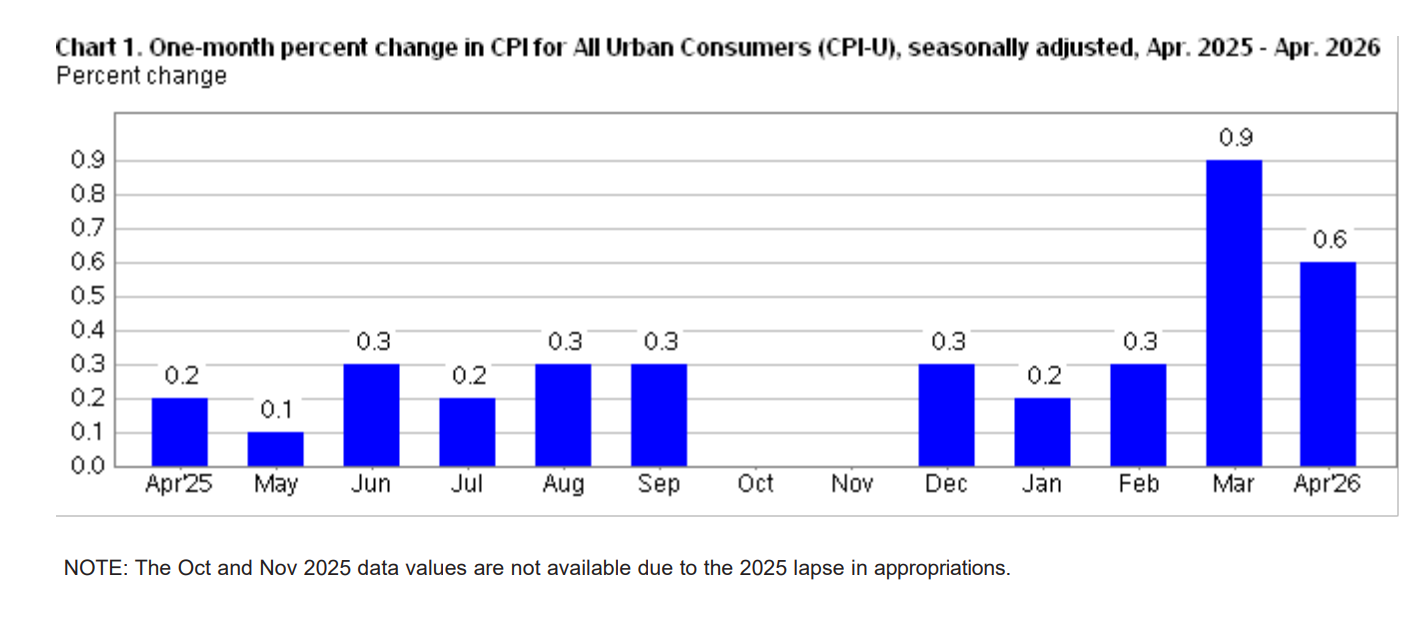
That leaves the Fed in an awkward place, walking a tightrope. The April FOMC minutes showed officials were still worried about inflation, energy prices, tariffs, softer hiring, and the uncertainty coming from the Middle East. The debate has become more two-sided: cut too early, and the inflation may come back; wait too long and the labour market may weaken faster than expected.
Markets, as usual, processed all of this with a mix of fear, denial, and greed.
Over the last two weeks, Bitcoin fell about 6%, gold slipped nearly 4%, and silver dropped more than 5%. Oil was down around 2% for the fortnight, but that number hides how volatile the asset remains. The S&P 500 rose a little over 1%, and US stocks closed their eighth straight winning week, helped by strong corporate earnings even as inflation worries kept sentiment fragile.
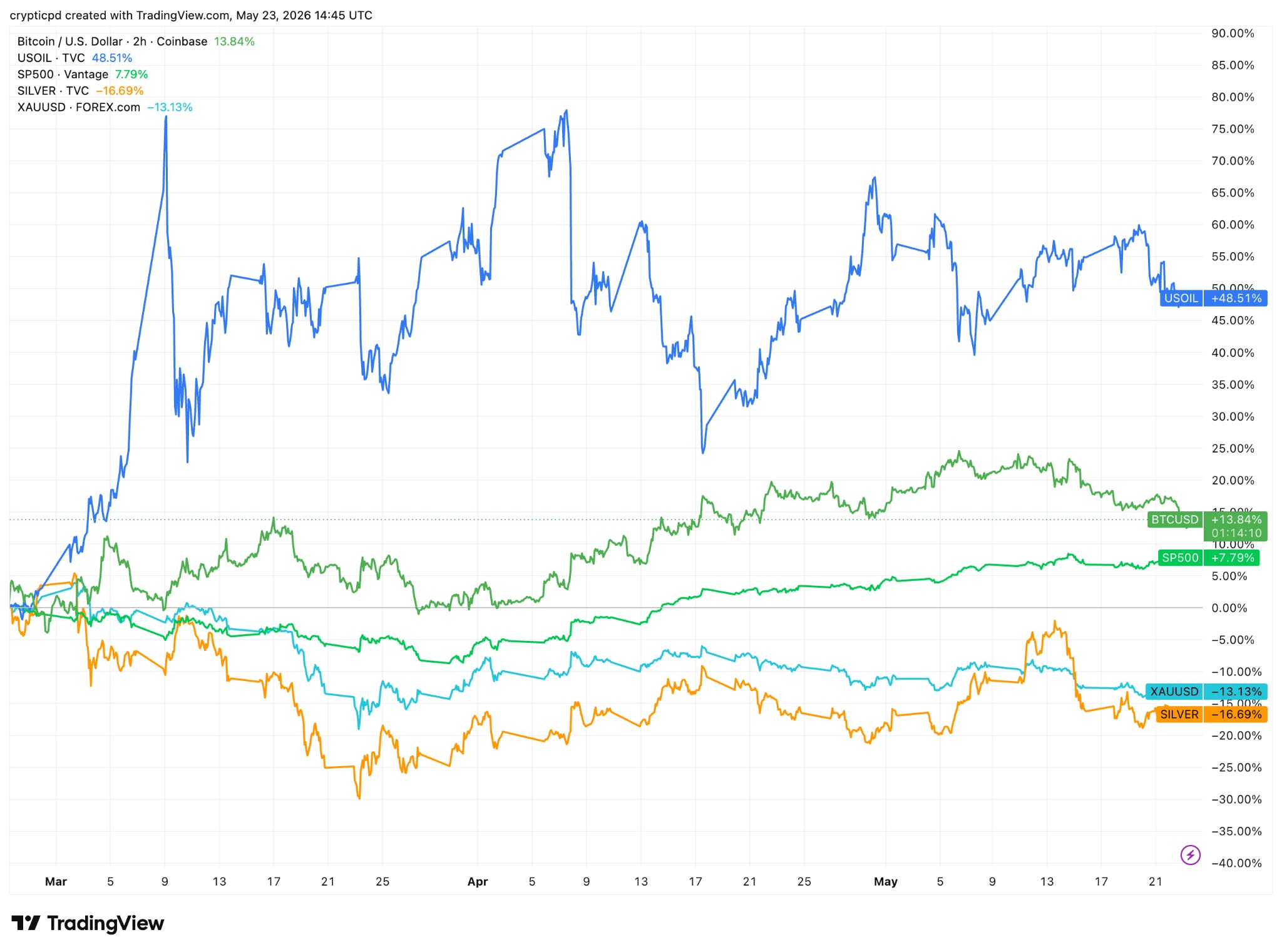
Since the war started, though, the story looks different. Oil is still up nearly 50%. Bitcoin is up about 14%. The S&P 500 is up close to 8%. Gold and silver are both still down double digits from where they were when the conflict began.
That’s the oddity of this market. The asset most visibly pricing war is oil. The asset quietly refusing to collapse is Bitcoin. The assets expected to behave like havens have not really done so. And equities, despite everything, are still levitating on earnings and AI enthusiasm.
With the charts out of the way, here’s what we wrote at the Token Dispatch.
What We Covered
The past fortnight was less about price charts and more about the invisible layers that decide who actually captures value in crypto: custody, regulation, distribution, legal wrappers, remittance corridors, and time.
I started with The Agentic Float, in which I examined how AI agents could create a new revenue stream from idle money. The piece argues that if agents need pre-funded stablecoin wallets to buy compute, APIs, content, and services, then whoever owns those balances can earn both transaction fees and float income. The agentic economy may create a Schwab-like float business for stablecoin issuers, wallets, and payment rails.
Vaidik then took the regulatory angle in The Decentralisation Test. The CLARITY Act may finally test crypto for when a token stops being treated like a security and starts being treated like a commodity. But the piece also asks if decentralisation becomes a legal threshold, does crypto become safer, or simply too expensive for small grassroots teams to launch?
Thejaswini followed with Regulatory Asphyxiation, a story about Ondo Global Markets and the long, messy road to tokenised stocks. Earlier attempts from FTX, Binance, and Mirror died because they treated regulation as a detail. Ondo is trying the opposite route: legal structure first, product later.
I then moved from stocks to swipes in Who Owns The Swipe?. Crypto cards look like a consumer product, but the card itself is the least interesting layer. The real business opportunity lies beneath the surface, in building a presence across multiple layers of the stack: issuing, compliance, APIs, FX, settlement, orchestration, and wallet distribution. Rain’s model shows why the winner will be the one who can provide infrastructure and earn from every swipe across multiple front ends, rather than just being a card provider.
Vaidik’s LATAM’s Remittance Trap extended the same infrastructure argument into remittances. The mistake most fintechs make is treating Latin America as a single market and remittances as a single product. Mexico, Argentina, Colombia, and Brazil each need something different: cheaper transfers, dollar savings, dollar access, or local settlement. The deeper lesson was that stablecoins win only when they disappear into the behaviour users already understand.
Finally, Thejaswini closed the fortnight with The Clock Is The Product. Hyperliquid’s edge is not only that it offers perps. It is that it stays open when traditional markets go dark. From oil contracts trading over the weekend to pre-IPO markets for Cerebras and SpaceX, the piece argues that continuous price discovery is becoming a product in its own right.
Taken together, the theme was that crypto’s next battle will be about owning the solutions that address existing bottlenecks.
Who holds the idle balances? Who passes the decentralisation test? Who controls the legal wrapper? Who runs the card stack? Who owns the remittance corridor?
We have a lot more coming over the next two weeks. Before we get there, here’s some literature that will keep you in good company.
Some of these could be behind a paywall. Sorry!
Regulation & Policy
Polymarket’s Dispute Machine Problem: A look at how prediction-market outcomes are resolved, and why even “truth markets” still need trusted arbiters.
America’s AI Backlash Grows: Local resistance to AI is moving from abstract fear to blocked data centres, political pushback, and worker anxiety.
Crypto & Tech
Maple’s Credit Market Test: GLC Research breaks down how Maple’s lending business performed through Q1 volatility across AUM, revenue, liquidity, and borrower demand.
Credit Beyond Borrow-Lend: Cork’s thread frames credit markets as a broader risk-pricing layer, not just another lending primitive. (Partial access only.)
Prediction Markets Hit Reality: Bloomberg takes a more sceptical look at whether Kalshi and Polymarket are actually forecasting machines or just better-shaped gambling venues.
Hyperliquid’s Wall Street Moment: 21Shares argues Hyperliquid is becoming legible to Wall Street as always-on market infrastructure, not merely a crypto perps venue.
Private AI Goes Onchain: A thread on private AI inference and why decentralised AI may be less about open models and more about private access. (Partial access only.)
Who Pays The Agent?: Keyrock maps the emerging agent-payment stack and why sub-dollar machine transactions break the card-era payments model.
State Of Crypto Perps: CoinGecko’s 2026 report traces the growth of perpetuals, the rise of DEX venues, and why perps are moving beyond crypto-native speculation.
Finance & Economy
SpaceX’s Private Market Jackpot: A private-market power-law story on how a SpaceX IPO could deliver enormous returns for early backers. (Paywalled)
Prediction Markets Go Public: Matt Levine frames prediction markets as the new workaround for private-market opacity, especially as retail investors seek exposure to companies like SpaceX, OpenAI, and Anthropic.
SpaceX Investors Can’t Complain: In this one, Levine looks at SpaceX’s giant IPO pitch and the strange logic of complaining about governance after buying into the Elon Musk machine.
Compute Becomes A Commodity: ICE wants to launch compute-power futures, turning AI infrastructure into something markets can price, hedge, and trade.
The Startup Deal Playbook: A practical guide to how crypto and startup acquisitions actually work once founders move from narrative to negotiation.
Sohn’s AI Market Lessons: a16z pulls together market charts from Sohn to show how investors are pricing AI, power, chips, and infrastructure.
Let The Bubble Flow: A useful essay on rolling bubbles, passive flows, and why modern markets may inflate and rotate faster than older cycles.
Markets Copy The Future: A sharp piece on the “mimetic premium” — how markets first buy the symbols of a future before separating real economics from wrappers.
Bubbles Don’t Burst Cleanly: The author compares today’s AI trade with past bubbles and argues that recovery and collapse rarely happen in one clean move.
AI & Innovation
AI’s Data Centre Problem: Gallup finds Americans are increasingly opposed to AI data centres near them, turning AI infrastructure into a local-politics problem.
AI’s Fake Legal Cases: Scientific American explains why lawyers keep citing hallucinated cases, and why the deeper problem is not AI error but human over-trust under pressure.
Meta’s AI Layoff Moment: A story on how AI restructuring is reshaping Meta’s workforce, culture, and internal pressure. (Paywalled)
Build The Internal Agent: Auditless makes the case that the best workplace AI agents should live inside shared Slack channels, where context and adoption compound publicly.
AI Is Too Expensive: Ed Zitron argues that the AI boom still has not solved its basic economic problem: enormous costs without convincing margins.
Autonomous Agents Need Infrastructure: A thread on the technical and economic stack autonomous agents need before they can become more than demos. (Partial access only)
The Bull Case Ends: A darker AI-markets essay arguing that the most important tail risk in the AI bull case may be impossible to hedge.
AI Eats The World: Benedict Evans’ latest presentation deck gives a broad strategic map of where AI sits in the longer platform cycle.
The Physical AI Map: Canonical breaks down robotics and physical AI funding, helping separate serious infrastructure buildout from hype.
What Comes After Automation: A thoughtful essay on why automation does not eliminate human work as much as raise the premium on judgment, taste, and oversight.
Citizens Building AI Evals: A strong argument for teaching people to evaluate AI systems rather than treating model assessment as something only labs can do.
Culture & Beyond
Nourish And Consumer Health: A consumer-health company profile that doubles as a broader bet on nutrition, behaviour change, and the next decade of health startups.
How Money Changes Lifestyle: A blunt essay on how wealth changes life in tiers, often in ways people only understand after crossing them.
How Money Changed Me: A more reflective companion piece on what money fixes, what it exposes, and what it never really solves.
The ROI Of Joy: A personal essay on the psychological cost of turning even happiness, leisure, and relationships into return calculations.
Make Immigration Boring: Aeon argues that migration debates need less moral theatre and more sober thinking about numbers, tradeoffs, rights, and long-term population policy.
Rights Need Money: A powerful essay on why human rights cannot be separated from tax, debt, public finance, and the global rules that decide who actually has money to fund them.
The Doomsday Math Problem: A fascinating Scientific American piece on the “doomsday argument,” the eerie probability puzzle that tries to estimate how far humanity may be from its end.
What I Am Reading & Watching
I finished Scott Galloway’s Notes on Being a Man this fortnight.
I picked it up after pausing Reporting from Ramallah, which I found difficult to read. The individual chapters were short, the context kept shifting quickly, and I wanted something more continuous for the week. Galloway’s book gave me that.
It is not a perfect book, but it was captivating. At its weakest, it can sound a little too prescriptive, as if complex gender conversations can be reduced to a few rules for young men. But at its best, it does something badly needed right now: it makes space to talk about boys and men without turning that conversation into a ‘he vs she’ conversation.
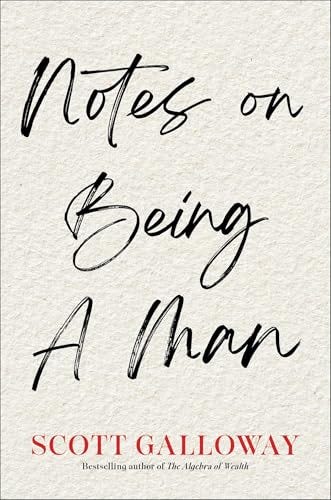
The personal aspects of the book stayed with me the most. Galloway writes about being raised by a single mother, the absence and complexity of male role models, his own anger, body image, ambition, insecurity, parenthood, and what it means to raise sons without passing down the worst parts of masculinity. The book is strongest when it simply notes and discusses how masculinity can take confusing forms rather than defining it.
The chapters on body image were particularly interesting. We often talk about body image as a woman’s issue. But young men are also growing up inside a visual economy that constantly measures them: their height, muscles, jawlines, income, social status, dating success, and perceived usefulness. Galloway discusses all this without making it sound like a competition of suffering.
This fortnight, I don’t yet know what I’ll watch next. But after a book like this, I might need something lighter. Write back to me if you have any recommendations.
That’s all for this fortnight. Catch you in the next edition.
Until then, happy reading!
Prathik

Token Dispatch is a daily crypto newsletter handpicked and crafted with love by human bots. If you want to reach out to 170,000+ subscriber community of the Token Dispatch, you can explore the partnership opportunities with us 🙌
📩 Fill out this form to submit your details and book a meeting with us directly.
Disclaimer: This newsletter contains analysis and opinions of the author. Content is for informational purposes only, not financial advice. Trading crypto involves substantial risk - your capital is at risk. Do your own research.